19 Best Children's Book Illustration Styles for Your Book
When you open a children's book, the illustrations are often the first thing that grabs you. Before a single word registers, a child's eyes are drawn to the visual world on the page. That's the power of illustration style, it sets the tone for everything that follows.
I've worked with authors, illustrators, and publishers long enough to know that choosing the right illustration style isn't just about aesthetics. It's about creating a cohesive experience where the visual approach amplifies your story's message and connects with your target readers on an emotional level.
If you're publishing a children's book, this is one of the most important decisions you'll make. Let me walk you through the landscape of illustration styles available to you, so you can make an informed choice that serves your story.
What is a Children's Book Illustration Style?
Before we dive into specific styles, let's clarify what we mean by illustration style.
An illustration style is the distinctive visual approach an artist takes to their work. It encompasses how they draw, the techniques they use, the level of detail they include, and the emotional tone they convey. It's the combination of artistic choices that makes a particular illustrator's work recognizable.
Think of it this way: you can immediately recognize a Dr. Seuss book by the illustration style, even before you read the name. The exaggerated proportions, the specific line quality, the color choices, they're all part of a cohesive visual identity.
For your children's book, your illustration style should complement your story. A gentle, contemplative picture book needs a different visual approach than a high-energy adventure story. Understanding the different styles available and what they communicate is crucial.
Now, let's explore the major illustration styles that are working in children's publishing right now.
Photorealistic Illustrations
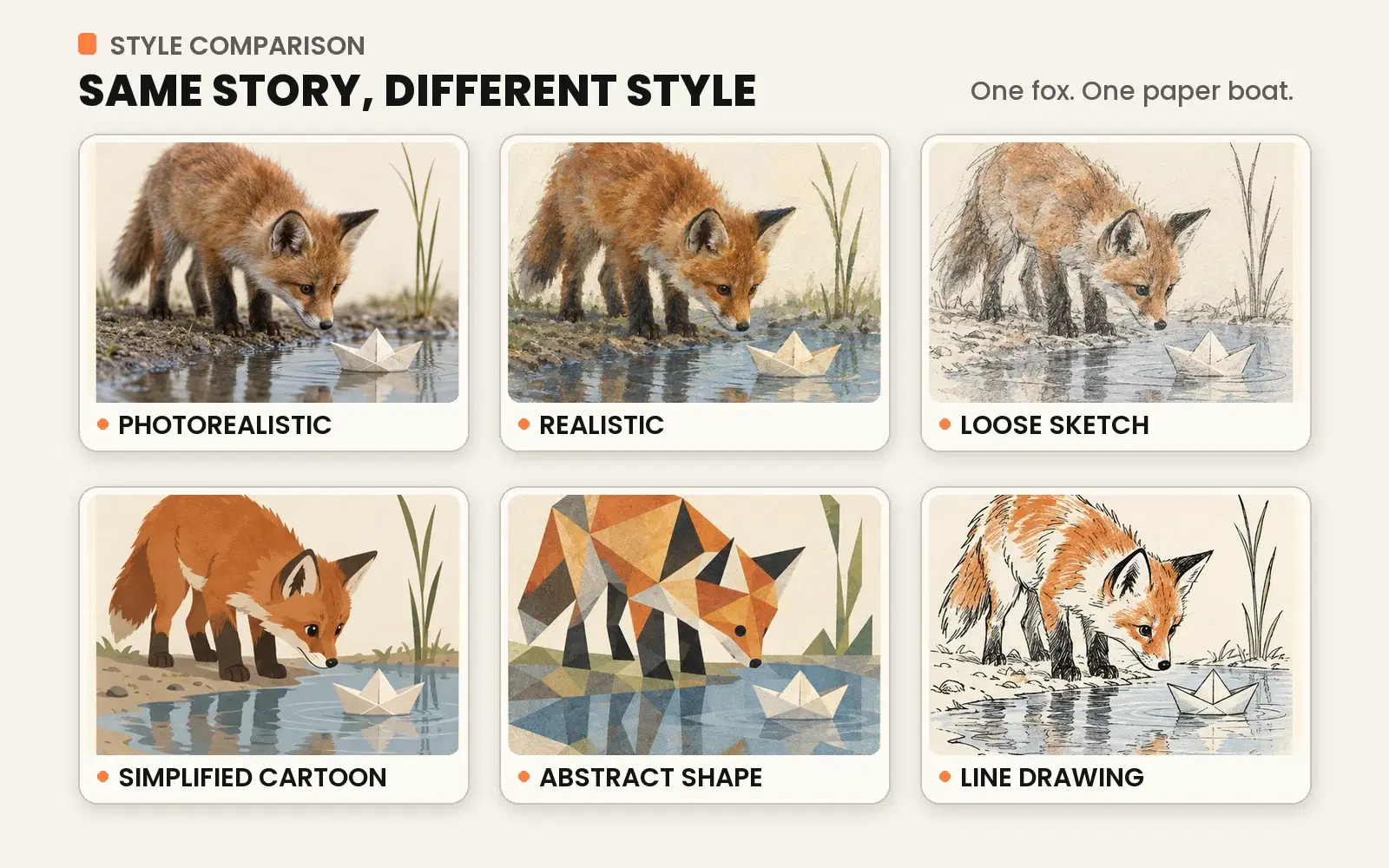
Photorealistic illustration is exactly what it sounds like: artwork so detailed and accurate that it looks like a photograph.
This style is less common in children's books than in other genres, but when it's used, it's powerful. Photorealistic illustrations work well for educational books, nature guides, and stories where visual accuracy matters. Children can learn exactly what a red panda looks like or see a detailed cross-section of how a beehive functions.
The downside? Photorealistic illustration is time-consuming and expensive to produce. It requires exceptional technical skill. And for very young children, the hyper-realism can sometimes feel cold or disconnected emotionally from the narrative.
That said, when photorealism is paired with the right story, it's unforgettable. Books about real animals, historical events, or scientific concepts benefit from this approach.
Best for: Educational books, nature guides, books about real animals or places, factual stories that require accuracy
Realistic Illustrations
Realistic illustration is photorealism's more approachable cousin. It's detailed and representational, but it maintains some artistic interpretation rather than aiming for photographic accuracy.
A realistically illustrated child in a picture book looks like an actual child with proportional features, realistic clothing, authentic body language but there's still artistic style visible. You can see the illustrator's hand in the work.
This style is incredibly popular right now, especially for contemporary picture books and early readers. It works because it feels authentic to children while still being illustration rather than photograph. Parents appreciate that their kids see realistic representations of diversity, different body types, and genuine human emotion.
Realistic illustration also works beautifully for books with emotional depth. A realistic face can convey subtle emotions that cartoon faces sometimes can't capture.
Best for: Contemporary picture books, stories with emotional weight, books featuring diverse characters, early readers, family stor
Sketches
Sketch-style illustration where the artwork retains the loose, unfinished quality of a sketch has become increasingly popular in recent years.
This style feels spontaneous and personal. There's visible line work, and often you can see multiple lines or corrections that suggest the hand-drawn nature of the work. It's honest and relatable in a way that polished illustration sometimes isn't.
Sketch style works particularly well for humorous books, stories about creativity or learning, and anything aimed at slightly older children who can appreciate the artistic technique.
The beauty of sketch style is that it's more forgiving than hyper-polished illustration. A small imperfection in a sketch feels intentional and charming rather than like a mistake.
Best for: Humorous stories, books about art or creativity, stories with a personal or intimate tone, books for ages 5-10
Vintage Illustrations
Vintage style draws on the aesthetic of older children's books, think golden age of illustration, art deco influences, or mid-century design sensibilities.
This style appeals strongly to adults reading with children, which is actually crucial in children's publishing. Many picture book purchases are made by parents and gift-givers who respond to the aesthetic appeal. A book with vintage-style illustrations often graces bookshelves as a decorative object, which increases its cultural visibility.
Vintage illustration typically uses a restrained color palette, elegant line work, and sophisticated composition. It feels timeless and classic, which means the book won't feel dated in five years.
The downside is that vintage style, if not handled carefully, can feel like pastiche or nostalgia rather than genuine artistic vision. The best vintage-inspired work takes the aesthetic sensibility and makes it feel contemporary and fresh.
Best for: Timeless stories, fairy tales, books with elegant or whimsical narratives, gift-worthy books, stories with nostalgic elements
Cartoon Illustrations
Cartoon illustration is what many people picture when they think "children's book." It's stylized, often exaggerated, and focuses on character and emotion rather than realistic detail.
Cartoon style ranges from simple and cute (think early Disney) to complex and expressive (think animation studios like Cartoon Saloon). The key characteristic is that it prioritizes personality and movement over visual accuracy.
This style works brilliantly for humorous stories, action-packed adventures, and anything aimed at younger children. Cartoon illustrations are often more affordable than realistic or photorealistic work because they don't require the same level of detail.
Cartoon illustration also translates well to animation and merchandise, which is an important consideration if you're thinking about adaptation
The risk with cartoon style is that it can feel generic if the illustrator doesn't have a distinctive personal style. The best cartoon illustration feels distinctive and memorable, not like it came out of a template.
Best for: Humorous stories, action adventures, books for ages 3-8, stories featuring animals or fantasy creatures, books with high energy
Fantasy Illustrations
Fantasy illustration brings magical, otherworldly elements to life. This style emphasizes imagination and wonder, often featuring intricate details, elaborate environments, and fantastical creatures.
Fantasy illustration can be realistic or stylized, detailed or minimal. What defines it is the subject matter and the sense of magic it conveys. A realistic dragon is still a fantasy illustration. A stylized fairy is still a fantasy illustration.
This style works for obvious reasons with fantasy stories, but it can also elevate contemporary stories by infusing them with a sense of wonder. A realistic picture of a child can become magical when rendered in fantasy illustration style with ethereal lighting or dreamlike qualities.
The challenge with fantasy illustration is that it can become overwrought if not handled carefully. The best fantasy illustration balances detail and clarity, ensuring that the magical elements don't overwhelm the narrative or confuse young readers.
Best for: Fantasy stories, magical realism, fairy tales, adventure stories, books that invite children into imaginative worlds
Abstract Illustrations
Abstract illustration doesn't aim to represent things realistically. Instead, it uses color, shape, and composition to convey mood and emotion.
Abstract style is less common in children's books, but when it's used effectively, it's incredibly powerful. It works particularly well for books exploring emotions, abstract concepts, or stories where mood matters more than literal representation.
Abstract illustrations appeal more to older children and adults than to very young readers, who typically benefit from more representational imagery. That said, there are beautiful examples of abstract illustration in picture books for ages 4+.
The risk is that abstract illustration can confuse young children if there's no clear connection between the visual and the narrative. The best abstract children's book illustration still communicates story and character, just through a non-literal visual language.
Best for: Emotional stories, books about abstract concepts, poetry and lyrical narratives, books for ages 5+, stories where mood is central
Muted Illustrations
Muted illustration uses a restrained, sophisticated color palette dusty roses, sage greens, warm grays, soft terracottas. Rather than bright, saturated colors, muted illustration relies on subtle color relationships and tonal variation.
This style has become increasingly popular and is appearing in award-winning books across multiple age groups. Muted colors feel calming and sophisticated without being boring. They also feel more mature than the bright primaries that dominated children's books in previous decades.
Muted illustration works beautifully for emotionally complex stories, contemporary narratives, and anything aimed at children ages 4+. It appeals strongly to adults as well, making these books shelf-worthy in family homes.
The technical consideration with muted illustration is that it requires skill to maintain visual interest and clarity with a limited color palette. A poorly executed muted illustration can feel flat and lifeless. Done well, it's gorgeous.
Best for: Contemporary stories, emotionally complex narratives, realistic illustration, books for ages 4+, sophisticated picture books
Exaggerated Illustrations
Exaggerated illustration distorts proportions and features for expressive or humorous effect. Think huge eyes, impossibly long limbs, wildly exaggerated facial features.
This style is perfect for humor and character expression. Exaggerated proportions can communicate emotion and personality in ways that realistic proportions can't. An exaggerated frown is funnier than a realistic one. Exaggerated excitement reads more dynamically than realistic enthusiasm.
Exaggerated illustration works across age groups and genres. It's particularly effective for comedy, but it also appears in serious stories where character expressiveness is important.
The key to successful exaggerated illustration is consistency. The exaggeration needs to follow its own internal logic. If the character's head is huge in one illustration and normal-sized in the next, it feels like a mistake. If the exaggeration is consistent, it feels intentional and right.
Best for: Humorous stories, character-driven narratives, emotional expression, action and adventure, stories for all ages
Line Drawings
Line drawing illustration uses primarily or exclusively line work, with minimal color or fill. Think pen and ink, or simple black line on white background.
This style is experiencing a renaissance right now, particularly in books for early readers and early elementary ages. Line drawings are clean, clear, and often charming. They're also more affordable to produce than full-color illustration.
Line drawings work particularly well for stories where clarity matters and where the narrative is strong enough to carry the visual experience. Early readers, chapter books, and middle-grade illustrated novels often use line drawing.
The beauty of line drawings is that they force clarity. You can't hide behind color or shading. The line work has to convey character, emotion, and story. Done well, line drawings are elegant and timeless.
Best for: Early readers, chapter books, middle-grade illustrated novels, stories where clarity is important, books with simple or bold narratives
Popular Illustration Mediums
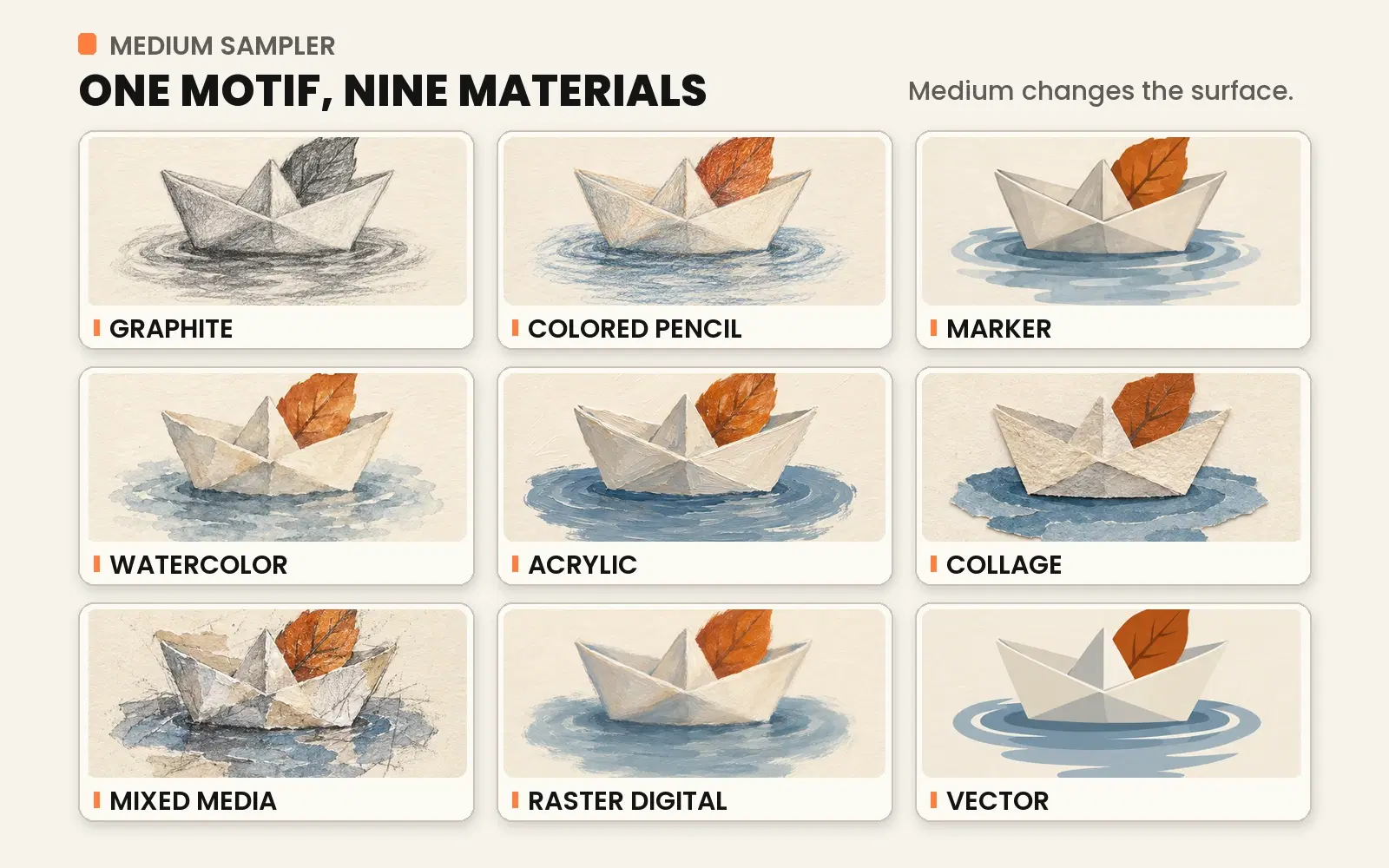
Now let's talk about how illustrations are actually created. The medium an illustrator uses affects the final appearance and feel of the work.
Graphite or Charcoal
Graphite (pencil) and charcoal create soft, tonal artwork with beautiful gradations and depth. These mediums are popular for realistic and sketch-style illustrations.
Graphite allows for precise detail and fine line work. Charcoal creates more dramatic tonal variation and a softer, more atmospheric quality. Both can be scanned and colored digitally, or left in black and white or grayscale.
The advantage of graphite or charcoal is that the work has an inherent quality of being hand-drawn that readers respond to emotionally. There's a human quality that purely digital work sometimes lacks.
The disadvantage is that scanning and reproducing graphite can sometimes lose detail, and the medium requires significant skill to master, especially for color work.
Best used for: Realistic or sketch-style illustration, emotional or contemplative stories, black and white or grayscale work
Colored Pencil
Colored pencils are a beloved medium for children's book illustration. They allow for precise control, beautiful color mixing, and the texture of the pencil mark visible in the final work.
Colored pencil illustrations have a distinctive quality, you can see the individual pencil strokes, which creates a hand-drawn feel that children and adults respond to. Many award-winning children's books use colored pencil.
The advantages are that colored pencil allows for detailed work, relatively quick production, and a specific aesthetic that scans beautifully. The disadvantage is that colored pencil work is labor-intensive and requires significant skill to avoid a waxy or overly blended appearance.
Best used for: Realistic illustration, sketch-style work, emotionally expressive illustration, any style that benefits from visible hand-drawn quality
Markers
Markers create bold, saturated color with crisp, defined edges. They're often used for cartoon or cartoon-adjacent illustration.
Markers are quick to work with and produce work that photographs and scans well. The flat color and graphic quality of markers work beautifully for character-driven stories and humorous illustration.
The disadvantage is that markers offer less flexibility for subtle color mixing or tonal variation. Markers are better for work that embraces bold, graphic qualities rather than subtle shifts.
Best used for: Cartoon illustration, graphic novels, bold color palettes, expressive character work, humorous stories
Watercolor
Watercolor is a classic medium for children's book illustration, and for good reason. Watercolor creates soft, luminous color with beautiful organic qualities. Watercolor illustrations feel artistic and personal in a way that other mediums sometimes don't.
Watercolor is beloved by many illustrators and appeals to parents and book buyers who associate it with quality and artistry. Many beautiful, award-winning children's books feature watercolor.
The disadvantage is that watercolor is notoriously difficult to control, requires significant skill, and scans/reproduces in ways that can feel different from the original. Watercolor also dries unpredictably, which means the final piece might not look exactly as the artist envisioned.
Best used for: Realistic or semi-realistic illustration, whimsical or magical stories, emotionally expressive work, anything benefiting from soft, organic qualities
Acrylic
Acrylic paint is a versatile medium that can mimic watercolor, oil, or create its own distinctive look. Acrylics dry quickly, allow for layering, and reproduce well.
Acrylic work can range from thin, watercolor-like washes to thick, textured paint application. This versatility makes acrylic appealing for illustrators who want control and predictability.
Acrylic is less "precious" than watercolor in terms of cultural association, but work can be absolutely stunning. Acrylic is also more forgiving, if you make a mistake, you can paint over it, which watercolor doesn't allow.
Best used for: Any illustration style, versatile and controllable work, layered or textured illustration
Collage
Collage illustration uses cut, torn, or layered paper and other materials to create the artwork. Collage can be purely paper-based or mixed media.
Collage creates a distinctive, tactile quality that appeals to children. There's something about knowing that an illustration was made from physical materials that engages viewers differently than a drawing or painting.
Collage is experiencing a real moment in contemporary children's books, particularly in award-winning work. It communicates authenticity and hand-made quality.
The disadvantage is that collage can be time-consuming and difficult to edit. If you need to change an element, you often have to start that section over. Collage also requires access to materials and sometimes specialized equipment.
Best used for: Contemporary stories, mixed media illustration, anything benefiting from tactile or hand-made quality, visually distinctive work
Multimedia
Multimedia illustration combines multiple mediums perhaps watercolor with pencil, collage with paint, digital with hand-drawn elements.
Multimedia is increasingly popular in contemporary illustration because it allows artists to leverage the strengths of multiple mediums and create work that's visually distinctive and complex.
Multimedia requires skill in multiple mediums and good problem-solving about how different materials work together. But when done well, multimedia illustration is striking and memorable.
Best used for: Contemporary or sophisticated illustration, work that requires visual distinctiveness, projects where complexity and layering serve the story
Digital
Digital illustration is now the most common medium for children's book illustration. Digital tools offer flexibility, speed, and reproducibility.
Digital illustration ranges from work that mimics traditional mediums (digital painting that looks like watercolor) to graphic design-influenced vector work. The quality can be indistinguishable from traditional work, or it can have a distinctive digital quality.
The advantages of digital are obvious: no need for physical materials, infinite undo, easy color adjustments, fast turnaround. The disadvantage is that purely digital work can sometimes feel slightly sterile or generic without careful attention to maintaining personality and hand-drawn quality.
Best used for: Any illustration style, fast turnaround projects, illustrators who want flexibility and control, work that will be extensively edited
Vector Illustration
Vector illustration uses mathematical shapes to create clean, graphic artwork. It's used for flat design, graphic novels, and contemporary illustrations.
Vector illustration is distinctive visually, there's no texture or tonal variation, just bold shapes and colors. This works beautifully for certain stories and aesthetics, particularly contemporary or graphic-driven work.
Vector illustration is quick to produce and reproduces perfectly at any size. The disadvantage is that vector work can feel less organic or hand-drawn than other digital approaches.
Best used for: Contemporary illustration, graphic design-influenced work, flat design aesthetics, bold color palettes
How to Choose a Children's Book Illustration Style
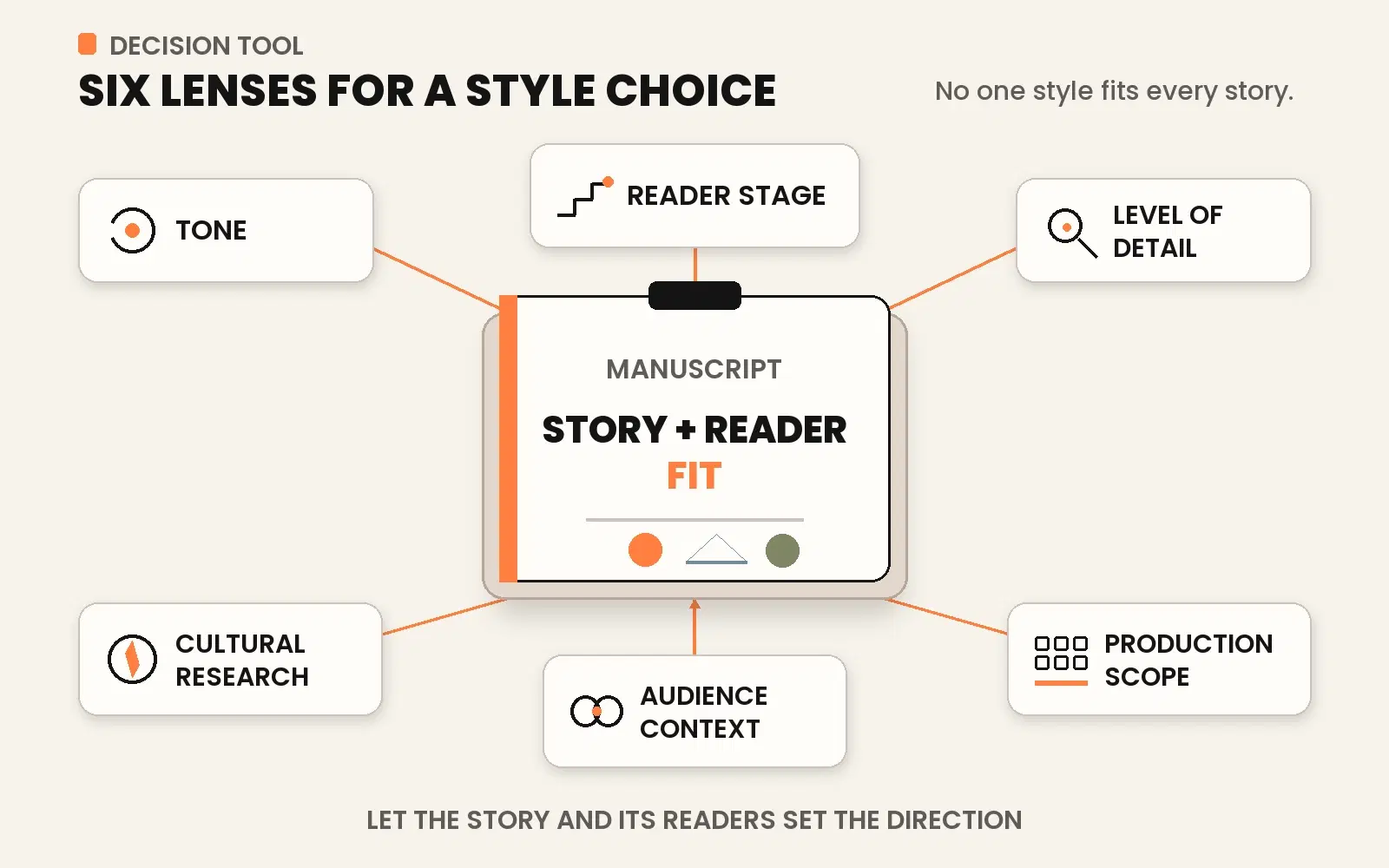
Choosing an illustration style for your children's book isn't about what's trendy or what you personally prefer. It's about what serves your story best.
Here are the key factors to consider:
Story genre and tone: A humorous picture book needs different illustration than a contemplative one. An adventure story needs different illustrations than a gentle bedtime book. The illustration style should amplify the emotional tone of your narrative.
Target age group: Books for toddlers typically use bolder shapes, simpler lines, and high contrast. Books for elementary-age children can accommodate more detail and complexity. Books for middle-graders can embrace more sophisticated visual storytelling.
Your budget: Some illustration styles are more affordable than others. Cartoon illustration is often more budget-friendly than photorealistic illustration. Digital illustration is often faster and cheaper than labor-intensive traditional mediums. Line drawing is less expensive than full-color illustration.
Your audience's expectations: If you're publishing a contemporary realistic picture book, readers expect illustration that's grounded in visual reality. If you're publishing fantasy, readers expect illustration that embraces the magical.
Your illustrator's strengths: Once you've identified potential illustrators, look at their work. What styles do they excel at? Don't hire an illustrator to work in a style that's outside their wheelhouse. Hire them for what they're genuinely good at.
Cultural context: Consider whether your story has cultural specificity. If it does, the illustration style should either authentically represent that culture or be deliberately abstract/stylized in a way that doesn't claim false realism.
Visual distinctiveness: In a crowded marketplace, illustration that stands out is valuable. A style that's distinctive and memorable will help your book be noticed.
Start by identifying what feeling and mood you want the illustration to create. Then look at published children's books in your genre and category. What illustration styles are being used? What do they communicate? Then choose a style that serves your specific story.
Traditional vs. Digital Illustration
One of the biggest decisions when working with an illustrator is whether to commission traditional or digital work.
Traditional Illustration
Traditional illustration uses physical materials paint, pencil, charcoal, collage to create the artwork.
Advantages:
- Has an inherent quality of being hand-made that readers respond to emotionally
- Many illustrators find traditional mediums more creatively satisfying
- Works beautifully for certain aesthetic effects (watercolor luminosity, pencil texture, collage tactility)
- Feels authentic and personal
Disadvantages:
- Slower to produce than digital work
- More difficult to make revisions or color adjustments
- Requires physical materials, workspace, and sometimes equipment
- Less predictable some traditional mediums don't always behave as expected
- Scanning can sometimes lose quality or color accuracy
Digital Illustration
Digital illustration uses digital tools tablets, styluses, software to create artwork.
Advantages:
- Fast to produce
- Easy to make revisions and adjustments
- Infinite undo mistakes aren't permanent
- Colors can be adjusted easily
- Reproducible consistently
- No special workspace or materials needed
Disadvantages:
- Can feel less personal or hand-made if not done thoughtfully
- Requires investment in equipment and software
- Can feel generic if the illustrator relies too heavily on default brushes or presets
- May lack the organic quality that traditional mediums provide
- Risk of looking "too digital"
The Hybrid Approach
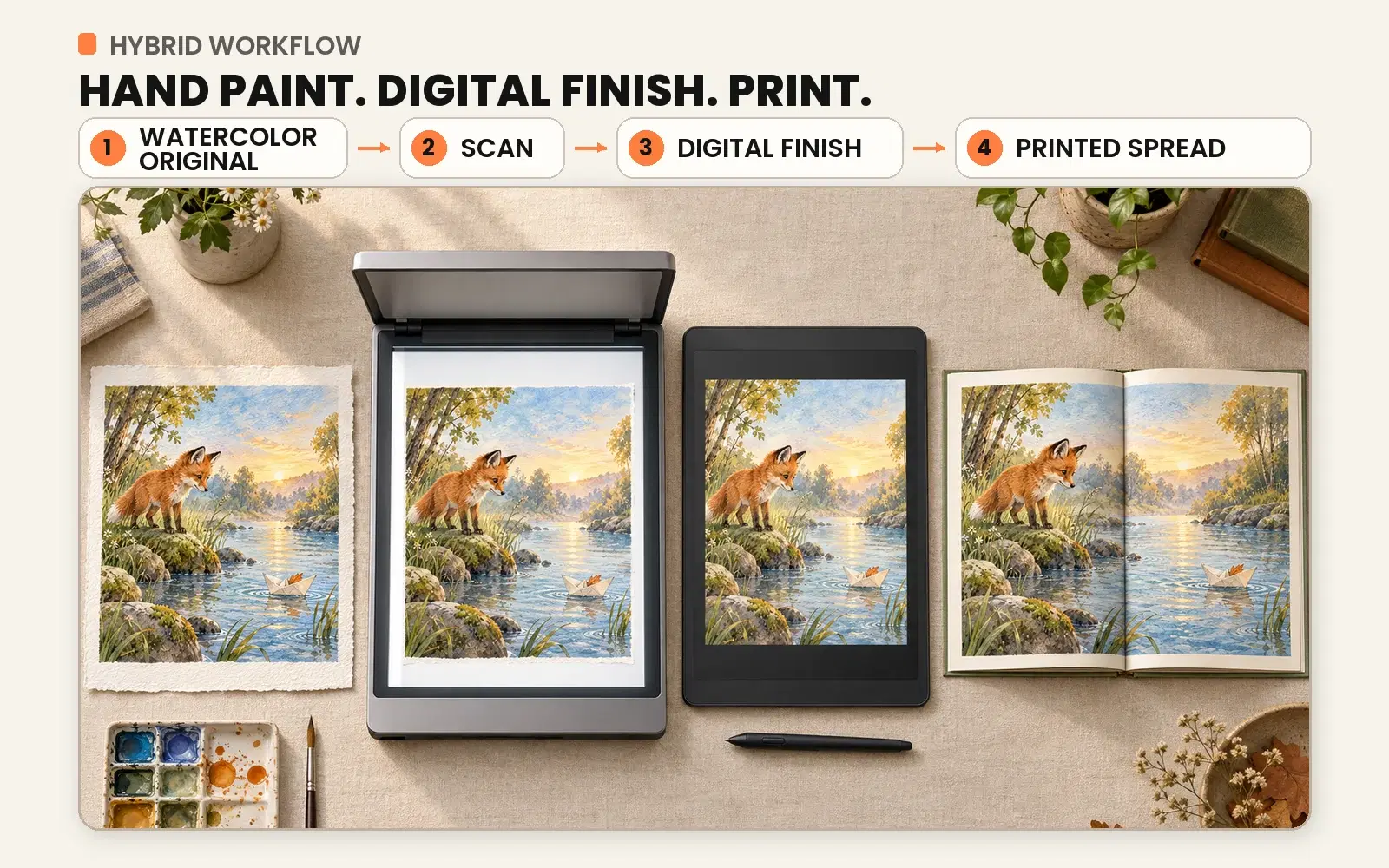
Many contemporary illustrators work hybrid creating traditional work and then scanning it to finish digitally, or creating primarily digital work that mimics traditional mediums.
This approach combines the benefits of both: the authentic quality of hand-made work with the flexibility of digital editing.
Target Audience
Your target audience matters here too. Parents and gift-buyers often have aesthetic preferences. Some prefer the authenticity of traditional illustration. Others appreciate the clean, contemporary look of digital work.
That said, quality is more important than medium. Beautiful work in any medium will appeal to readers. Poor work in any medium will not.
How Formatting Impacts Illustration Style
The way your book is formatted affects how illustrations work and what styles are possible.
Spot Illustration
Spot illustrations are small illustrations scattered throughout text. They're decorative and supplementary rather than central to the narrative.
Spot illustrations work with almost any style, but they're particularly effective with line drawing, sketch, or cartoon illustration. Spot illustrations in a chapter book create visual interest without requiring extensive illustration throughout.
Vignette
A vignette is an illustration that doesn't extend to the edges of the page. It's surrounded by white space.
Vignette illustrations work beautifully for delicate or intimate moments. They create a sense of focus and drawing attention to a specific moment rather than establishing an entire world. Vignettes work with almost any illustration style and are particularly effective with watercolor or sketch illustration.
Full-Bleed Page
A full-bleed illustration extends all the way to the edges of the page with no white space. One illustration covers an entire page.
Full-bleed pages create immersive illustration experiences. They work for any style but are particularly effective for realistic, fantasy, and visually complex illustration. Full-bleed pages say, "This moment is important. Look at this visual world."
Full-Bleed Spread
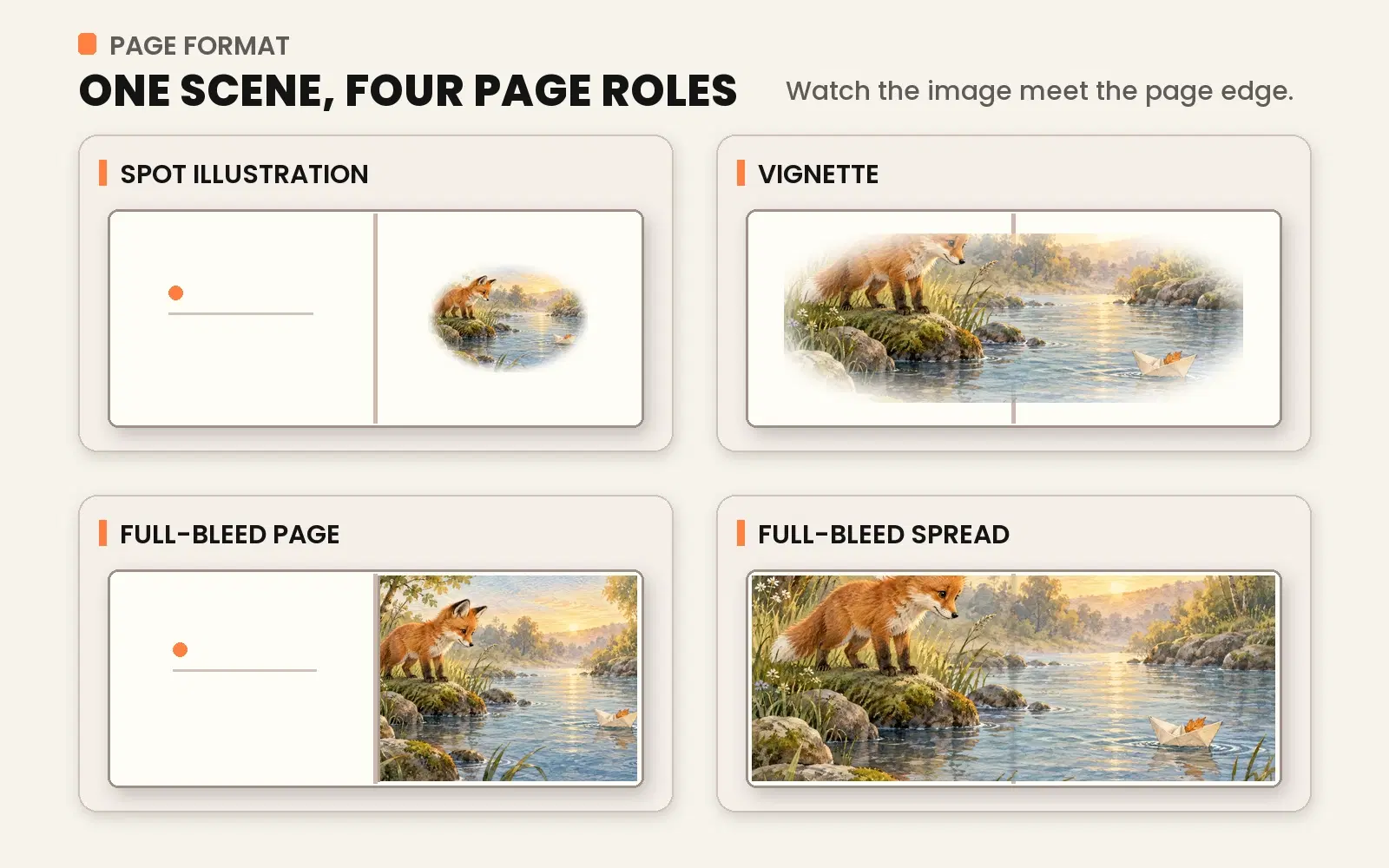
A full-bleed spread is one continuous illustration across two facing pages. It's the most immersive illustration format.
Full-bleed spreads work beautifully for establishing scenes, showing panoramic or expansive moments, or creating stunning visual moments that deserve emphasis. Picture books frequently use full-bleed spreads to maximum effect.
Hiring an Illustrator
Once you've identified the illustration style you want, you need to find an illustrator who can deliver it.
Where to find illustrators:
- Illustration websites and portfolios
- Social media (Instagram is huge for illustrators)
- Illustration agents
- Publishing industry directories
- Recommendations from other authors or publishing professionals
- Art schools and illustration programs
What to look for:
- A portfolio that demonstrates the style you want
- Experience with children's books specifically (illustrating for children is different from other illustration)
- Professional communication and reliability
- Understanding of the publishing process
- Ability to work with feedback and revision
Questions to ask:
- Do you have experience illustrating children's books?
- Can you work in the style I'm envisioning?
- What's your timeline?
- Do you require a contract?
- How many revisions are included?
- What format will you deliver files in?
- What about copyright and usage rights?
Budget considerations: Budget varies wildly depending on experience, style, and complexity. A new illustrator might charge $1,000-3,000 for a full picture book. An experienced, award-winning illustrator might charge $10,000-50,000 or more. Line drawings for chapter books are typically less expensive than full-color picture book illustration.
Be clear about your budget upfront. Professional illustrators deserve fair compensation, and budgets communicate the scope and nature of the project.
Making Your Final Choice
Choosing an illustration style is one of the most consequential decisions you'll make in publishing your children's book. It affects how readers experience your story, how your book competes in the marketplace, and what potential exists for adaptation or merchandising.
Take time with this decision. Look at published books in your category. Identify what illustration styles resonate with you and why. Consider what your specific story needs. Then find an illustrator who can deliver that vision with skill and passion
The right illustration will elevate your story and help it find its audience. The wrong illustration will undermine even the most wonderful narrative. Choose thoughtfully.
Your story deserves illustration that honors it.
Frequently Asked Questions
What are the most popular children's book illustration styles?
Cartoon, watercolor and digital styles come up most often, because they suit the widest range of ages and print well at picture book size. Realistic and photorealistic work appears more in non fiction and older readers. The style that is right for you is the one that matches your story's mood, not the one that is fashionable this year.
How do I choose an illustration style for my book?
Start with your reader's age, then your story's tone. A bedtime story and an adventure story pull in different directions even at the same age. Read the book out loud and notice what it feels like, then look for a style that carries that feeling. If you are still torn, ask for a sample spread in two styles and compare them side by side.
What is the difference between an illustration style and a medium?
The style is the look, cartoon or realistic or abstract. The medium is what it is made with, watercolor or colored pencil or vector. The same style can be reached through different mediums, and the same medium can produce very different styles, which is why the two are chosen separately.
Is digital or traditional illustration better for a children's book?
Neither is better. Digital is faster to revise and easier to prepare for print, which matters if your book has a deadline. Traditional work has texture that many readers respond to, and originals you can keep. Plenty of books use both, with traditional textures scanned and finished digitally.
How many illustrations does a children's picture book need?
A standard picture book carries 28 pages of story content, which is 14 two page spreads, so most books need art on every spread. How much art each spread carries depends on the format you choose, from a small spot illustration up to a full bleed spread that runs to the edge of the paper.
Do I own the illustrations once they are finished?
Yes. The artwork made for your book is yours, and you decide where it is used, on the cover, inside the book, in your marketing or on a later edition. You receive the layered source files as well as the finished ones, so a future edition can be adjusted without commissioning the work again.