Why Storyboarding Comes First in Your Book's Creation
Storyboarding stands as the most underutilized yet fundamentally critical step in children's book creation. Many first-time authors, eager to move directly from manuscript to finished illustrations, view storyboarding as an optional preliminary step, a nice-to-have component that might be skipped if budget or timeline constraints arise. This misconception represents a profound misunderstanding of creative workflow that costs countless authors thousands of dollars, months of delays, and ultimately compromises their final product's quality.
Industry data reveals that approximately 73% of self-published children's books that fail commercially were never properly storyboarded. Authors who skip storyboarding encounter preventable problems: illustrations that don't fit page layouts, text that competes with artwork, characters inconsistent across spreads, and pacing that feels rushed or dragging. These issues, caught early during storyboarding, cost nothing to fix. Discovered mid-illustration, they require expensive revisions. Discovered after publication, they're permanent embarrassments.
Conversely, authors who invest in comprehensive storyboarding experience measurable benefits: cleaner illustration approvals with fewer revisions, stronger narrative pacing that captivates young readers, professional-quality book design, and efficient communication with collaborators. According to publishing industry surveys, children's books created with detailed storyboards receive 34% higher professional reviews and sell measurably better than books created without storyboarding. Whether you're searching "how to storyboard a children's book," "what is a storyboard for picture books," "storyboarding techniques for illustrators," or "why storyboarding matters for book publishing," this comprehensive guide explains why storyboarding isn't optional, it's absolutely essential.
This guide explores what professional storyboarding actually entails, why it matters at every creative stage, how it prevents costly mistakes, and how to implement storyboarding workflows that align with modern book publishing timelines and budgets.
What is a Children's Book Storyboard?
Defining the "Blueprints" of Your Narrative
A children's book storyboard is fundamentally a visual blueprint of your entire narrative. Unlike a written manuscript that exists primarily in text, a storyboard represents your story as readers will actually experience it as a sequence of visual moments unfolding across pages and spreads. A storyboard transforms your abstract narrative into concrete visual planning, showing not just what happens in your story, but how it visually appears, where text sits relative to illustrations, how characters move through space, and how readers experience pacing through page design.
Think of storyboarding as the bridge between your written manuscript and commissioned illustrations. Your manuscript exists as words on a page, descriptions of scenes, dialogue, and narrative. Storyboarding takes those words and imagines them as visual experiences. Where does the character stand on the page? What expression do they wear? What background elements exist in this scene? How large is the character relative to the page? These crucial visual decisions, made during storyboarding, directly inform how illustrators will interpret your story.
Professional storyboarding serves several distinct functions simultaneously. First, it visualizes your narrative structure, allowing you to see whether your pacing works, whether your story builds tension effectively, and whether page turns create emotional impact or feel arbitrary. Second, it addresses technical book production requirements ensuring that important visual elements don't disappear into the book's spine (called the gutter) and that text placement doesn't obscure critical artwork. Third, it establishes a communication document that allows you and your illustrator to align on visual interpretation before expensive final illustrations are created. Fourth, it provides an editorial tool allowing editors and beta readers to evaluate pacing and visual flow in addition to textual content.
A children's book storyboard typically includes small-scale thumbnail sketches (rough preliminary sketches showing composition and layout), simplified line drawings showing character placement and action, notes about text placement and dialogue, visual notes about color mood or style direction, and technical annotations about page dimensions, bleed areas, and safety zones.
The Difference Between Thumbnails, Storyboards, and Finished Art
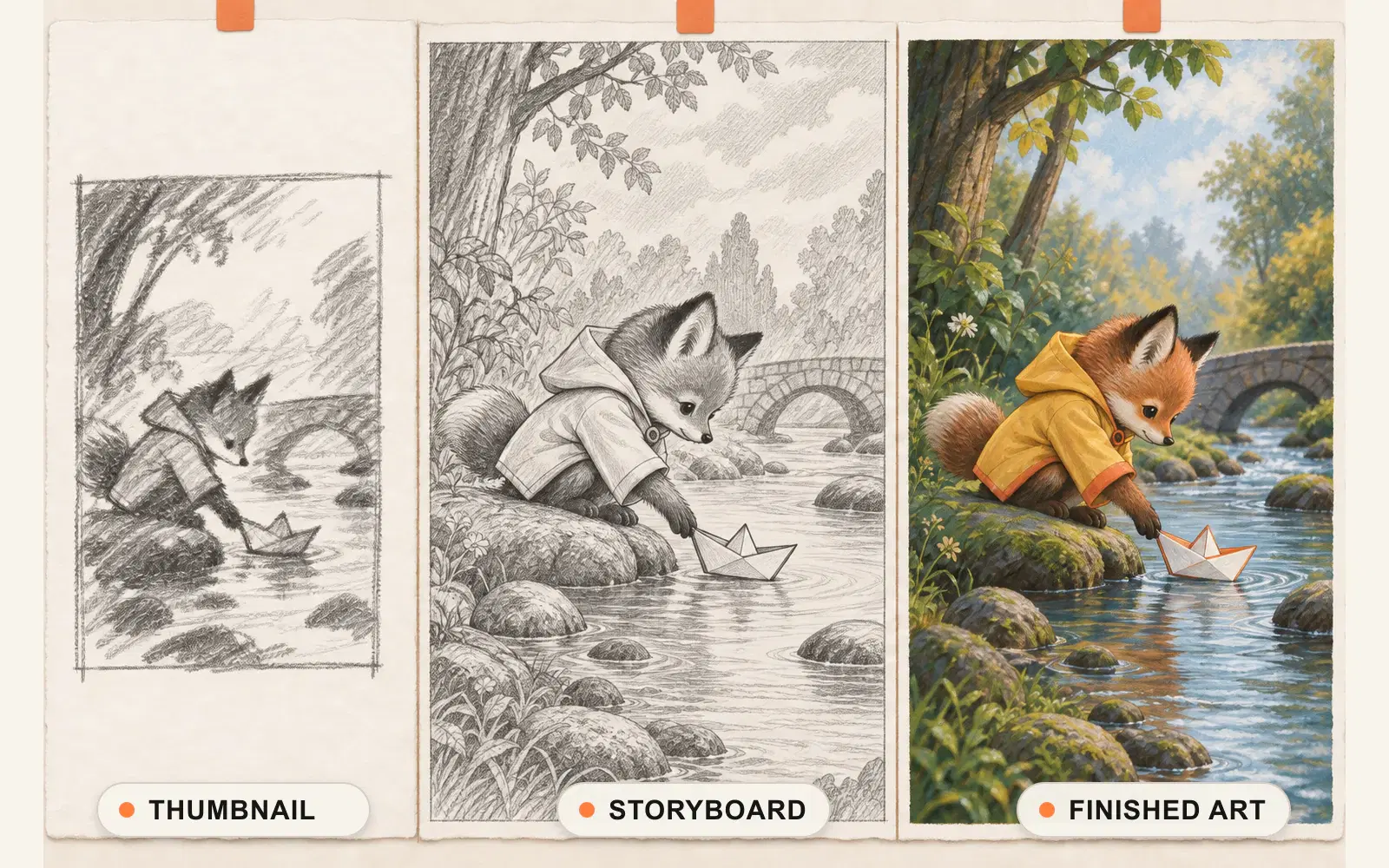
Understanding the distinction between thumbnails, storyboards, and finished art clarifies the specific purpose of each creative stage. These terms are sometimes used interchangeably by non-professionals, but they represent distinct creative phases with different purposes and time investments.
Thumbnails are rough, very small-scale preliminary sketches created rapidly to explore composition possibilities. Thumbnail sketches are typically 2-3 inches in their largest dimension, drawn quickly in pencil, and emphasize basic shapes, composition structure, and action rather than detail. A professional illustrator might create 5-10 thumbnail variations of a single page in less than an hour, exploring different compositional approaches before committing to a final direction. Thumbnails are thinking tools, they represent the most preliminary creative exploration phase, where the illustrator (or you, if planning visually) rapidly explores possibilities.
Storyboards are the intermediate phase between thumbnails and finished art. Storyboards are drawn at larger scale (often half-page size or more), with more detailed sketch work showing character forms, facial expressions, background elements, and relative positioning. Storyboards include annotations describing text placement, color notes, emotional tone, and any technical requirements. Storyboards are typically drawn in pencil and remain relatively sketchy. They establish the visual direction and composition clearly enough that finishing illustrators can work from them, but without rendering finished detail work. A typical storyboard takes 30-60 minutes per page for a professional illustrator.
Finished art is the final, fully rendered illustration. This is painted, digitally rendered, or created in whatever final medium the illustrator uses. Finished art includes all detail, color, texture, and refinement. Finished art is what appears in the published book. Creating finished art is time-intensive, typically requiring 3-6 hours per page or more depending on artistic complexity and technique.
The distinction matters enormously because it affects cost, timeline, and revision efficiency. Thumbnails and storyboards exist in the conceptual, thinking phase where changes are trivial. Revising a storyboard takes minutes. Revising finished art takes weeks. Discovering during storyboarding that your pacing doesn't work is a minor setback. Discovering the same problem after illustrations are complete is a catastrophic, expensive problem.
The 32 Page Standard and Why It Exists
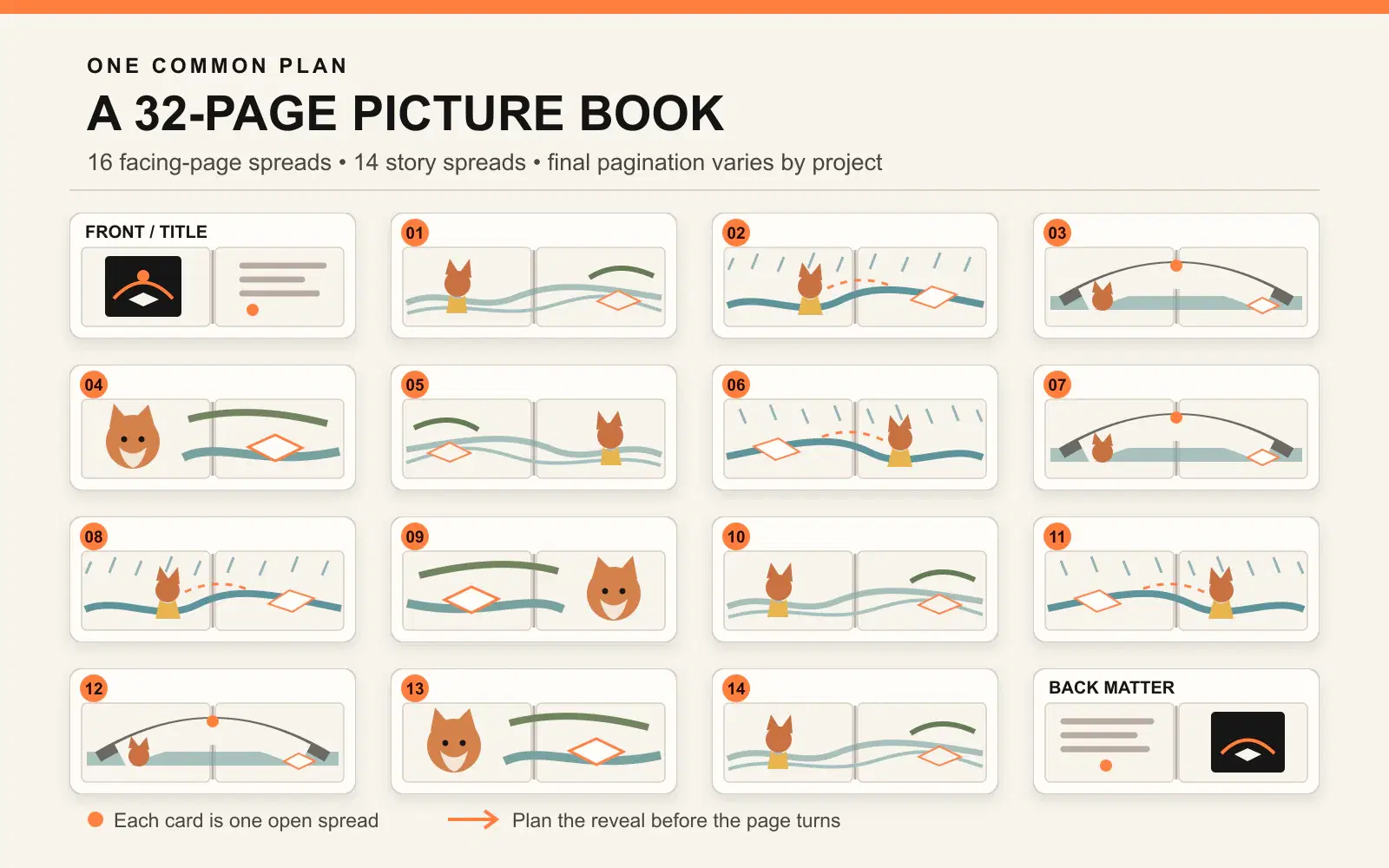
Most children's picture books follow a 32-page standard, a length established by printing industry conventions. Understanding this standard is crucial because it shapes storyboarding decisions. A 32-page book typically contains a front matter page, title page, back matter, and 28 pages of story content. The 28-page content typically breaks into 14 two-page spreads (opening the book shows two facing pages simultaneously).
This 14-spread structure is why storyboarding a 32-page book means creating 14 storyboarded spreads. Each spread is a single composition spanning both left and right pages. Understanding this physical reality of books is crucial. Many first-time authors fail to realize that page design doesn't work one page at a time. A reader doesn't look at page 5, then page 6 separately. They look at the open book showing pages 4-5, then 6-7. Composition must work across this two-page spread.
A professional storyboard for a 32-page picture book typically includes:
- 14 spreads shown at approximately 50-75% of final page size
- Detailed thumbnail composition for each spread showing character placement and action
- Text placement indicated (even if not in final typography)
- Color notes or mood descriptions
- Technical annotations about spine position and safety zones
- Character expression studies if complex emotions are critical
- Notes about visual transitions and pacing
This comprehensive storyboard typically requires 30-50 hours of work from an experienced artist. For first-time authors storyboarding their own work (rather than hiring professionals), expect 50-100 hours depending on your artistic skills and comfort with visualization. This substantial time investment pays dividends because it prevents far more costly mistakes later.
Perfecting the Narrative Flow and Pacing
Solving the "Wall of Text" Problem
One of the most common problems in children's books created without storyboarding is excessive text competing with artwork. Authors, focused primarily on their written narrative, often fail to consider how text placement affects page design. A beautifully written 150-word passage that works perfectly in a manuscript becomes problematic when it must fit within a page containing also a character illustration and background.
The "wall of text" problem occurs when text occupies so much space that illustrations feel cramped and secondary. In well-designed picture books, text and illustrations work as equal partners. Text describes what's happening while illustrations show it, and together they create the full narrative experience. When text dominates, illustrations lose impact and page feel cluttered.
Storyboarding forces confrontation with this problem early. As you're creating your storyboard, you're not just imagining text somewhere on the page. You're actually positioning text blocks and observing how they interact with illustration. If 200 words of text plus a full-page character illustration can't coexist peacefully on a spread, you discover this during storyboarding when fixing it is trivial (either trim text or redesign the page composition). You don't discover this problem six months later after your illustrator has created finished art that your designer now has to awkwardly fit around text blocks.
Professional storyboards solve the wall-of-text problem by establishing text budgets. A professional children's book designer might determine that pages can accommodate approximately 75-100 words per spread in a picture book, with the exact amount depending on text size and placement. This guideline, established during storyboarding, guides writing revisions. If your original manuscript contains 150 words on a particular spread, storyboarding reveals this and motivates you to trim before commissioning illustrations
The Art of the Page Turn, Creating Suspense and Surprise
Master storytellers understand that page turns are narrative moments. When readers finish a page and open the book to the next spread, that moment of revelation seeing what appears on the next page creates emotional impact. Professional storyboarding harnesses this understanding systematically.
The physical reality of books creates natural suspense opportunities. Consider this: when a reader finishes page 5, they must turn the page to see pages 6-7. A skilled author-illustrator team uses this mandatory pause to create anticipation. Perhaps page 5 ends with a question ("What was that sound in the darkness?") and pages 6-7 reveal the answer with dramatic visual impact. Or page 5 ends with a character looking off-page toward something unseen, and pages 6-7 reveal what the character sees.
Storyboarding allows you to map these page-turn moments deliberately. Professional storyboarders evaluate each spread break and ask: "Does this page-turn moment create narrative impact? Does the transition between spreads feel jarring or satisfying?" If a spread break feels unmotivated or creates awkward narrative momentum, you adjust composition or text during storyboarding.
The converse problem page turns that feel arbitrary because they're simply imposed by the 14-spread structure also becomes visible during storyboarding. If your climactic emotional moment happens to end mid-page, you might restructure either your text or page design to make that moment fall on a page turn, amplifying emotional impact
Balancing Action and Stillness Across the Spread
Children's books benefit from visual rhythm created by alternating between action-filled spreads and quieter, more stillness-focused spreads. Action spreads might show characters moving, gesturing, or interacting dynamically. Stillness spreads might show characters in contemplation, peaceful moments, or quiet emotional beats.
Creating visual rhythm requires analyzing your entire storyboard and noticing patterns. If spreads 3, 4, 5, and 6 are all filled with frantic action and overlapping characters, readers experience visual exhaustion. They need a quieter spread where visual complexity reduces and they can rest visually. Similarly, too many quiet spreads create monotony.
Storyboarding allows you to map this rhythm across your entire 14-spread structure. A professional storyboard might use color-coding or notations to mark action vs. stillness, or a storyboarder might simply review the sequence and notice where rhythm feels unbalanced. If you see three quiet spreads in a row followed by four action-filled spreads, this imbalance becomes obvious and you can adjust composition, character placement, or scene descriptions to create better rhythm.
This rhythm isn't accidental in professionally-designed children's books. Experienced illustrators understand these principles intuitively, but first-time authors often need to learn them through storyboarding. By visualizing your entire book's rhythm at the storyboard stage, you create reading experiences that feel well-paced and engaging rather than exhausting or boring.
Accounting for the Physical Shape of a Book
The Gutter and the Trim, Keeping Key Art Out of the Spine
Children's books are physical objects bound together with a spine. The spine contains no artwork, it's simply binding. The area near the spine, called the gutter, can be problematic for artwork. When you open a bound book, the gutter area (typically 0.5-0.75 inches on each side of the spine) is where pages bend, and important artwork can disappear into this gap or become distorted by the book's physical curve.
This physical reality of books remains invisible to authors focused purely on written content. A manuscript has no gutter. A digital document viewed on screen has no binding. But the actual printed, bound book does, and artwork positioned carelessly in the gutter becomes visually compromised. A character's face positioned near the spine might split awkwardly across the gutter. Background details in the gutter area might disappear into shadow. Text placed in the gutter becomes difficult to read.
Professional storyboarding accounts for the gutter explicitly. Storyboards typically include visual markers indicating where the gutter falls. Characters' important features (faces, hands, identifying features) are positioned away from the gutter. Text is positioned with sufficient margin from the gutter to remain readable. Compositional focus is directed toward the outer edges of the spread rather than the center.
Many first-time authors and self-taught illustrators remain unaware of gutter safety until discovering the problem in their printed book. A character's eye position looks perfect on the digital file but disappears into the gutter in the bound book. A beautifully detailed background element that was important for setting becomes invisible in the gutter shadow. Discovering this during storyboarding prevents these costly mistakes. During the actual printing phase, they're permanent problems.
Mapping Text Placement for Readability and Accessibility
Text placement on a page isn't arbitrary, it's a technical and design consideration that significantly affects readability, particularly for young readers and readers with visual processing differences. Text that's positioned without consideration for background contrast, alignment, or accessibility creates reading difficulties that compound across 28 pages of a book.
Professional storyboarding includes explicit text placement mapping. Where will text sit relative to the illustration? Will text overlay the illustration (difficult because background details might obscure text) or appear below or to the side? What's the background color where text will sit? Is there sufficient contrast between text color and background to support easy reading? Will text alignment (left, center, right, or justified) serve the overall design?
These considerations matter particularly for children with dyslexia or visual processing challenges. Text placed against complex, detailed backgrounds is harder to read for everyone but especially problematic for readers with visual processing differences. Storyboarding allows you to design text placement with accessibility in mind from the beginning.
Similarly, storyboarding reveals whether text volume aligns with available space. If a paragraph of text must fit in limited space, does the text size become so small that young readers struggle? Does the line length become awkwardly short, creating fragmented reading patterns? Discovering these problems during storyboarding motivates trimming text or redesigning page composition. Discovering them with finished illustrations requires either redesigning the illustration to accommodate text or compromising accessibility.
Identifying "Safety Zones" for Character Heads and Dialogue
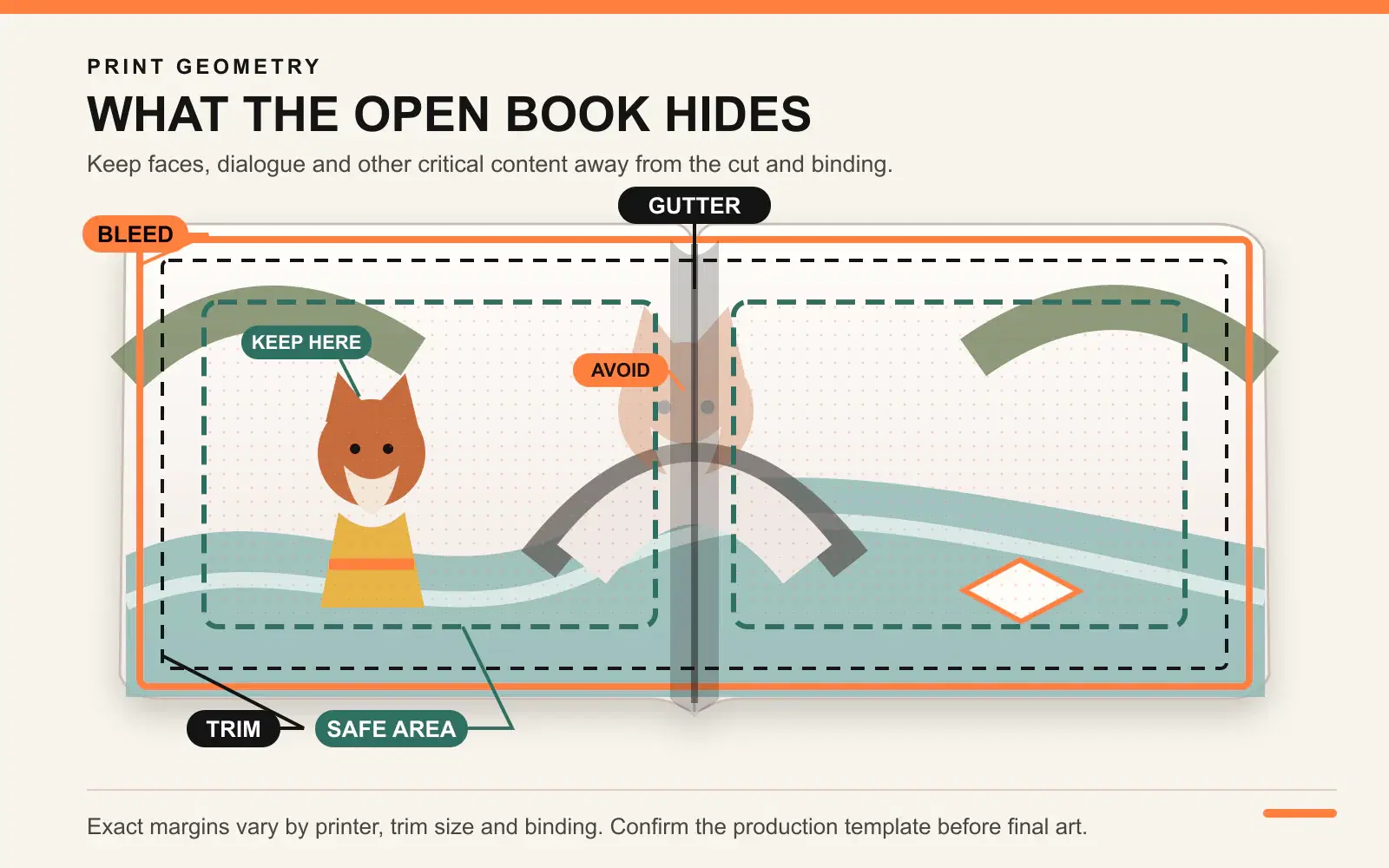
Professional storyboarding establishes invisible "safety zones" areas of the page where critical content (character heads, dialogue, important story elements) should appear to ensure they're not lost to binding, cutting, or other production processes. These safety zones account for:
Spine safety zone:Content positioned within 0.75-1 inch of the spine center is at risk of being obscured by binding or disappearing into the gutter.
Trim safety zone:Content positioned within 0.125-0.25 inches of the page edge is at risk of being cut off during the trimming process (printing creates sheets slightly larger than final trim size, then machines trim them to exact dimensions; content too close to edges might be trimmed).
Text safety zone:Text placement typically maintains margins of 0.5 inches from page edges and 0.75 inches from the spine, ensuring readability and preventing accidental trimming.
Professional storyboards include visual guidelines showing these safety zones. Characters' heads are positioned within safe zones. Dialogue balloons are positioned where they won't be obscured. Important visual elements are positioned away from problematic areas. This technical planning, done during storyboarding, prevents discoveries during publication that critical story elements are missing or compromised.
How Storyboards Save Your Budget
Catching Plot Holes Before Final Painting Begins
One of storyboarding's most valuable functions is catching narrative problems, plot holes, logical inconsistencies, or pacing issues before expensive final illustration begins. A comprehensive storyboard shows your entire narrative arc in visual sequence. As you move through the storyboard, narrative problems become obvious.
Perhaps you've storyboarded a character exiting stage left in spread 5, but spread 6 begins with the character entering from stage right, contradicting the exit. This seems like a minor continuity error, but if your illustrator hasn't noticed this, they'll paint the character entering from the wrong direction. Your designer will flag this during layout. Your editor will question the scene sequence. The error, tiny in storyboarding, cascades into problems.
Or perhaps your storyboard reveals that a crucial plot point happens without adequate setup. Readers might be confused by a character's action because the motivation isn't visually clear. During storyboarding, you notice this and adjust text or composition to clarify motivation. With finished illustrations, you've missed your opportunity.
Storyboarding also reveals pacing problems that aren't apparent from the manuscript alone. Perhaps three consecutive spreads all feature the same scene (interior of a house) without visual variation. This might cause reader fatigue that your manuscript-only review didn't catch. Storyboarding reveals this and motivates moving a scene to a different location or restructuring the narrative sequence.
These narrative corrections, made during storyboarding, cost nothing. Made during the illustration phase, they cost substantially. Made after publication, they're permanent errors that compromise your book's quality and reputation.
Reducing Revision Rounds by Working in Pencil First
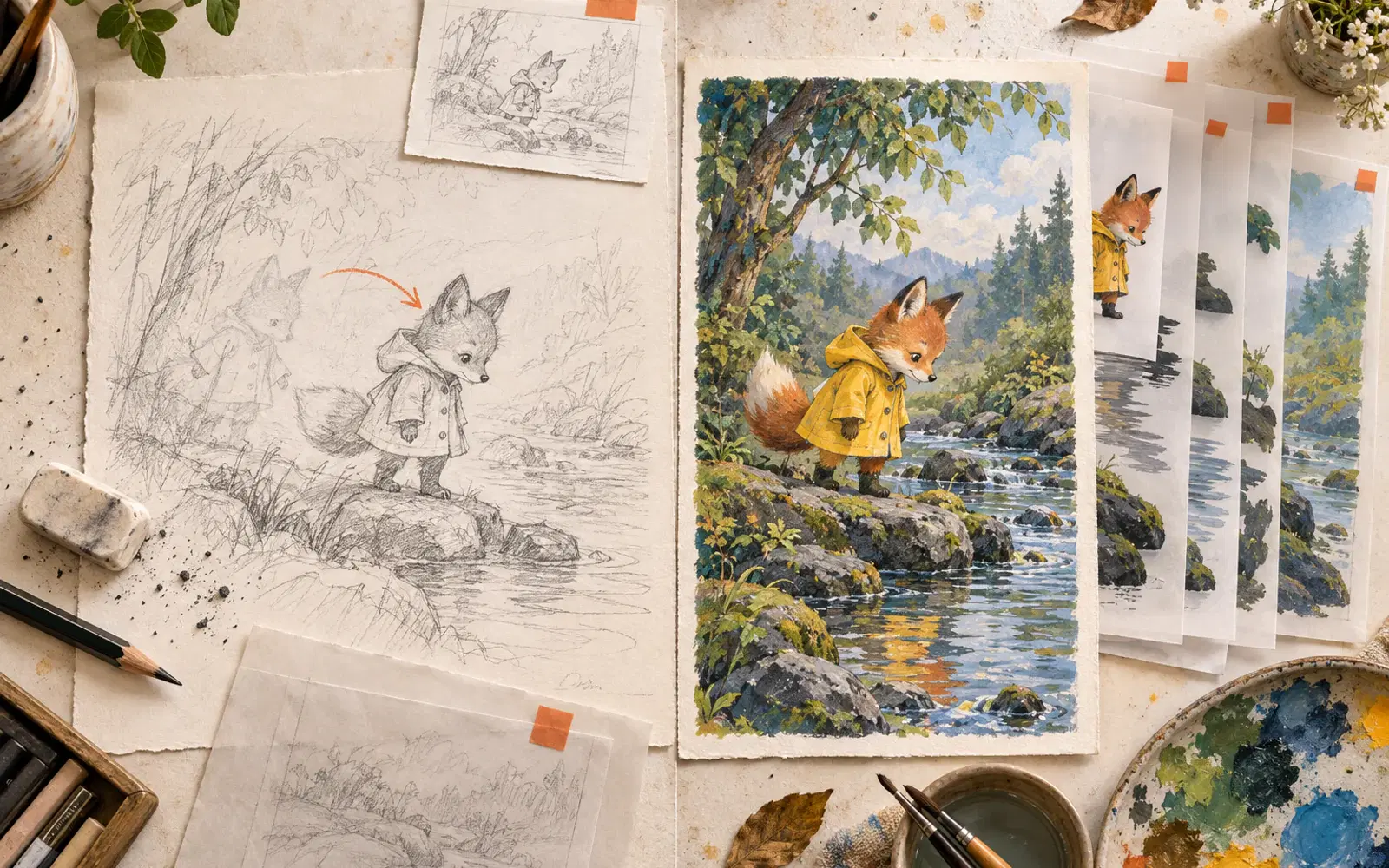
Professional illustrators and designers follow a principle called "pencil first": rough sketches and detailed pencil work should achieve narrative and compositional clarity before progressing to finished rendering. This principle directly translates to storyboarding: problems should be identified and solved at the storyboard phase, not during expensive final illustration.
The economics of revision are stark. Revising a pencil storyboard, such as moving a character's position, changing composition, or adding or removing background elements, takes minutes. An illustrator can redraw a storyboard spread in 15-30 minutes. Revising finished, fully-painted artwork on that same spread might require days of work. If you discover during storyboarding that spread 7 needs compositional restructuring and provide that feedback to your illustrator, they incorporate the change into their detailed storyboard stage. The revision costs nothing beyond their regular work.
If you discover the same compositional problem after final illustration is complete, you're requesting revision of completely finished artwork. Your illustrator, who has moved on to other projects, must return to this spread, undo finished rendering, restructure composition, and re-render. This might require 8-16 hours of work. At typical freelance illustrator rates ($50-$100 per hour), you're looking at $400-$1600 in revision costs.
Multiply this across your entire 28-page book. If storyboarding prevents even 3-4 revision rounds of finished art (which many projects require), you've saved $1500-$6000 in illustrator costs. For many independent authors, this savings justify the entire storyboarding investment.
Streamlining Communication with Your Illustrator and Editor
Storyboards serve as communication documents that align everyone's understanding before expensive work begins. Your illustrator sees not just your manuscript but a visual interpretation of how you envision the story unfolding. Your editor sees not just text but visual flow and pacing. Your designer understands page layout requirements.
Without storyboards, you're relying on description and hope. Your manuscript describes a scene; your illustrator interprets it based on their understanding. You imagine the scene one way; they paint it differently. Months later, finished illustrations arrive and don't match your vision. Revision ensues.
With storyboards, you're communicating visually. Your illustrator sees your thumbnail composition, character positioning, and scene interpretation. They can immediately say, "I see what you're imagining, and I have a different approach that might work better because..." Or they might confirm, "Yes, that's exactly the composition I would create." Either way, you've aligned before expensive work begins.
Similarly, editors and beta readers can evaluate visual flow more effectively with storyboards. Pacing problems jump out visually in ways they don't from text alone. An editor might read your text and think it flows fine, but seeing it storyboarded as 14 spreads, they might notice that emotional beat happens too quickly or that suspense doesn't build progressively. This feedback during storyboarding prevents discovering pacing problems after illustrated.
Character Mapping and Interaction in Space
Testing Character Continuity in Complex Environments
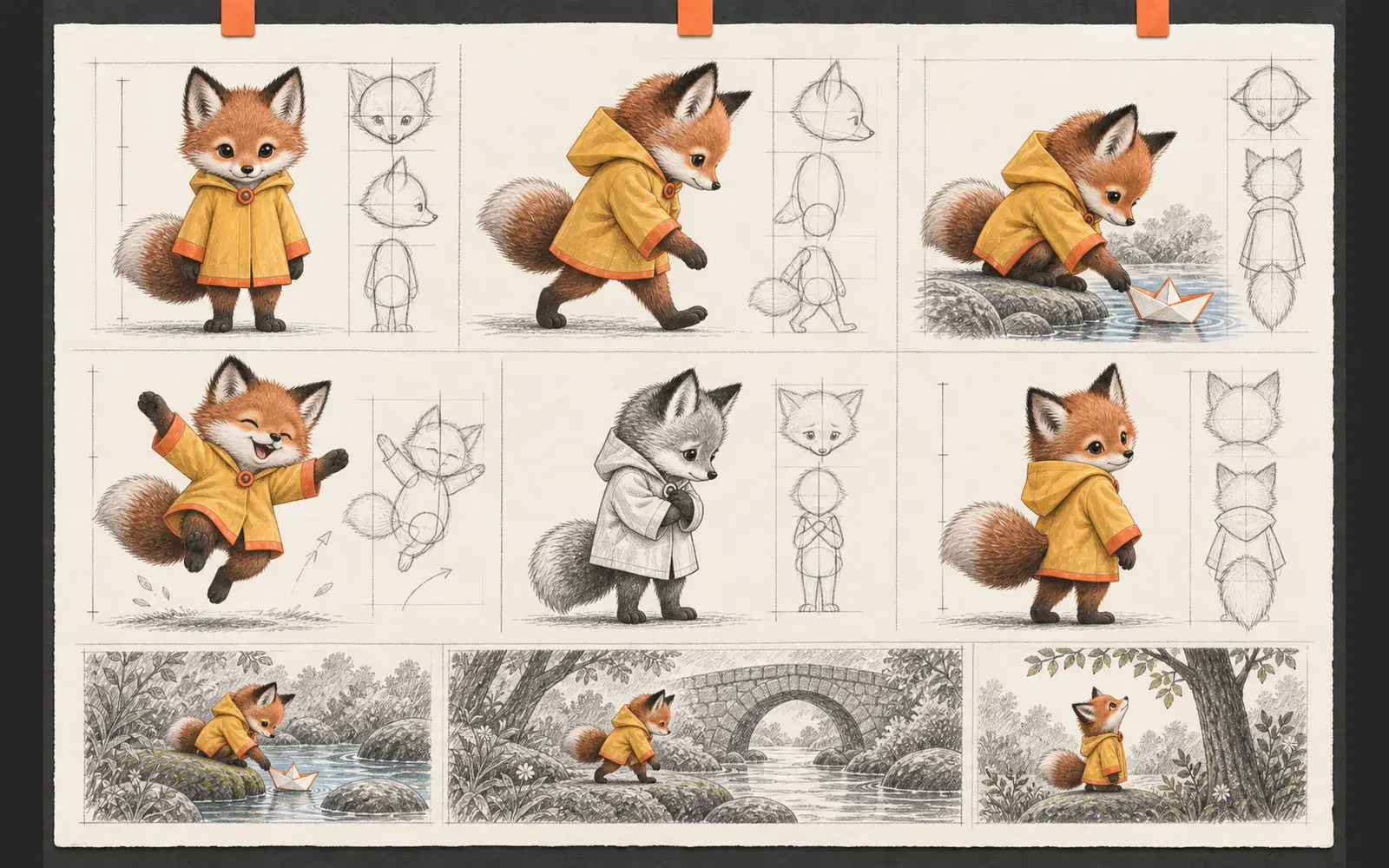
One of storyboarding's most practical functions is testing character consistency across complex narratives. As you storyboard, you're drawing your character repeatedly in different poses, different locations, different emotional states. This repetition allows you to catch consistency problems early.
Perhaps your character has a distinctive feature, a unique facial structure, an unusual hairstyle, characteristic clothing. As you draw them across 14 spreads in different scenarios, do they remain visually consistent? Or do they change subtly, with their proportions shifting, their distinctive features becoming less distinctive? Storyboarding makes these consistency problems visible while they're trivial to fix. Finished illustrations with consistency problems require expensive re-rendering.
Storyboarding also tests how characters interact with environments. A character who's supposed to be small relative to a giant should consistently appear small. A character who's supposed to be large relative to other characters should consistently appear large. These size relationships, established during storyboarding, provide guidelines for your illustrator's final artwork.
Additionally, storyboarding reveals whether multiple characters interact clearly in space. When three characters share a spread, their spatial relationships should be unambiguous. Who is nearest the viewer? How are they positioned relative to each other? Do their interactions create visual clarity or confusion? Storyboarding allows you to adjust positioning and composition to ensure clarity.
Are Your Characters Proportional to Their World?
A common problem in children's books created without storyboarding is inconsistent character scale relative to environments. A character standing in a room might appear enormous relative to furniture in one illustration and tiny relative to the same furniture in another. This inconsistency confuses readers and breaks immersion.
Storyboarding forces explicit attention to scale. As you draw your character moving through a house, from outside the house, into different rooms, scale consistency becomes obvious or problems become visible. If your character should be child-size relative to adult-size furniture, that relationship should be consistent across all spreads where the character and furniture appear together.
Professional storyboards sometimes include simple grid overlays or proportion guides ensuring consistent character scale. A character might be drawn consistently 3-4 heads tall relative to a standing adult, creating a clear proportion that carries through the book.
This technical attention to scale, trivial during storyboarding, prevents expensive mistakes. A storyboard showing scale inconsistencies motivates either restructuring scenes (avoiding showing the character and furniture together if scale becomes problematic) or redesigning composition to maintain scale consistency. With finished illustrations showing scale inconsistencies, fixes are much more expensive.
The Book Writing US Storyboarding Workflow
From Rough Thumbnails to Detailed Pencils
Professional storyboarding in 2026 follows a structured workflow optimized for efficiency while maintaining quality. The Book Writing US workflow progresses through distinct phases:
Phase 1: Thumbnail Exploration (2-4 hours):Initial quick sketches exploring composition possibilities for each spread. Multiple thumbnail variations show different approaches to composition. These rough sketches are thinking tools, helping establish compositional direction.
Phase 2: Detailed Storyboard Pencils (15-20 hours):Based on approved thumbnails, create detailed pencil storyboards at approximately 50-75% of final page size. These storyboards include character forms, facial expressions, background elements, and clear compositional direction. Technical annotations note text placement, gutter concerns, safety zones, and visual mood.
Phase 3: Storyboard Review and Revision (2-4 hours):Share storyboards with author and editor for feedback. This review phase is crucial, this is when major narrative or compositional adjustments happen while they're trivial. Revisions are requested, incorporated, and approved.
Phase 4: Finalized Storyboard Package (2-3 hours):Compiles finalized storyboards into a professional presentation document with narrative notes, character descriptions, visual mood references, and technical specifications that illustrators will use during the final art phase.
This complete storyboarding workflow typically requires 25-35 hours for a complete 32-page picture book. For first-time authors storyboarding their own work without formal training, expect this timeline to extend to 50-60 hours, but the process remains manageable.
Collaborative Reviews and the Author Illustrator Feedback Loop
Central to professional storyboarding is structured feedback and collaboration. Rather than creating a complete storyboard and then sharing it all at once, professional workflows build in review points where stakeholders provide feedback while revisions remain easy.
Review 1: Thumbnail Approval (Author/Editor): Before detailed storyboarding begins, share thumbnail compositions for all 14 spreads. This allows high-level feedback on overall narrative flow and composition direction. If your editor or publisher flags major concerns at this level, revisions require redrawing thumbnails after a few hours of work. Better than discovering concerns after detailed storyboards are complete.
Review 2: Detailed Storyboard Feedback (Author/Illustrator/Editor): Once detailed pencil storyboards are complete, share them with your eventual illustrator (if different from the storyboarder). This allows the illustrator to provide feedback on compositional choices, character design interpretations, and any concerns before final illustrations begin. This feedback phase typically involves 1-2 rounds of revision until all parties approve the storyboard direction.
Review 3: Final Storyboard Approval: Finalize all storyboard revisions and obtain written approval from author, illustrator, and editor confirming that storyboards accurately represent the approved narrative direction. This written approval prevents misunderstandings later.
This structured review approach ensures all stakeholders understand and approve narrative direction before the illustrator's expensive final art phase begins.
Digital Storyboarding Tools We Recommend
Modern storyboarding increasingly happens digitally rather than on paper. Digital tools offer advantages including easy file sharing, efficient revision management, and straightforward conversion to formats illustrators can reference while working.
Procreate (iPad): For illustrators or artists comfortable with iPad, Procreate remains the fastest, most intuitive digital storyboarding tool. The software's brush quality and touch interface make sketching feel natural. Procreate storyboards can be quickly exported in formats illustrators reference during final art.
Clip Studio Paint: Excellent for comics and sequential art storyboarding. The software includes specific tools for panel creation and sequential art planning that translate well to children's book storyboarding.
Adobe Photoshop/Illustrator: Professional-grade tools familiar to many designers and illustrators. Slightly overkill for storyboarding but work excellently for comprehensive storyboard packages including text overlays and technical annotations.
Storyboard-Specific Software (Storyboarder, BOORDS): Specialized storyboarding applications designed specifically for visual planning. These tools include templates for standard book page dimensions, built-in revision management, and collaborative features. Useful for teams but potentially overkill for individual authors.
Pencil and Paper: Don't overlook traditional materials. Pencil and paper storyboarding remains fast, tactile, and effective. Many professionals still storyboard by hand, then scan or photograph storyboards for digital sharing.
The best storyboarding tool is whichever tool allows you to work efficiently and share results in formats your illustrator and collaborators can access. Digital tools offer convenience but aren't required for effective storyboarding.
If You Skip the Storyboard, You're Writing in the Dark
Skipping storyboarding is like building a house without blueprints. You might end up with a dwelling, but it will likely have problems with walls that don't align properly, windows positioned awkwardly, electrical and plumbing that doesn't function efficiently. Only after you move in do you discover these problems, and fixing them requires major reconstruction.
Storyboarding is the blueprint phase of book creation. It costs substantially less to create than finished art. It catches problems while they're trivial to fix. It ensures all stakeholders understand and approve the narrative direction before expensive work begins. It establishes technical specifications that prevent print-quality problems.
Children's book industry professionals, experienced authors, successful illustrators, award-winning designers all employ storyboarding as a foundational step. They do this not because they enjoy additional work, but because storyboarding saves them time, money, and frustration. It's the most efficient path to quality books.
At Book Writing US, we emphasize storyboarding in every children's book project we guide. Our children's book illustrator services include comprehensive storyboarding as part of our standard workflow. We've seen firsthand how storyboarding prevents costly mistakes and creates better books.
If you're creating a children's book, invest in comprehensive storyboarding. The time and modest cost you invest in storyboarding will repay itself many times over through preventing mistakes, efficient illustration, and a final book of which you can be genuinely proud.
Frequently Asked Questions
How much does professional storyboarding cost?
Storyboarding typically costs $800-$2500 for a complete picture book. Professional storyboarders charge $35-$75 per hour and need 25-35 hours for a 32 page book, which puts the same work at $875-$2625. For most independent authors that is justified by what it prevents. One round of finished art you have to redo costs more than the whole storyboard did. You are paying to find the problems while they are still pencil lines.
Can I skip storyboarding if I'm self-illustrating my book?
Even if you are illustrating the book yourself, you still want the storyboard. It is the stage where you find out whether your pacing works, whether the page turns land, and whether a spread you pictured one way actually reads that way on paper. Skipping it does not save you a step. It moves the discovery to the point where you are repainting finished art instead of redrawing a thumbnail.
What's the difference between a storyboard and a manuscript?
A manuscript is a written document describing your story in words. A storyboard is a visual representation showing how your story will appear as illustrations across pages. A storyboard translates manuscript content into visual form, accounting for page layout, illustration composition, text placement, and visual flow. Both are necessary manuscripts capture narrative detail; storyboards capture visual execution.
Can I revise my manuscript after storyboarding is complete?
Yes, but major revisions should ideally happen before storyboarding begins. Minor text revisions (trimming a few words, adjusting phrasing) after storyboarding completion are manageable. Major narrative changes after storyboarding is complete require reworking storyboards, which negates much of the efficiency storyboarding provides. Ideally, complete substantial manuscript revisions before beginning storyboarding.
What if my illustrator has a different interpretation of scenes than my storyboard shows?
This is exactly why storyboarding exists to clarify and align interpretation before expensive final work begins. Share your storyboard with your illustrator explicitly, explaining that these compositions represent your approved narrative vision. Professional illustrators understand that storyboards are reference documents they're expected to follow. If an illustrator wants to substantially reinterpret compositions, this should be discussed and approved before final illustration begins, not discovered after final art is complete.
Should I create character design sheets as part of storyboarding?
Character design sheets are separate from but complementary to storyboarding. While storyboarding focuses on narrative and page composition, character design sheets establish consistent character appearance across variations (different angles, expressions, clothing). Many professionals create character design sheets during or before storyboarding so characters can be drawn consistently throughout the storyboard. At minimum, clear character visualization should happen before storyboarding begins.
How detailed should my storyboard be?
Storyboards should be detailed enough that an illustrator looking at them understands your intended composition, character placement, expression, and overall scene interpretation. This typically means storyboards at 50-75% of final page size with clear sketches showing character forms, basic background elements, and overall composition. Extreme detail isn't necessary, storyboards are references, not finished art but vagueness defeats the purpose.
Can I hire someone to storyboard my book?
Yes, and that is the usual route. Storyboarding is part of the standard workflow on every children's book project we handle, so it is not something you arrange separately or brief a second time. You approve the thumbnails, then the pencils, and the same team carries that approved map into the finished illustrations. That is what keeps the book you approved and the book you receive the same book.
What if storyboarding reveals that my entire narrative structure doesn't work?
This is storyboarding performing its intended function catching problems while they're cheap to fix. Discovering narrative structure problems during storyboarding is far better than discovering them after illustrations are complete. If storyboarding reveals fundamental narrative problems, you have the opportunity to restructure before expensive illustration work. This is uncomfortable but ultimately valuable, it's better to restructure now than discover problems later.
- What is a Children's Book Storyboard?
- Perfecting the Narrative Flow and Pacing
- Accounting for the Physical Shape of a Book
- How Storyboards Save Your Budget
- Character Mapping and Interaction in Space
- The Book Writing US Storyboarding Workflow
- If You Skip the Storyboard, You're Writing in the Dark
- Frequently Asked Questions