Genre Conventions in Writing, and What Ignoring Them Costs a Manuscript
Short Answer: Genre conventions in writing are the things readers expect from a certain kind of book, like a happily ever after in a romance. Leave one out and your readers feel cheated, even if they can't say why. Your manuscript pays in plainer ways too. It's harder to pitch, harder to shelve, and harder for the readers who'd love it to find.
You've got a story you love. Maybe it's a love story with a murder in it, or a thriller with a dragon. Sooner or later, someone's going to ask you what genre it is, and your answer matters more than most first-time authors expect.
Every genre carries a short list of promises, and its readers know that list by heart. Keep the promises and your reader relaxes into your book. Break one by accident, and they'll feel it long before the last page.
Below, you'll find what each major genre expects and where tropes fit in. You'll also see which rules you can bend, and what it really costs a manuscript to ignore its genre.
What Are Genre Conventions in Writing?
Genre conventions in writing are the things a genre can't do without. They're what readers expect every single time they pick up that kind of book. Nobody ever wrote them down as law, but your readers enforce them anyway.
If you've only met the idea in a film or media class, here's the book version. Genre conventions in a novel come in three kinds.
- Things your book has to contain. A mystery needs a crime and someone to solve it.
- Moments that have to happen on the page. A romance needs the scene where the couple finally commits.
- A feeling your reader has to leave with. Horror has to make you uneasy, not just grossed out.
Miss any one of those and your book feels off, even when the sentences are lovely. So here's the plain genre conventions meaning for your book. They're the promises it makes just by sitting on a certain shelf.
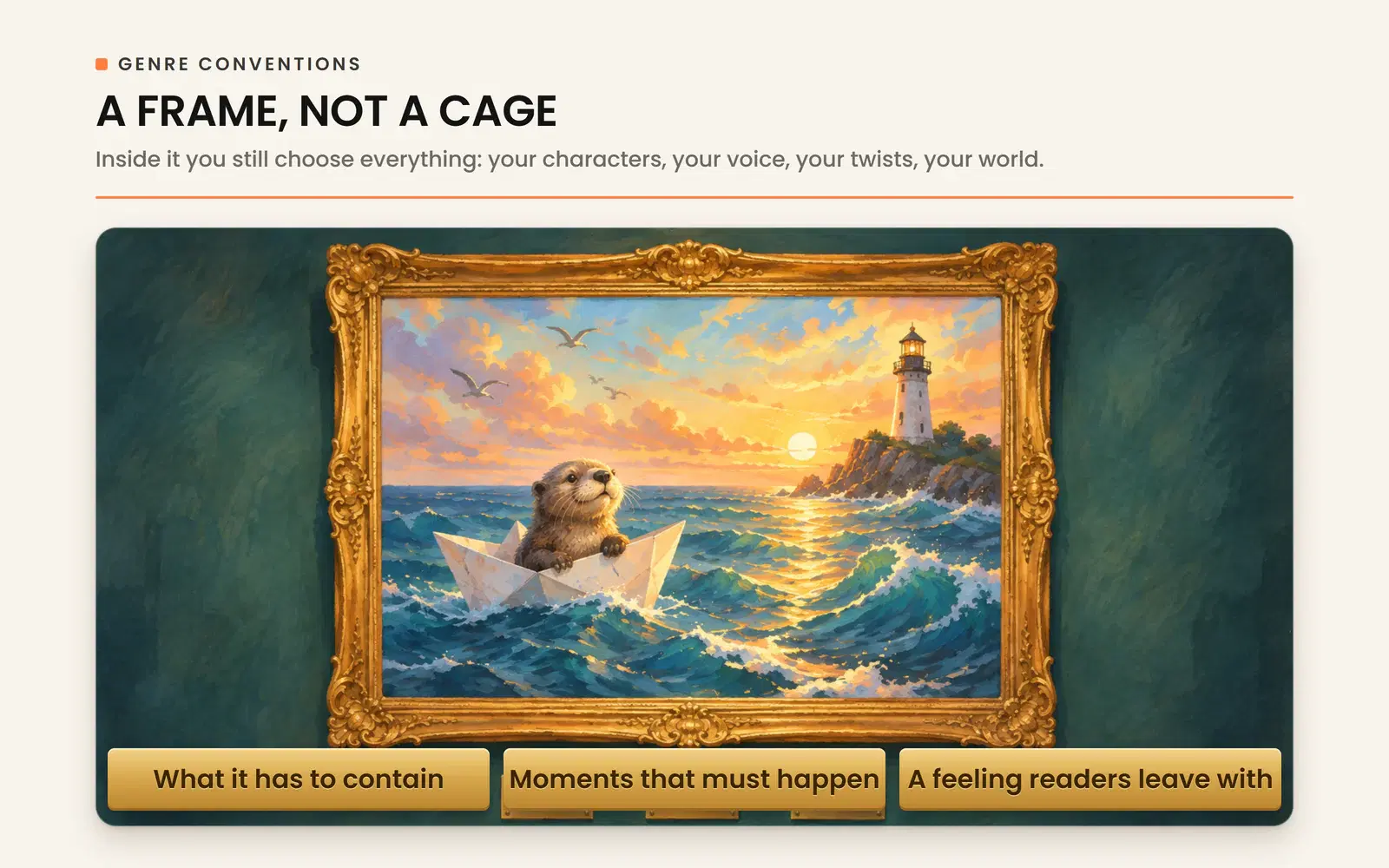
The good news is that conventions aren't a cage. They're a frame, and you still choose everything inside it, from your characters and your voice to your twists and your world.
Why Readers Hold You to Them
Readers hold you to your genre's conventions because they picked your book for a specific experience. Someone reaching for a romance wants the ache and the payoff, and someone reaching for a thriller wants their pulse up. The genre label is how they found you, and it's a promise.
So when your book breaks that promise by accident, readers don't admire the bold choice. They assume the book's broken, even if they can't name the missing piece. They'll just feel let down, and that feeling often ends up in a review.
Picture a manuscript that gets nearly everything right. The writing's strong, the idea's fresh, and the ending quietly breaks the one promise the cover made. It's one of the easiest problems to prevent early, and one of the hardest to fix late.
What Readers Expect From Each Major Genre
Each major genre makes its readers a few specific promises, and those readers check for them on every page. What are some genre conventions you'd spot on almost any bookshelf? Here are the genre conventions examples that matter most for your book, genre by genre.
Here's the whole list at a glance, before we go through each one.
| Genre | What readers expect | When it's missing |
|---|---|---|
| Romance | A central love story and a happily ever after | A love story with a sad ending, sold as a romance |
| Mystery | A crime, a solver, and clues the reader could have caught | A killer named from a clue the reader never saw |
| Thriller | Rising danger, a ticking clock, a hero with a lot to lose | A threat that's handled halfway through the book |
| Fantasy | Magic that follows rules, and power that costs something | A spell that fixes every problem for free |
| Science fiction | One big change to the world, followed through honestly | A huge new idea that changes nothing |
| Horror | Dread that builds, and a threat stronger than the hero | A monster explained away before it gets scary |
Length is on every genre's list too, since a tight thriller and a sprawling fantasy aren't expected to run the same distance. A book that's far longer or shorter than its shelf can look out of place. If you want the actual ranges, here's our guide to novel word count by genre.
Romance Promises a Happily Ever After
Romance readers expect two things from your book. The love story has to be the main plot, not a side dish, and it has to end well, with the couple together and happy.
Romance readers call that ending a happily ever after, or HEA for short. A happy for now ending, or HFN, counts too, where the couple's solid even if their future's still open.
Here's the everyday test. Romeo and Juliet is a love story, but it isn't a romance, because nobody walks away happy. Write a romance where the couple splits on the last page, and you haven't written a daring romance. You've written a different kind of book with a romance cover on it.
Your romance also makes a promise about heat. A sweet romance keeps the bedroom door closed, and a steamy one opens it. Readers choose their heat level on purpose, so a book that swerves from one to the other lets both kinds of reader down.
Romance readers will forgive you a lot, from a slow start to a silly misunderstanding to one brooding look too many. What they won't forgive is a broken ending.
A Mystery Has to Play Fair
A mystery has to play fair with its reader, which means every clue that matters shows up on the page before the solution does. Mystery readers call this fair play, and they take it seriously.
Picture this. Your detective gathers everyone in the library and names the killer, a cousin nobody's met, using a letter your reader never saw. You've solved the case, but you've cheated your reader. Mystery readers read to play along, and a hidden clue rigs the game.
Your mystery also has to land its ending. The crime gets explained, the explanation fits what the reader saw, and it all happens inside the book. Subgenres add their own promises on top. A cozy mystery reader, for instance, expects an amateur sleuth and a murder that happens mostly offstage.
Is a Thriller Just a Faster Mystery?
No, a thriller isn't just a faster mystery. A mystery looks backward at a crime that's already happened and asks who did it. A thriller looks forward at a disaster that hasn't happened yet and asks whether anyone can stop it.
So thriller readers expect different things from your book. The danger has to grow as the story goes on, and your hero needs something real to lose. There also has to be a clock, whether it's a deadline, a countdown or someone closing in. A psychological thriller can swap the ticking bomb for a mind you can't trust, but the pressure still has to climb.
Here's what breaks a thriller. The bomb gets defused halfway through, and the rest of the book is cleanup. Or the villain waits politely while your hero works things out. Thriller readers came for the pressure, and without it the book goes flat, however clever the plot is.
A thriller can even reveal its villain on page one, because the question was never who. It's whether they'll get away with it.
Fantasy Needs Magic That Follows Rules
Fantasy readers will believe almost anything, as long as your world plays by its own rules. If magic works one way in chapter two, it has to work the same way in chapter twenty.
Fantasy readers also expect power to cost something, because a spell that fixes every problem for free doesn't create tension, it kills it. Say your hero can teleport, and readers will fairly ask why she spent half the book walking.
The stakes need to match the size of your world, too. If you've built kingdoms, gods and a thousand years of history, a squabble in one village can feel like a letdown. It works only if that village turns out to matter to everything else.
Subgenres move the stakes around. Epic fantasy readers expect the fate of a world on the line, while cozy fantasy readers expect low stakes and warm company. Hand a cozy fantasy reader a bloody war, and you've broken the promise from the other side.
Science Fiction Starts With One Big What If
Science fiction readers expect you to change one thing about the world and then follow it honestly. What if people could upload their memories? What if the oceans rose? The fun is in the consequences.
That's the big difference from fantasy. Fantasy asks readers to accept a rule, while science fiction asks them to believe the rule makes sense. Then it follows the fallout into jobs, families, laws and ordinary life. Dystopian fiction, a close cousin, starts from a society gone wrong and shows what it costs the people inside it.
Your subgenre sets how much explaining readers want. Hard science fiction readers expect the science to hold up, while space opera readers care more about the adventure than the physics.
What breaks it? A premise that changes nothing. If everyone in your book can read minds but nobody's life looks any different, science fiction readers will notice. They'll notice time travel that fixes everything with no side effects, too.
Horror Needs Dread That Doesn't Let Up
Horror readers expect dread, that sense of something bad coming before you know what it is. Shock and gore can be part of horror, but they aren't the promise. The dread is.
Horror readers also expect the threat to stay stronger than your hero for most of the book. If your monster's easy to beat, you've written an action story.
Here's a classic way horror breaks. Halfway through, a character explains the monster in a tidy speech, and the fear drains out of the room. Horror lives in what your reader doesn't know yet, so explain too much, too soon, and there's nothing left to be afraid of.
What Happens When a Book Ignores Its Genre?
A book that ignores its genre gets hurt in three ways, and none of them has anything to do with how well you write. Your readers feel cheated, agents struggle to place your book, and stores file it where its readers aren't looking.
The frustrating part is that all three can happen to a beautifully written book. These aren't writing problems. They're promise problems.
Readers Feel Cheated, Even When the Writing Is Good
A reader who was promised one kind of book and handed another reacts to the mismatch, not to your sentences. It's like ordering pizza and getting sushi. The sushi might be excellent, but you're still annoyed.
Readers bring habits to each genre. A mystery reader tracks suspects and files away small details, expecting to need them later. Hand that reader a quiet novel about grief that happens to include a death, and those habits have nothing to do. Your book feels like a failure, when it's really a different kind of success that met the wrong reader.
Sell that same novel as literary fiction and it meets readers who love exactly what it does. Nothing in the text changed. Only the promise did.
Nobody Can Name the Books Yours Is Like
Agents and publishers usually ask which recent books yours is like. These are called comp titles in publishing, short for comparable titles, and they tell everyone at a glance who already buys books like yours.
A manuscript that sits between genres often has no honest comp titles. Naming books it doesn't really resemble is worse than naming none, because the first person who reads it will spot the gap. If you can't say what your book is like, it's hard for anyone else to say who it's for.
The same question comes back at the cover and the blurb. Both have to signal a genre at a glance, which is why a thriller cover and a cozy mystery cover look nothing alike. Neither one can signal a genre you haven't picked.
Your Book Lands on the Wrong Shelf
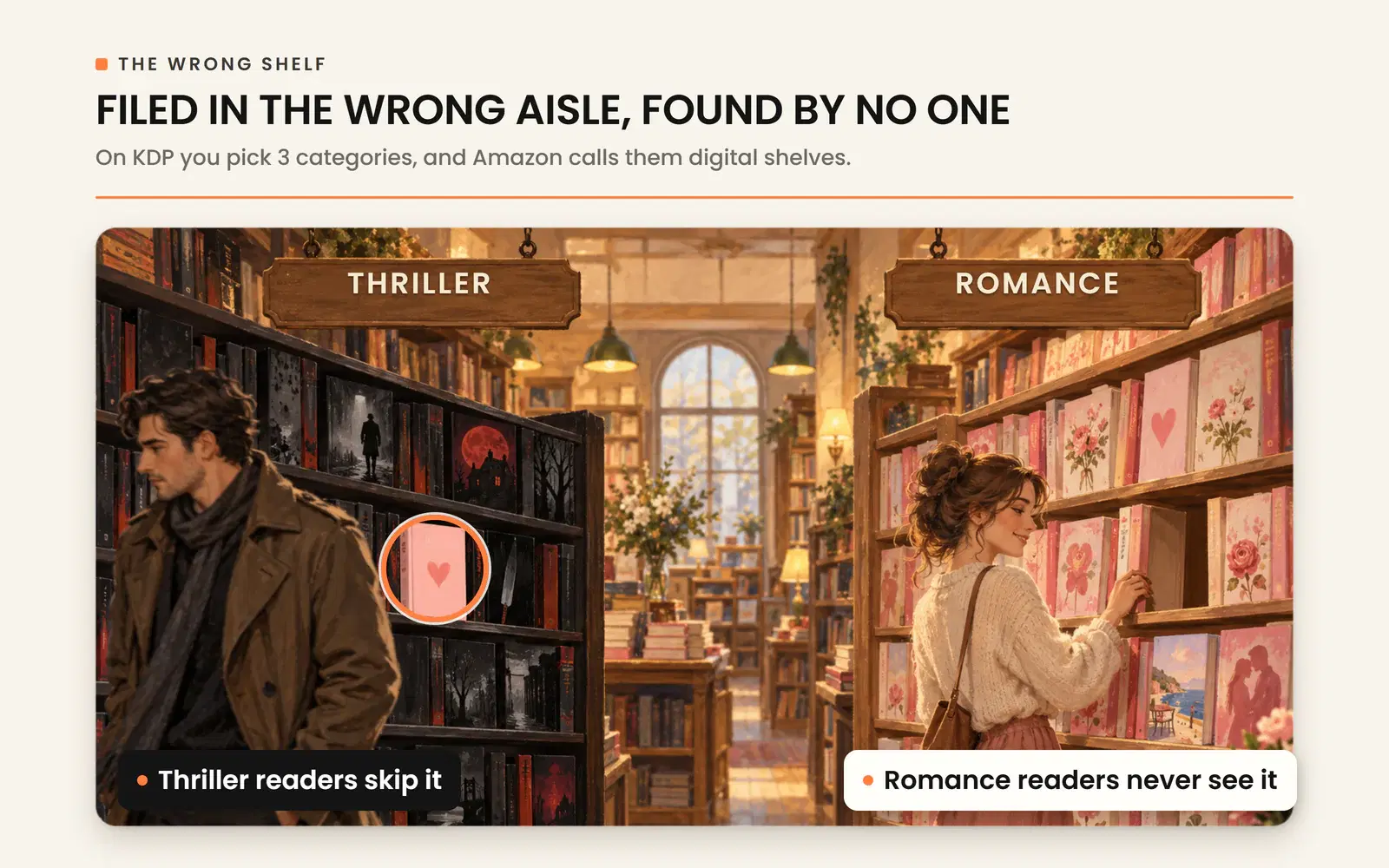
Every book gets filed somewhere before anyone can find it, and you don't get to invent the shelf. When you publish through KDP, you can pick 3 categories for your book. Amazon describes its categories as digital shelves, just like the sections in a physical bookstore.
The wider book trade works the same way, with a standard list of fiction subject headings kept by the Book Industry Study Group. Your book might sit under FICTION / Romance / Contemporary, or somewhere as specific as FICTION / Mystery & Detective / Cozy / Culinary.
A book with a fuzzy genre still gets filed, because something has to be picked. Put a romance in thriller categories, and thriller readers skip it while romance readers never see it. Amazon's help pages even say it doesn't tolerate categorization that misleads readers.
Can You Break Your Genre's Rules?
Yes, you can break most of your genre's rules, as long as your reader sees the rule before you break it. Breaking genre conventions in your novel on purpose is a skill, while ignoring them by accident is a mistake. From the outside they can look alike, but your readers feel the difference.
A twist works like a punchline, because the setup does most of the work. If you want to surprise readers by letting the mentor live, they first have to expect the mentor to die. Skip the setup, and your twist isn't a twist. It's just a thing that happened.
The Few Rules You Can't Break
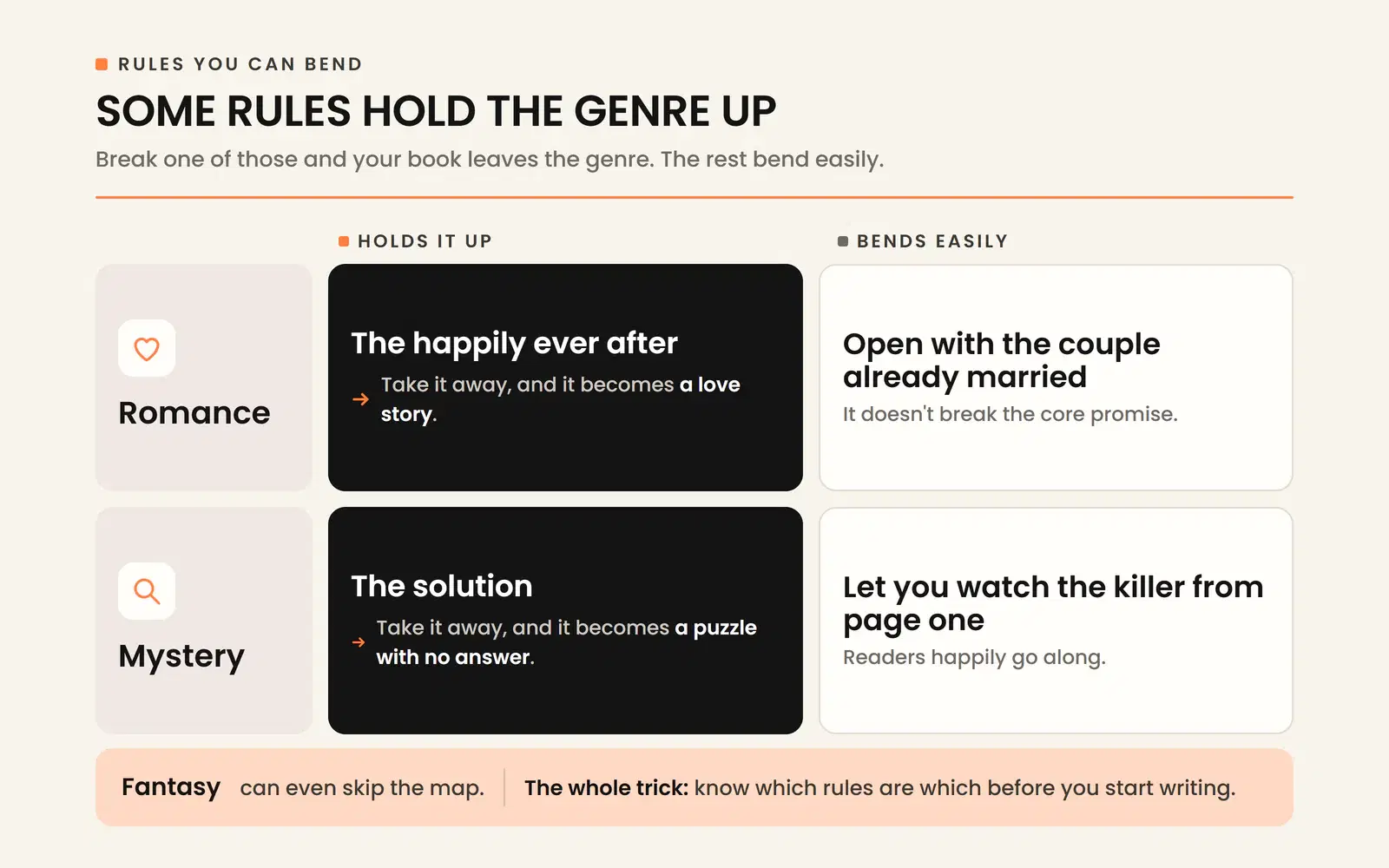
A few rules hold the whole genre up, and breaking them doesn't twist the genre, it leaves it. Take away the happily ever after, and your romance becomes a love story. Take away the solution, and your mystery becomes a puzzle with no answer.
Plenty of other rules bend easily. A romance can open with the couple already married, and a mystery can let you watch the killer from page one. A fantasy can even skip the map. None of those break the core promise, so readers happily go along.
Knowing which rules are which, before you start writing, is the whole trick. It's the difference between a book that surprises readers and one that loses them.
Is Subverting Expectations Bad Writing?
Subverting expectations isn't bad writing on its own. It turns into bad writing when the surprise is the only idea. Writers genuinely disagree about this, and both sides have a point.
One side says surprise is the heart of fiction. A story that gives you exactly what you expected hasn't told you anything new. The other side says a genre is a deal, and the reader has already kept their half. Twist for the sake of twisting, and it feels like a broken promise, not a clever one.
Both sides agree on one thing, though. The rule has to be set up before it's broken. A subversion lands because the reader saw the normal version coming, and that's why the best twists feel surprising and fair at the same time.
Tropes, Cliches and Conventions Are Different Things
Tropes, cliches and conventions get mixed up all the time, but they're three different things. A convention is something your genre needs. A trope is a familiar pattern you can choose to use. A cliche is a trope that shows up with nothing new.
Mixing them up sends you off to fix the wrong problem, so here's how the most common terms compare.
| Term | What it means | Quick example |
|---|---|---|
| Convention | Something a genre's readers expect every time | A mystery gets solved by the end |
| Trope | A familiar pattern readers recognize and can name | Rivals forced to work together |
| Cliche | A trope used with nothing new added | The wise mentor who dies right on cue |
| Archetype | A broad character role found in stories everywhere | The mentor, the trickster, the hero |
| Stereotype | A flat assumption about a group, used instead of a real character | A character who's a label, never a person |
| Theme | The big idea your book explores | Whether people can really change |
What Are Tropes in Books?
A trope is a familiar pattern that readers recognize and can name. So what are tropes in books, in plain terms? They're the situations, character types and turns that keep showing up across a genre. Think enemies who fall in love, the chosen one, or the heist crew gathered one expert at a time.
Tropes in writing aren't good or bad by themselves. They're building blocks, so calling your book tropey tells you what it's made of, not whether it's any good.
Tropes differ from conventions in one big way. A convention is required, and a trope is optional. Your romance needs a happily ever after, but it doesn't need enemies to lovers.
What's the Difference Between a Trope and a Cliche?
A cliche is a trope that shows up with nothing new. The pattern's the same, but there's nothing in it the reader hasn't seen before. So what's the difference between a trope and a cliche? It's the handling, not the idea.
The whole tropes vs cliche question comes down to one quick check. Describe the pattern in a sentence, then ask what your version adds. If the honest answer is nothing, it'll read as a cliche. If you can name something specific, like a cost, a reason or an unusual outcome, it'll read as a trope.
That's good news for your manuscript, because you don't need a brand new idea. You need a reason for the familiar one to be there.
Where Archetypes, Stereotypes and Themes Fit
An archetype is a broad role that turns up in stories everywhere, like the mentor or the trickster. It sits one level above a trope. The mentor is an archetype, but the mentor who dies early, so your hero has to carry on alone, is a trope.
A stereotype is a different kind of problem. It's a flat assumption about a group of people, dropped in where a real character should be. A cliche can be revived with a fresh twist, because the pattern underneath is fine. A stereotype can't, because the flattening is the problem.
A theme is the big idea your book explores, like whether people can really change. Conventions are what your book has to contain, and theme is what it's about. Two romances can keep every convention in the genre and still say opposite things about love.
Are Tropes Good or Bad?
Tropes are neither good nor bad, they're tools. So, are tropes good or bad for your book in particular? That depends on whether you give them something new to do.
A trope is a promise readers recognize, and recognition helps the right reader find you. Plenty of readers go looking for a pattern they already love, like two rivals forced to share a cabin. A book built from no familiar patterns at all isn't more original, it's just harder to describe.
The problem is never the trope itself. It's the trope arriving unchanged. Readers don't mind recognizing the shape, but they do mind recognizing it and finding nothing inside.
There's a practical side, too. A book with clear patterns can be described in one sentence to a cover designer, a marketer and a reader. A book that fights that sentence makes every one of those conversations harder.
When a Trope Is Actually Worn Out
A trope is worn out when its setup gives away the ending. Common isn't the same as worn out. Common tropes in writing, like found family or rivals forced to team up, aren't a problem at all. Their familiarity is part of the fun, and cutting them to look original takes away what your reader came for.
Overused tropes in writing share one habit, which is that the setup announces the outcome. Here are four classics.
- The prophecy that names your hero as the only one who can win. It gives away the ending in chapter two.
- The mentor who dies early to push the hero out the door. Readers see it coming from the first kind word.
- Amnesia that hides facts from the reader, not just the character. It delays an answer without creating a real question.
- The dream that undoes everything. It takes back the price the story just made your reader pay.
Most lists of tropes to avoid in writing stop there. The more useful move is to fix the predictability, not ban the pattern. Let the prophecy be true and have your hero refuse it anyway, or let the mentor live and turn out to be wrong.
That's what subverting tropes really means. You keep the familiar shape and change what it delivers. Overused tropes in fiction are rarely a sign to throw an idea out, just a sign it needs one more decision.
Fantasy Tropes to Avoid, Unless You Change Them
The fantasy tropes to avoid are the ones that reward your hero for nothing. The hidden royal bloodline is the classic. Your hero turns out to be the lost heir, so they win by birth, not by choice. That can make every struggle before the reveal feel fake.
The dark lord who's evil just because is another one. A villain with no goal your reader could understand has no pull. Give him a reason, even a terrible one, and he stops being wallpaper.
The farm boy with a secret destiny, the wizard who knows everything but explains nothing, the quest for magic objects collected one per chapter. All of them can still work. Each one just needs a cost, a choice or a surprise that the usual version doesn't have.
Blending Two Genres in One Book
A book can blend two genres, and lots of good ones do. One genre still has to lead, because your book has to be filed somewhere first. Genre blending doesn't average two sets of promises. It stacks a second flavor on top of a complete first one.
Here's a quick way to tell which genre leads. Ask which broken promise would leave your reader feeling cheated. A romance set on a spaceship is a romance first if the couple's ending is the book's ending. It's science fiction first if the big change to the world is what resolves the story.
A detective in a fantasy world works the same way. If readers get a fair shot at the clues, it's a mystery. If not, it's a fantasy with a detective in it. Cross genre books get into trouble when they keep neither set of promises fully.
The book trade's standard subject list makes this call for two common blends. Its science fiction section sends romance over to FICTION / Romance / Science Fiction. Its thriller section does the same, pointing romance to FICTION / Romance / Suspense.
Blends are also where genre knowledge matters most, because you're keeping two sets of promises at once. If your book is a romance with a murder at its heart, it helps to work with book writers for hire who know both genres inside out.
What If You Can't Name Your Genre?
If you can't name your book's genre, you've got a positioning problem, not a creative one. Your book's rarely too original to categorize. More often, you're describing what it's about instead of what it does.
Genre comes from what a book does. What does your reader want to happen? What's standing in the way? What does the book owe them by the last page? A book about grief isn't a genre. A book where a woman investigates her sister's death and names the killer is a mystery that happens to be about grief.
The published books yours is most like can help, too. If they all sit on one shelf, that's probably your genre.
This is one of the most common first manuscript mistakes we see, and it's rarely about talent. New to all this? Our beginner's guide to writing your first book walks through the other early decisions. It also explains why the writer you work with should know your genre.
What Writing to Market Really Means
Writing to market means choosing your genre first and writing the book its readers are looking for. The other way round is writing first and hunting for a shelf afterward. The phrase gets used as an insult sometimes, but it doesn't have to be one.
It doesn't mean copying whatever sold last month, either. It means knowing what your chosen shelf's readers are there for, and making sure your book gives it to them.
The honest case for it is simple. When you know your genre's promises before chapter one, you build them in from the start. You're not bolting a happy ending onto a book that was heading somewhere else. That saves you the most painful kind of rewrite, the structural kind.
The honest limit is just as simple. Writing to market tells you what your book has to include. It never tells you what'll make it worth reading. Two books can keep every promise in the same genre, and readers will only finish one of them.
Think of your genre as the ticket in, since it gets your book through the door. Your characters, your voice and your ideas are what keep readers in their seats.
How We Handle Your Genre From Day One
At Book Writing US, we settle your book's genre before the first chapter gets written. A genre's promises shape the structure, the length and the ending all at once. That's why genre conventions in writing belong in the outline, not the edit. Fixing a genre after the draft is done isn't editing. It's rewriting.
The questions that matter at that stage are simple ones. Which genre is your book promising? What does that genre's reader need to get? Which rules, if any, will your book bend, and how will it set them up first?
Romance, thrillers and mysteries are all genres our professional book writers for hire specialize in, alongside memoir, self help, business and health books. Bring us an idea, an outline or a draft that's drifted off course. We'll help you find the genre it's promising, then write the book that keeps that promise.
Frequently Asked Questions
What is an obligatory scene?
An obligatory scene is a moment your genre's readers expect to see on the page, not hear about afterward. In a mystery, it's the reveal where the culprit gets named. In a romance, it's the moment the couple finally commits. Summarize it instead of showing it, and your readers feel shortchanged.
Does literary fiction have genre conventions?
Yes, literary fiction has conventions too, it just doesn't advertise them. Its readers expect a rich inner life, prose worth slowing down for and room for ambiguity. A neatly tied ending can feel as wrong in literary fiction as an unsolved crime feels in a mystery.
Should you avoid tropes completely?
No, avoiding every trope won't make your book more original. It'll just make it harder to describe and harder for the right reader to find. Aim to give each trope you use something your reader couldn't predict from the setup.
Are middle grade and young adult genres?
No, middle grade and young adult are age groups, not genres. They tell you who a book is for, while genre tells you what kind of story it is. A young adult fantasy and a young adult romance share an age group but make very different promises.
What is a micro trope?
A micro trope is a tiny, specific pattern inside a bigger one, small enough that readers ask for it by name. Only one bed at the inn is a micro trope. Rivals forced to travel together is the bigger trope around it.
Are character tropes different from plot tropes?
Yes, a character trope is a type of person, like the reluctant mentor or the narrator you can't trust. A plot trope is a type of event, like a heist gone wrong or a false accusation. Feedback about tropes is much easier to act on once you know which kind it means.
- What Are Genre Conventions in Writing?
- What Readers Expect From Each Major Genre
- What Happens When a Book Ignores Its Genre?
- Can You Break Your Genre's Rules?
- Tropes, Cliches and Conventions Are Different Things
- Are Tropes Good or Bad?
- When a Trope Is Actually Worn Out
- Blending Two Genres in One Book
- What Writing to Market Really Means
- How We Handle Your Genre From Day One
- Frequently Asked Questions