Novel Word Count by Genre, and the Ranges Publishers Actually Expect
Short Answer: Most novels run 70,000 to 100,000 words, and anything from 40,000 words up counts as a novel. Your genre moves that number more than anything else. A thriller usually lands around 80,000 to 90,000 words, fantasy often passes 100,000, and a picture book needs only a few hundred. If it's your first book, aim for the middle of your genre's range.
You've got a story, maybe even a finished draft, and one question keeps nagging at you. How long should this book be? Look up novel word count by genre and you'll find plenty of answers. The catch is that they don't all agree.
That's worth sorting out, because word count is what decides the size of your book. It sets how many pages your book prints to and how thick it looks on a shelf. It sets how long your book takes to read. It even sets how much work goes into writing it.
This guide covers the main fiction genres, nonfiction and children's books. You'll see where the guides agree, where they don't, and what to aim for. You'll also see what a first-time author can expect, and what it means when your book runs very long or very short.
How Many Words Is a Novel?
A book counts as a novel once it reaches 40,000 words. That's the novel word count minimum, and it isn't random. It's the line the Science Fiction and Fantasy Writers of America uses in its Nebula Award rules, and the popular writing guides use the same floor.
So how long should a book be to be considered a novel? At least 40,000 words. But counting as a novel and feeling like one aren't the same thing.
Writing guides suggest aiming for at least 50,000 words if you plan to sell your novel. At 42,000 words, a romance can feel brisk and satisfying. Give an epic fantasy the same length and your readers may feel short-changed.
Most novels land well above that floor, somewhere between 70,000 and 100,000 words. So ask how many words in a novel, and you'll really get three answers.
- 40,000 words makes your book a novel.
- Around 50,000 words makes it feel like one.
- 70,000 to 100,000 words is where most novels actually land.
How long should a book be in words, then? Start from those three numbers. Then check your genre, because that's what moves your target the most. It's also the honest answer to how many words should a book be, since there's no single number for every story.
Word Counts for the Main Fiction Genres
Your genre sets the range your book gets judged against. Readers who love a genre know roughly how long its books run, even if they've never counted a word. Agents and editors know it too.
You'll often see these numbers called the average novel word count by genre. They're really ranges, and the guides don't all give the same ones. So the table below shows the book word count by genre where the guides overlap. That's the safest place for your book to land.
| Genre | Word count to aim for | What shapes the length |
|---|---|---|
| Thrillers and mysteries | 80,000 to 90,000 | Fast pace keeps them tight |
| Romance | 80,000 to 90,000 | Varies a lot by subgenre |
| Fantasy and science fiction | 100,000 to 115,000 | World building takes room |
| Historical fiction | 80,000 to 100,000 | The past needs room on the page |
| Horror | 70,000 to 90,000 | Small casts and tight settings |
| Literary fiction | 80,000 to 100,000 | Judged on the writing, can run shorter |
| Contemporary fiction | 70,000 to 90,000 | The default for modern, everyday stories |
| Young adult | 55,000 to 80,000 | A little shorter than adult fiction |
None of these are hard rules, and plenty of good books sit outside them. But if you're writing your first novel, landing inside your genre's range means your book has fewer questions to answer before anyone reads it.
What if your book mixes genres, like a romance with a mystery at its heart? Use the range for the shelf it'll sit on, the section a bookstore or an online store would file it under. That's the range readers in that aisle will expect.
Thrillers and Mysteries Stay Tight
How many words in a thriller novel? Usually 70,000 to 100,000, and most guides agree on 80,000 to 90,000. Mysteries and crime novels sit in the same range.
The reason is pace. A thriller runs on suspense, twists and momentum. Every extra chapter is a chance for that momentum to slip. That's why thriller writers are usually told to stay under 100,000 words.
Mysteries need a little more room than you'd think. You've got suspects to introduce and clues to plant, and your reader needs time with both. But pace still wins. A mystery that stops to explain itself loses the reader who came to solve it.
Real books show the pattern. Shutter Island runs 81,666 words. Gone Girl runs 145,719, which proves the rule can bend. But that's a famous exception, not a plan for your first thriller.
Romance Depends on the Kind You Write
Most guides agree on 80,000 to 90,000 words for a romance novel, and plenty of well-known romances sit right around there. Nicholas Sparks's The Choice runs 79,950 words. But romance changes a lot depending on the kind you write, and you'll see it put anywhere from 40,000 to 100,000 words.
Category romance is the big exception. These are shorter romances published as part of a series line, and they follow a set formula. The focus stays on the couple, with no subplot. Some lines cap a contemporary romance at 50,000 to 55,000 words and ask for 70,000 to 75,000 for a historical one.
Other romance has more room. A contemporary romance or romcom from a traditional publisher can carry subplots and a bigger cast, but it's usually kept under 90,000 words. Historical romance runs longer, and sweeping historical sagas can pass 120,000.
So before you settle on a number, pin down which kind of romance you're writing. If you're aiming at a particular publisher or line, their guidelines beat any general range.
How Many Words Should a Fantasy Book Be?
Most fantasy and science fiction runs 90,000 to 120,000 words, and 100,000 to 115,000 is where the guides overlap. Epic fantasy can stretch to 150,000. For a feel, Ender's Game runs 100,609 words and The Golden Compass runs 112,815, both right inside that overlap.
World building is the reason. You're not only telling a story, you're building the place it happens in, with its own history, rules and maybe magic. All of that needs room on the page before your plot can really move.
Science fiction works the same way. A space opera with lots of planets, factions and points of view runs longer than a close, single-character story. Sci-fi that leans literary tends to run shorter.
So how many words should a fantasy book be if it's your first? Stay off the top of the range. One guide puts the ideal at about 120,000 words and treats 150,000 as the absolute limit. Longer books cost more to print, pace is harder to hold across that many pages, and a very long book is tougher to sell in other languages.
Historical Fiction Needs Room for the Past
Guides usually put historical fiction at 80,000 to 100,000 words, a little longer than most genres. The extra length gives you space to bring an unfamiliar time to life.
Your reader can't picture another century the way they picture their own street. So the details of that world have to be built on the page, a lot like fantasy.
Still, your story comes first. For a debut, one guide suggests staying at or under 100,000 words. People who want a history lesson can buy a history book. Your reader came for the characters and the plot.
If your story is a romance set in the past, check the romance guidance above too. Historical romance has its own numbers, and category lines set them tightly.
Horror Keeps the Cast Small
Guides usually put horror at 70,000 to 100,000 words, and 70,000 to 90,000 is where they overlap.
Horror tends to keep a small cast in a tight space, and that's where a lot of the fear comes from. It also means a long horror novel can start to feel repetitive. Tension has to keep climbing, so every scene has to earn its place.
Some favorites show how lean horror can be. The Haunting of Hill House runs just 66,691 words, and Bird Box runs 78,608. The best-selling Mexican Gothic comes in around 93,000.
The biggest names in horror can write at any length they like. If you're new, it's smarter to stay close to the genre's usual range.
Literary and Contemporary Fiction Sit in the Middle
Guides put literary fiction at 80,000 to 100,000 words and contemporary fiction at 70,000 to 90,000. Both sit near the middle of the fiction range.
Literary fiction is judged on the writing itself, so it gets a little more freedom. Literary editors tend to ask whether a manuscript could win a major prize, while commercial editors look for pace and hooks. That's why a well-crafted literary novel can be as short as 60,000 words.
Editors still want a literary novel to hold a reader, though, so a draft that's well past 100,000 words will face questions. Life of Pi runs 98,783 words, close to the top of the range.
Contemporary fiction is the default for stories set in the modern, everyday world. Not sure which genre your book fits? If it's a modern story about ordinary life, 70,000 to 90,000 words is a sensible target.
Young Adult Runs a Little Shorter Than Adult Fiction
Young adult novels usually run 55,000 to 80,000 words. The main guides all cover that stretch, which makes it one of the safest targets here. The Perks of Being a Wallflower runs 60,438 words, and Eleanor & Park runs 78,179.
YA is written for readers aged 12 to 18, and it's often a bit shorter than adult fiction, though not by much. Fantasy and dystopian YA can run longer to make room for the world. The Hunger Games, for example, comes in at 99,750 words.
If your readers are younger than 12, you're into middle grade, which has its own numbers in the children's section below.
Nonfiction Usually Runs Shorter Than Fiction
Most nonfiction runs 50,000 to 80,000 words, a bit shorter than the typical novel. Your subject decides where your book lands in that range.
Here's how the main types usually run.
- Memoir, 80,000 to 90,000 words.
- Business, psychology and history, 70,000 to 80,000 words.
- Self-help and how-to, 40,000 to 50,000 words.
- Biography, 80,000 to 200,000 words.
Nonfiction also has more give than fiction. A focused self-help book can be far shorter than the range, while a big-idea history can run far longer. Sapiens, for example, runs over 120,000 words. What matters is that your length fits what your book is trying to do.
How Long Is a Memoir?
Most memoirs run 80,000 to 90,000 words. You'll see anything from 60,000 to 100,000 quoted, and 80,000 to 90,000 is where those numbers overlap. That makes it the safest word count for a memoir.
Plenty of well-known memoirs land right there. Educated runs 83,424 words, and Eat, Pray, Love runs 87,216.
A memoir isn't your whole life story. It's one part of it, like an illness, an addiction, your faith, or being a parent. That focus is what keeps it readable. Editors want a memoir to pull the reader along the way a good novel does.
A literary memoir can run a little shorter if the writing is truly outstanding. Going short is rarely an advantage in memoir, though.
Length can sink a memoir before anyone reads a page. At one writers' conference, a writer shared that their memoir ran 270,000 words. An editor in the room had to tell them the truth. No agent would read past that number.
A biography is different, because it covers a whole life. That's why it can run much longer than a memoir.
Self-Help, Business and Health Books
Self-help and how-to books usually run 40,000 to 50,000 words, the shortest of the main nonfiction types. Some well-known ones are shorter still. The War of Art runs about 25,000 words.
These books stay short because they're built around one big idea and meant to be used, not just read. When a self-help draft runs long, it's worth asking whether a second big idea has crept in.
Business books sit in the standard nonfiction range. One guide puts business titles at 70,000 to 80,000 words, while the general nonfiction range starts at 50,000. Health and wellness books follow that same general range, and the more research and sources your book carries, the closer it tends to sit to the top.
How Many Words Should a Children's Book Be?
How many words should a children's book be? It depends on the type of book and the age of the child. The younger your reader, the shorter the book, from a couple of hundred words in a board book to tens of thousands in middle grade.
Children's books are also where writing guides disagree the most. So the word counts below are the stretch where most of them overlap. Land there and your book looks the right size to anyone who checks.
| Book type | Reader age | Word count to aim for |
|---|---|---|
| Board book | 0 to 3 | Up to 200 |
| Picture book | 3 to 8 | 400 to 500 |
| Early reader | 5 to 8 | 1,000 to 3,500 |
| Chapter book | 5 to 10 | 5,000 to 10,000 |
| Middle grade | 8 to 12 | 30,000 to 40,000 |
Notice that the ages overlap. A 6-year-old might read a picture book, an early reader and a chapter book in the same week. That's why the type of book matters more than the exact age of your reader.
Board Books Use the Fewest Words
Board books use the fewest words of any book, usually a couple of hundred at most. One guide says around 300 words, another says 25 to 200. Staying under 200 keeps you safely short either way.
Board books are made for babies and toddlers, with thick pages built to survive little hands. Each page has room for a word or a short line, not a paragraph. If your idea needs more words than that, it may really be a picture book, which gives you a bit more room.
Picture Books Are Made to Be Read Aloud
Most guides put a children's picture book word count somewhere between 250 and 800 words, and some picture books have no words at all. The guides overlap at 400 to 500 words, so that's a smart target.
A picture book is read aloud to a child who can't read yet, and the pictures carry much of the story. So your words have to be few, easy to follow, and work hand in hand with the art.
Because the art carries so much of the story, your words don't need to describe what's already in the picture. That's a big reason picture book texts stay so short.
Some picture books rhyme. Rhyming text is hard to translate, though, so many publishers prefer picture books that don't.
Early Readers Are Built for Kids Learning to Read
Early readers usually run 1,000 to 3,500 words, and around 2,000 is common. You'll see numbers as low as 200 quoted, but most guides meet in that 1,000 to 3,500 stretch.
The big difference from a picture book is who's reading. With an early reader, the child reads the book, not a grown-up. So the real limit isn't the page count. It's the words themselves, which have to be simple enough for a new reader to manage alone.
If your early reader starts climbing past 3,500 words, it's probably turning into a chapter book.
Chapter Books Bridge Early Readers and Middle Grade
Chapter books usually run 5,000 to 10,000 words, for readers around 5 to 10. Some guides stretch them to 20,000 words, and one folds them into middle grade entirely.
Chapter books are often a child's first longer books, split into short chapters so the length feels doable. Those short chapters matter as much as the total. They give a young reader a natural place to stop and a reason to pick the book back up.
Chapter books overlap with middle grade, and the line between the two is blurry. If your manuscript sits around 18,000 words, you're in that gray zone, and it's worth knowing before you pitch it.
Middle Grade Has the Widest Range
Middle grade novels, written for readers 8 to 12, run anywhere from 20,000 to 60,000 words. The safe middle is 30,000 to 40,000 words. Charlie and the Chocolate Factory runs 30,644 words, right in that middle, while Escape from Mr. Lemoncello's Library runs 47,493.
The range is wide because the readers are. An 8-year-old who's just started reading alone and a 12-year-old who's nearly ready for YA want very different books.
Don't measure yourself against the famous exceptions, either. The Harry Potter books run far longer than a typical middle grade novel. They're outliers, not the rule.
How Many Words Is a Novella?
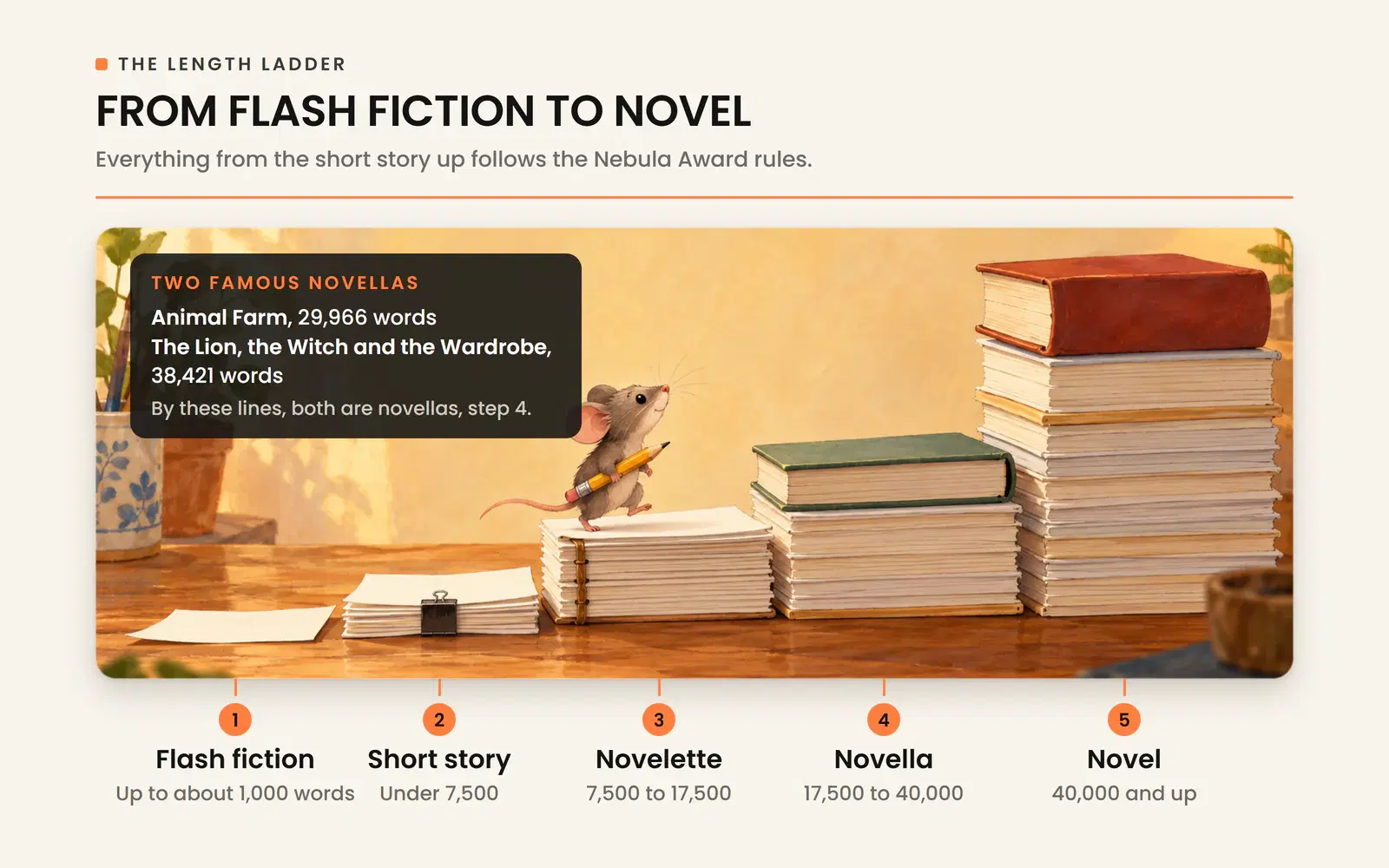
A novella runs 17,500 to 40,000 words. It's longer than a short story and shorter than a novel. Here's the full ladder, shortest to longest. Everything from the short story up follows the Nebula Award rules.
- Flash fiction, up to about 1,000 words.
- Short story, under 7,500 words.
- Novelette, 7,500 to 17,500 words.
- Novella, 17,500 to 40,000 words.
- Novel, 40,000 words and up.
The novelette is the one most people haven't heard of. It sits between a short story and a novella, and some guides skip it entirely.
Plenty of famous books sit below the novel line. Animal Farm runs 29,966 words, and The Lion, the Witch and the Wardrobe runs 38,421. By these lines both are novellas, and nobody holds it against them.
The novella is where guides split again. One stretches short stories to 30,000 words and novellas to 50,000. So a 25,000-word story is a novella by the Nebula rules and a short story by that guide.
So how many words in a novella, if you want to be safe? Keep it between 30,000 and 40,000, where both views overlap. And if your book lands between 40,000 and 50,000 words, you're in a gray zone where one guide still calls it a novella.
Why Do Word Count Guides Disagree?
Writing guides disagree because each one draws on different books, different editors and different corners of the market. Middle grade shows it best. Look it up and you'll find ranges like these.
- 20,000 to 55,000 words.
- 22,000 up to about 60,000 words.
- 25,000 to 40,000 words.
- 30,000 to 50,000 words.
That's four answers to one question, and none of them is exactly wrong. Word count guidelines by genre are rules of thumb, not laws. Each guide is describing the books it knows best.
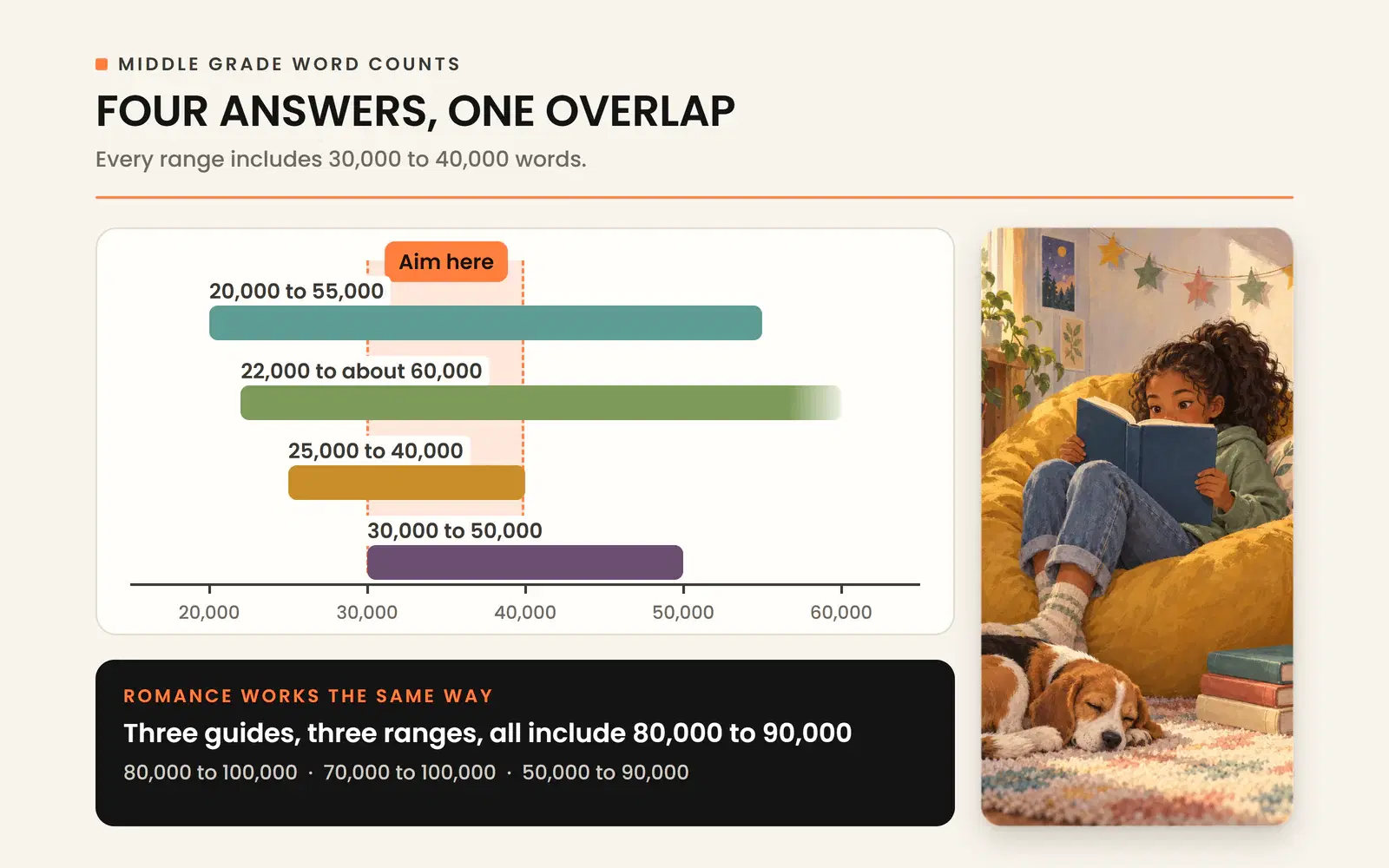
So here's the smart move. Aim for the overlap. Every range above includes 30,000 to 40,000 words. Land there and your book looks the right size to an agent, an editor or a reader, whichever guide they have in mind.
This matters most when you pitch. You can't know which guide the person reading your pitch trusts, and the overlap covers you either way.
That's what the "word count to aim for" column in both tables shows. It's the stretch where the guides overlap.
Adult genres split less than children's books, but they still split. Romance gets 80,000 to 100,000 words in one place, 70,000 to 100,000 in another and 50,000 to 90,000 in a third. All three include 80,000 to 90,000.
Word Count Decides the Size of Your Book
Your word count decides how big your finished book is. It sets the page count, the thickness of the spine, how long your book takes to read and what it costs to print.
Readers notice size before they read a word. Someone browsing for a light, fast mystery is unlikely to grab a 1,000-page brick. Readers in general are less likely to pick up an 800-page novel than one of 300 to 400 pages, because a long book asks for a bigger time commitment.
Publishers notice cost. Longer books cost more to print, mostly because of paper, so publishers weigh word count before they take a book on. A very long book looks like a bigger risk.
Self-publishing doesn't make any of this go away. There's no agent to say no, but a very long book still costs more per copy to print, and fewer readers will stick with it to the end.
Length also touches every step after the draft. A longer book takes longer to edit, proofread and lay out, so your whole schedule stretches with it.
How Many Pages Is 80,000 Words?
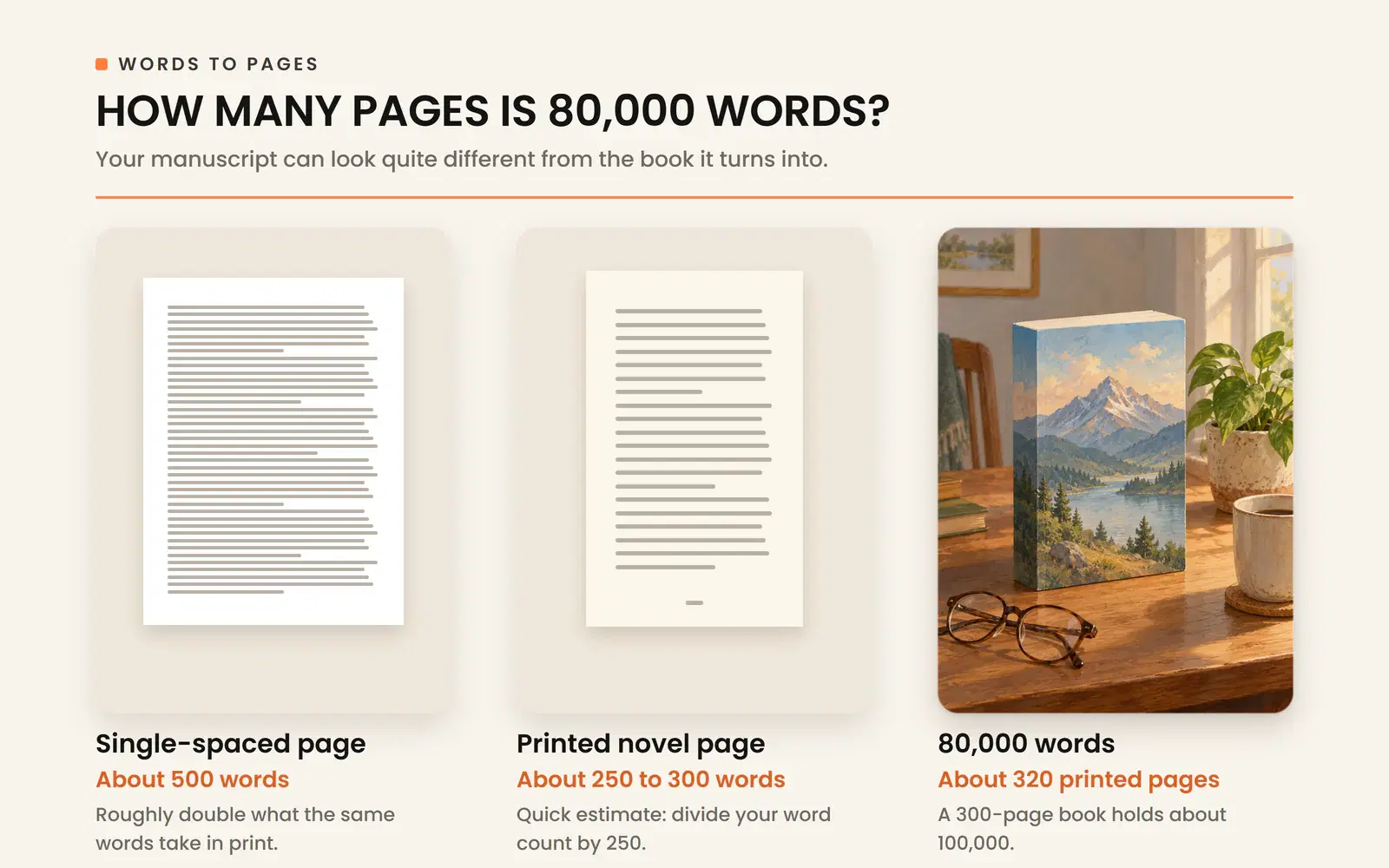
An 80,000-word novel comes to roughly 320 printed pages. A printed novel page usually holds about 250 to 300 words, sometimes up to 350. Dividing your word count by 250 gives you a quick page estimate.
Going the other way, a 300-page book holds about 100,000 words. That's a slightly different ratio, and it shows how much the layout matters. Font, page size, margins, line spacing and pictures all change how many words fit on a page.
Don't judge by your manuscript pages, either. A single-spaced page typed in 12-point font holds about 500 words, roughly double what the same words take up in print. In a standard double-spaced manuscript, 80,000 to 90,000 words comes to roughly 300 pages. So your manuscript can look quite different from the book it turns into.
What Word Count Should Your First Book Aim For?
Aim for the middle of your genre's range, and stay out of the top of it. A first book from a new author gets judged against tighter limits than the next book from a famous one.
Traditional publishers usually won't take on a first novel over 100,000 words from a new author. It isn't a hard rule, but you'll hear it a lot. One editor who used to work at literary agencies put it plainly. A 120,000-word manuscript rarely made it out of the slush pile, the stack of unrequested submissions. Even a strong long book takes a lot of convincing before an editor will buy it.
Your genre changes the math. A 120,000-word fantasy can be perfectly normal. A 120,000-word debut thriller could make an agent nervous before they read a page.
What about the famous long books? Most of them came out after their authors already had big audiences. Harry Potter and the Order of the Phoenix runs 257,045 words, but it was the fifth book in a series readers already loved. There are exceptions, like Outlander, a debut that ran about 305,000 words. They're exceptions, though, not a plan.
Here's the good news. You don't need an exact number before you start. Your genre and a rough target are enough. When we plan a first book with an author, length comes up early, right alongside what the book is about and who it's for. That's how book writing services for aspiring authors should work. The target gets set with you, not handed to you.
If you're still at the planning stage, our guide to writing your first book walks through the rest, from choosing a writer to planning your budget and timeline.
What If Your Book Runs Too Long or Too Short?
A book that lands far outside its genre's range is usually telling you something about the story, not just the number. Way over often means there's more than one story in there. Way under often means parts of your story haven't had room yet.
When a manuscript runs tens of thousands of words long, it usually turns out to be one of these.
- Two books sharing one cover.
- A subplot that grew bigger than the story needs.
- More characters than the plot can carry.
If it's the first one, you're facing a bigger question than length. You may be deciding whether your story should be a series or a standalone, and that choice changes the word count question completely.
A short manuscript is rarely a tight one. More often, big moments get a paragraph when they need a scene, or the middle of the story is thin. One former managing editor at a publisher summed it up well. When a novel is very short or very long, the writer often doesn't quite have a grip on the story yet.
That's why the number is a symptom, not the problem. Chopping or padding to hit it treats the symptom and leaves the cause. Finding the cause takes a clear outside read of the whole manuscript, and it's very hard to give your own book that kind of read.
Both happen to plenty of first-time authors. Neither one means your book is bad. It means the plan needs another look.
Word Count Sets the Size of the Writing Job
When a professional team writes your book, the word count is the size of the job. It decides how many chapters get planned, how much research goes in, how long drafting takes and how many rounds of review fit the schedule.
A 55,000-word romance and a 140,000-word epic fantasy aren't the same project at different lengths. The longer book has more characters to track, more timeline to keep straight and more places for small details to slip. That's why length is one of the main things that shapes what your book costs to write and how long it takes.
So what can you expect if it's your first book? You don't need an exact number to get started. Bring your genre and a rough sense of the size you want. Our professional book writing services start there, then build the outline with you around that target.
Not sure of your genre yet? That's fine too. Working out where your book sits is part of the first conversation, because it sets the range everything else is planned around.
At Book Writing US, we've been writing books with authors for more than a decade, first books and fifth books alike. We write across genres, including self-help, business, health and wellness, memoir and biography, thrillers and mysteries, and romance and contemporary fiction.
Tell us your genre and the size you have in mind, and we'll show you what your book takes.
Frequently Asked Questions
Is 50,000 words a novel or a novella?
It's a novel. Anything from 40,000 words up counts as a novel under the Nebula Award rules and most writing guides. It's on the short side, though, and one guide stretches novellas all the way to 50,000. For most adult genres, you'll want more room.
Is 60,000 words enough for a YA novel?
Yes. 60,000 words sits comfortably inside the usual young adult range, which runs from about 45,000 words at the low end to 90,000 at the high end. It's a solid length for most YA. Fantasy YA often runs longer to make room for world building.
How long is a New Adult novel?
Usually 50,000 to 90,000 words, about the same as young adult. The difference is the characters, not the length. New Adult bridges YA and adult fiction, with college-age characters facing things like leaving home and starting a first job.
Is upper middle grade longer than lower middle grade?
Yes. Books for the younger end of middle grade sit close to chapter book length, near the bottom of the range. Books for readers near 12 run longer, and a few go a little past 55,000 words. Your reader's age is the best guide to where your book should land.
How many words should a chapter be?
There's no set length, and you don't need one. A chapter runs as long as the piece of story it holds, so chapter length changes from book to book and often within the same book. Your total word count matters far more, and that's what your genre's range is for.
How many words is a commercial novel?
About 90,000 words is a good benchmark. The novel word count average sits close to that, and best-selling novels average about the same. Commercial fiction just means books written for a wide audience, like most thrillers, mysteries and romance, so your genre's range still applies.
- How Many Words Is a Novel?
- Word Counts for the Main Fiction Genres
- Nonfiction Usually Runs Shorter Than Fiction
- How Many Words Should a Children's Book Be?
- How Many Words Is a Novella?
- Why Do Word Count Guides Disagree?
- Word Count Decides the Size of Your Book
- What Word Count Should Your First Book Aim For?
- What If Your Book Runs Too Long or Too Short?
- Word Count Sets the Size of the Writing Job
- Frequently Asked Questions