
Is KDP Select Worth It, and What Exclusivity Really Costs You
Short Answer: KDP Select is worth it when your ebook is one reader's binge, like a long novel or a series. It's a weaker deal for short, illustrated or practical books that people keep and reread. Joining is free. The real cost is that your ebook can't be sold anywhere but Amazon, 90 days at a time.
You're setting up your Kindle ebook, and Amazon asks if you'd like to enroll it in KDP Select. It sounds like a free bonus. More readers through Kindle Unlimited and a couple of promotion tools. So, is KDP Select worth it for your book, or is there a catch?
There's a catch, and the checkbox doesn't spell it out. While your ebook is enrolled, it's Amazon's alone to sell. Whether that's a good trade depends on your book, not on what worked for somebody else's.
This guide lays the trade out in plain words. You'll see what you get, what you give up, and how the 90-day term really works. You'll also find a detail that's easy to miss. One of Amazon's own help pages lists public libraries as a place your ebook can still go. The main KDP Select page never mentions them.
Here's the short version. KDP Select only ties up your ebook, never your paperback or audiobook. Each term lasts 90 days and renews on its own. And the right answer for a thriller series can be the wrong one for a cookbook.
What's the Difference Between KDP and KDP Select?
KDP is Amazon's self-publishing platform, and KDP Select is an optional program inside it, just for your Kindle ebook. You can publish on KDP for years and never join Select.
Think of KDP as the store where your book is listed. KDP Select is a deal you can sign with that store, one ebook at a time and 90 days at a time. Amazon describes it as a free 90-day program for Kindle ebooks only.
So the difference between KDP and KDP Select comes down to one word, exclusivity. Publishing on KDP doesn't stop you from selling your ebook anywhere else. Enrolling in KDP Select does, for as long as the book stays enrolled.
That's also why you decide book by book. You could put one title in KDP Select and keep another one in every store you like. The choice you make for your first book doesn't bind the next one.
Is KDP Select the Same as Kindle Unlimited?
No. KDP Select and Kindle Unlimited are two different things, but they come as a pair. KDP Select is the program you join as the author. Kindle Unlimited is the subscription readers pay for, and it lets them read as many books as they want.
When you enroll your ebook in KDP Select, Amazon adds it to Kindle Unlimited automatically. There's no second sign-up. You also can't join KDP Select and keep your ebook out of Kindle Unlimited.
Your ebook stays on sale in the Kindle Store as well. Kindle Unlimited members can borrow it, and anyone can still buy it. That's why people use the two names as if they meant the same thing. When an author says a book is "in KU", they mean it's enrolled in KDP Select.
What You Get When You Enroll
The main benefits of KDP Select are a place in Kindle Unlimited and two promotion tools you can't get any other way. Here's what each one gives you.
- Kindle Unlimited. Your ebook joins Amazon's reading subscription, and members see a Kindle Unlimited badge next to it.
- Kindle Countdown Deals. Your ebook goes on sale at a discount for up to 7 days, and the price steps back up as the deal runs.
- Free Book Promotions. Readers can get your ebook free for up to 5 days in each 90-day term, all at once or spread out.
Both promotion tools belong to KDP Select. If your ebook isn't enrolled, you can't use either one.
A Countdown Deal is built to feel urgent. Readers see your regular price, the deal price and a clock showing how long the deal has left. There's one catch for launch plans. Your ebook has to be in KDP Select for at least 30 days before it can run one. So if you enroll on launch day, a Countdown Deal can't be part of your launch week.
A Free Book Promotion is simpler. Your ebook is free to everyone on the days you pick, and Amazon pitches it as a way to reach new readers. Every copy goes out free, so think of it as a way to get read, not a sale.
For some authors, those tools are the whole reason to enroll. So ask yourself early whether you'd actually use them. If you wouldn't, you're giving up a lot for Kindle Unlimited alone.
How Kindle Unlimited Pays Authors
Kindle Unlimited doesn't pay you per copy. Amazon pays you a share of a monthly fund, based on how many pages Kindle Unlimited readers read in your book for the first time.
That one detail explains a lot about this decision. What counts is pages actually read, not borrows. A reader who borrows your book and stops at chapter two reads far fewer pages than one who reads to the end.
Those pages aren't your paperback's pages, either. Amazon counts them with its own standard page count, built from set font and spacing settings, so the number works the same on every device. Counting usually starts at chapter one.
Rereads don't add anything. A member can read your book as many times as they like, but Amazon only pays for pages the first time that reader reads them.
There's also one rule to know before you plan any giveaways. Amazon doesn't allow authors to reward Kindle Unlimited readers for reading, whether that's with money, gifts, contest entries or bonus content.
Kindle Unlimited doesn't stop sales, though. Your ebook is still for sale to anyone in the Kindle Store, member or not. Borrowing is just one more way in.
What You Can't Do With Your Ebook in KDP Select
While your ebook is enrolled in KDP Select, only Amazon can sell it or hand it out digitally, with one exception covered below. That's the heart of KDP Select exclusivity, and it lasts for the whole term.
Does Amazon KDP require exclusivity? Not by itself. When you publish on KDP, you give Amazon a nonexclusive right to sell your book, which leaves you free to sell it elsewhere too. Amazon KDP exclusivity only starts when you enroll a book in Select, and it ends when the book leaves.
Here are the Kindle Unlimited exclusivity rules in plain words. They apply for as long as your ebook stays enrolled.
- Your ebook can't be sold in other ebook stores, such as Apple Books, Kobo or Google Play Books.
- You can't sell it or offer it as a download on your own website or blog.
- You can't give it away, either. The rule covers handing the ebook out as well as selling it, so a free copy for your newsletter readers counts.
- A lightly reworked copy won't get around it. Amazon's contract also covers any "substantially similar" book in digital form.
You'll often hear this called the Kindle Unlimited exclusivity clause. Strictly speaking, it's a KDP Select rule. But since KDP Select is what puts your ebook in Kindle Unlimited, it works out the same.
Here's where it bites. Say you planned to sell the ebook from your author website, or send it free to everyone who joins your mailing list. Both have to stop while the book is enrolled. If that direct line to readers matters to you, it counts heavily against enrolling.
Your Paperback and Audiobook Aren't Part of the Deal
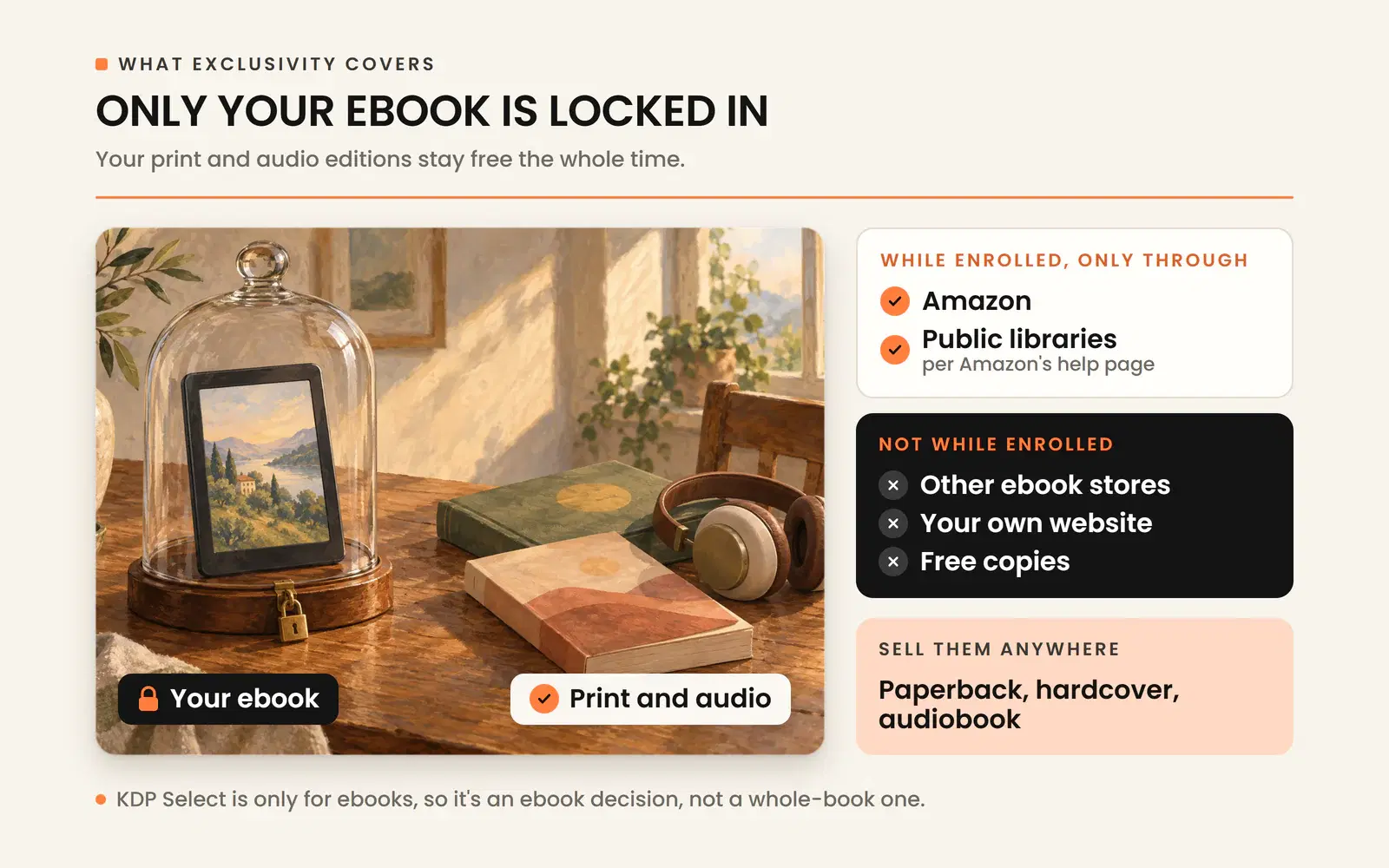
KDP Select is only for ebooks. Your paperback, hardcover and audiobook can be sold anywhere you like, the whole time your ebook is enrolled.
Amazon's help page says so directly. While your ebook is enrolled, you "can continue to distribute print, video, audio, or other formats" of your book wherever you want.
This is where plenty of authors trip up. The word exclusivity sounds like it covers the whole book, so they assume their print edition is tied to Amazon too. It isn't. Your paperback can also be printed and sold through a print on demand service like IngramSpark. Your audiobook can go to any audio store.
So when you weigh KDP Select, you're only weighing your ebook. Everything else stays free, whichever way you go.
Can Your KDP Select Ebook Still Go to Libraries?
Yes. A KDP Select ebook can still go to public libraries, according to Amazon's own help page. It's a detail that's easy to miss, and it matters if your readers borrow books.
The line is on Amazon's help page on enrolling in KDP Select. It says your Kindle ebook "can only be distributed through KDP and public libraries" during the 90-day term. So besides Amazon, public libraries are the one place that page names.
So why would anyone think libraries are off limits? Because they're reading a different page. The main KDP Select page is the one that pitches the program. It says you "cannot distribute your book digitally anywhere else, including on your website, blogs, etc." Libraries don't come up anywhere on that page.
Read that page on its own, and you'd assume your ebook can't go anywhere but Amazon. It's also the page you're most likely to have seen, since it's the one that sells you on joining.
Neither the contract you agree to nor Amazon's short overview of the program mentions libraries. And Amazon updates these pages from time to time.
That isn't as odd as it sounds. A sales page keeps things short, a help page gets into the details, and a contract speaks in legal terms. The trouble starts when you only read one of them.
Who should care most? Authors whose readers borrow before they buy. Think of a local history, a memoir with a hometown following, or a book written for book clubs.
So what should you do with that? If library readers matter for your book, don't guess either way. Read the current wording before you enroll, and save a copy of what it says.
It's also a fair question to ask whoever sets up your ebook. When we handle Amazon ebook publishing services for an author, we go over details like this one before the KDP Select box is ever ticked.
What Happens to KDP Select After 90 Days?
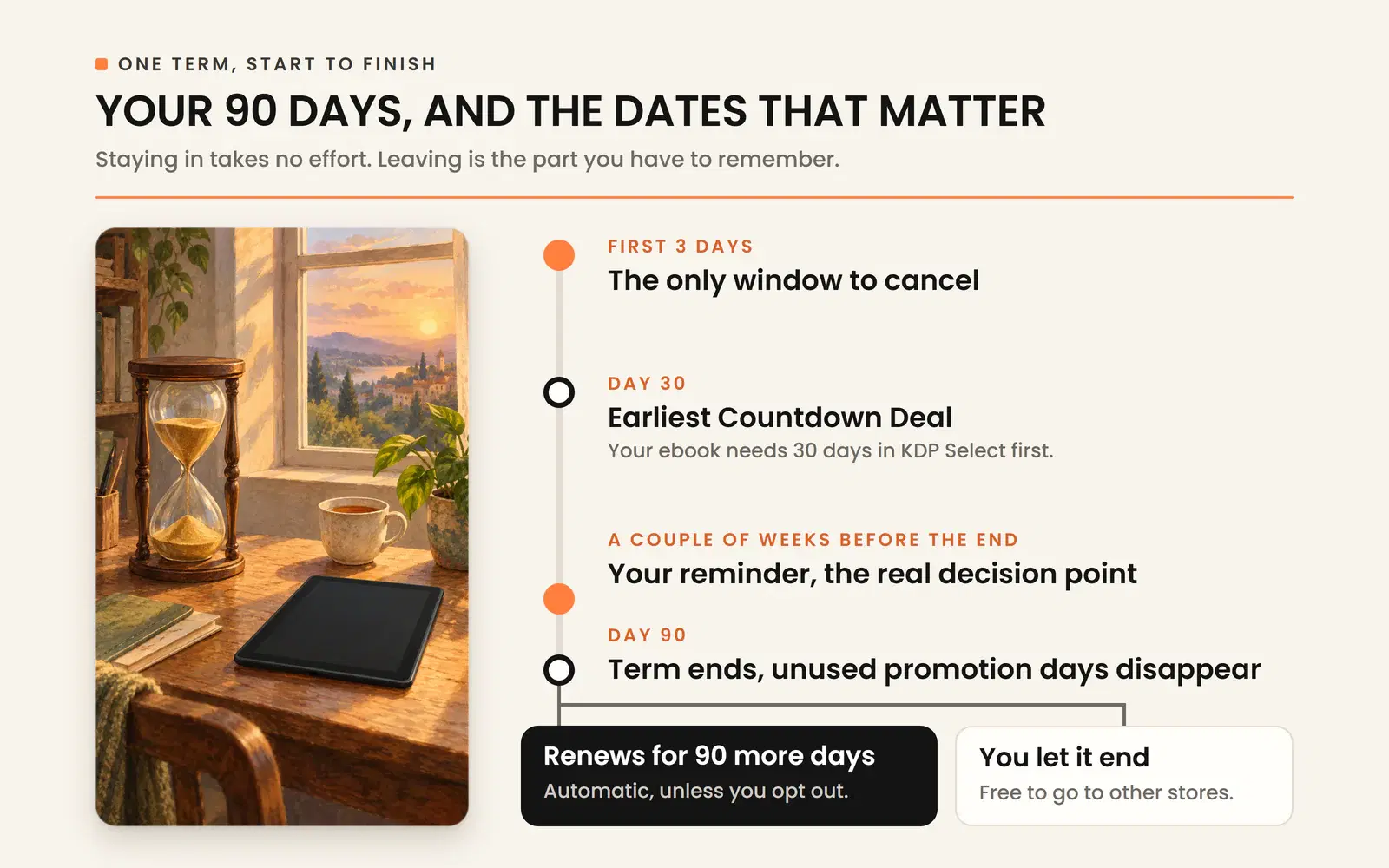
KDP Select renews for another 90 days on its own. Amazon automatically renews every enrolled ebook unless you opt out, so staying in takes no effort. Leaving is the part you have to remember.
Turning off auto-renewal doesn't end your current term, either. Your ebook stays enrolled until its 90 days are up. Only then is it free to go elsewhere.
Here's a simple habit worth building. Your term has a fixed start and end date from the day you enroll. Put the end date in your calendar right away, with a reminder a couple of weeks before it. That reminder is your real decision point.
So what happens with KDP Select after 90 days is up to you, as long as you decide before the renewal date. If you let the term end, your ebook is back to normal. You can put it in other stores, sell it on your own site, or keep it on Amazon alone.
Readers who borrowed your ebook won't necessarily lose it. Amazon's terms say it may let a Kindle Unlimited reader keep your book checked out as long as they like. That can hold even after your ebook leaves KDP Select.
Their reading still counts, too. Pages those readers read for the first time after your term ends still earn you a share of the fund.
One more thing ends with the term. Any promotion days you haven't used disappear, so use them while you can.
You Can Switch Later, in Either Direction
You're not choosing forever when you enroll in KDP Select. It runs one 90-day term at a time, so you can move between Select and wide as your plans change.
Going from KDP Select to wide is the easy direction. Let a term end without renewing, and your ebook is free to go to other stores.
Going the other way takes a little more care. Your ebook has to be exclusive to Amazon for the whole enrollment period. So it needs to be off every other ebook store before a term starts. If it's still listed somewhere else, you're breaking the rule from day one.
Pre-orders come with a catch of their own. If you enroll a pre-order ebook in KDP Select, you can't cancel that enrollment until the book is released.
Either way, your paperback and audiobook don't move. Only the ebook changes lanes.
Going Wide Means More Stores, Not Leaving Amazon
Going wide means your ebook isn't locked to Amazon, so you can sell it in other stores as well. Alongside Amazon, that usually means stores like Apple Books, Kobo, Google Play Books and Barnes & Noble.
So, what does publishing wide mean for your book? It isn't a program you sign up for. It's simply the freedom your ebook has whenever it's not in KDP Select. You still have to list it in those other stores, or have someone do that for you.
The biggest mix-up is thinking wide means leaving Amazon. It doesn't. A wide ebook still sells in the Kindle Store, on the same book page. It just isn't in Kindle Unlimited, and it can't use the KDP Select promotion tools.
Going wide does mean more setup. Every store has its own listing, and each one sets its own file and metadata rules. A file that one store accepts, another may reject. And when something changes later, like a new cover or a fixed typo, every store needs the update.
KDP Select vs Going Wide, Side by Side
Here's how KDP Select vs going wide compares on the things that actually change. Think of it as the KDP Select pros and cons, laid out for your ebook.
| What you're comparing | KDP Select | Going wide |
|---|---|---|
| Where your ebook is sold | Amazon's Kindle Store only | Amazon plus stores such as Apple Books, Kobo and Google Play Books |
| Kindle Unlimited | Included automatically | Not included |
| Kindle Countdown Deals and Free Book Promotions | One type per 90-day term | Not available |
| Selling or giving away the ebook on your own site | Not allowed during the term | Allowed |
| Your paperback, hardcover and audiobook | Sell them anywhere | Sell them anywhere |
| How long you're committed | 90 days at a time, renewing on its own | No set term |
Look at the row that matches. Your print and audio editions sit the same in both columns. That's why KDP Select vs wide is really an ebook decision, not a whole-book one.
The KDP Select advantages and disadvantages come down to one swap. You trade every other ebook store, plus your own site, for Kindle Unlimited and Amazon's promotion tools, 90 days at a time.
Kindle Unlimited Suits Books Readers Binge, Not Books They Keep
Kindle Unlimited suits books that readers finish and then go hunting for the next one. Because it pays by pages read the first time, it favors books that get read cover to cover.
So ask yourself one question about your book. Will people read it, or keep it?
Books that people read straight through usually look like this.
- Novels readers race through, like a gripping thriller or a romance they can't put down.
- Series, where finishing book one sends a reader straight to book two.
- Longer books in general, since a full read covers more pages.
Books that people keep usually look like this.
- Cookbooks, workbooks and reference books that readers dip into for years.
- Practical guides that a reader wants on the shelf, not just on loan.
- Books people reread, since Kindle Unlimited only counts pages the first time someone reads them.
- Short books, where even a full read doesn't cover many pages.
Readers of the second kind often want a copy of their own. They buy wherever they already shop for books. Exclusivity keeps your ebook out of every store but Amazon, so it can keep you away from those readers.
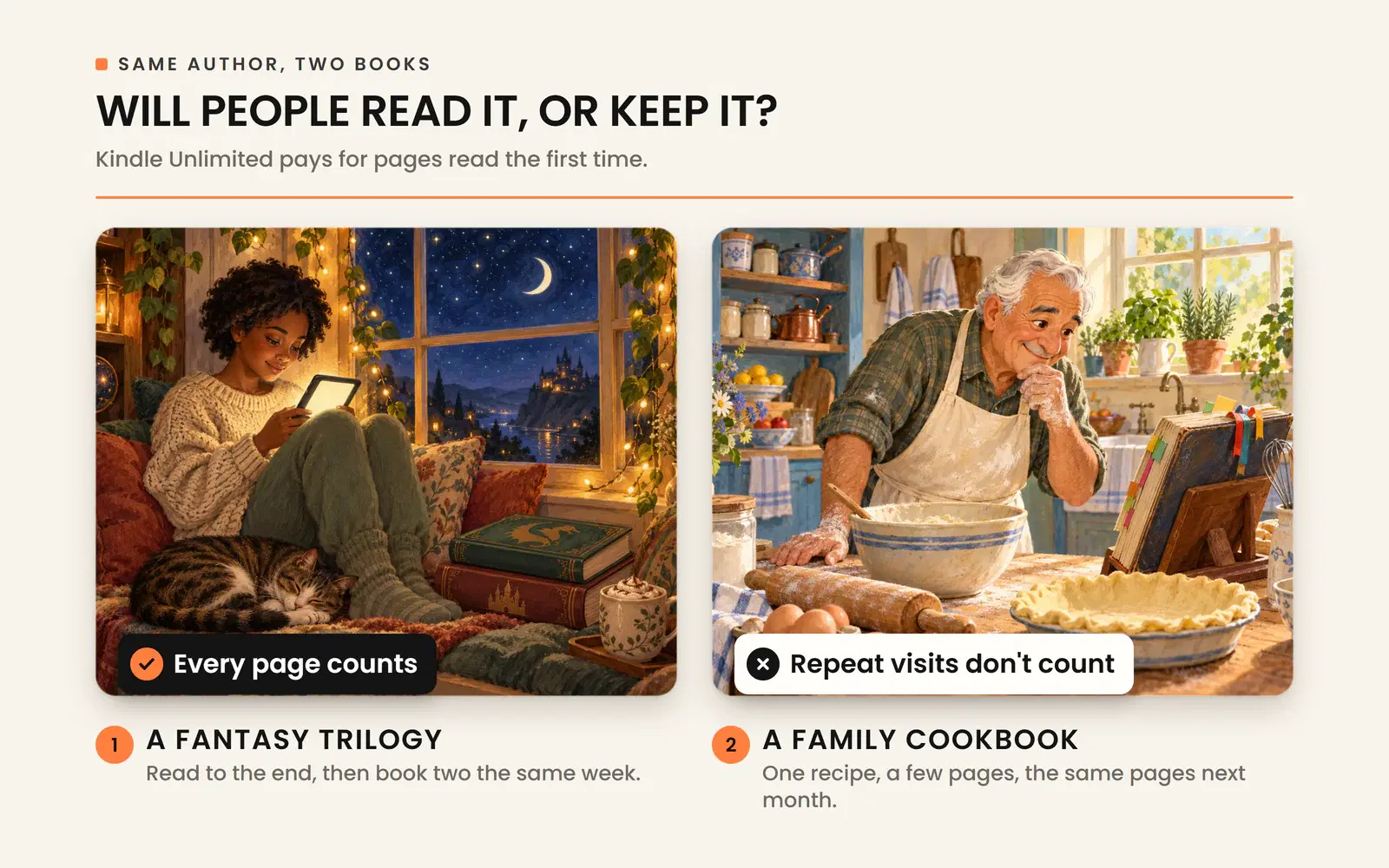
Picture one author with two books. The first is book one of a fantasy trilogy. The second is a cookbook of family recipes.
The trilogy is a natural fit. A member borrows book one, reads to the end, and borrows book two the same week. Every one of those pages counts.
The cookbook works the other way. A reader flips to one recipe, reads a few pages, and comes back to the same pages next month. Those repeat visits don't count, and that reader probably wants a copy of their own anyway.
So is KDP Select worth it for authors in general? That's the wrong question. The useful one is whether it's worth it for this book, and the same author can get two different answers.
Plenty of books sit somewhere in between. For those, one 90-day term can work as a trial run, since it's short enough to try and then leave. Just set that calendar reminder first.
Why Children's Picture Books Are a Different Case
A children's picture book is mostly a print product. It's made to be held, read aloud and passed around, and KDP Select doesn't touch print at all. Picture books also get read again and again, while Kindle Unlimited only counts pages the first time. That changes the whole trade, so we cover it separately in our guide to publishing a children's book on Amazon.
Should You Enroll in KDP Select?
Enroll in KDP Select if readers binge your book, they mostly shop on Amazon, and you aren't selling the ebook anywhere else. Stay wide if your book is one people keep, or if you've already built readers outside Amazon.
If you're still asking yourself "should I enroll in KDP Select?", look at three things before you tick the box.
- Your book. Is it read straight through, or kept and reread? Is it part of a planned series?
- Your readers. Do they buy on Amazon or somewhere else? Do you sell ebooks from your own site, send them to a mailing list, or count on library readers?
- Your next book. A choice that suits book one may not suit a whole series. Deciding one title at a time can leave a series split across stores, which is one more reason to plan a multi-book series as a whole.
Is KDP Select worth it for a first book? There's a fair case for trying one term. You may not have readers on other stores yet, so exclusivity costs you less. Amazon also pitches Kindle Unlimited as a way for readers to discover new books. The case gets weaker if you're building a mailing list from day one, or if your book is a keeper.
This is a call we make with you, not for you. If this is your first book, our book publishing services for new authors walk you through choices like this one before anything goes live. We publish ebooks to Amazon KDP and to other stores such as Apple Books and Google Play Books, so your book can go either way.
Tell us about your book, and we'll help you see which side of the trade it sits on.
Frequently Asked Questions
Can I leave KDP Select before the 90 days are up?
Only in the first three days of a term. Amazon lets you cancel within three days of the start of your enrollment period, and after that its help page says to contact Amazon. Taking your book down doesn't free you, either, because unpublishing just pauses the term until you republish.
Can I run a Kindle Countdown Deal and a Free Book Promotion in the same term?
No. You get one type of promotion per 90-day term, so it's a Countdown Deal or a Free Book Promotion, not both. You can choose the other type when a new term starts.
Do I need to own all the rights to my book to enroll?
You need the exclusive rights to its main content. Amazon won't accept a book that's mostly public domain material, or content you only hold non-exclusive rights to, meaning others can publish it too. If your book uses material that belongs to someone else, get the rights settled before you enroll.
Why are some authors leaving Kindle Unlimited?
Because they want their ebook in more places than exclusivity allows. They might want to sell it on their own website, send it to a mailing list, or put it in other ebook stores. None of that is allowed while the ebook is in KDP Select. Leaving Kindle Unlimited means leaving KDP Select, since the two come together.
What does it mean when my ebook says KDP Select enrolled?
It means your ebook is inside a 90-day KDP Select term right now. Until that term ends, Amazon is the only store that can sell it, and it's in Kindle Unlimited. Your paperback and audiobook aren't affected. Unless you've turned off auto-renewal, a new term starts when this one ends.
- What's the Difference Between KDP and KDP Select?
- What You Get When You Enroll
- What You Can't Do With Your Ebook in KDP Select
- Can Your KDP Select Ebook Still Go to Libraries?
- What Happens to KDP Select After 90 Days?
- Going Wide Means More Stores, Not Leaving Amazon
- Kindle Unlimited Suits Books Readers Binge, Not Books They Keep
- Why Children's Picture Books Are a Different Case
- Should You Enroll in KDP Select?
- Frequently Asked Questions