Publishing a Children's Book on Amazon, What Exclusivity Costs an Illustrated Book
Short Answer: If you're publishing a children's book on Amazon, exclusivity touches much less of your book than you might think. KDP Select only covers the Kindle eBook. Your paperback and hardcover, the copies that end up on laps, in classrooms and on library shelves, stay free to sell anywhere. The choices that really cost money come earlier, in the art, the print format and who owns the illustrations.
You've finished your story. Maybe you've even got a first sketch of your main character. Then someone mentions KDP Select, and suddenly you're reading about exclusivity and wondering if Amazon is about to own your book.
It isn't. And the fact that you're asking is a good sign. It means you're thinking about where your book will go before it gets there.
So here's the plan. First, what Amazon actually does for a children's book, and which copies exclusivity really touches. Then why print matters so much for a picture book. After that, the decisions that deserve your worry instead. The art, the print choices, the rights to your pictures, and how libraries and bookstores get their copies.
Does Amazon Publish Your Children's Book?
No, not the way a publishing house would. When you're publishing a children's book on KDP, Amazon prints it and sells it, but you stay the publisher. KDP's own homepage puts its job simply. It will print your books on demand and ship them to customers around the world.
Print on demand means there are no boxes of books in your garage. A copy gets printed when someone orders one, and Amazon says that means you don't have to carry any inventory.
That's a big, useful job. It just isn't the whole book.
Before anything goes on sale, you upload a finished manuscript and a finished cover. KDP doesn't edit your story. It doesn't draw your pictures, plan your pages or design your cover. Everything that turns an idea into a book a child asks for twice happens before Amazon sees a single file.
When you're self-publishing an illustrated children's book on Amazon, KDP won't tell you whether your pictures match your words, or whether your hero looks the same on every page. That's your job, or the job of whoever you hire.
Children's books on Amazon KDP get the same deal as novels and cookbooks. Here's how the work splits.
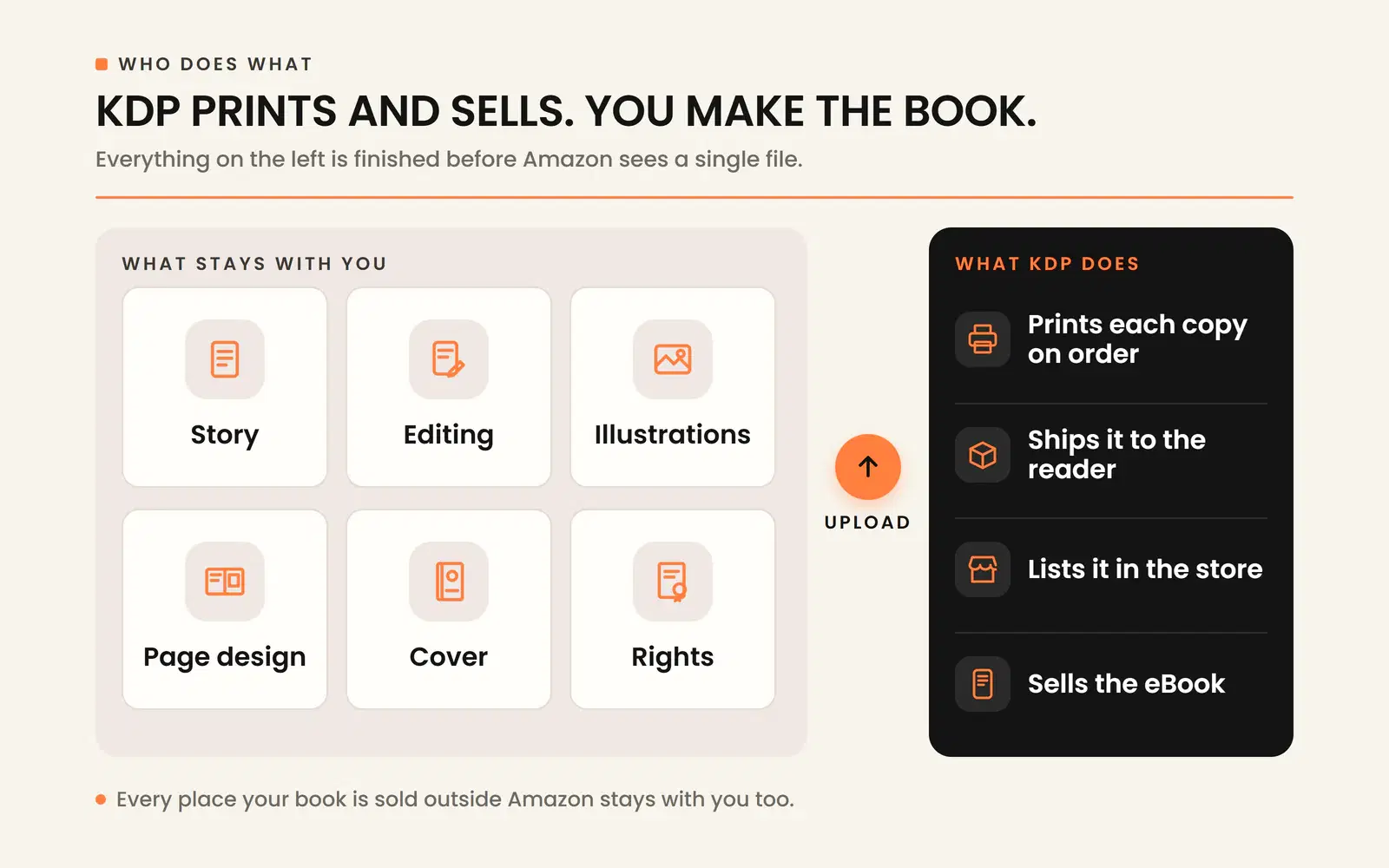
- What KDP does. It prints your paperback and hardcover when they're ordered, ships them, lists your book in its store and sells your eBook in the Kindle Store.
- What stays with you. The story, the editing, the illustrations, the page design, the cover, the rights to all of it, and every place your book is sold outside Amazon.
You're also the publisher on paper. KDP asks every author for an imprint, the publisher's name that goes with the book's ISBN. In other words, the publisher is you.
So self-publishing a children's book on Amazon means you're running the project. You choose the illustrator. You approve the art. You decide the editions, the price and where else the book goes. That surprises a lot of first-time authors, because "publishing on Amazon" sounds like handing the book over. It's closer to hiring a printer with a very big shop window.
Which Copies of a Children's Book Does KDP Select Cover?
Just one. KDP Select covers the Kindle eBook of your children's book and nothing else. Your paperback and your hardcover aren't part of it.
Amazon's help page for the program says it in one short line. "KDP Select is for Kindle eBooks only." The same page explains what happens while your eBook is enrolled. It "can only be distributed through KDP and public libraries," and you can keep selling print, video, audio and other formats of your book elsewhere. So a narrated audiobook or an animated read-aloud of your picture book isn't tied up either.
Notice the one exception Amazon names there, public libraries. Your enrolled eBook can still be distributed through them.
Amazon's KDP Select page says the same thing from the other side. During exclusivity, you can't distribute the book digitally anywhere else, and that includes your own website and blog. You can still sell it "in physical format, or in any format other than digital."
Enrollment runs 90 days at a time, and it renews on its own unless you opt out. Here's how that plays out across the editions of a children's book.
| Edition | Covered by KDP Select? | Free to sell elsewhere while enrolled? | Can Amazon pass it to bookstore and library distributors? |
|---|---|---|---|
| Kindle eBook | Yes, 90 days at a time | No, only through KDP and public libraries | No, that route is for paperbacks |
| Paperback | No | Yes, exclusivity never touches print | Yes, through Expanded Distribution, if distributors accept it |
| Hardcover | No | Yes, exclusivity never touches print | No, hardcovers aren't eligible for Expanded Distribution |
So yes, you can enroll your eBook and still sell print everywhere. Say your eBook goes into KDP Select the same week you do a school visit. You can sell paperbacks at that visit, at the book fair next month and through your own website. None of it breaks the rules.
What you get back for that eBook promise is a separate question. Enrolled eBooks go into Kindle Unlimited automatically, and the program comes with its own promotion tools. If you want the full picture, our guide to whether KDP Select is worth it walks through the whole trade.
Why Print Is the Copy That Counts for a Picture Book
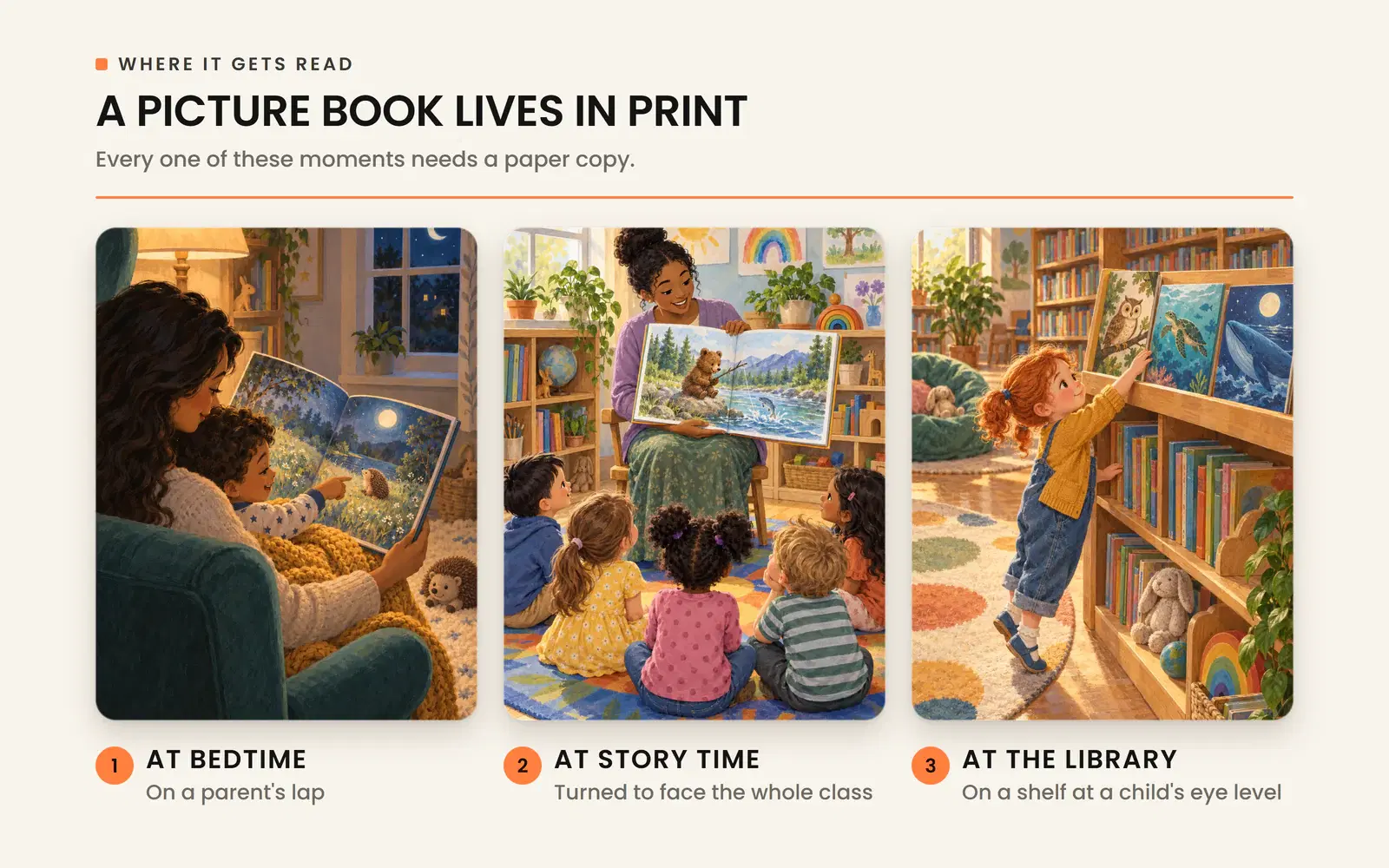
A picture book lives in print. Think about where yours will actually get read. On a parent's lap at bedtime. In a teacher's hands at story time, turned around so the whole class can see. On a library shelf, at a four year old's eye level. Every one of those is a paper copy.
Publishing a children's picture book is mostly a print project for that reason. The art is the point, and the book gets handled, shared and read again and again.
The eBook is a different animal. Amazon's own format guide says the Kindle format suited to "children's picture books" is a fixed layout with text pop-ups. It lists Fire tablets and the Kindle apps as supported, with Kindle e-readers only "on a case by case basis." It also lists what that format gives up. There's no text selection, no dictionary, no font settings and no screen reader support.
Now look at what exclusivity actually asks of a picture book. You're promising Amazon the edition that runs on tablets and the Kindle apps, and only sometimes on a Kindle e-reader. You're keeping every paper copy free. For a novel, the eBook can be the main event. For a picture book, it's more of a side door.
None of this means you should skip the eBook. A fixed layout edition can still reach parents who read with their kids on a tablet. It just shouldn't be the edition you plan the whole book around.
So what does exclusivity cost an illustrated book? The eBook can't be sold anywhere but Amazon, 90 days at a time. Every print copy stays yours to sell wherever you like. It's also a choice you can make later, since Amazon lets you enroll an eBook after it's published, and you can opt out when a term ends.
That's why exclusivity isn't the big decision for an illustrated book. It's a real choice, and it's worth getting right. But the money and the risk sit somewhere else.
The Big Money Decisions Happen Before You Publish
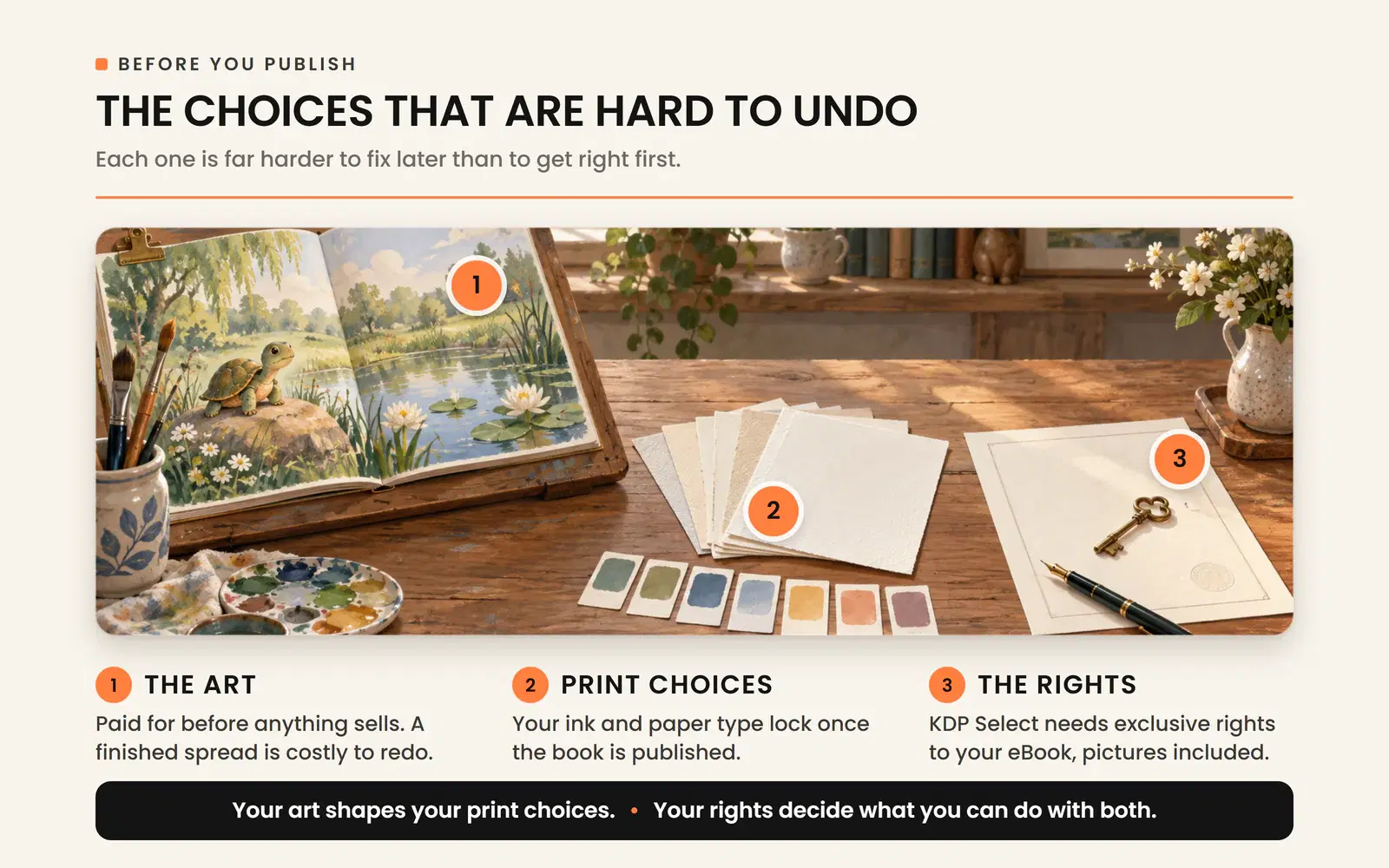
When you're publishing a children's book on Amazon, the expensive choices come before KDP ever sees a file. Most first-time authors spend their worry in the wrong place. They worry about KDP Select, which they can switch on after publishing and drop when a term ends. Meanwhile the choices they can't easily undo get made in a hurry.
Those choices sit in three places, and each one is far harder to fix later than to get right first.
- The art. Your pictures are finished before there's anything to sell, and a finished spread is expensive to redo.
- The print choices. Amazon locks your ink and paper type once the book is published.
- The rights. KDP Select asks you to hold exclusive rights to your eBook's content, pictures included.
The three are also connected. Your art shapes your print choices, and your rights decide what you can do with both.
Why Is the Art the Hardest Thing to Change?
Because the art is finished before your book exists. You can't list a picture book until the pictures are done, so the art gets paid for before a single copy sells.
Compare that with a novel. If a novel has a clumsy sentence, the author fixes it and uploads a new file. If a picture book's main character looks different on page 12 than on page 3, someone has to redraw pages. And one change can ripple. Swap the character's coat, and every spread with that coat changes too.
That's why self-publishing a children's book with illustrations on Amazon runs in a different order from a novel. The story gets settled first. Then the look. Then the pages. Each step makes the next one more expensive to change.
Lock the words before the art starts, too. The costliest habit we see is changing the text after the pages are laid out, because then every page has to be rearranged.
So what is the illustration budget actually buying? Not just pictures. It buys a handful of things that are easy to miss until they're missing.
- One style, held all the way through. If you haven't picked one yet, our guide to children's book illustration styles walks through the main options.
- A main character who looks like the same child on every single page.
- Pictures planned with your words, so the text and the art land where they should.
- Spreads that feel like one book, not a gallery of separate pictures.
Most of that gets settled before any final art starts. It happens at the sketch stage, which is why storyboarding comes first in a picture book. A sketch is cheap to change. A finished spread isn't.
Print Choices That Lock When You Publish
Some print choices on a children's book can't be changed once it's live on Amazon. Amazon's print options page says your ink and paper type are "locked after publication due to ISBN requirements." On a full color picture book, that's the look of every page.
Color is where this bites. Amazon prints color books on white paper, which it says "shows a higher contrast for images and graphics." Amazon also notes that color costs more to print, so it's a money decision as well as a looks decision.
One more detail catches people out. Paperbacks can use standard or premium color ink, but hardcovers can only use premium. So if your paperback uses standard color, your two editions won't be printed the same way.
Screens also flatter art. Your monitor lights a picture from behind, and paper doesn't. A spread that glows on screen can come back darker or flatter in print. That's why Amazon itself recommends ordering a proof before you publish. A printed proof is the honest check. A screen preview isn't.
When you're self-publishing a children's picture book, these calls are yours to make. Make them with a printed copy in your hands, not a picture on a screen.
Why Amazon Cares Who Owns Your Illustrations
Because you can't enroll an eBook in KDP Select unless you hold exclusive rights to what's in it. Amazon's help page states the rule plainly. "You must have exclusive rights for the primary content of the Kindle eBook." In a picture book, the pictures are a big part of that content.
So here's the question to answer before anyone draws a single line. When your illustrator hands over the art, what rights come with it? For which editions? Where in the world? For how long? If you can't answer those, you can't be sure you meet Amazon's rule.
Timing is the real trap. Once the art is finished and paid for, your rights are whatever the agreement said at the start. Going back later to ask for more is awkward at best. We see this most with books drawn by a friend, a relative or a freelancer found online, where nobody wrote anything down.
Why does writing it down matter so much? The U.S. Copyright Office's basic guide says that, as a general rule, copyright starts out with the person who created the work. It also says owning a copy doesn't make you the copyright owner, and that a transfer generally has to be in writing and signed. So paying for the pictures, or holding the files, isn't by itself the same as holding the rights.
The fix is simple, even if the paperwork isn't. Settle the rights in writing before the drawing starts. Then the question never comes back to bite you at the worst possible moment, which is right when your book is ready to go live.
How Libraries and Bookstores Order Children's Books
Libraries and bookstores generally don't buy the way a parent does. Amazon's own help page puts it in one line. "Booksellers and libraries purchase paperbacks from large distributors." So a listing on Amazon, however good it looks, doesn't by itself put your book where those buyers order.
That catches a lot of first-time authors off guard. Selling children's books on KDP puts your book in front of Amazon shoppers. On its own, it doesn't reach the distributors a library or bookstore orders from.
If your book is meant for classrooms, story times and library shelves, this matters as much as anything on the page. On Amazon's side, two things decide whether those distributors can get your book. Amazon's Expanded Distribution option, and the ISBN you choose.
What Amazon's Expanded Distribution Can and Can't Do
Expanded Distribution is Amazon's option for offering your paperback to the large distributors that bookstores and libraries buy from. Amazon says it can help you reach "bookstores, online retailers, libraries, and academic institutions." You have to enroll your paperback in it. It doesn't happen on its own.
If a distributor accepts your paperback, bookstores and libraries can then find it and order it. It's useful, and it comes with three limits worth knowing before you plan around it.
- It's for paperbacks only. Amazon's page says plainly that hardcover books aren't eligible.
- It doesn't guarantee anything. Amazon says enrolling doesn't guarantee a distributor will accept your book or that a bookseller or library will order it.
- Distributors set their own rules. Amazon lists content they may not accept, including paperbacks whose pages "require a high concentration of ink to be printed."
That last point deserves a close look if your pages are covered edge to edge in color. It doesn't mean a picture book can't qualify. It means the question should come up early, while there's still time to plan around the answer. And if a distributor does turn your book down, Amazon says your book's availability on Amazon isn't affected.
Hardcover still has its place. It's sturdy, it makes a lovely gift, and it survives a lot of little hands. It just won't reach distributors through this option. If library shelves are part of your plan, your paperback is the edition doing that job on Amazon's side.
What Does Your ISBN Choice Change?
It changes where your book can go and whose name shows as the publisher. KDP gives you two options. You can use an ISBN from KDP, or you can buy your own.
An ISBN from KDP is the simple route, but it stays on Amazon. Amazon says those ISBNs "can only be used on KDP," and they can't be used to publish outside of it. Your imprint will also show as "Independently published" rather than a publisher name you picked.
Your own ISBN lets you list your own imprint, such as a business or brand name. It also keeps the door open to another print and distribution service, such as IngramSpark. It's one small choice at setup, and it quietly decides what's possible afterwards. That's why we bring up ISBNs at the start of a project, not on publishing day.
What We Do Before Your Children's Book Reaches Amazon
We help you make the early calls in the right order, before anything is drawn or printed. That's what our custom children's book publishing is built around, for picture books, early readers and educational books.
It starts with a conversation, before any art begins. What kind of book is it, and who's it for? Which editions do you need? Does it have to reach libraries and bookstores, or mostly family and friends? Who's drawing it, and what rights will you hold when they're done?
Then the book gets made in that order. Manuscript first, then illustration and design, then typesetting and proofing, then printing and publishing. Each stage builds on decisions that are already made. At the end, your finished book is prepared to each platform's file and cover requirements and listed for sale, Amazon included.
Already have finished art? We build the design around what exists instead of starting over. Nothing drawn yet? The illustrations become part of the project, and they flow straight into design and print.
KDP Select comes up too, of course. By the time it does, it's a much smaller call, because the big decisions are already behind you.
Not sure where your book stands right now? That's normal, and it's exactly what a first conversation is for. Bring whatever you have, even if it's just the manuscript. Tell us where your book is now, and we'll tell you which of these decisions are still open.
Frequently Asked Questions
Can I still sell copies myself if my eBook is in KDP Select?
Yes, as long as they're print copies. KDP Select only covers the Kindle eBook, so you can sell paperbacks and hardcovers at school visits, book fairs, readings or on your own website. What you can't do while enrolled is sell or give away the eBook yourself, not even as a download from your own site.
Does a self-published children's book need its own ISBN?
Each print edition does. Amazon says every format, paperback and hardcover, needs its own ISBN, while an ISBN is optional for eBooks. You can use one from KDP or buy your own. That choice decides whether the edition can be published anywhere other than KDP later.
Can I use AI pictures in a children's book on Amazon?
Amazon's content guidelines don't forbid AI pictures, but they do require you to tell KDP about them when you publish. The guidelines spell out that this includes cover and interior images. Amazon also makes you responsible for making sure that content respects intellectual property rights. What the guidelines don't settle is who owns AI art, and that's the question KDP Select's exclusive rights rule depends on.
Can I publish my children's book on KDP and IngramSpark?
Amazon's rules leave room for it, but your ISBN decides how. An ISBN from KDP can only be used on KDP, so it won't carry over to a second service. Amazon's Expanded Distribution also won't take an ISBN that has already been submitted for distribution through another service. So pick which service will handle bookstore and library distribution before you publish, not after.
Do libraries accept self-published children's books?
There's no single rule, because each library decides what it orders. Amazon says so directly, noting that the decision to order your book "lies solely with the individual booksellers and libraries." Amazon also says it can't tell you which libraries bought your book. What you can control is whether your paperback is somewhere a library can order it from.
- Does Amazon Publish Your Children's Book?
- Which Copies of a Children's Book Does KDP Select Cover?
- Why Print Is the Copy That Counts for a Picture Book
- The Big Money Decisions Happen Before You Publish
- How Libraries and Bookstores Order Children's Books
- What We Do Before Your Children's Book Reaches Amazon
- Frequently Asked Questions