Series vs Standalone Books, the Decision Authors Make Before Book One
Short Answer: The series vs standalone books choice comes down to one question. Does your story finish in one book, or does it need more room? A standalone tells one complete story, and a series carries a story or its people across several books on purpose. If you're torn, a standalone with series potential gives you one finished book with a door left open.
You've got an idea you can't stop thinking about. Maybe it's a detective you could follow for years. Maybe it's one story with an ending you've carried around forever. Sooner or later, someone asks you the big question. Is this one book, or the start of a series?
The book series vs standalone question is worth answering before you write book one, not after. Your answer changes how big your world needs to be, who gets a backstory, and how your last chapter ends. Those things are easy to plan and hard to fix later.
This post helps you make the call. You'll see what each choice commits you to, the options in between, and what happens if you change your mind. It's written for authors deciding about their own book, in any genre.
What Counts as a Standalone, and What Counts as a Series?
A standalone is one book that tells one complete story. A series is two or more books that carry a story, a world or a cast forward on purpose, and they're published as a set.
A Standalone Finishes Its Own Story
A standalone novel raises its big question and answers it before the last page. A reader who never picks up another of your books still gets the whole story, start to finish.
So what is a standalone novel, in practice? Here's a quick test. Does your last chapter answer the question your first chapter asked? If it does, you've written a standalone, whatever you plan to write next.
A standalone can still share a world with your other books. It can borrow a town, or let a side character wander in. What it can't do is leave its own story unfinished. That's the standalone novel meaning in one line, a book that's complete in itself and isn't part of a bigger story.
A Series Carries Something Forward on Purpose
Books become a series when something carries forward by design. Usually it's the story itself. Sometimes it's a main character, a world or a premise that runs through every book.
Sharing a setting isn't enough on its own. Two of your books that happen to share a town aren't a series unless you write and sell them as one. Inside a series, there's one more split worth knowing. In some series, book two needs book one, so readers have to start at the beginning. In others, every book works alone, even though they share a world. Both count as series, but they ask very different things of you.
The Names for a Two, Three or Four Book Series
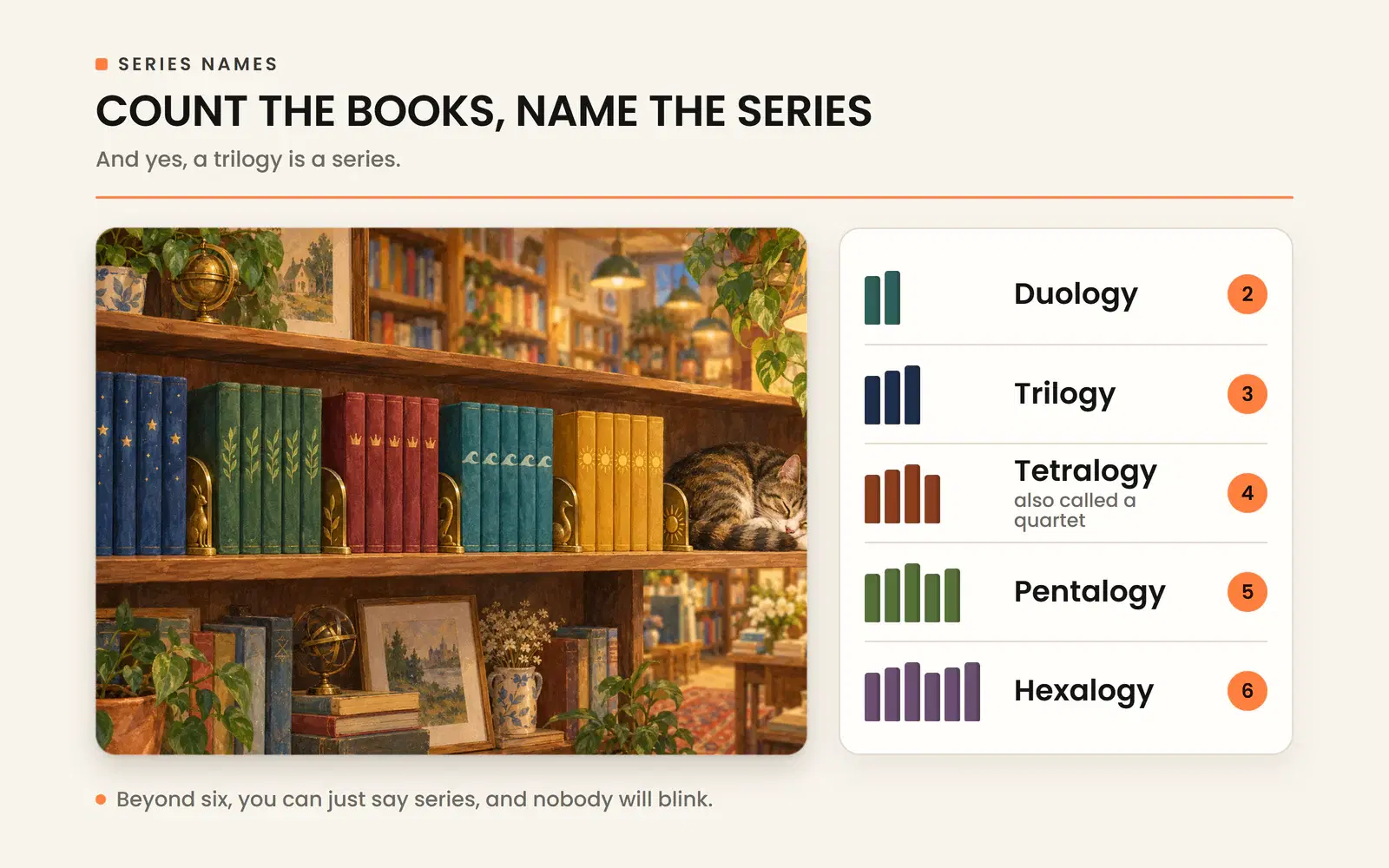
A series gets its name from how many books are in it. Here's the ladder, from two books up.
- A 2 book series is a duology. The word isn't in every dictionary yet, but it's widely used in genre fiction.
- A 3 book series is a trilogy. And yes, a trilogy is a series.
- A 4 book series is a tetralogy, which you'll also hear called a quartet.
- A 5 book series is a pentalogy, and a 6 book series is a hexalogy.
- Beyond that, you can just say series, and nobody will blink.
Two more words get mixed up with series. A saga names the sweep of a story, not the count. It's a long tale that covers a long stretch of time, and it can fill one book or many. A serial is one story released in parts on a schedule, where each part is an episode rather than a finished book.
Should Your Book Be a Series?
Your book should be a series if its story can't finish in one book. If it can, it's probably a standalone, however much you love the world. Your idea usually tells you whether it's a book series or standalone early on, as long as you know what to look for.
Signs Your Idea Wants More Than One Book
Your idea probably needs more than one book if these sound familiar.
- Your main question is too big for one book. A war that won't end in one summer, or a kid who has to grow all the way up, usually needs more room.
- Your hero has more than one big change in them. If they change once, that's a book. If they change three times, that might be three.
- Your world is bigger than your plot. You've built five cities, and your story only visits one.
- Readers in your genre like to follow people from book to book. Mystery readers often love a detective who comes back, and fantasy readers are used to worlds that run across several books.
- You'd happily spend years with these characters. A series is a long relationship, so you've got to want it.
Signs It's One Complete Story
Your story is probably one book if these sound more like it.
- Your story asks one big question, and your ending answers it.
- Your ending only works if nothing comes after it. A final twist, or a loss that has to stay final, belongs in a standalone.
- You want your next book to be different. A new genre or a new voice is easier when nothing carries over.
- It's your first book. Finishing one teaches you things no plan can, and you'll hear from real readers before you promise them more.
Still Not Sure? Try the One Sentence Test
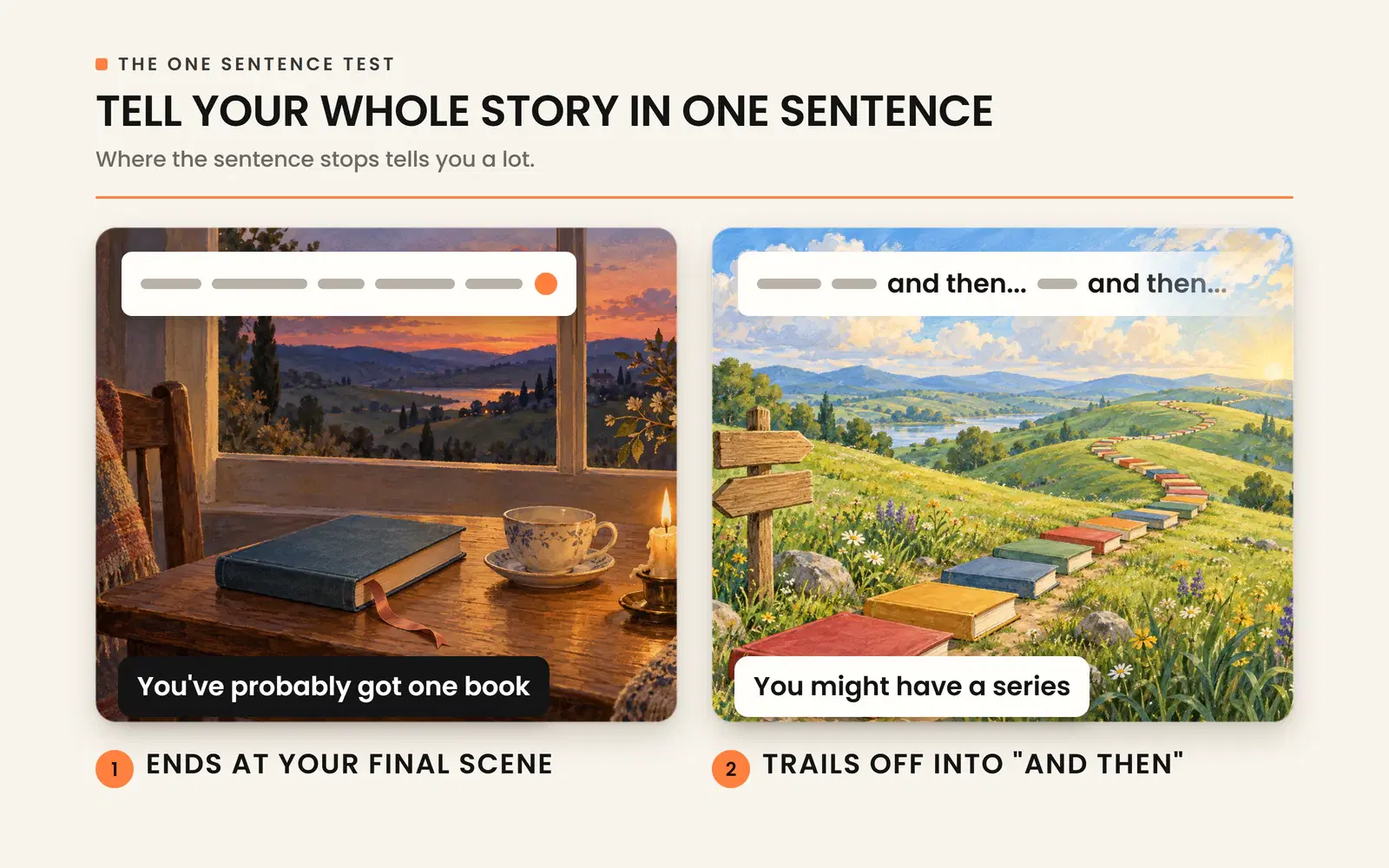
Try telling your whole story in one sentence. If the sentence ends at your final scene, you've probably got one book. If it trails off into "and then," you might have a series.
Nonfiction authors face a version of this too. Does your idea fit in one book, or does it split cleanly into a beginner's book and a next step?
Plenty of first books start life this way. The idea shows up as a trilogy before book one even has an ending. That's not a problem. It just means the series or standalone question deserves a real answer before anyone starts writing.
One book or several is also one of the first things a good book writing company should ask you about. We ask it early for a simple reason. Your answer changes what gets planned before chapter one.
What Does a Series Lock You Into?
A series locks you into more books, choices that stick, readers who wait, matching covers and a longer road. None of that is bad. It's just a bigger promise than one book, so it's worth seeing clearly before you make it.
- More than one book, for real. You're not writing a book anymore. You're writing the first part of a set, and your idea has to be big enough for all of it.
- Choices that stick. The names, rules and history you set in book one are the ones you'll live with in book four. You can't quietly rewrite your hero's past in book three.
- Readers who wait. Put "book one" on a cover and readers start watching for book two. If it never shows up, that's what they'll remember about the book they did read.
- Covers that match. Your covers need to look like a set so readers can spot the next one. If you're writing a children's series, our post on children's book cover design shows how one locked element on every cover helps a young reader find book two.
- A longer road. Your finish line moves from this book to the last one in the set.
Already sure a series is right for you? Then your next read is our guide to planning and writing a multi-book series. It covers the series bible, outlines that span every book, keeping one voice, budgeting and launch. This post stops at the decision, and that one picks up right after it.
What a Standalone Gives You
A standalone gives you a finished story, one decision instead of many, freedom for your next book and a faster finish line. Each one is the flip side of something a series asks of you.
- An ending that's all yours. Your book answers its own question, and you owe readers nothing after the last page.
- One decision, not a chain of them. You make the big calls once. A series asks you to keep deciding, book after book, with every answer boxed in by the last one.
- Freedom for your next book. Nothing carries over, so your next book can switch genre, voice or audience completely.
- A finished book sooner. Your finish line is this manuscript, and you'll see how readers react before you commit to more.
Writing a standalone novel doesn't mean you'll never go back to that world, either. It just means this book doesn't depend on another one.
So which wins, standalone book or series? Neither, on its own. A series gives your readers somewhere to go next. A standalone gives you somewhere to go next. The right pick is the one that fits your story, and the next few years you want to spend on it.
What Is a Standalone With Series Potential?
A standalone with series potential is one complete book that leaves room for more. Book one ends properly. But the world, the cast and one small question are built so a second book is possible, without rewriting the first.
The middle path works because you don't have to decide everything up front. You finish one real book, see how readers take it, and decide about book two with better information.
On the page, your last chapter settles the story you started. Something else stays open, like a place your story never went, or a side character with a life of their own. Readers who never come back won't feel cheated. Readers who want more will spot the door.
Picture a heist novel. The job works, the crew splits the money, and the book is done. But the getaway driver keeps dodging questions about a sister nobody has met. Readers close the book satisfied, and if you ever want a book two, it's already waiting.
People often ask how to write a standalone with series potential as if there's a trick to it. There isn't. It's mostly choices made before chapter one, like how big your world is and who in your cast has a story this book won't tell. Those choices are easy at the start and hard to add once the book exists.
Here's a pattern we run into a lot. An author finishes a standalone, readers ask for more, and only then do they wish they'd left a door open. Adding one afterward means changing book one. Leaving it open from the start costs you very little.
Here's how the three main choices compare side by side.
| What you're weighing | Standalone | Standalone with series potential | Series |
|---|---|---|---|
| How book one ends | The whole story wraps up | The whole story wraps up, with one door left open | Book one's plot wraps up, and the bigger story keeps going |
| What readers expect next | Nothing, and that's fine | Nothing, though more would be welcome | The next book |
| What you're promising | One book | One book, with room for more | Every book in the set |
| If you change your mind | Possible, but it takes more work | Much easier, since the room is already there | Hard to back out once readers are waiting |
| Best for | A story with one clear ending | An author who isn't sure yet | A story too big for one book |
Four Ways to Write More Books Without a Full Series
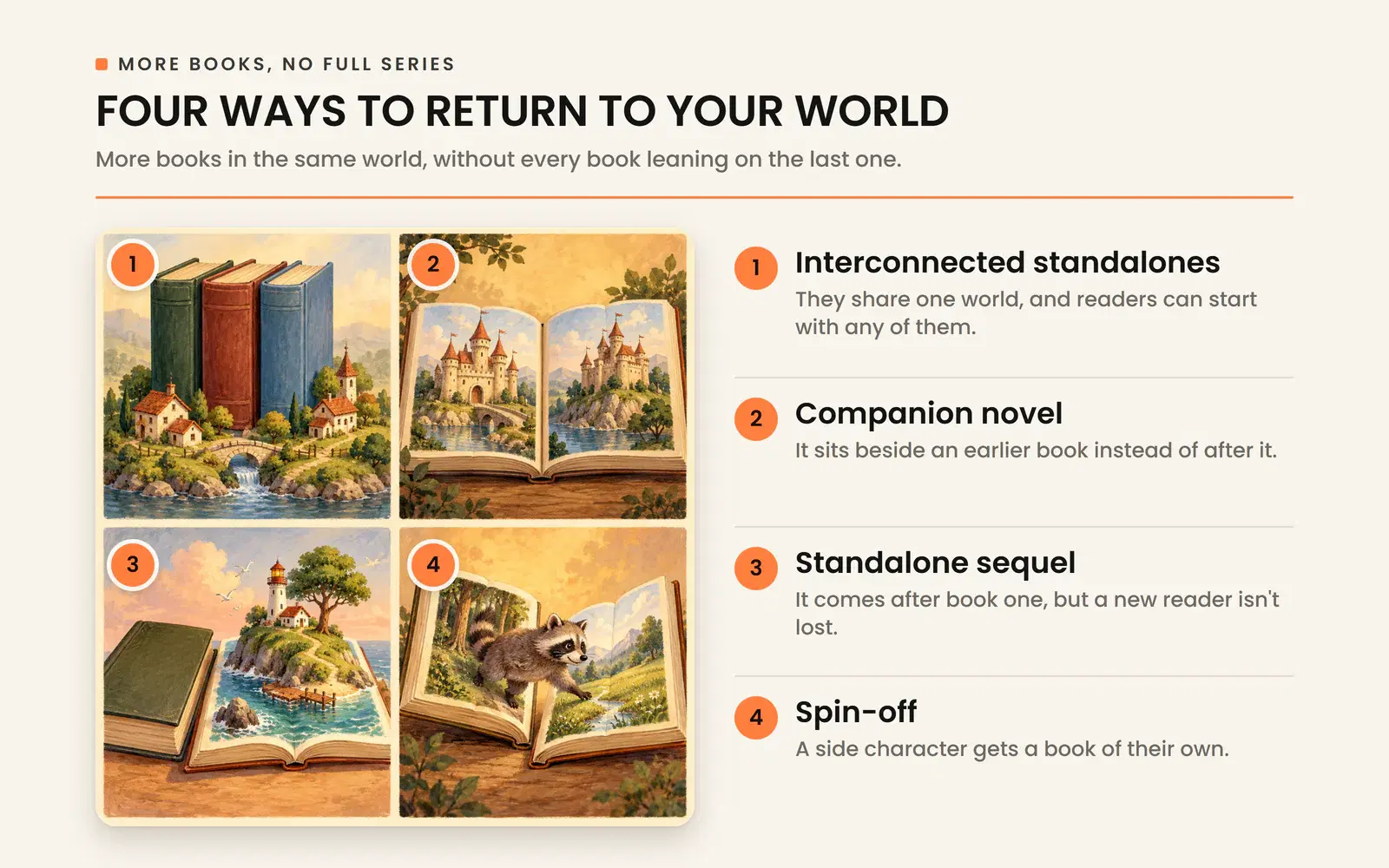
You don't have to choose between one book and a full series. Four other setups let you write more books in the same world, without every book leaning on the last one.
Interconnected Standalones Share One World
Interconnected standalones are books that each tell a complete story while sharing a world, a town, a family or a friend group. Readers can start with any one of them. Reading in order adds small rewards, like spotting an old favorite in a cameo, but nobody gets lost. What you commit to is the shared world, not one long plot. Each book gets a fresh lead and a fresh ending.
How Is a Companion Novel Different From a Sequel?
A companion novel sits beside an earlier book instead of after it. It might retell the same events from another character's side, or follow a side character through their own story at the same time. A sequel moves the story forward and assumes readers know book one. A companion novel assumes nothing, so someone can read it first and only miss a few nods. A companion novella is the same idea at a shorter length.
A Standalone Sequel Works Without Book One
A standalone sequel comes after an earlier book, with the same people or the same world, but it's written so a new reader isn't lost. Everything they need is inside it. That matters, because readers don't always find book one first. With a standalone sequel, someone who picks up book two can enjoy it and then go back. You'll see this a lot in crime fiction, where the detective returns but each case wraps up by the last page.
A Spin-Off Hands the Lead to Someone New
A spin-off takes one piece of an earlier book, usually a side character, and gives it a book of its own. It's different from a sequel because the main character changes. It's different from a companion novel because it heads into new ground instead of revisiting old ground. A spin-off borrows your world and the goodwill readers already feel for it. It still has to work for someone who's never read the original.
What If You Change Your Mind After a Standalone?
You can change your mind, because a standalone can become a series later. It's just more work than deciding up front, and how much more depends on the kind of "more" you want.
The easy routes don't touch book one. A standalone sequel, a companion novel, a spin-off or another interconnected standalone can all follow a finished book. Each one works for a reader who starts there, so your first book stays exactly as it is.
The hard route is turning book one into part one of a long story. Your standalone already closed. Its ending answered the big question, so a longer story has to find a new one, or reopen something readers thought was settled. It's doable, but it's the most work of any path here.
Say your standalone is a small town romance. A second book about the heroine's best friend is easy, because it's an interconnected standalone and book one doesn't change. Stretching the first couple's story into a trilogy is much harder, because their happy ending already happened.
If readers are already asking for more, ask what they want more of. Is it the world, a side character, or the same people? Their answer usually points you to one of the easy routes.
Leaving a door open in book one skips most of that work. The door's already built. You just decide later whether to walk through it.
How Your Answer Changes the Ending of Book One
Your choice between a series and a standalone shows up on the last page of book one. A standalone closes the whole story. A first book in a series closes its own plot but keeps a bigger story going. A standalone with series potential closes fully and leaves one small question open.
Picture a quest story. Book one ends when the heroes win their first battle and learn the real enemy is bigger. The battle's over. The war isn't.
Decide first, because endings are hard to swap. Change your ending later, and you'll usually need to change the chapters leading up to it, too. Book one of a series still has to satisfy on its own. If it stops mid-story, it reads like a trailer instead of a book.
Is an Open Ending the Same as a Cliffhanger?
No, an open ending and a cliffhanger work in opposite ways. An open ending answers your book's main question and leaves a different one hanging. Readers finish satisfied and curious. A cliffhanger holds back the answer to the main question itself. Readers finish stopped, not satisfied.
The choice between an open ending and a cliffhanger matters most in book one. A cliffhanger is a promise that book two exists. If you're not sure it will, that's a promise you can't keep yet. An open ending makes no promise, so it's safe either way.
What Your Answer Changes When You Hire a Writer
Your answer to the series vs standalone books question sets the size of the job before any writing starts. A standalone, a standalone with series potential and a first book in a series can end up the same length. What has to be worked out before each one is very different.
A first book in a series carries extra groundwork. The world, the cast and the decisions book two will build on all need to exist before book one does. A standalone needs none of that, and the middle path sits in between.
Every author faces this choice, new or published, in any genre. When you hire a professional book writer, settle it early, and you don't need a finished draft to do it.
It helps to bring three things to that first talk. Bring your idea in a few lines, how you picture it ending, and whether you can see more books after it. Those three answers give a writer a clear place to start, and we'll work out the rest with you, whether it's one book or the start of several.
Frequently Asked Questions
Is a duology the same as a duet?
Close, but duology is the safer word. A duology is two connected books. Duet is borrowed from music, where it means two voices, and some authors use it for a pair of books too. If you're describing your own two books to an agent or a reader, duology is the clearer choice.
What is the second book in a series called?
It's usually called the sequel, or simply book two. In a trilogy, people sometimes call it the middle book. Sequel isn't only for book two, though. Any book that carries on a story from an earlier one is a sequel.
Do agents and publishers prefer a standalone or a series from a debut author?
There's no single rule you can count on, because it changes by genre and by agent. What a standalone with series potential gives you is a book that works either way. It asks for a yes on one book, with more possible later.
How long does it take to write a book series compared with one book?
Longer, and not just because there are more books. Each book still has to be written, edited and proofread in full. A series also needs groundwork before book one that a standalone skips. There's no honest single number, because your genre and your book length change the answer a lot.
Which genres use interconnected standalones?
You'll hear the term most in romance and fantasy. In romance, it usually means one couple per book inside a shared friend group, family or town. In fantasy, it usually means one world with a new lead in each book. Any genre can use it, as long as each book finishes its own story.
Is it standalone or stand-alone?
Both are accepted, stand-alone with a hyphen and standalone as one word, and they mean the same thing. Written as two words with no hyphen, it's what a book does, as in your book can stand alone. Pick one form and stick with it, and standalone is the simplest. Search stand alone books meaning or standalone novel meaning and you'll land on the same idea, a book that's complete on its own and not part of a larger series.
- What Counts as a Standalone, and What Counts as a Series?
- Should Your Book Be a Series?
- What Does a Series Lock You Into?
- What a Standalone Gives You
- What Is a Standalone With Series Potential?
- Four Ways to Write More Books Without a Full Series
- What If You Change Your Mind After a Standalone?
- How Your Answer Changes the Ending of Book One
- What Your Answer Changes When You Hire a Writer
- Frequently Asked Questions