The Four Types of Book Editing and What Each Round Actually Catches
Short Answer: The four types of book editing are developmental, structural, line and copy editing. Developmental and structural editing catch problems with your story and how it's put together. Line and copy editing catch clunky sentences, errors and inconsistencies. Proofreading comes after all four, as a last check of the finished pages.
Finishing a draft is a big deal. Then someone tells you it needs an editor, and suddenly you're looking at four different kinds. Which one do you need, and what will they actually do to your book?
What does a book editor do exactly? It depends on the round. Each type of editing hunts for a different kind of problem, and each one expects the round before it to be done already.
That's why the order matters so much, and why skipping a round can hurt more than you'd expect. Below, you'll see what each editor looks at, a small example of what they'd catch, and when each round happens. You'll also see what your book loses when a round gets skipped, and how to tell which round you need next. The rounds are the same for a novel, a memoir, a business book or a children's book.
What Are the Four Types of Book Editing?
There are four types of book editing, and each one has its own job. Developmental and structural editing work on your story, while line and copy editing work on your words. Proofreading follows all four, but it's a final check, not another round of changes.
Each round zooms in a little closer than the one before. It starts with your whole book, then the order of its parts, then your sentences, and finally single words and commas. Here's how the rounds compare side by side.
| Round | What the editor looks at | What they'd catch, for example | When it happens |
|---|---|---|---|
| Developmental editing | Your whole story or argument | A villain with no reason to wait until the last chapter | First, on a finished draft |
| Structural editing | How your chapters and scenes are arranged | A big reveal in chapter 9 that would hit harder in chapter 15 | With developmental work, or right after it |
| Line editing | Your sentences and paragraphs | Three paragraphs in a row that all start with "She" | Once the story and structure are settled |
| Copy editing | Errors and consistency | A sidekick called Jon on page 12 and John on page 140 | After line editing, once you've stopped rewriting |
| Proofreading, the final check | Your laid out pages | The same word printed twice across a line break | Last, after layout |
See the pattern? These aren't four options to pick from. They're rounds, and the editing stages of a book run in that order for a reason. So if you've been weighing developmental editing vs line editing vs copy editing as if you only get one, you don't have to choose. You just need to know which one your book needs next.
Most books need more than one round, and plenty need all four. The good news is that you don't have to plan every round on day one. You only need the next step.
Why the Rounds Run in This Order
The four types of book editing run from big to small, so no round wastes the work of the one before it. Fix the big things first, and every small fix only has to happen once.
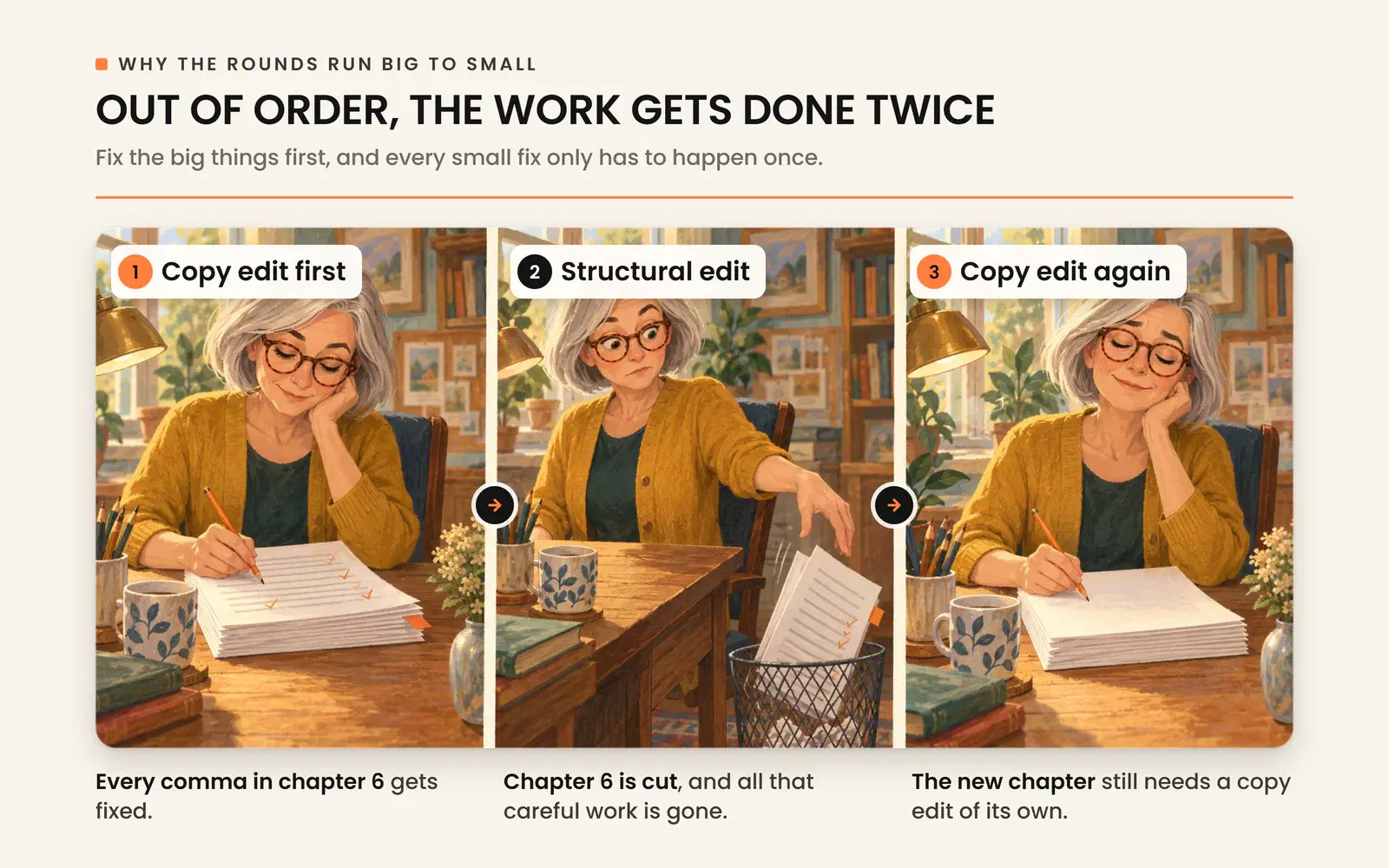
Here's what goes wrong the other way around. Say you book a copy edit first, and your copy editor fixes every comma in chapter 6. Then a structural edit cuts chapter 6 completely. All that careful work is gone, and the new chapter that replaces it still needs a copy edit of its own.
It's the same all the way down. Polish the sentences in a scene that later gets cut, and the line edit's wasted. Proofread pages that are about to change, and you'll end up proofreading them twice.
It happens more often than you'd think, and it's rarely carelessness. It usually comes from booking the round that feels most urgent instead of the round that comes next. Typos feel urgent because they're the easiest problems to see.
Why Do Some Lists Say Three Types and Others Say Four?
Because people draw the lines between editing jobs in different places. You'll find three types of book editing on one site, four on the next, and even more on a third. Nobody's counting wrong. They're just counting different things.
Three choices change the number.
- Whether proofreading counts. Some lists leave it out, because it checks your pages rather than improving your writing.
- Whether structural editing gets its own slot. Some lists fold it into developmental editing, since the two overlap so much.
- Whether extras count. A few lists add a manuscript critique or fact checking as types of their own.
Even lists of 4 types of book editing don't always agree on which four. The Editorial Freelancers Association, a professional group for freelance editors, says editing is usually broken down into four types. Its four are developmental editing, line editing, copy editing and proofreading, and it treats structural editing as another name for developmental editing.
We count four too, but we split structural editing out as its own round. Moving chapters around is a different job from judging whether your story works. Proofreading still happens. It just comes after the four, as the final check. Either way, the same work gets done, and only the labels change.
Developmental Editing Asks Whether Your Book Works
A developmental editor reads your whole manuscript and asks one big question. Does this book work? They're looking at the story or the argument as a whole, not at your sentences.
So what does a developmental editor do, day to day? In a novel, they look at your plot, your pacing and your characters. They check whether people act for reasons the story supports, and whether the ending pays off what the beginning set up.
In nonfiction, they check whether your argument holds together and whether each chapter delivers what your introduction promised. In a children's picture book, they'll ask whether the story works read aloud and suits the age it's written for. They'll also check that the words leave room for the pictures to do some of the telling.
What do editors look for in a manuscript at this stage? The big stuff. Here's the kind of thing a developmental edit catches.
- A villain with no reason to wait until the last chapter to act.
- A subplot that starts strong, then quietly disappears.
- A middle that sags because the same kind of scene keeps repeating.
- A memoir that never says why the story matters now.
- A business book that promises 5 steps and only really teaches 3.
These problems are hard to spot in your own book. They're spread across hundreds of pages, and you already know what you meant, so your brain quietly fills the gaps. A developmental editor comes to your book cold, the way your reader will.
Not sure you need one? If you keep rewriting the same chapter and it still feels off, the problem is often bigger than the sentences. That's developmental territory.
Developmental editing happens first, on a complete draft, before anyone polishes a single sentence. There's no point perfecting a scene that might not survive the next draft.
What You Get Back From a Developmental Edit
A developmental edit gives you written feedback, not a rewritten book. It's often an editorial letter that lays out the big problems and suggests ways to fix them. The feedback points to specific scenes, so you can see why each one was flagged.
Then you do the rewriting. That's the point. The editor explains what isn't working and why, and you decide how to fix it in your own voice. That's different from line and copy editing, where the changes come back right in your file.
Expect the letter to be honest, and expect to disagree with some of it. That's normal. A good letter argues its case, and you're free to push back where your plan for the book is different. If an editor hands back scenes they've quietly rewritten for you, though, that isn't a developmental edit.
Structural Editing Moves the Pieces Around
A structural editor looks at how your book is put together and moves things so it reads better. The question isn't whether your story works. It's whether everything's in the right place.
They look at the order of your chapters and scenes, where your book starts, and how much room each part gets. Then they find the parts that need more detail, the parts that should be cut, and the parts that should move.
The main goal of structural editing is simple. Every part of your book should sit where it does the most good for your reader. A structural edit might catch things like these.
- A big reveal in chapter 9 that would hit harder in chapter 15.
- A memoir that opens with 3 chapters of family history before anything happens.
- A self help book that explains the fix before it explains the problem.
- Two chapters that cover the same ground and belong together.
Structural and developmental editing overlap a lot, so they're often run together in one pass. In our own process, they're a single stage. They're still two different jobs, though. A book whose chapters are strong but out of order doesn't need a rethink, it needs moving. That's why we list structural editing services as a round of their own.
Structural editing happens alongside developmental work, or right after it. Either way, it comes before anyone touches your sentences, because a chapter that moves usually needs new sentences leading into it and out of it.
Line Editing Works on How Your Sentences Sound
A line editor works through your book sentence by sentence, looking at how your writing reads. By this point your story's settled, so the job is rhythm, clarity, word choice and tone.
What does a line editor do differently? They make your writing easier and more enjoyable to read, while keeping it sounding like you. They smooth rough patches, cut words that aren't pulling their weight, and fix the links between one idea and the next. Here's what they'd catch.
- Three paragraphs in a row that all start with "She".
- A sentence that says the same thing twice.
- Dialogue where every character sounds like the author.
- A chatty chapter sitting right next to one that reads like a textbook.
- A nonfiction paragraph full of terms your reader won't know yet.
- "She felt a wave of fear wash over her" where "Her hands shook" would do more.
You probably can't see these in your own writing. You wrote every sentence in order, so it all sounds right to you. A line editor hears it the way a new reader will.
Developmental editing vs line editing is a comparison people ask about a lot, so here's the simple version. A developmental editor asks whether a scene belongs. A line editor asks whether its sentences read well. The developmental editor won't fuss over a clunky sentence, and the line editor won't tell you a subplot goes nowhere.
Line editing comes once your story and structure are settled. Polishing a scene that gets cut later is effort nobody needed, and that's the whole reason it waits its turn.
Copy Editing Catches Errors and Inconsistencies
A copy editor checks that your book is correct and consistent from the first page to the last. They fix spelling, grammar, punctuation and word use, and they make sure the same thing is written the same way every time.
What does a copy editor do that you can't do yourself? They catch the small stuff your eyes skip over, because you know what's supposed to be there. Here's what that looks like.
- A sidekick called Jon on page 12 and John on page 140.
- A made up word for a magic power, capitalized in chapter 2 and lowercase in chapter 19.
- Past tense that slips into present for two sentences.
- "See chapter 7" when that chapter is now chapter 8.
- Numbers written as words in one chapter and as digits in the next.
A copy editor also flags things that don't add up. Say a character is 34 in March and 36 by June. That comes to you as a question, not a fix, because only you know which age is right. The same goes for dates, names and places that don't match from one chapter to the next.
Line editing vs copy editing is where a lot of authors get mixed up. A line editor makes your writing better, and a copy editor makes it correct. A copy editor isn't there to make your sentences prettier. That was the line editor's job.
Copy editing comes after the line edit, once you've stopped rewriting. The two often run close together, and in our process line and copy editing share a stage. Our copy editing services work to a professional style guide, so small choices get made the same way on every page.
Your Style Sheet Is Worth Keeping
A style sheet is a short record of every choice made about your book, and preparing one is part of a copy edit. It lists things like how names are spelled, which made up words get capital letters, and whether numbers appear as words or digits.
Ask for yours at the end of a copy edit, and keep it somewhere safe. If you're planning a series, hand it to whoever edits book 2. That's how your main character avoids picking up a second spelling in the sequel.
Proofreading Comes Last, on the Finished Pages
Proofreading is a final check on your laid out pages, not another round of changes. A proofreader looks for typos and formatting mistakes that slipped through the earlier rounds or crept in during layout.
Some lists call proofreading a type of editing and some don't. Either way, it does a different job from the four editing rounds. It doesn't improve your writing. It makes sure nothing's broken on the page.
Proofreading has to come last, because many of the problems it catches don't exist until your pages are laid out. Here are a few.
- The same word printed twice across a line break.
- A page header showing the title of the chapter before.
- A word that went missing during the last round of changes.
- A photo caption that ended up on the wrong page.
A proofreader also checks that every correction from the last round actually made it onto the page. Fixes can go missing between one version and the next, and this is the last chance to catch that before your book reaches a reader.
A proofread can't fix a slow middle or a flat sentence, and it isn't meant to. Proofreading a book that hasn't been copy edited just means checking text that's about to change. We cover the difference between editing and proofreading in more detail in a separate post.
Beta Readers and Manuscript Critiques Aren't Edits
A beta read and a manuscript critique are both useful, but neither one changes your manuscript. A beta reader tells you how your book felt, and a critique tells you what's wrong with it. Only an edit actually works on your pages.
A beta reader reads like one of your future readers. They'll tell you where they got bored, where they got confused, and which character they couldn't stand. That's real information, and an editor can't fake it, because editors read like editors. But a beta reader isn't working to a brief, and two of them can tell you opposite things.
A manuscript critique, sometimes called an assessment or an evaluation, is a diagnosis. An editor reads your whole book and tells you what's working, what isn't, and what to fix first. It doesn't fix anything itself.
Both fit best before your first round of editing. Wondering whether a beta reader or an editor should come first? Beta readers usually go first, because their reactions are great to hand to your developmental editor. A critique, meanwhile, tells you which round your book needs.
That's the same reason our editing process opens with a manuscript review. It works out the level of editing your book needs before any editing starts, so you don't end up booking a round your book isn't ready for.
How Much of Your Book Will an Editor Change?
How much an editor changes depends on the round, but you always get the final say. A good editor fixes what has a right answer and asks you about everything else.
A misspelled name, a missing comma, a chapter number that's now wrong? Those get fixed right in your file, where you can see each change. Anything that's a judgment call, like whether a scene runs long or a joke lands, comes to you as a question. Your book, your call.
What do book editors look for beyond the mistakes? The places where what you meant and what a reader will feel have drifted apart. A question works better than a rewrite there, because only you know what you meant.
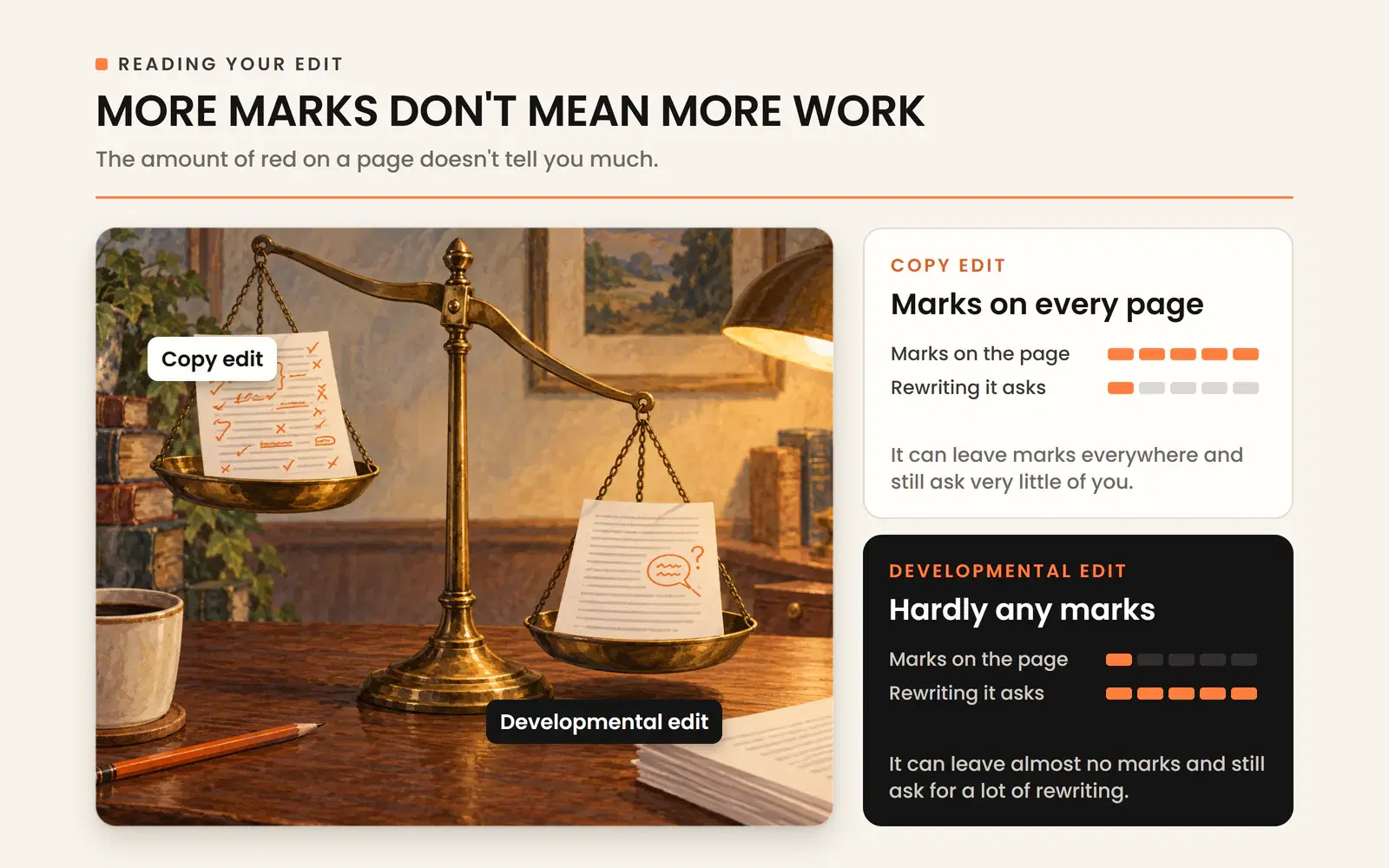
The amount of red on a page doesn't tell you much. A copy edit can leave marks on every page and ask very little of you. A developmental edit might leave hardly any marks and still ask for a lot of rewriting.
Your voice stays yours through all of it. Line and developmental edits work inside your style, not over it. You can turn down a suggestion, and if an edited chapter stops sounding like you, say so.
What Skipping a Round Costs Your Book
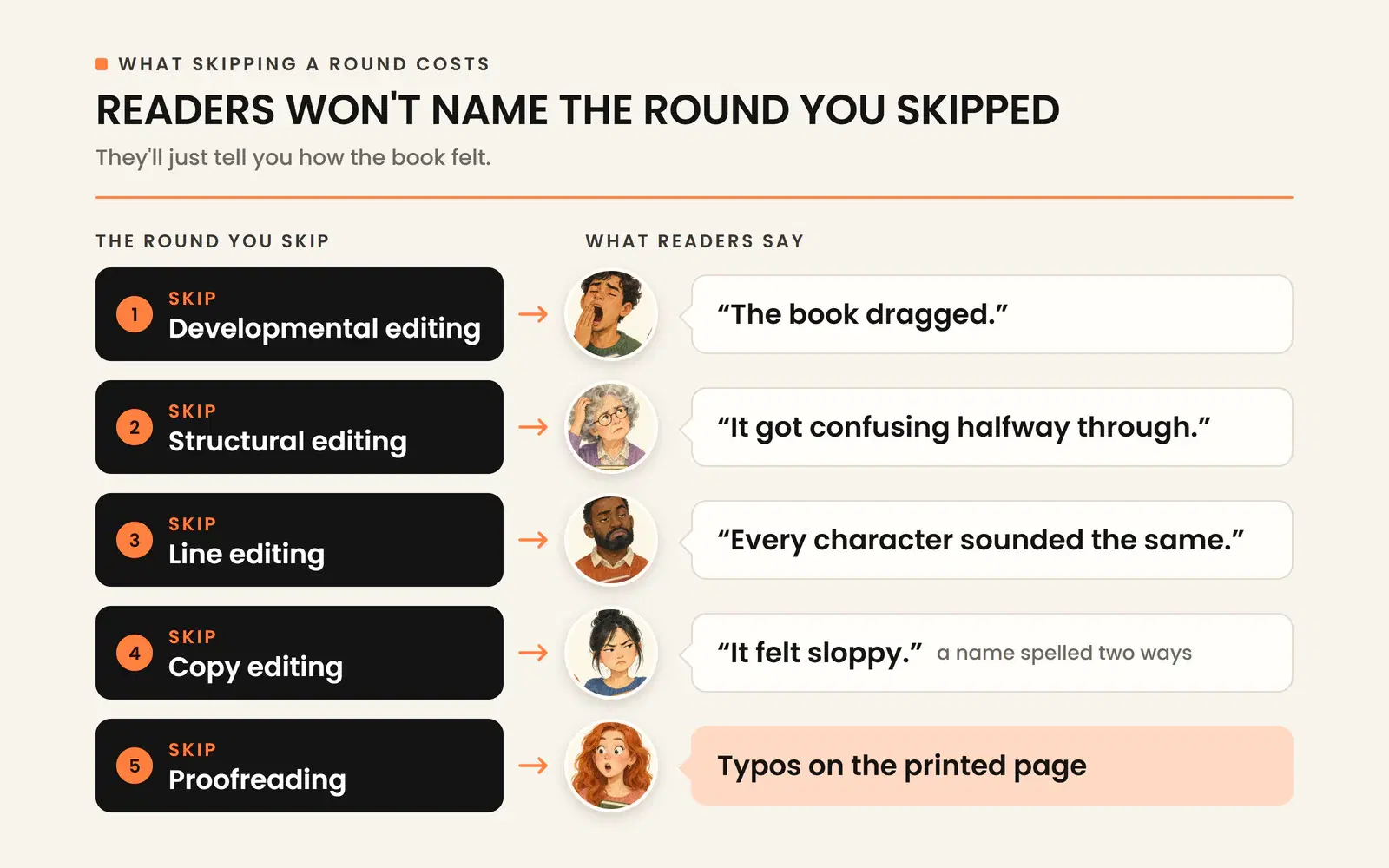
Each round of editing catches its own kind of problem, so skipping one sends that problem straight to your readers. They won't name the round you skipped. They'll just tell you how the book felt.
- Skip developmental editing, and readers say the book dragged, the middle lost them, or the ending fell flat.
- Skip structural editing, and readers say it took too long to get going or got confusing halfway through.
- Skip line editing, and readers say the writing felt flat or every character sounded the same.
- Skip copy editing, and readers say the book felt sloppy. This is the one they point out, because a name spelled two ways is easy to spot.
- Skip proofreading, and typos or layout slips end up on the printed page.
Do you need an editor to publish a book? Technically, no. Nothing stops you. With a traditional publisher, the publisher's team decides which editing rounds your book gets. When you self-publish, that call is yours.
So, do self-published books have editors? Some do and some don't, because the author decides which rounds happen. That freedom is great, but it means nobody else is watching for gaps.
If time is tight, combining rounds is usually safer than dropping one. Structural and developmental work often run as a single pass, and line editing is often done alongside copy editing. The order stays the same, big to small. Rounds that sit next to each other just run together instead of one after the other.
None of this means every book needs every round. It means you should know what you're giving up before you skip one.
When Should You Hire a Book Editor?
Knowing when to hire a book editor comes down to one thing, whether your draft is complete. Rough is fine. Missing chapters aren't.
A developmental editor can't judge the shape of a story that's missing its ending. If some chapters are still unwritten, say so up front, because it changes which round is worth running first.
The opposite mistake is booking the last round first. A proofread on a draft you're still revising checks pages that won't be final, and every change after that means checking them again.
When you do reach out, tell your editor who the book's for, whether you're self-publishing or pitching agents, and any publication date you're working toward. Those details shape what the editor pays attention to and how the rounds get scheduled.
Leave yourself room between rounds, too. After a developmental edit, you're the one doing the rewriting, and that takes as long as it takes. Rushing it just carries problems into the next round.
The stages of editing a novel and a nonfiction book run the same way. A series is what changes things. If you're planning one, tell your editor at the start. Send your series bible too, if you keep one, so the choices made in book 1 carry through to book 2.
Which Round Does Your Book Need Next?
The round your book needs next depends on where your draft is right now. Here's a quick way to match your draft to a round.
- Still writing, or not sure your story works? You'll want developmental editing once the draft's done.
- The story works, but the order feels off? That's structural editing.
- Story's settled, but the writing doesn't sound the way you hear it in your head? That's line editing.
- Happy with the writing and nearly ready for layout? Copy editing comes next, then a proofread once your pages are laid out.
If two of these sound like your book, start with the one higher up the list. The later round can wait, and it'll go more smoothly once the earlier one's done.
If you're still asking "do I need an editor for my book?", try a better question. Which round, and when? That's hard to judge from inside your own book, and that's fine. It's exactly what a manuscript review is for.
Whoever you work with, ask them to name the round they're quoting for and what you'll get back at the end. Our guide on what to ask before you sign with a book writing company covers the rest.
At Book Writing US, our book editing services start with that manuscript review. So before any editing begins, you'll know which of the types of book editing services your book needs, and why. Tell us where your draft is, and we'll take it from there.
Frequently Asked Questions
Can one editor handle every round of my book?
Yes, and plenty of authors work that way. There's one good reason to bring in fresh eyes, though. An editor who's read your book three times starts to skim, just like you do. A new reader for the copy edit or the proofread catches what familiar eyes miss.
How long does book editing take?
It depends on your book's length, how many rounds it needs, and how clean the draft is. A developmental edit takes longer than a copy edit, because the editor's diagnosing, not just correcting. Your own rewriting time between rounds counts too. Ask for a schedule round by round instead of one end date.
How many times should a book be edited before it's published?
Once per round, in order, is the usual answer. Running the same round twice on unchanged text rarely finds much. The exception is new material. Anything you rewrite after a copy edit needs a copy edit of its own.
What's the difference between a style guide and a style sheet?
A style guide is a rulebook for lots of books, and The Chicago Manual of Style is one example. A style sheet records the choices made for your book alone, like how your characters' names are spelled. Your copy editor follows the guide and builds the sheet.
Is fact checking part of copy editing?
Not fully. A copy editor may flag a fact that looks wrong in passing, but checking every claim is a separate, deeper job. If your book names real people, dates or events, ask for fact checking by name.
What's the least editing a book needs before it's published?
If your story and writing are already strong, a copy edit and a proofread. Those catch the mistakes readers notice fastest. The hard part is knowing whether your story and writing really are strong, and that's tough to judge about your own book. A manuscript review can tell you.
- What Are the Four Types of Book Editing?
- Developmental Editing Asks Whether Your Book Works
- Structural Editing Moves the Pieces Around
- Line Editing Works on How Your Sentences Sound
- Copy Editing Catches Errors and Inconsistencies
- Proofreading Comes Last, on the Finished Pages
- Beta Readers and Manuscript Critiques Aren't Edits
- How Much of Your Book Will an Editor Change?
- What Skipping a Round Costs Your Book
- When Should You Hire a Book Editor?
- Which Round Does Your Book Need Next?
- Frequently Asked Questions