
What Makes a Good Children's Book, and Why a Lesson Is Not the Answer
Short Answer: A good children's book is one a child asks for again. It holds a reader who's free to wander off, sounds great, reads aloud, makes kids laugh, and leaves the pictures something to do. Your book can carry a lesson too, but the lesson can't do any of that work for you.
Maybe you've finished a children's story, or you're halfway there, and you're wondering if it's any good. Good question. It's also a tricky one, because what makes a good children's book isn't always what you'd guess.
If you're like a lot of first-time authors, you guessed the lesson. A book about kindness, sharing or being brave feels like it's worth something. Your readers see it differently. Ask a parent which book their child brings them at bedtime, night after night. There's a good chance it's the silly one, not the one with the big message.
Kids don't love a book because it's good for them. They love it because something in it works on them, every single time. Across the first children's manuscripts we read, the ones that work usually share 5 things. See how many your story already does.
- They hold a young reader who's free to walk away.
- They sound good out loud, on the 20th reading as much as the first.
- They're funny, or at least playful, in a way your reader can actually get.
- They give a child a reason to come back tomorrow.
- Their words leave the pictures something to do.
Notice what's missing? There's no lesson on that list. That's not because lessons are bad. It's because a lesson can't do any of those 5 jobs for you, even though a first manuscript often asks it to. We'll come back to that once you've seen what your readers actually respond to.
What Holds a Reader Who Can Walk Away?
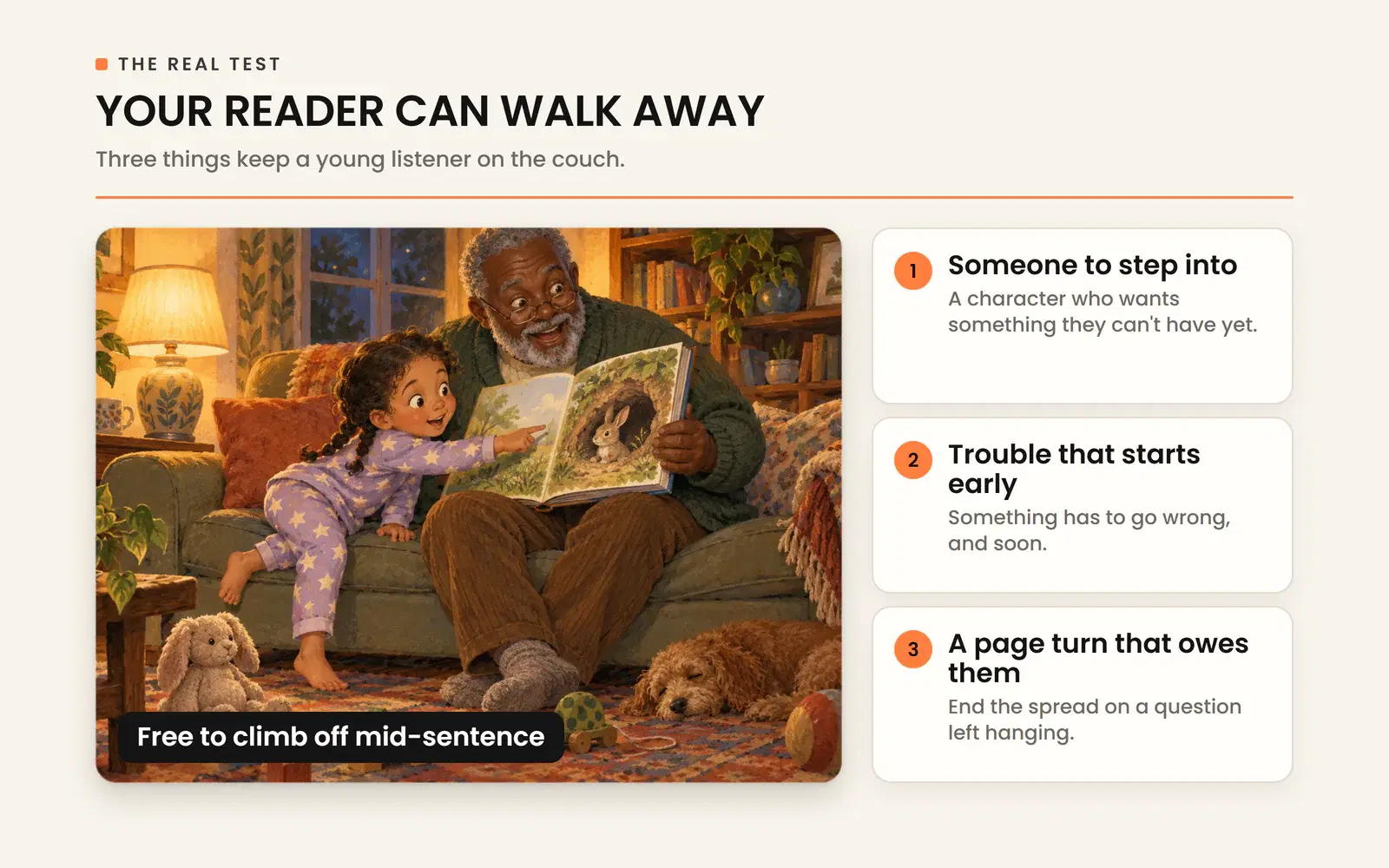
A children's book holds a young reader with 3 things working together. Your reader needs a character they can step into, trouble that starts early, and a page turn that leaves a question hanging. Take any one away and your listener starts looking around the room.
You've probably finished a book you weren't enjoying. Most grown-ups have. We push on to be polite, or because we paid for it. A 4 year old won't. Your audience can climb off the couch in the middle of a sentence, and plenty do. That's the real test your book has to pass.
So why do kids love books? Because a good one gives them someone to be and something to find out. Your job is to keep both moving faster than their attention runs out.
Start with your character. Kids don't watch a hero from across the room. They climb right inside. That's why a character who's calm, capable and never in doubt holds nobody. Give yours something they want and can't have yet, even something small, like a turn on the tire swing. Now your reader has somewhere to stand.
Then comes the trouble. What do kids like in books? Ask them and you'll hear about the funny part, the scary part and the part where everything goes wrong. That's one answer wearing 3 different costumes. Something in your story has to go wrong, and it has to go wrong early.
Last is the page turn. In a picture book, turning the page is a real moment, and somebody has to decide to do it. Your best spreads will end owing the reader something, like a door about to open or a joke about to land. A spread that wraps up neatly hands your reader the perfect place to stop.
Put those 3 together and you've got story shape, which matters more than your subject. A book about a lost sock can hold a room as well as one about a dragon. Want to see that shape up close? Our guide for first-time authors shows how a children's book plot grows out of its main character.
Your First Page Has 3 Jobs
By the end of its first spread, a strong children's book has already done 3 things. It's put your reader somewhere, given your character something to want, and left a reason to turn the page. None of it is explained. It's all just moving.
Setting the scene takes less room than you'd think. A rainy window, a messy kitchen, the last light before bedtime. That's enough for a child to know where they are. What eats up your pages is explaining the world before anything happens in it.
The wanting is what most weak openings are missing. A character who's simply there, however cute, gives a child nothing to wait for. A character who wants something turns your reader into someone waiting to see if they'll get it. That waiting is what carries them to page 2.
Openings that work tend to begin in the middle of something. The trouble is already underway on page 1, and your reader has to hurry to catch up. For a kid, that's a great feeling. It means something's happening, and you've got them.
Your Book Has to Sound Good Out Loud
A children's book has to sound good in a grown-up's mouth, because that's how most young kids meet it. A parent, a grandparent or a teacher will read your book out loud, often at the end of a long day. And there's a small, very honest critic listening to every word.
That changes what good writing means for you. A sentence can look fine on the page and still trip someone up out loud. Trouble reading aloud tends to show up in the same 4 places. Watch for them in your own manuscript.
- A sentence that needs a second run. The reader gets halfway, loses the thread and has to start over to find out who's doing what.
- A rhythm that breaks at the page turn. When a line runs across the turn, the pause lands in the wrong place and the beat you built is gone.
- A name nobody can say. Your invented names look fun on paper. Out loud, the adult has to pick a pronunciation on the spot, and kids notice if it changes.
- A rhyme that almost works. A near rhyme makes the reader bend a word to fit, and a child who knows that word hears it.
Rhythm matters in your prose too, not just in rhyme. A line that lands on a strong word gets a reaction. A line that trails off gets a yawn. Kids can't tell you why one line works and another doesn't, but their faces can.
The best books to read aloud also give the grown-up something to perform. Think of a character with a catchphrase, a sound effect, or a line that begs to be whispered. Hand the adult a moment like that and they'll read your book with more energy. Kids feed off it.
Why can't you catch the bumps yourself? Because you know how every line is meant to sound, so your mouth smooths them over before your ears notice. That's why your manuscript should be read aloud by someone who's never seen it. Every spot where they stumble is a spot that still needs work.
Picture books are the extreme case, but early readers get read aloud too. First an adult reads them, then a child works through every word alone. Either way, your book has to survive a real voice.
Humor Keeps Kids Listening
Humor keeps a child listening, and a child who's still listening can take in everything else your story has to say. That's why funny isn't decoration in a children's book. It's what holds the rest of your book up.
Humorous children's books sometimes get treated as the lighter option, the warm-up before the serious book. Kids don't see it that way, and you shouldn't either. A laugh is proof that your listener is paying attention. You can't fake that, and no message can buy it.
Your book doesn't have to be a comedy, of course. A quiet bedtime story can be lovely. But even gentle books usually have some play in them, a silly sound, a small surprise, a character who gets something a little wrong. That lightness gives your reader a reason to lean in.
Your jokes also get better with time, which is more than a moral can say. Heard twice, a moral is just being told again. Heard twice, a good joke lets the child wait for it and then watch the grown-up walk right into it.
Jokes Kids Get, and Jokes That Sail Past Them
Kids laugh at a narrower set of jokes than you might expect, and some of the jokes adults love go right over a child's head. Here's how the common kinds of humor in children's books tend to land.
| Kind of joke | What it looks like on the page | Who laughs |
|---|---|---|
| The mishap that repeats | The same thing goes wrong 3 times, and by the third the child calls it out before it happens | The child |
| The character who's wrong | Grandpa searches the whole house for the glasses sitting on his head | The child, loudly |
| Words that are fun to say | A silly made-up word the child repeats all week | The child |
| The wink to the grown-up | A line about bedtime that only a tired parent gets | The adult |
| The pop culture nod | A reference to a show the child has never seen | The adult |
| The spelling pun | A joke that only works if you can see the letters | The adult, if anyone |
Most of the kid rows work the same way. They put the child in charge. When a young reader spots something a character can't, they get to shout the answer at the page. For someone who spends all day being corrected, that's a thrill.
A few grown-up jokes are fine. The adult has to enjoy your book too, especially on the 30th night. But if the grown-up rows are doing all the work, the child has no reason to ask for your book again.
Why Do Kids Want the Same Book Again?
Kids ask for the same book again because knowing what's coming is the fun part. If your reader mouths the next line before the grown-up reads it, they aren't bored. They own your story now, and they're performing it too.
Rereading isn't wasted time for your reader, either. Researchers have tested it. In one small study of storybook reading with 3 year olds, children were visited at home 3 times in one week. At each visit, some heard the same story 3 times in a row. Others heard 3 different stories that used the same made-up words. The kids who heard the same story learned the new words and still knew them later. The kids who heard different stories didn't learn them.
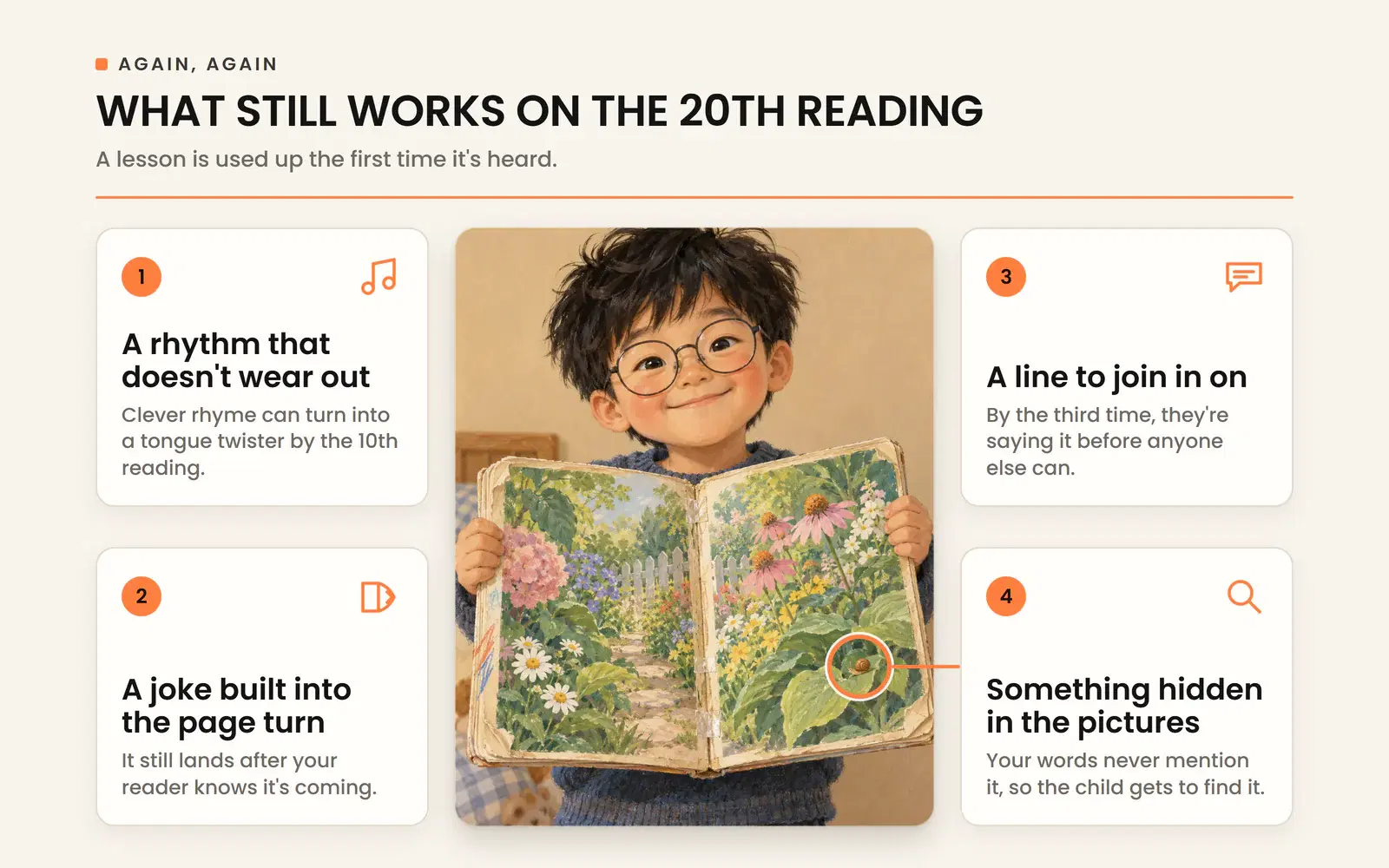
So the reread is where a lot of your book's work gets done. That means your book has to survive it. Here's what still works on the 20th reading.
- A rhythm that doesn't wear out. Rhyme that felt clever to you the first time can turn into a tongue twister by the 10th. A tired adult starts smoothing the rough lines, and the child stops them to put the real words back.
- A joke built into the page turn. When the laugh comes from turning the page, not from one clever sentence, it keeps working. It still lands after your reader knows it's coming.
- A line to join in on. A refrain that comes back on every spread gives your listener a job to do. By the third time, they're saying it before anyone else can.
- Something in the pictures they haven't found yet. A snail hiding on every spread, or a background character with a little story of their own. Your words never mention it, so the child gets to find it.
What doesn't hold up is the book with a point. Once your reader has got the point, there's nothing left to find. A good story gives more each time, because the child gets to look forward to the best parts. A lesson is used up the first time it's heard.
Leave the Pictures Something to Do
A good picture book leaves your reader something to find that the words never mention. When your words and the pictures each tell part of the story, the child gets to put the two together. That little moment of figuring it out is a big part of the fun.
It's also a big part of what makes a good children's picture book. Kids love being the one who notices. A picture that shows more than your words say puts your reader ahead of the story, and sometimes ahead of the grown-up reading it.
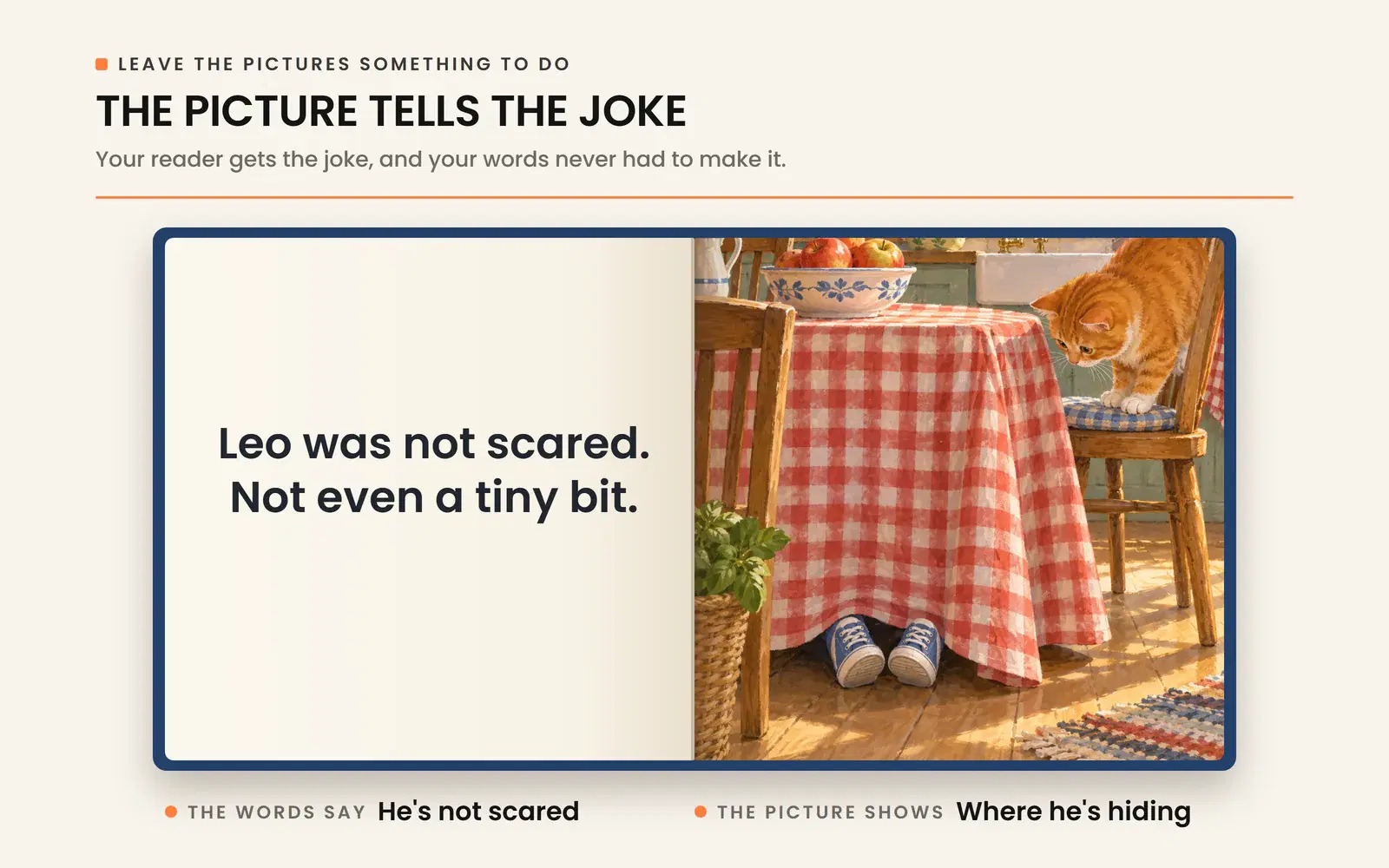
Here's how that plays out. Say your text reads, "Leo was not scared. Not even a tiny bit." The picture shows Leo hiding under the table with only his sneakers sticking out. Your reader gets the joke, and your words never had to make it.
For you, that's good news. Some of your book's best moments don't need a single word from you. A good illustrator fills the room you leave with jokes and little secrets you didn't know your story had. Those are often what a child spots on the 10th reading.
If you're writing an early reader, things work a little differently. There, the pictures support a child who's reading alone, so the art tends to match your words more closely. The gap still matters. It's just smaller.
Does a Children's Book Need a Moral?
No, a children's book doesn't need a moral. It can carry one, and plenty of well-loved books do, but a moral isn't what makes a good children's book. When your first manuscript starts from the lesson, the story usually comes out flat.
It's easy to see why you'd reach for it. Tell people you're writing a children's book and the first thing they ask is what it's about. "A duck who won't get his feet wet" sounds small. "A book about being brave" sounds important. The lesson makes your project feel worth doing.
The trouble starts once the lesson is locked in. Now your main character exists to learn it, the plot exists to teach it, and the last page exists to say it out loud. Every choice you make bends toward the point, and the fun gets squeezed out.
Kids can hear a lecture coming from a mile away. They get explained to all day long. When your story starts explaining too, you can watch the room change. A kid who was leaning in a minute ago is suddenly very interested in their sock. They've stopped wondering what happens next and started wondering when it ends.
What if your book has a real job, like helping a child through a new baby or a first day of school? That's fine, and those books matter. They still work best as stories first. Your reader has to care what happens to the character before your book can help with anything.
If you've got the lesson habit, you're in good company. It turns up in a lot of the first manuscripts we read. It's one of the habits on our list of what not to do when writing a children's book. It can be a hard one to let go, too, because the lesson is often why someone started writing in the first place.
A Theme Lives in the Story, a Lecture Stops It
A theme is what your story is about underneath, and your reader finds it by living through the story with your character. A lecture is the story stopping to tell the child what it's about. It's the same idea delivered in opposite ways, and kids can feel the difference long before they could explain it.
Here are 3 signs your manuscript has slipped from theme into lecture.
- A character suddenly explains what they've learned, in words no kid would ever use.
- Your last page repeats the point the story already made, just in case.
- One character is wrong at the start and right at the end, and nothing else ever happens to them.
That last one backfires in a funny way. Kids tend to side with the character being corrected, because they know exactly how that feels. So your book's sympathy lands in the one place you didn't want it.
The version that works keeps the meaning inside the action. Picture a story about a girl whose knees shake the whole way up the ladder to the high slide, and she climbs anyway. Nobody needs to tell your reader that being brave means being scared and doing it anyway. They already felt it.
That's the difference between a book that teaches and a book that lectures. When the plot grows out of what your character wants, the meaning comes along for free.
What Makes a Children's Book Successful?
A children's book is successful when the child it was written for wants it again. That's the test that matters most. Sales figures and star ratings tell you how a book did with the grown-ups who bought it. They can't tell you whether it worked for the child on the couch.
So what makes a successful children's book? The same things that make a good one, done well enough to survive real life. You can see your book working when these things happen.
- The child watches the page, not the room.
- The interruptions are about the story, like "why is he doing that?" instead of a snack request.
- The book comes back the next night, and nobody had to suggest it.
- The grown-up gets through a whole spread without stumbling.
And what makes a great children's book? It does all of that so well that the grown-up doesn't mind the 30th reading either.
If you're asking what makes a children's book successful, look at how your reader responds, not at the message your book carries. Kids ask for the funny one, the scary one, the one with the snail on every page. They rarely ask for the one about patience.
Here's the encouraging part. If your story already has a character who wants something, some trouble and a few laughs, you're further along than you think.
When the Story Works, It's Time to Make the Book
Once your children's story works, your next job is turning it into a real book. That means formatting, illustration and design, typesetting and proofing, printing, and getting it listed where readers can find it.
Each of those steps can protect your story or quietly undo it. The page turns and the rhythm you worked on depends on where each line lands. One line on the wrong spread can flatten a joke.
Book Writing US has worked with authors for more than 10 years. Our children's team handles picture books, early readers and educational books, from manuscript to finished copy. When you're ready to publish your children's book, tell us where it stands today. We'll tell you what it still needs.
Frequently Asked Questions
What makes a good children's book title?
A good title tells the grown-up what kind of book yours is and gives the child something fun to say. If your title names the character and hints at the trouble, it's probably doing both. A title built on a big idea, like Kindness, tends to do neither, because kids rarely ask for a book by its theme.
What is a good size for a children's book?
Your book's size follows its format, and the format follows your reader's age. Picture books suit a larger page, often wider than it is tall, because an adult holds the book open for a child to see. Early readers suit a smaller page, since the child holds the book alone. The size gets settled before illustration starts, because the art is drawn to fit your page.
Why do kids like fantasy books?
Fantasy lets a child feel powerful in a world where they usually aren't. A talking fox or a secret door hands a young reader choices their real day doesn't. That pull isn't limited to fantasy, though. If your child character gets to decide things and fix things, your story can hold a reader just as well.
What do parents want to see in children's books?
Parents want a book that suits their child's age and one they can read aloud again and again without wincing. That's worth knowing, but parents aren't who you're writing for. A parent buys the first copy. The child decides whether it ever comes off the shelf again.
Why are children's books important?
A children's book is often a child's first taste of story, rhythm and jokes, long before they can read alone. A fun first taste can make books something a child goes looking for. That's a big part of why your book is worth writing well, and why it's harder than it looks.
What can a children's book teach without a lesson?
Plenty. Your readers pick up new words from stories, especially the ones they hear again and again. They get to try on big feelings, like being scared or left out, safely, through a character. And they learn that books are fun, which might be the most useful thing your book can teach.
- What Holds a Reader Who Can Walk Away?
- Your Book Has to Sound Good Out Loud
- Humor Keeps Kids Listening
- Why Do Kids Want the Same Book Again?
- Leave the Pictures Something to Do
- Does a Children's Book Need a Moral?
- What Makes a Children's Book Successful?
- When the Story Works, It's Time to Make the Book
- Frequently Asked Questions