What First-Time Children's Book Authors Get Wrong
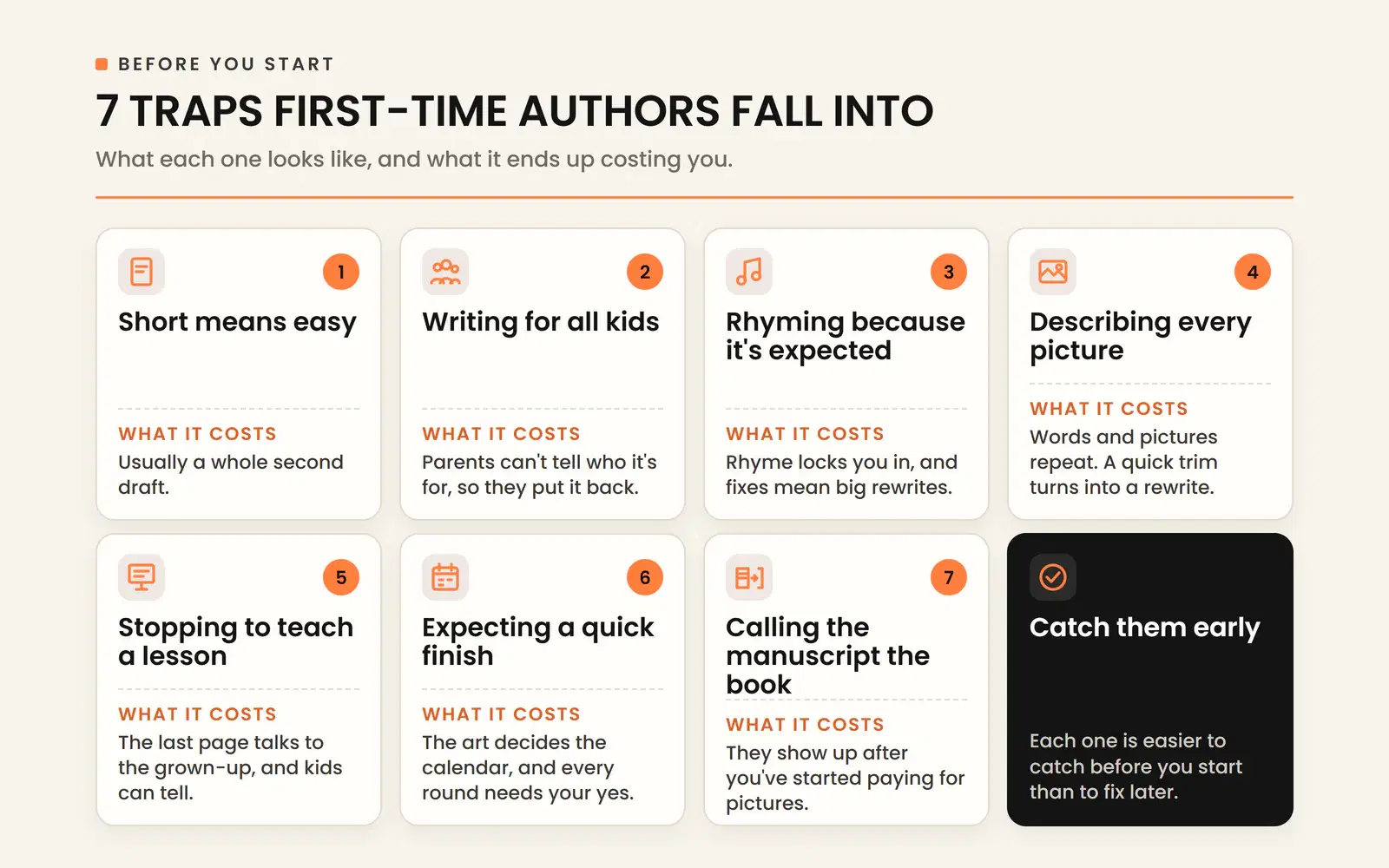
Short Answer: First-time children's book authors tend to trip over the same 7 things. They think a short book is an easy book, write for “kids” instead of one age group, and rhyme because it feels expected. They also describe every picture, preach a lesson, expect a quick finish, and call the manuscript the finished book. Each one is easier to catch before you start than to fix later.
Knowing what not to do when writing a children's book matters more than it sounds. You've got a story you love, maybe one your kids can already recite, and it's tempting to jump straight in. The trouble is that none of these mistakes feel like mistakes while you're making them.
They turn up in plenty of first children's manuscripts, and they don't mean you can't write. They happen because a children's book looks simple from the outside. Most of the hard parts don't show up until after you've finished writing.
You won't find a step by step writing guide here. What you'll find is the list we wish every first-time author read before starting, with what each mistake looks like and what it ends up costing you. Most of the examples are picture books, since that's where a lot of first-time authors begin, but the same traps show up at every age.
Is It Hard to Write a Children's Book?
Yes, and assuming it isn't is where a lot of first books start to go wrong. A children's book is short, and that's exactly what makes it hard. Every word has to pull its weight, because a weak line sticks out on a page that small.
When people ask us "is it hard to write a children's book?", they're usually picturing the page count. That's the trap. A novel has hundreds of pages to win a reader over. A picture book gets a line or two per page, with a picture right beside it and a page turn waiting underneath.
And a picture book still needs everything a novel needs. Your main character wants something, something gets in the way, and the ending has to pay it off. You just get a tiny fraction of the room to do it in.
Your word choice gets squeezed too. You need words a child knows that still feel fresh, and a voice that never talks down. Simple words that sparkle are much harder to find than big ones.
Here's what the mistake looks like on the page. The picture shows a puppy wagging its tail, and the line underneath says the puppy was very happy. The words just repeat the picture. In a novel, a line like that would slip by. In a picture book, it might be the only line on the page, and it's wasted.
Then there's the read aloud test. Your book has to work when a tired parent reads it cold at bedtime. If the rhythm trips them up, or a sentence runs out of breath, the child hears it. That's a much harder test than reading it to yourself, because you already know how it's supposed to sound.
So what does this mistake cost you? Usually a whole second draft. You end up writing the book twice, and the second time is the real one.
Not Picking an Age Group First
Every children's book is written for one age group, and you need to pick yours before you write a word. "Kids" isn't an audience. A 3 year old being read to at bedtime and a 9 year old reading under the covers want completely different books.
Children's book age ranges aren't just labels for the shelf. Your age group decides how long your sentences can be, which words you can use, and whether a grown-up reads the book aloud or the child reads it alone. Children's picture book age ranges start from one simple fact. Your reader can't read yet.
Your age group also sets the format, and the format shapes how your book gets made, from how many pictures it needs to how it's printed. That's why it's the first decision, not a finishing touch. Pick it after the draft is done, and you're not polishing anymore. You're rewriting.
Here's how the main children's book age groups line up. The exact ages shift a year or two depending on who you ask, so treat them as a guide, not a rule.
| Book type | Who it's for | How it gets read | What the writing needs |
|---|---|---|---|
| Board book | Babies and toddlers | Read aloud by a grown-up, and often chewed | Very few words, simple ideas and lots of repetition |
| Picture book | Young children who can't read yet | Read aloud by a grown-up, usually on repeat | A complete little story that shares the job with the pictures |
| Early reader | Kids just starting to read on their own | Read by the child, often out loud to a grown-up | Short sentences and words a new reader can sound out |
| Chapter book | Ages 5 to 10 | Read alone or with a grown-up, one chapter per sitting | Short chapters with a reason to keep going |
| Middle grade | Ages 8 to 12 | Mostly read alone, sometimes all in one go | Bigger plots and real stakes, with no talking down |
The line between a picture book and an early reader is simple. If a grown-up reads it to the child, it's a picture book. If the child reads it, it's an early reader.
And notice how chapter books and middle grade overlap? A 9 year old could be reading either one. That's why age alone doesn't settle it. How the book gets read does.
Educational books follow the same rule. An alphabet book for a toddler and a science book for a 10 year old are both educational, and they have almost nothing else in common.
The Book That Falls Between Two Age Groups
The most common way to miss your age group is a picture book story told in chapter book sentences. It's an easy slip, and a hard one to spot in your own writing.
Say your story is about a bunny who's scared of the dark. That's perfect for a 4 year old. But your sentences run long, your words are big, and some of your jokes are really for the parent. A 4 year old can't follow it, and a 9 year old thinks it's for babies.
The opposite version happens too. It's a picture book carrying a middle grade plot, with a big cast, two storylines and a twist that needs a whole chapter to explain.
Either way, the cost shows up the moment a parent picks your book up. They can't tell who it's for, so they put it back. Try to write for every kid, and you end up with a book no particular kid reaches for. If you can't say who's holding your book and who's doing the reading, it's probably stuck between two groups.
Should Your Children's Book Rhyme?
Only if the story truly needs it, and only if it sounds effortless read aloud. Rhyme isn't a requirement. Deciding your book has to rhyme before you've worked out the story is one of the most common first-time mistakes we see.
Should children's books rhyme at all? Some do, and a great rhyming book is a joy to read aloud. But often the question "should my children's book rhyme?" only comes up once a whole draft is already rhyming. By then, you've made the choice without meaning to. Plenty of us grew up on rhyming bedtime books, so rhyme feels like the default before the story has even taken shape.
Rhyme also locks you in. Once your text rhymes, you can't swap a single word without checking that the whole verse still bounces. Rhyme is hard to translate, too, which is one reason many publishers prefer picture books that don't rhyme.
Here's a quick check if you're not sure. Retell your story in plain sentences, with no rhyme at all. If it still works, the rhyme is a choice you're making. If it falls apart, the rhyme was holding it up.
Do Most Children's Books Rhyme?
If you've been asking "do most children's books rhyme?", the honest answer is no. And do all children's books rhyme? Not even close. Rhyme shows up mostly in books read aloud to young children, and even there it's one style among many.
Once kids start reading for themselves, most of their books are prose. Early readers, chapter books and middle grade novels rarely rhyme, and for a brand new reader, rhyme can get in the way. A new reader needs words they can sound out. A rhyme just needs a word with the right ending, whether your reader can manage it or not.
So why does it feel like every children's book rhymes? Because the rhyming ones stick in your head. You remember the books you could recite, not the prose stories you loved just as much.
Where Rhyme Goes Wrong
Rhyme problems are sneaky, because you hear your own lines the way you meant them. Here's what usually goes wrong.
- The rhyme picks the story. The duck goes out to take a stroll, and on the way he meets a troll. Now there's a troll in your book, not because the story needed one, but because "stroll" did.
- The sentence gets twisted. To land the rhyme, the words get bent into an order nobody talks in. "To the park went Sam and Jill" is a line no real person would ever say out loud.
- The beat only works in your head. You know which words to lean on, so it sounds smooth to you. A parent seeing it for the first time lands on the wrong syllable, and the whole line wobbles.
- The word is too big. Sometimes the only rhyme you can find is a word your reader has never heard, and the story grinds to a halt while someone explains it.
- The rhyme lands on the wrong page. The punchline shows up before the page turn, so there's nothing left to discover when the child turns it.
When a rhyming manuscript lands with us, the first thing we do is read it out loud. If it trips us up on that first pass, tweaking single lines rarely saves it. Getting the rhythm right across a whole book usually means rewriting big parts of it.
Describing Every Picture in Your Manuscript
Your job is the words. The pictures belong to the illustrator, and a manuscript that describes every one of them leaves the illustrator with nothing left to say. It's also one of the most common reasons a first picture book text runs long.
Here's what it looks like. Compare these two lines.
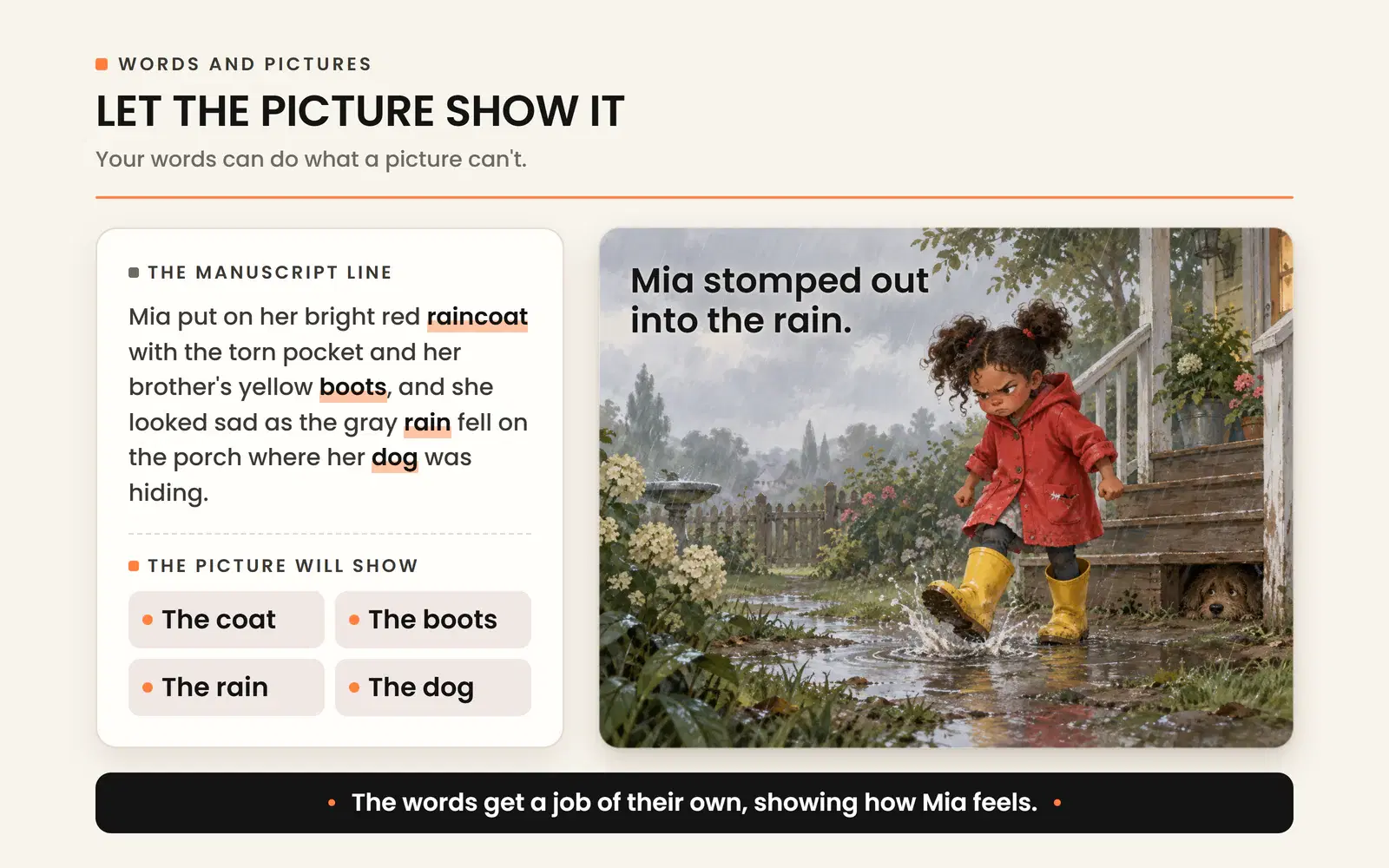
- Mia put on her bright red raincoat with the torn pocket and her brother's yellow boots, and she looked sad as the gray rain fell on the porch where her dog was hiding.
- Mia stomped out into the rain.
The first line describes things the picture will show anyway, the coat, the boots, the rain and the dog. The second leaves all of that to the illustrator and gives your words a job of their own, showing how Mia feels.
Words and pictures are good at different things. Your words can do what a picture can't, like what a character says, thinks, hears or wants, and how much time has passed. The pictures can show what everything looks like. When each does its own job, the page says more than either could alone.
Why does it cost you? First, your words and the pictures end up repeating each other, and a picture book has no room for repeats. Then, when the extra description comes out, the lines that leaned on it stop making sense. So a quick trim turns into a rewrite.
A quick note for the illustrator is fine, and often useful, when the picture has to show something your words don't say. Say your text tells us everything was perfectly calm, while the picture shows total chaos. That note earns its place. A note on every line doesn't.
Stopping the Story to Teach a Lesson
A lot of first children's books wrap up by explaining their own moral. That last page talks to the grown-up, not the child, and kids can tell.
It usually goes like this. Your little bear has already shared his honey and made a new friend, so the story has done its job. Then your last page says that's why we should always share with others. The story already showed it. The last line just says it again, louder.
Having something to say is fine. Plenty of wonderful children's books are about sharing, courage or saying goodbye. The mistake is stepping out of your story to announce it, when the story could have shown it.
Kids notice when a story turns into a lecture. One page it's a bear and his honey, and the next it sounds like a grown-up giving instructions. In the first manuscripts we read, that lesson line usually sits on the very last page, and it's often the one the author is proudest of.
If you've felt the urge to teach, you're in good company, and it's a big enough topic to get its own post. We look at why a lesson isn't the answer in what makes a good children's book.
How Long Does It Take to Write a Children's Book?
Less time than it takes to make one. Putting the words down is rarely what holds a first book up. The time goes into what happens once the manuscript is done, especially the pictures, and expecting all of that to move fast is the mistake.
If you're asking "how long does it take to write a children's book?", you're probably expecting a short book to mean a short wait. Not quite. The writing still has its own stages, from the first idea through the rewrites to reading it aloud until it flows. You can see the stages of writing a children's book laid out in our guide.
Your words aren't frozen once the edit is done, either. A few lines usually change when the sketches come in, because seeing your text next to the pictures shows you what the art already says.
Then the real production starts. An illustrated book goes through 5 stages before anyone can buy it.
- Manuscript formatting.
- Illustration and book design.
- Typesetting and proofing.
- Printing and production.
- Publishing and distribution.
Those 5 stages are exactly how our children book publishing services are set up, and none of them can start until the one before it is signed off. If you plan your launch around the day you finish writing, the calendar will surprise you.
Why the Pictures Set the Pace
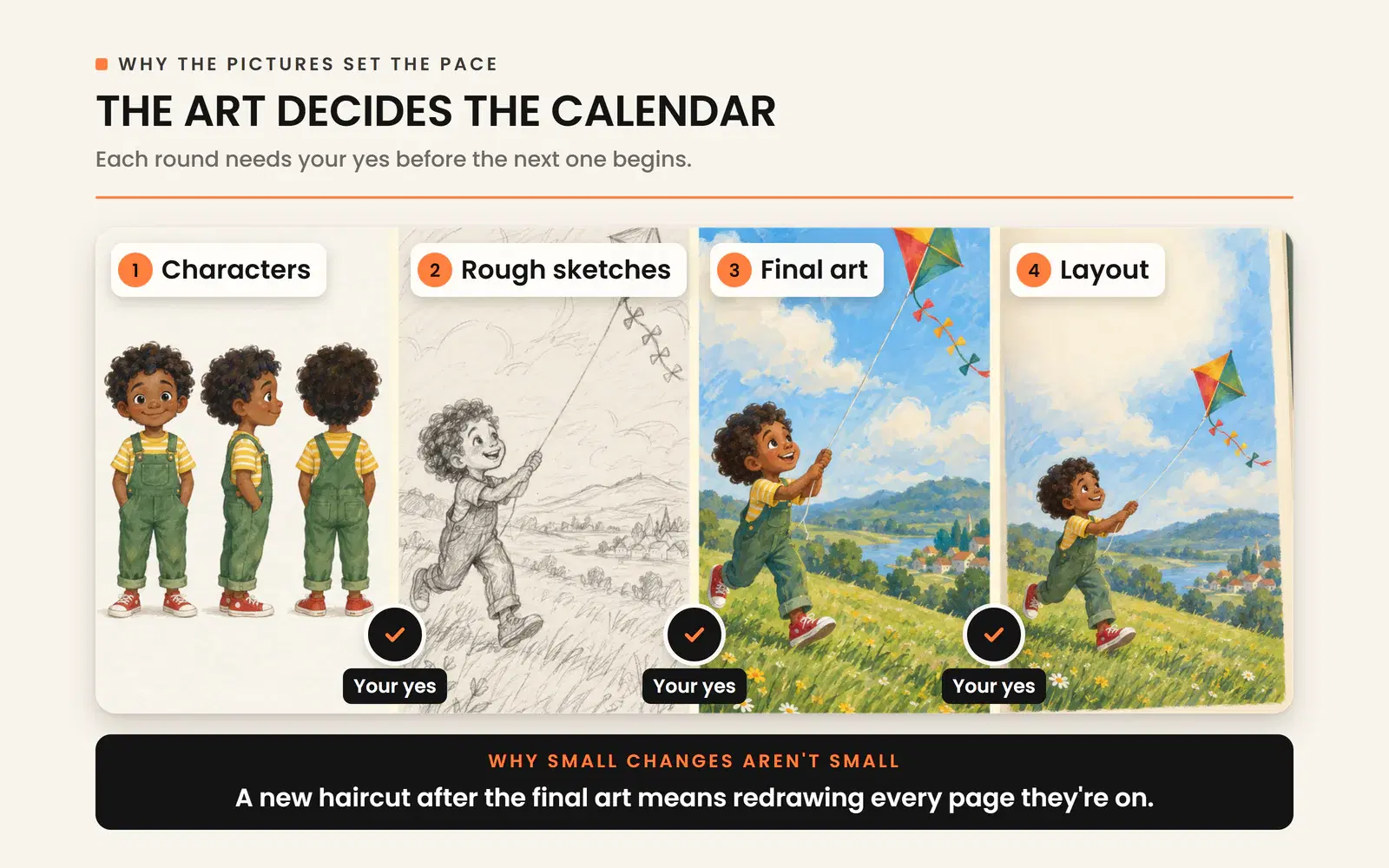
In an illustrated children's book, the art decides the calendar. It gets made in rounds, and each round needs your approval before the next one begins.
Your characters come first, and you sign off on how they look. Next come rough sketches of every page. Only after those are approved does the final art get made, and then it's placed into the layout. There's no point painting final art of a character who might still change.
That's why small changes aren't small. Give your main character a new haircut after the art is done, and every page they're on needs redrawing. In a picture book, your main character is on almost every page.
Layout adds its own surprises. Once your words sit on the finished art, a sentence that looked fine in a document might cover a face or crowd a corner. So it gets moved, split or trimmed, and that needs your yes too.
Your own replies are part of the schedule as well. When you take a while to reply, everything after that step waits with you. That's why we build an illustrated book's schedule from its approval rounds. The two things you control are how settled your text is before the art starts and how quickly you say yes.
Treating Your Manuscript as the Finished Book
Finishing your manuscript is a big moment. It's also where making the actual book begins, and the mistakes at this stage tend to be the expensive ones, because they show up after you've started paying for pictures.
The first is letting only family and friends read it. They love you and they already know the story, so they quietly fill in anything the page doesn't say. A stranger won't. Someone who doesn't know you will trip right where your rhythm breaks, and a child will show you exactly where they got bored, usually by wriggling.
The second is starting the pictures before the text is edited. It feels like progress. But if the story changes after the art is done, some of those pictures belong to a book that no longer exists.
It helps to know what a first edit usually does to a children's manuscript. It cuts more than it adds. The notes to the illustrator, the explanation after the joke and the lesson on the last page are often the first things to go. That can sting. But a shorter text usually reads aloud better, and it gives your illustrator room to do their part.
The third is leaving the cover until the very end. Parents meet your cover before anything else, yet it's often the last thing a first-time author gets to. Give some early thought to what a children's book cover has to do, so yours never ends up as a rush job.
Where First-Time Authors Usually Need a Hand
Knowing what not to do when writing a children's book helps, but the mistakes are still hard to spot from inside your own manuscript. That's not a sign you can't write. A children's book is a team job, usually shared by an author, an editor, an illustrator and a designer, and that's a lot to carry on your own.
That's the part we take off your plate. At Book Writing US, we work with authors on picture books, early readers and educational books. We handle what comes after the words, from illustration and design to typesetting, printing and distribution.
If you've spotted a few of these in your own draft, that's normal. They're much easier to put right before the pictures start than after. Tell us where your manuscript is now, and we'll help you spot which of these mistakes it's making and what it needs next.
Frequently Asked Questions
What is the difference between a picture book and a children's book?
Every picture book is a children's book, but not every children's book is a picture book. "Children's book" covers the whole shelf, from board books up to middle grade novels. A picture book is the short illustrated kind, usually read aloud by a grown-up, where the words and pictures share the story.
What age is too old for picture books?
There isn't one, and older kids still enjoy a good picture book. Kids tend to move on to early readers and chapter books once they want to do the reading themselves. As an author, the more useful question is who's doing the reading. If your reader reads alone, a picture book probably isn't your format.
Do children's books need page numbers?
Picture books usually don't show them. At bedtime nobody's hunting for a page number, and one in the corner just gets in the way of the art. Chapter books and middle grade novels do, since kids read them over several sittings and like to know where they stopped. Either way, it's decided at layout, not in your manuscript.
Do children's books have a table of contents?
Picture books don't. There's only one story in there and nothing to look up. Longer books often do, especially chapter books with named chapters and nonfiction books kids dip in and out of. Like page numbers, that's settled during design, not in your manuscript.
How long does it take to publish a children's book?
There's no single timeline, because it depends on how many rounds of approval your book needs. Illustrated books take longer, since every stage of the art waits for a yes before the next one starts. After the art come typesetting, proofing, printing and distribution. So two authors who finish their manuscripts together can still see their books arrive far apart.
- Is It Hard to Write a Children's Book?
- Not Picking an Age Group First
- Should Your Children's Book Rhyme?
- Describing Every Picture in Your Manuscript
- Stopping the Story to Teach a Lesson
- How Long Does It Take to Write a Children's Book?
- Treating Your Manuscript as the Finished Book
- Where First-Time Authors Usually Need a Hand
- Frequently Asked Questions