How to Tell a Legitimate Children's Book Publishing Company From a Scam
Short Answer: You can tell a legitimate children's book publishing company from a scam by what it puts in writing before you pay. A real company writes down the work, the price, what you'll own and what you'll approve, and it gives you time to decide. Children's book publishing scams do the opposite, with vague terms, rights grabs, pressure to sign and big sales promises. Paying for publishing work isn't a warning sign on its own, but unclear or one-sided terms are.
Maybe an email arrived praising your picture book and offering to publish it. Maybe a friendly caller wants to publish the story you wrote for your grandchildren. Either way, you'd like to know whether the company is real before any money changes hands.
Children's book publishing is a real field, full of honest editors, illustrators and printers. Book publishing scams are real too, and they borrow the same words. This guide sets ten red flags beside what a legitimate company does instead. It also covers contract terms, sales tactics, checks you can make yourself and what to do if you've already paid.
Is Children's Book Publishing Legit, or Mostly Scams?
Yes, children's book publishing is legit, and the scams inside it survive by copying the language of the real thing. The honest parts are easy to name. Traditional publishing houses buy the right to publish a book and pay the author. Platforms such as Amazon KDP and IngramSpark let authors publish directly, and many authors hire companies to edit, illustrate, design and print their books. Our guide to the jobs a children's book publishing company actually does explains that work.
Children's book authors can be easier to confuse than other writers, and it isn't about being naive. It's often a first, very personal book, written for a grandchild or with a child. Illustration is also a big job most authors have never paid for, so a vague offer is hard to judge.
That's why watchdogs exist. Writer Beware, sponsored by the Science Fiction and Fantasy Writers Association, has tracked publishing schemes and scams since it was founded in 1998. It notes that there are reliable providers among the companies that help authors self-publish. So the real question isn't whether a company charges, but whether it passes the checks below.
Does Paying a Publishing Company Mean It's a Scam?
No, paying a publishing company isn't a sign of a scam by itself. Paying for editing, illustration, design and printing is normal, and many authors choose to. What matters is what the money buys, and whether the terms are fair to you.
There are two kinds of arrangement, and the money moves in opposite directions. A traditional publisher buys the right to publish your book and pays you. That's why the Authors Guild, a professional organization for published writers, says a traditional publisher won't ask you to pay it up front. A company you hire works the other way round. It charges for its work, and it should leave your rights with you.
So judge a paid offer by four things, not by its cost. The terms should be clear, and you should get a written list of what you'll receive. You should approve the work as it goes, and your rights should stay yours. The self-publishing scams to worry about fail those tests. One might take a share of your royalties on top of its fee, while another never says what the money buys.
A picture book shows the difference clearly. Paying an illustrator to draw your pages is normal. Paying and never seeing a written agreement about who owns the art is not. If you're still deciding whether to hire help at all, read our honest look at whether self-publishing a children's book is worth it.
Publisher Red Flags, and What a Legitimate Company Does Instead
The red flags start with hidden or vague terms, rights or royalty grabs, pressure to sign now and promises of big sales. Vague lists of jobs, no approvals, no samples, unclear file ownership, hidden upsells and no real contact details belong on the list too. Each one has a plain opposite you can ask for, and the table sets them side by side with a quick check. One serious red flag, such as a contract that takes your rights, is enough to walk away.
| Red flag | What a legitimate company does instead | How to check |
|---|---|---|
| Hidden or vague terms | Puts the work, the price and the terms in writing before you pay | Ask for the full agreement to read at home |
| A contract that takes your rights or royalties | Leaves your copyright and your sales money with you | Read the lines on rights and on royalties |
| Pressure to sign now | Gives you time to think and answers your questions | Say you need a week, and watch the reply |
| Promises of big sales or chart rankings | Promises only the work it will do | Ask what happens if the book sells slowly |
| Vague promises instead of a list of jobs | Lists every job and what you'll receive | Ask for the list in writing |
| No approval steps | Asks for your yes before each stage moves on | Ask what you'll approve, and when |
| No samples of past work | Shows finished children's books, inside pages too | Find those books on Amazon yourself |
| Unclear ownership of the final files | Says in writing which art and print files are yours | Ask which files you'll have at the end |
| Upsells you couldn't see up front | Shows what's included and what isn't before you sign | Ask what isn't included |
| No real contact details | Gives a real address, phone number and named people | Call the number and look up the address |
Every one of these publisher red flags is about the terms and the way a company behaves. None of them is about whether it charges for its work.
Contract Terms That Should Make You Stop
Three kinds of contract terms are a reason to stop before you sign a children's book publishing agreement. Watch for terms that take your rights or royalties, terms that keep the art and files, and terms that never really let you leave. Any term a company can't explain in plain words belongs on that list too. This is general information, not legal advice, and a lawyer can read an agreement for you if anything feels unclear.
A Service Contract Shouldn't Take Your Rights or Royalties
A bad contract quietly moves your copyright or a share of your royalties to the company. A fair one from a company you hire leaves both with you. Royalties are the money your book earns from each sale. The U.S. Copyright Office explains that once you create an original work and fix it, for example by writing it down, you're the author and the owner. It adds that ownership can move through contracts such as assignments, so the wording matters.
In an agreement for services, slow down at words like "assign," "grant," "exclusive rights," "all rights" and "in all formats worldwide" before you sign. Exclusive rights mean only the company may publish the book in the ways listed, so you couldn't take it anywhere else. Also watch for a clause that gives the company a cut of your royalties on top of its fee. If the book will be listed in the company's own account, ask how and when the sales money reaches you.
Here's an example. An agreement for services that grants the company exclusive rights in all formats is a reason to stop, however friendly the sales call was.
Who Owns the Illustrations and the Print Files?
The written agreement decides who owns the illustrations and the print files, not the payment. The U.S. Copyright Office explains that whoever creates a work is its first owner. Under a work made for hire arrangement, the hiring party is the author and owner from the start, and ownership can also pass later through a contract such as an assignment. So a fair agreement says clearly who holds the rights to the art. It also says you'll receive the final print-ready files, which are the finished pages and cover set up to a printer's rules.
A picture book has art on nearly every page, and that art has its own creator. A bad contract leaves the art rights unstated or lets the company keep the files. Then you can't reprint the book, fix a typo or move to another printer. Writer Beware says it has heard from writers who lost control of their books after a scammer closed down or stopped responding.
Picture a mom who wants extra copies of her daughter's picture book for a school fair. She then learns that the company holds the files and won't release them. A fair agreement prevents that by naming the files you'll receive before any work starts. One question tests any company quickly. Ask, "If you closed tomorrow, could I still reprint my book?"
The Contract Should Say How You Can Leave
A fair contract lets you leave if the work isn't done, and it gives your rights and files back when it ends. The part of an agreement that covers ending it is called a termination clause, and it's the first place to look if a company stops doing the work. A bad contract has no clear way out. The Authors Guild gives related advice for hiring paid book publicists and marketers. It suggests a carefully worded agreement that sets out the tasks, when they'll be done and your ability to end it.
A bad exit usually takes one of two shapes. Sometimes there's simply no way to end the agreement at all. Other times there's a termination clause, but your rights only come back after a condition that may never happen. One example is a clause that waits until every printed copy is sold. Writer Beware describes a real clause like this and says termination in that case isn't really termination. It becomes an open-ended extension of the rights you first granted.
You don't have to understand every clause yourself. You should still be able to find the way out and read it in plain words before you sign.
Warning Signs in the Sales Pitch
A scam sales pitch usually rushes you, flatters you or promises results nobody can control. You'll hear those signs in the way a company talks to you, long before you see a contract.
A Deadline to Sign Is a Reason to Slow Down
Pressure to sign or pay today is one of the clearest signs of a scam, because an honest company gives you time. The Federal Trade Commission (FTC), the federal agency that enforces consumer protection laws, says scammers pressure people to act immediately. It adds that honest businesses give you time to make a decision. In another alert, the FTC calls pressure to act now a reason to stop. Amazon KDP's help pages warn that companies falsely claiming a link to KDP can pressure authors into spending money with discounts for quick payment.
In a children's book pitch, the pressure often sounds friendly. The price ends at midnight, or there are only two places left this month. Sometimes a manager needs your answer before the call ends. A dad might hear that his son's dinosaur story will lose its spot unless he pays by Friday. A real company would rather he read the terms first.
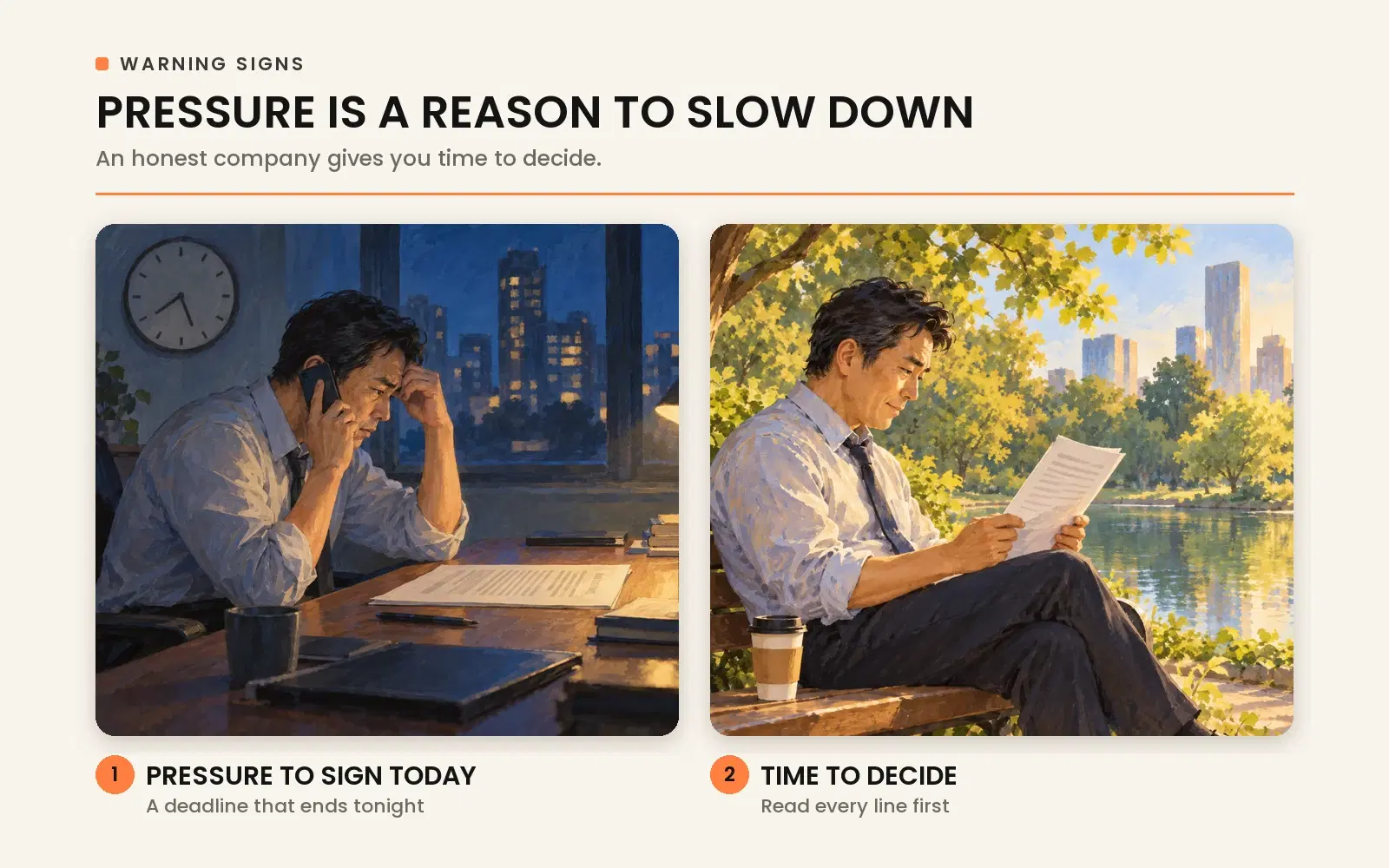
Here's a simple test. Say you need a week to read the agreement at home, then notice whether the reply is "of course" or a harder push. For more signs that apply well beyond publishing, read the FTC's advice on how to avoid a scam.
Can Anyone Promise Your Book Will Sell?
Nobody can honestly promise sales, rankings or awards for a children's book. A company that does is telling you what you want to hear. Writer Beware lists extravagant promises among the warning signs when authors hire book publicists. In April 2026, the FTC announced a settlement with a company that sold online self-publishing programs. The charges said the company misled people about how much money they were likely to earn.
A real company can promise the work on its list. That means the editing, the illustrations, the layout, the cover, the files and your approvals, which it controls. It can't promise how many copies sell, where a store shelves the book or whether a reviewer picks it up. Readers and stores decide those things. So be wary of lines about topping the charts or earning back your costs within a month.
Sort each promise into work or results. A promise about work can be written into an agreement and checked later. A promise about results can't, so it tells you nothing about the company.
Offers You Never Asked For
An out-of-the-blue offer to publish, republish or promote your book is a reason for extra care. The Authors Guild notes that traditional publishers, movie studios and directors rarely approach authors that way. Writer Beware goes further. It calls out-of-the-blue contact the main way overseas publishing scammers find their clients.
Here's how such an offer can look. A grandmother publishes a picture book about her grandson's lost teddy bear. A week later, an email says a "book scout" found it and a large publisher wants to republish it. Other offers promise to "rebrand" a book that's already on Amazon. Some come from someone writing as Amazon, KDP or a well-known publisher, using a look-alike or free email address. The FTC notes that scammers often pretend to be from an organization you know.
Some offers arrive soon after an author registers a copyright. The U.S. Copyright Office explains that its records are public. It also says some publishers send someone to collect the names and addresses of recently registered authors, so they can offer their services. It adds that this practice isn't against the law. So the letter isn't from the Copyright Office, and it proves nothing about the sender either way.
The safest habit is simple. Find the company's website yourself and contact it there, not through the link or phone number in the message.
What You Should See Before the Work Starts
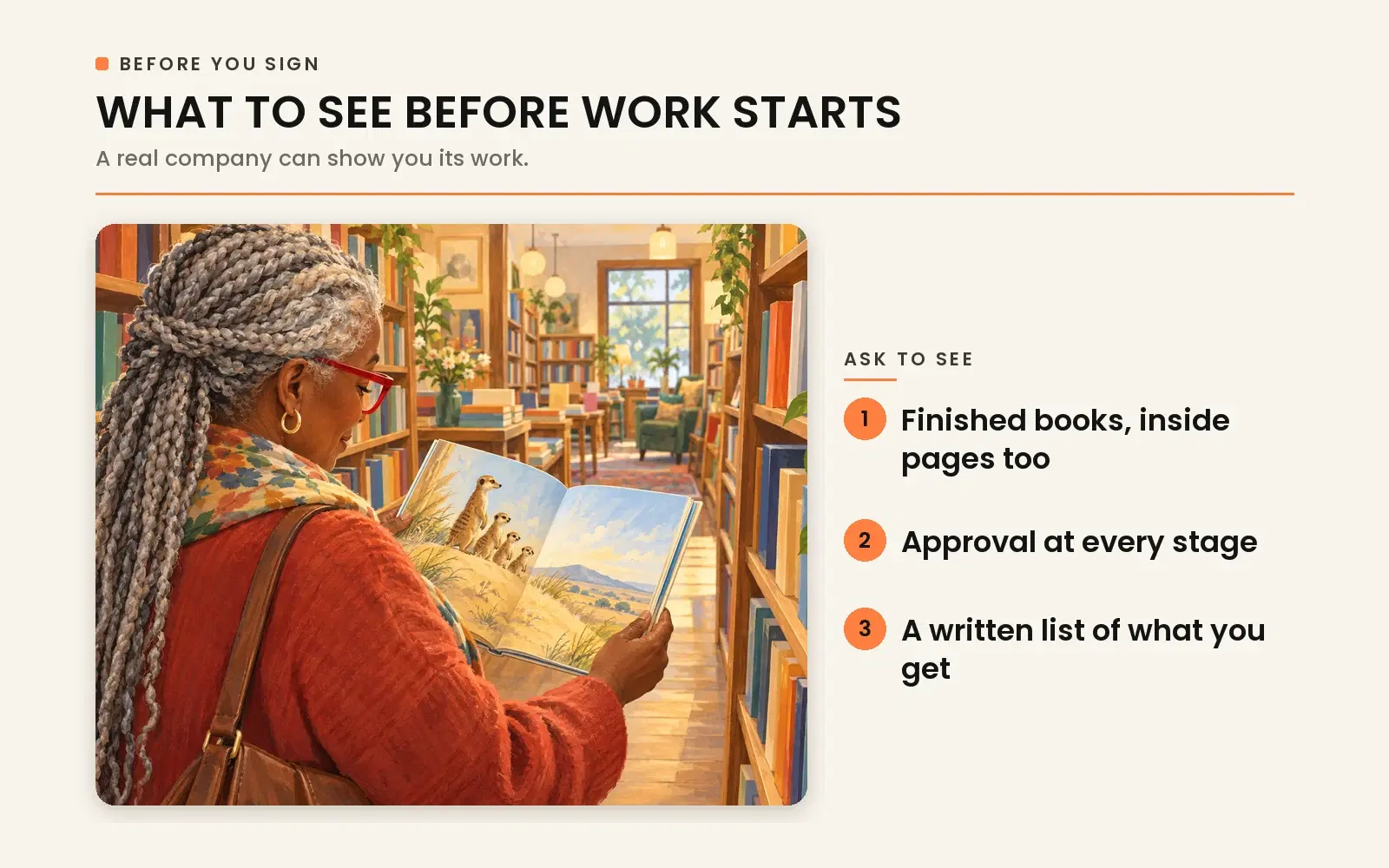
Before you pay, a real children's book publishing company should show you three things. You should see the list of jobs, where you'll approve the work, and finished books it has made. Those tell you more than any sales call, because they show the work itself rather than a description of it.
Vague Promises and Extras You Didn't See Coming
A real offer names each job and what you'll receive, while a vague one uses big words and leaves room for surprise extras. Phrases like "full publishing support" or "premium launch" sound generous. They don't say what's actually being done.
A clear offer for a picture book reads more like a list. It names the editing, how many pages get illustrations, the trim size and the cover. It also names the ISBN, a proof copy, the formats and where the book will be listed. An ISBN is the number that identifies one edition of a book, so it belongs on the list.
Upsells are the other half of this red flag. Writer Beware describes scams that keep pushing authors to spend more and more on items the scammer claims are essential. A fair company shows what's included and what isn't before you sign, so ask what isn't included and keep the answer in writing. Our guide to what a children's book publishing package includes, and what it leaves out shows how to compare two offers line by line.
Approval at Every Stage, From Sketch to Proof
A legitimate company asks for your approval before each stage of your children's book moves on. That way, you never see the finished book for the first time on delivery day. In a picture book, the approval points follow the order the book is made. You approve the edited text, then the character sketches, the rough layouts and the final art. After that come the cover and the proof copy, a printed test copy you check before the book goes on sale.
Approvals catch problems while they're still easy to fix. Say the main character has curly red hair in the sketches and straight brown hair in the final art. At an approval step, that's a quick correction. After printing, it means fixing the art and printing the book again.
The red flag is a company that says it'll send everything once it's done. That sounds relaxed, but it leaves you no chance to say no until changes are slow and costly.
Finished Children's Books You Can Check Yourself
Ask for finished children's books the company has made, then look them up yourself instead of trusting a gallery of covers. Writer Beware advises authors to look for samples of a provider's work and to ask for references. It says a reputable provider should be glad to share them.
Checking takes only a few minutes. Search the titles on Amazon and open the inside preview if there is one. See whether they're children's books like yours, with the art and words working together on each page. If you can reach one of those authors, ask them how the work went.
Be careful if every sample is a cover image with no book behind it. The same goes for titles that don't turn up anywhere outside the company's own website.
How Do I Know if a Publisher Is Legit?
You can tell whether a publisher is legit by checking it from the outside before you trust what it says about itself. Start with its contact details, its reviews and what watchdogs have heard. That outside view is the core of how to avoid publishing scams, because a company's website is written to sell. If you're hiring help for the first time, see our guide on how to hire your first book writing company for the wider questions.
Contact Details You Can Actually Test
Check that the company gives you a street address, a phone number someone answers and an email address on its own web domain. You can test all three in a few minutes. Call the number during business hours and see who picks up. Look the address up on a map. Then compare the email address with the company's website, letter by letter.
That last step matters more than it sounds. The Authors Guild warns that some scammers create domain names that look like those of real companies. IngramSpark has also warned authors about impersonators using look-alike websites and emails. A real company names the people you'll work with, too. Be careful if the only way to reach a company is a contact form, or if its emails come from a free account.
How to Read Children's Book Publishing Reviews
Read children's book publishing reviews from several places and look for patterns, because a company's own website only shows the reviews it chose. The FTC's advice on online reviews makes a good guide. It says to look at a variety of sources and to watch for a burst of reviews over a short time. It also suggests checking whether a reviewer has written other reviews. And the FTC points out that fake reviews aren't always positive.
Useful reviews sound like real projects. They mention a named book, the sketches or proofs the author approved, and how the company handled a problem. Imagine a teacher who wants to publish a classroom book written with her second graders. One review about how a late change to the art was handled would tell her more than a page of glowing lines.
Then add a watchdog check. Writer Beware keeps an archive on companies and services that engage in questionable practices. It invites writers to send in a company's name, and it will summarize what's in its files. If it has no information, it says so, and that's useful to know too.
What Should You Do if You've Already Paid?
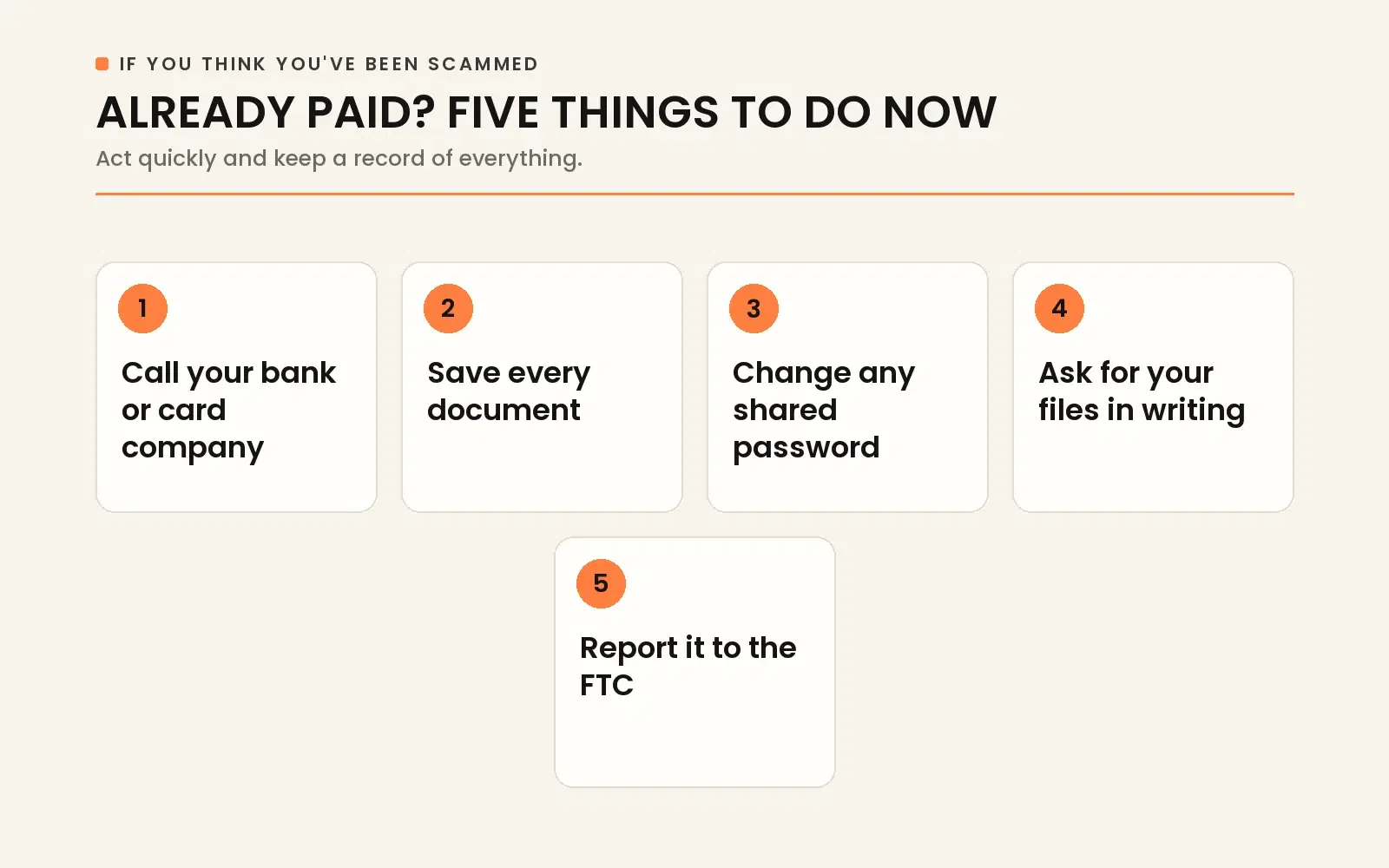
If you've already paid a children's book publishing company and it has stopped answering, act quickly. Ask your bank or card company whether the payment can be reversed, keep every record, and report it to the FTC. Think of a grandfather who paid a deposit for his bedtime story, got one cheerful email and then heard nothing for weeks. He isn't foolish, because scams are built to fool careful people.
- Contact your bank, credit card company or payment app right away. Ask them to reverse the payment and refund your money, as the FTC advises.
- Save the agreement, the invoices, the emails and the messages, along with screenshots of the company's website.
- If you shared a login, such as your Amazon KDP password, change it to a new, strong password.
- Ask the company in writing to send your files and to confirm that any rights you granted come back to you.
- Report what happened at ReportFraud.ftc.gov.
After that, be careful about who you listen to. The FTC warns about refund and recovery scams, where someone offers to get your money back if you pay them first. The FTC says that if you do, you'll lose more money. It also says government agencies and legitimate organizations will never ask for money to help you get a refund.
Talking to Book Writing US About Your Book
Bring your questions when you talk to us. Book Writing US works as children's book publishers for picture books, early readers and educational books. We help authors turn a finished manuscript into a finished book, with editing, illustration, page design, the cover, printing and publishing.
If you already have art, we can work with it. If nothing is drawn yet, the art can be made through our children's book illustration services. Tell us where your story is today, and ask us anything on your list.
Frequently Asked Questions
Are Amazon KDP and IngramSpark legit?
Yes, Amazon KDP and IngramSpark are both real platforms that authors use to publish and sell books. The risk comes from people pretending to be them. KDP's help pages say it doesn't offer paid services such as editing or book design. IngramSpark says it doesn't currently offer editing, proofreading or design services. So be wary of any message selling those services in either name. Log in through the official website, never through a link in a message.
How should a real publishing company ask you to pay?
A real publishing company asks you to pay through normal invoices that match your written agreement. That way, you know what each payment covers before you make it. The FTC warns against paying anyone who insists you can only pay with cryptocurrency, a wire transfer, a payment app or a gift card. It also says there's never a reason to pay for anything with a gift card.
Can a publisher steal your book or your idea?
A publisher can't legally take the copyright in your story or your art unless you transfer it, usually by signing an agreement. Copyright doesn't protect a bare idea, though. The U.S. Copyright Office says copyright won't protect the idea itself as revealed in your written or artistic work. What's protected is the way you've expressed the idea, in your words and pictures. That's one more reason to read every line about rights before you sign.
Can a freelance illustrator be a scam too?
It can happen with a freelance illustrator too, and the same checks work for one person as for a company. Writer Beware warns that hiring freelancers calls for real care. That's partly because of scams, and partly because some people aren't qualified for the job. Ask to see finished picture books the illustrator has drawn, and get the rights to the art in writing. Then approve rough sketches before any final art is made.
How can you tell if a literary agent is legit?
A legitimate literary agent has a record of sales to publishers that you can check, and earns money from commissions rather than fees. Writer Beware says an established agent should have a verifiable track record of sales to publishers that pay advances. It adds that the agent should be willing to share that record. It also says an agent's income should come from commissions on sales, not from fees charged to clients.
Do you need a special license or certificate to republish your book?
No, you don't need a special license or certificate to republish your book. Writer Beware lists made-up documents that scammers try to sell to authors, with names that sound official. Examples include a Separation of Book Rights Order, an Independent Publishing Registration, Book Returns Insurance and a Global Copyright Certificate. Writer Beware calls them entirely fake things invented to get money from writers. If someone says your book needs one, treat it as a warning sign.
- Is Children's Book Publishing Legit, or Mostly Scams?
- Publisher Red Flags, and What a Legitimate Company Does Instead
- Contract Terms That Should Make You Stop
- Warning Signs in the Sales Pitch
- What You Should See Before the Work Starts
- How Do I Know if a Publisher Is Legit?
- What Should You Do if You've Already Paid?
- Talking to Book Writing US About Your Book
- Frequently Asked Questions