Is Self-Publishing a Children's Book Worth It, and Who Is It Right For?
Short Answer: Self-publishing a children's book is worth it when you know what the book is for and who will read it. It also fits when you want the final say on the words and pictures, and you're ready to pay for and run the project yourself. It's a harder choice if you need someone else to carry the cost, the art and the job of finding buyers.
Your story is written, and now you're asking, "Is self-publishing a children's book worth it?" Everyone around you seems to have an opinion. One friend says to just put it on Amazon, and another says you'll regret it, but nobody explains what you'd really be signing up for.
This guide gives you a straight answer. You'll see what it really means to be your own publisher and the honest pros and cons of self-publishing a children's book. Then you'll see who it suits, who it doesn't, and when getting help is the better call.
Can You Self-Publish a Children's Book, and What Does It Mean?
Yes, you can self-publish a children's book, even if you've never published anything before. It means you're the publisher. The decisions about the book are yours, and so is the bill for making it.
Here's how that works for a children's book. First the book gets made: the story is edited, the pictures are drawn, and the words and pictures are laid out on each page. Then the finished files go to a print on demand platform such as Amazon KDP or IngramSpark. The platform prints a copy whenever someone orders one and makes the book available to buy.
For a children's book, the making is the bigger half of the job. Every picture has to exist before a single copy can print. You also decide where your book is sold and in which formats, such as paperback, hardcover or eBook. Amazon KDP asks for an imprint, which is the name of the publisher linked to your book's ISBN. Whose name shows there depends on whose ISBN you use. If you buy your own ISBN, you can list an imprint of your own, such as a business or brand name. With a free KDP ISBN, the imprint appears as "Independently published" instead.
A print on demand platform prints and distributes a finished book, but it doesn't make the book. Amazon KDP says it gives you control over your book's content, design, price, audience and advertising. That control also means the platform prints exactly what you send it, mistakes and all. If your main character's hair is curly on one page and straight a few pages later, that's how every copy will look.
Being the publisher doesn't mean doing every job with your own hands, though. You can hire an editor, an illustrator or a designer and still be the publisher, because the final say and the bill stay with you.
If your real goal is a deal with a publishing house, that's traditional publishing, and it usually starts with finding a literary agent. Traditional publishing has real strengths too, because the publisher won't ask you to pay up front. It also takes care of the pictures, the printing and getting the book out to stores. Our guide to the stages of publishing a children's book walks through each one, from finished manuscript to printed copy.
Start With What You Want Your Book to Do
Whether self-publishing is worth it depends on the job you want your children's book to do. A teacher's picture book for their own class is a very good fit. So are a few copies for your own family. A book you hope to see in bookstores across the country is a much harder job to carry on your own.
This guide measures worth against goals you can plan for, rather than sales that no one can predict for a new book. Once you know what your book is for, you can decide whether publishing it yourself is worth the money and the work.
| What you want the book to do | Is self-publishing a good fit? | What decides it |
|---|---|---|
| A keepsake for your own family | Very good | A beautiful printed copy matters, a store listing doesn't |
| A book for readers you already reach, such as your class, your patients or your community | Very good | You know who the readers are and how copies will get to them |
| A book you'll sell yourself at talks, events and online | Good | You carry the selling, so plan for it from the start |
| The first book in a series | Good, if you want control | Keeping the look and the main character the same across books is your job |
| A book stocked in bookstores and libraries across the country | Hard on your own | Each store and library chooses what it stocks, and reaching them is work you carry |
A book can have two jobs at once, such as a keepsake you'd also like to sell at events. When that happens, let the harder job decide. That's the one that will ask the most of you. If a family keepsake is the whole plan, printing a book just for your family is a simpler job with a guide of its own.
What You Gain When You Self-Publish
The two biggest gains from self-publishing a children's book are ownership and control. Your rights stay yours, and so do the creative calls, from who draws the pictures to the day the book comes out. You don't need a publishing house to accept your book, so it moves when you're ready.
Do You Keep the Rights When You Self-Publish?
Yes, you keep the rights to a self-published children's book, and that includes a book you publish on Amazon KDP. Copyright protects your story from the moment it's written down. Self-publishing doesn't hand that copyright to anyone.
Amazon KDP's own homepage says you retain ownership of your content. According to the U.S. Copyright Office's plain guide to what copyright covers, protection starts as soon as an original work is fixed in a tangible form. For a writer, that just means written down or saved.
A picture book has one extra wrinkle, because the pictures have their own creator. Copyright usually belongs first to the person who created the work. Handing it to someone else generally has to be done in writing and signed. One important exception is a work made for hire, where the person who hired the artist counts as the author and owner. So agree on the rights to your illustrations in writing with the person who draws them. Do it at the start, not after the art is finished. This is general information, not legal advice.
Imagine that a coworker who paints on weekends offers to illustrate your book. It's a kind offer, and it still needs a short written agreement about who owns the art before the first sketch. That protects you both, because the illustrator knows what they're agreeing to and you know what you can do with the art.
You Make the Creative Calls and Set the Pace
As a self-publishing author, you choose the illustrator, the art style, the title, the cover and what stays in the story. You also decide when the book is ready.
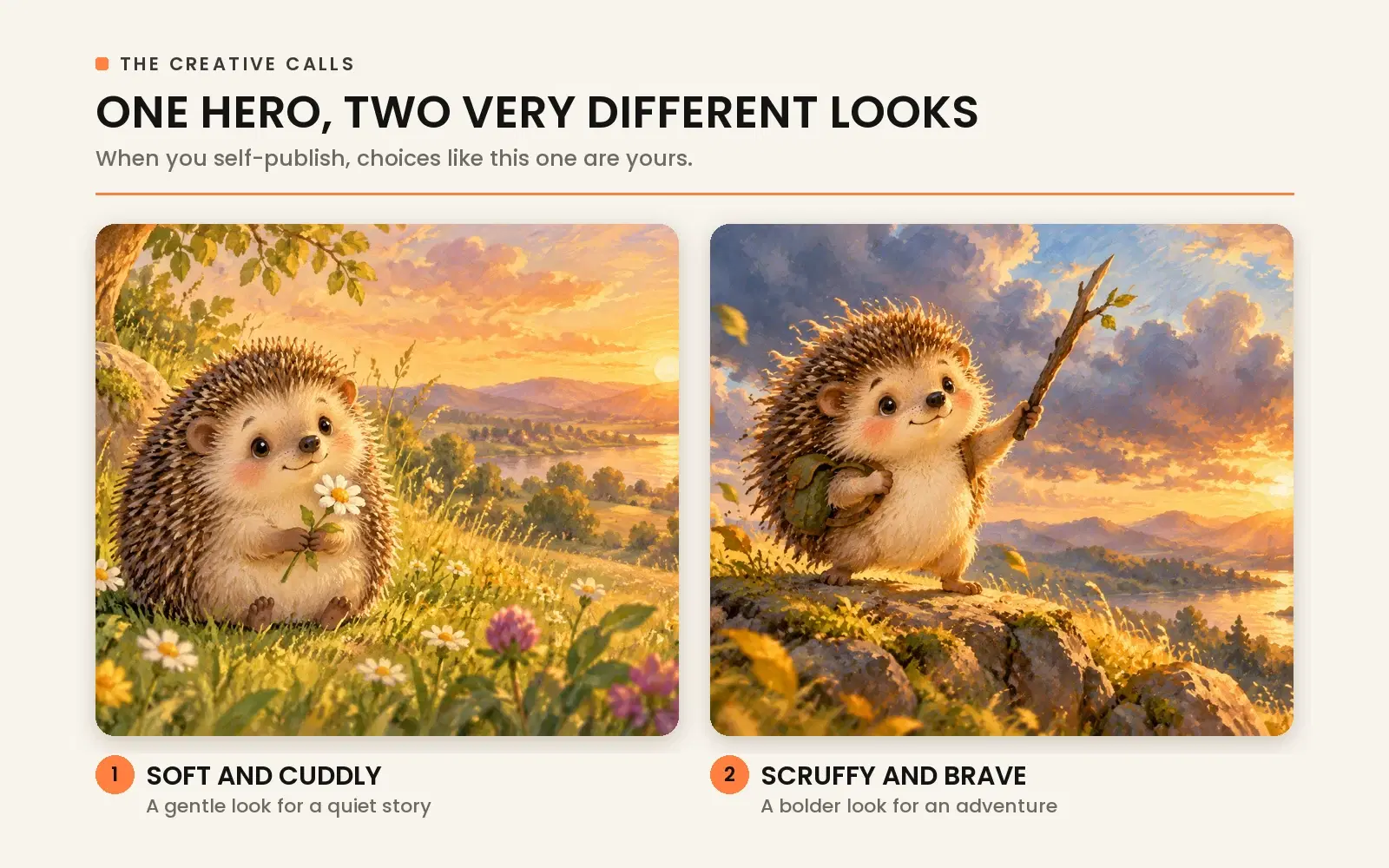
That control means something real when the pictures matter as much as the words. Picture a story whose hero is a shy hedgehog. You're the one who decides whether she looks soft and cuddly or scruffy and brave. Every choice like that shapes how a child feels about the book, and every one of them is yours to make.
Setting the pace matters for children's books, because so many are written with a moment in mind. A grandparent might want copies ready for a birthday. A teacher might want the book in hand for the start of the school year. When you're the publisher, the date is yours to set, and you can plan the whole project around it. Just choose it early, so the art and the proofs have the room they need.
What You Take On When You Self-Publish
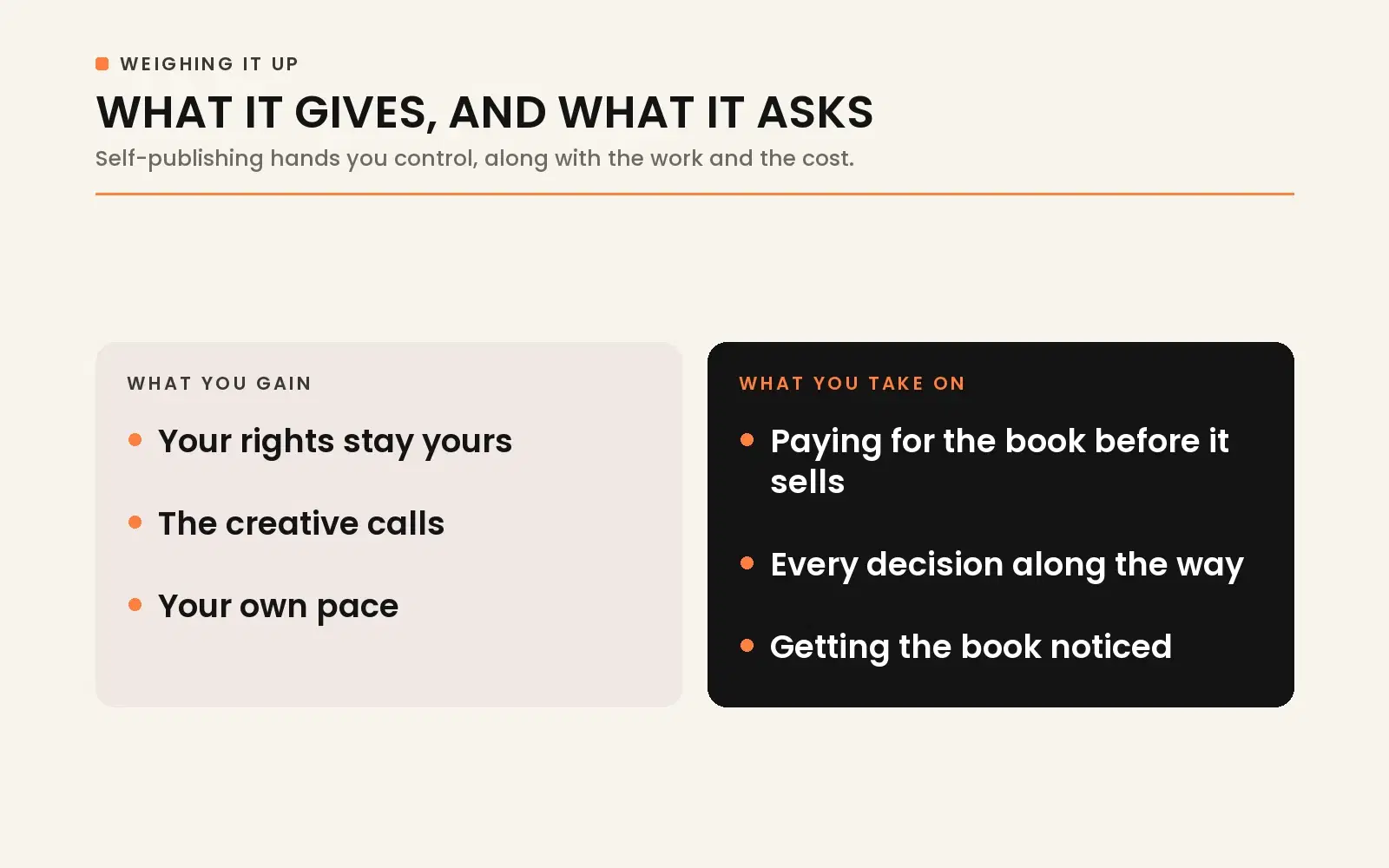
Publishing a children's book yourself puts three things on you alone. They're the cost of making the book, every decision along the way, and the job of telling readers the book exists. None of that is a reason to stop. It's just much easier to plan for when you can see it clearly.
You Pay for the Whole Book Before It Sells
Yes, publishing your own children's book means paying for the making of it before a single copy sells. The editing, the illustrations, the page design and your proof copies are all paid for up front. For a picture book, the number of illustrated pages is one of the things that moves that total the most.
Amazon KDP, for example, takes its printing cost out of what each sale pays you. So there's no printing bill up front for copies readers buy. That helps, but printing is only one part of the book. The book itself still has to be made before anything can print, and that's where your money goes.
The honest risk is that you might not earn back what you spend on the book. Nobody can promise that you will. That's one more reason to know what the book is for before you spend anything.
If you've heard it's free to publish on Amazon, read our guide to whether you can publish a children's book for free. For the choices that move the total, see what drives the cost of publishing a children's book.
Every Decision Is Yours to Make
On a self-published picture book, you're the project lead, so every choice waits for your yes. That's true even when you hire help, because the people you hire still need your answer before they can move on. Here are the main decisions that land on you.
- You choose the illustrator and the style of the pictures.
- You decide how the words sit on each page next to the art.
- You pick the trim size, which is the finished size of the book.
- You choose paperback, hardcover or both.
- You decide on the ISBN, the number that identifies one format of your book, such as the paperback.
- You approve the proof copy before anything goes on sale.
- You set the price.
The order of these choices matters as much as the choices themselves, and trim size is a good example. It's best to settle the trim size and binding before the pictures are drawn, because the art is made to fit the page. Change the size late, and the finished art may no longer fit. It's far easier to learn that at the start than to find it out on the proof.
None of these decisions is hard on its own. What catches first-time authors off guard is how many there are, and how often one choice has to wait on another.
Getting Your Book Noticed Is Your Job
Once your children's book is published, telling readers it exists is your job. A print on demand platform makes your book available to buy. But a book being for sale doesn't make anyone go looking for it.
A new listing sits among a very large number of other children's books. Parents, teachers and gift buyers tend to find a book because someone or something pointed them there. That might be a friend's recommendation, a review they trust or a post from someone they follow.
For a picture book, telling people could look like a read-aloud at a community event or a short piece in a parents' newsletter. It could also be a teacher who loves the book and passes it along to other teachers. It helps to know this before you publish, because it shapes how much time you'll need once the book is out.
Getting noticed takes steady effort, and it's work to plan for before launch day, not after it. You can't control how many copies sell, but you can control whether the right readers get a fair chance to see the book.
Why Is a Picture Book a Bigger Job to Self-Publish?
A picture book is a bigger job to self-publish because it's two pieces of work, the words and the pictures, planned together. Both have to work across every page turn. So when you publish a picture book yourself, you also become the person who hires the illustrator and approves every picture.
A novelist mostly needs the words edited and a cover designed. A picture book needs art on nearly every page. Unless you're an illustrator yourself, you'll be hiring one, and that brings a string of new jobs. Someone has to describe each scene clearly enough for the art to match the story. Someone has to check that the main character looks like the same character on every page. The words and pictures also have to be planned together before final art, which is why the storyboard comes first.
Here's what that looks like in practice. Before any color goes on, an illustrator will often share rough sketches of each spread for your approval. A spread is the two facing pages a reader sees at once. With no publisher above you, that approval is yours to give, so you'll need the time and attention to look closely at every page.
If you'd rather not manage an illustrator yourself, you can hand the art to a team that offers children's book illustration services. You'll still want to see the sketches, but you won't have to find, guide and check on an artist by yourself.
The size of the job grows with the amount of art. An early reader or chapter book with a few pictures is a lighter self-publishing job than a fully illustrated picture book. So the kind of book you've written really does change whether self-publishing is worth it for you.
Should You Self-Publish Your Children's Book?
Self-publishing your children's book makes sense if your goal fits and you want the final say on it. It also asks you to give the project real time and to pay for the making up front. Think twice if you'd rather someone else carried those things. Either way, the answer says nothing about how good your book is. The two lists below will help you work out where you stand.
Who Self-Publishing Suits
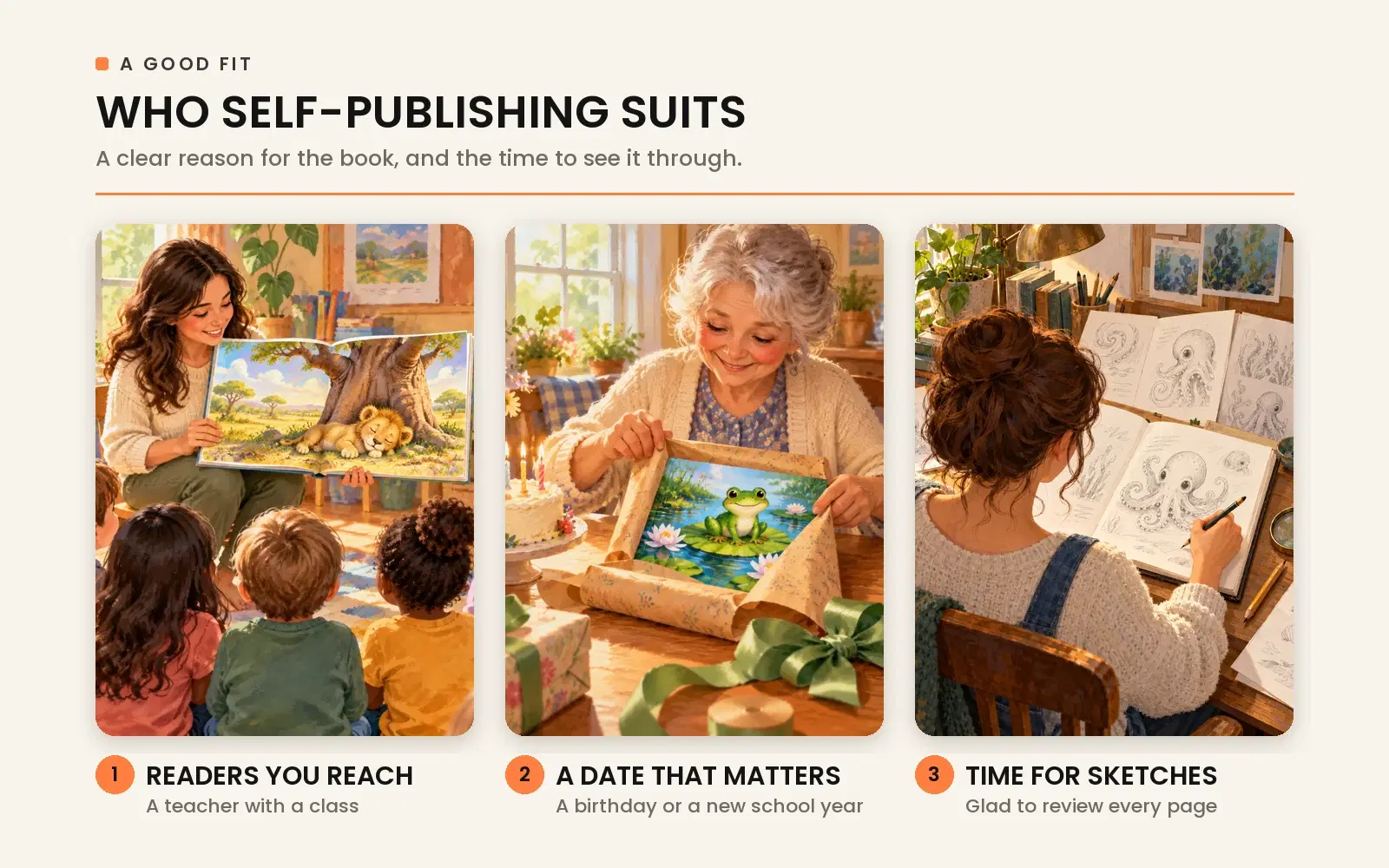
Self-publishing a children's book suits authors who have a clear reason for the book and the time and means to see it through. You might recognize yourself in one of these.
- A teacher, counselor or speaker who already reaches the readers the book is for, so copies have a clear place to go.
- An author who wants the last word on the story and the pictures, and is happy to make those calls.
- An author writing for a date that matters, such as a birthday or the start of a school year.
- An author who sees this book as the start of something bigger, such as a series.
- An author who's glad to review sketches and proofs closely.
- An author who can pay for the making up front without needing the money back quickly.
If several of these sound like you, self-publishing is likely a good fit for your book.
Who Self-Publishing Doesn't Suit
Self-publishing a children's book is a bad fit when you need someone else to carry the cost, the decisions or the work of finding readers. These are the situations where it's likely to feel like the wrong choice.
- You need someone else to pay for the art and the printing.
- You want the book on shelves in bookstores across the country, but you don't want to do the legwork of reaching them.
- You don't have time for the decisions, sketch reviews and proof checks that a picture book needs.
- You need the book to pay for itself quickly, and a slow start would put real pressure on you.
- You'd rather not choose an illustrator or look after the art at all.
None of this means your book isn't worth making. It only means this route may not suit you right now. If only one or two of these fit, getting help with those parts may be all you need.
Do You Have to Do It All Yourself?
No, being your own publisher doesn't mean doing every job yourself. The decisions and the bill are yours, but you can still pay people for the jobs you'd rather not do.
Many first-time authors ask, "Should I self-publish or use a publisher?" If you want a publishing house to pay for the book, look at traditional publishing. Just expect the publisher to make more of the decisions, such as who draws the pictures. If you'd rather keep those decisions, the useful question is which jobs to hand over and which to keep. Help usually comes in one of two ways.
- You hire each person yourself, such as an editor, an illustrator and a book designer, and you coordinate them so the work fits together.
- You work with one team that handles the stages of the book while you approve each one before the next begins.
The first way gives you the most hands-on control. It also means you're the one keeping everyone on the same page. The second way gives you one point of contact, and a good team should still leave the final call at each step to you. Getting help usually makes more sense in situations like these.
- Your book is a full-color picture book with art on almost every page.
- You have little free time for sketch reviews, layout checks and proofs.
- It's your first book, and print choices like trim size and paper are new to you.
- You'd like one point of contact instead of several people to manage.
Whichever way you go, keep the final say on your book, and get the ownership of the art and the finished files in writing. Our guide to what a children's book publishing company actually does explains the jobs a team takes on and what you keep. If you decide to bring in a team, our tips on how to hire your first book writing company cover what to look for.
Getting Help With Your Children's Book
If you'd rather not carry every job alone, Book Writing US works on picture books, early readers and educational books. Our children book publishing services help authors turn a finished manuscript into a finished book. That takes in editing, illustration, page design and the cover, printing and publishing.
We can work with art you already have, or have the pictures drawn through our illustration service. If you'd like to talk your book over with us, get in touch.
Frequently Asked Questions
Should I self-publish my first book?
You can, and whether self-publishing is worth it doesn't depend on it being your first book. What matters more is what you want the book to do and how you feel about making a long list of decisions. If you have a clear goal and you'd enjoy being in charge, a first book is a fine place to start. If the decisions sound tiring, getting help with the jobs you'd rather not do can still leave you in control.
How hard is it to self-publish a children's book?
Uploading and listing a finished children's book is the easy part. The hard part is making a book good enough that parents want to buy it and children want to hear it again. For a picture book, most of that work sits in the art. The pictures need the most planning, the most decisions and the most checking. It's less about technical skill and more about time, attention and careful choices.
Do self-published children's books sell?
A self-published children's book can sell, but whether it does depends on the book and its readers, not on the route. A book sells when the people it's for can find it and want it. That comes down to how well the book is made and whether the right readers hear about it. What you can control is making a book worth wanting and having a plan to let its readers know it's there.
Can a self-published children's book be sold in bookstores?
Yes, a self-published children's book can be sold in bookstores, but each store decides what it stocks. A distribution service such as IngramSpark says it connects books to libraries, retailers and online stores. That makes your book available for a store to order. Available to order isn't the same as sitting on a shelf, though, because each store still chooses what goes on its shelves.
Are self-published children's books any good?
Self-published children's books can be every bit as good as any others. Quality comes from how a book is made, not from who publishes it. A parent reading at bedtime judges the story, the pictures and how well the two work together, not the publisher's name. When a self-published book falls short, the reason is in how it was made, and that part is in your hands.
- Can You Self-Publish a Children's Book, and What Does It Mean?
- Start With What You Want Your Book to Do
- What You Gain When You Self-Publish
- What You Take On When You Self-Publish
- Why Is a Picture Book a Bigger Job to Self-Publish?
- Should You Self-Publish Your Children's Book?
- Do You Have to Do It All Yourself?
- Getting Help With Your Children's Book
- Frequently Asked Questions