What Children's Book Publishing Packages Include, and What They Leave Out
Short Answer: Children's book publishing packages usually bundle the editing, the art or the placing of your own art, the page layout and the cover. Most also cover the print-ready files, a proof, the ISBN and listing setup, and distribution. What they may leave out, or sell as extras, includes more art changes, marketing, extra author copies, a hardcover or other extra editions, and clear terms on your files. Two packages that look alike can cover very different books, so compare them line by line against your own story.
Picture a grandmother with two package pages open for the picture book she wrote about her grandson's dog. Both packages are called full service, and both come with a long list of ticks. She's read them twice, and she still can't tell which one actually covers her book.
If that sounds like your evening, you're in a very normal place. A package's name and its tick list don't show you how much work sits behind each line. That's the part that matters. This guide explains what each usual line means for a children's book. It also shows what often sits outside a package, and how to compare two packages side by side. It names no package sellers and quotes no prices, because the aim is to help you read any package with confidence.
What Is a Publishing Package?
A publishing package is a set of publishing jobs that one company sells together, as one scope of work, for one book. You pay the company for that work. For a children's book, the jobs usually run from editing the story to a finished book that's listed for sale. Self-publishing packages and book publishing packages are simply two more names for the same idea.
Three things are worth knowing before you compare any two packages.
- Platforms such as Amazon KDP and IngramSpark print and list a finished book from the files you upload. They don't edit your story or draw your pictures, so a package covers the making of the book.
- Names like basic, standard, premium or full service tell you the size of a bundle, not what's inside it. Full service book publishing only means the bundle runs from editing all the way through to listing.
- Children's packages are usually sized by the book itself. They set limits on the number of words, the number of pictures and the use of color, which packages for novels don't need.
That's why the names alone can't guide you. Two packages can both be called full service, yet one has an illustrator draw every spread while the other only places art you already own. They look alike on paper, but they're very different jobs for very different amounts of work.
Whether you should self-publish at all, or hire each person yourself instead of one team, is a separate choice. If you're still weighing that up, start with whether self-publishing a children's book is worth it for you.
What Most Packages Include
Most children's book publishing packages include the same handful of lines. You'll usually see editing, illustration or art placement, page layout and the cover, print-ready files, a proof, and the ISBN with listing setup and distribution. The lines look almost identical from one package to the next, but the detail inside each one often doesn't. So the useful question isn't whether a line is there, but how much of the job it really covers. A separate guide explains the jobs a children's book publisher does one by one, so this one sticks to how packages describe them.
Which Kind of Editing the Package Covers
When a package says editing is included, that one word can mean anything from a final proofread to a full story edit. The difference matters more in a picture book than in most books, because every word is read aloud and the illustrator draws from the text. So ask which kind of editing the package covers, and how many times the editor goes through your manuscript.
There are three main kinds, and each one does a different job. A story edit, often called a developmental edit, looks at the plot, the pacing and what happens at each page turn. A copy edit fixes grammar, word choice and consistency. A proofread is the final check for typos and small slips once the words sit on the finished pages.
Say the middle of your story drags and you already suspect it. A package that only includes a proofread will tidy your commas and leave the drag exactly where it was. If your words may still change, look for a package with a story edit in it, or plan for one before the package work begins.
Are the Illustrations Drawn for You, or Do You Supply Them?
Some children's book packages include new illustrations drawn for your book, and others only place art that you supply yourself. That one line changes the size of a package more than any other. It's the first thing to check. A package that draws every spread and a package that lays out your finished pictures aren't the same job, even when they share a name.
How a package counts the art matters just as much. A full spread fills two facing pages, and a single-page picture fills one. A spot illustration is a small picture that sits beside the words with white space around it. The cover is a separate piece again, and many packages count it apart from the inside art. So a package that offers "a set number of illustrations" tells you very little until you know which kind it's counting.
Two more details sit inside the art line. The first is a character sheet, a page of drawings that shows the main character from different angles. It helps the illustrator keep them looking the same on every spread. The second is color, because full color art takes more work to draw than black and white line art. Check which one the package means before you compare it with anything.
Here's a simple habit that makes art allowances easy to read. Count the spreads your story needs, and note which ones need a full picture and which could carry a small one. Then hold each package's art line up against that count, and you'll see quickly whether it covers your book or a smaller one.
Page Layout, the Cover and Print-Ready Files
Most packages include the page layout, the cover design and the print-ready files. Each of those lines has a scope question behind it. Page layout means setting your words and pictures together, page by page. Ask whether it includes the pages at the front and back of the book, such as the title page, the copyright page and the dedication.
Cover design raises a format question. A printed cover is built for one format at a time. On Amazon KDP, a paperback cover and a hardcover cover are each one PDF with the back, the spine and the front joined together. KDP keeps a separate guide for hardcover covers, too. So the cover line in a package may cover the paperback only, which makes the hardcover's cover a second job.
Print-ready files are the finished files of your pages and your cover, built to the printer's rules so they can go straight to print. They're made for one format at a time, which is how a second format quietly adds work. One more question is worth asking while you're on this line. How many rounds of changes does the cover get before it's treated as final?
Check Whether the Proof Is Printed or Only on Screen
A package's proof can mean a file you check on screen or a printed proof copy you hold in your hands. Check which one you're getting. For a picture book, the printed copy is the one that matters. It shows you the real book, with its paper, its trim and its binding, before any reader sees it. Amazon KDP describes its proofs as test copies for you to review before publication, marked with a "Not for Resale" watermark.
A printed proof also shows problems that only turn up on paper, such as a word creeping into the center fold where two pages meet. Ask how many printed proofs the package includes, since you may want a second one after your corrections are made.
ISBN, Listing Setup and Where Your Book Is Sold
Most packages set up the ISBN and the listing details for your children's book. They also make it available to order through print on demand services like Amazon KDP and IngramSpark. The details to check are how many formats that covers, where the book will be listed, and what distribution really means on that package page.
An ISBN is a book's identity number, and it belongs to one edition, so each print format gets its own. Amazon KDP says a paperback and a hardcover each need a separate ISBN, while an ISBN is optional for an ebook. In the United States, the ISBN agency is Bowker. So if a package includes an ISBN, ask how many ISBNs it covers and whose name they'll be tied to.
Listing details are the facts a store uses to show and sort your book. Think of the title, the description, the categories and the age range of the reader. On Amazon KDP, each copy is printed on demand when a customer orders it. IngramSpark describes its reach as libraries, retailers and online stores.
One plain point is easy to miss on a package page. Distribution in a package usually means your book is listed and can be ordered, not that it sits on a bookstore shelf. A bookstore can order a copy for a customer, but each store decides for itself what to stock.
What Packages Often Leave Out or Charge Extra For
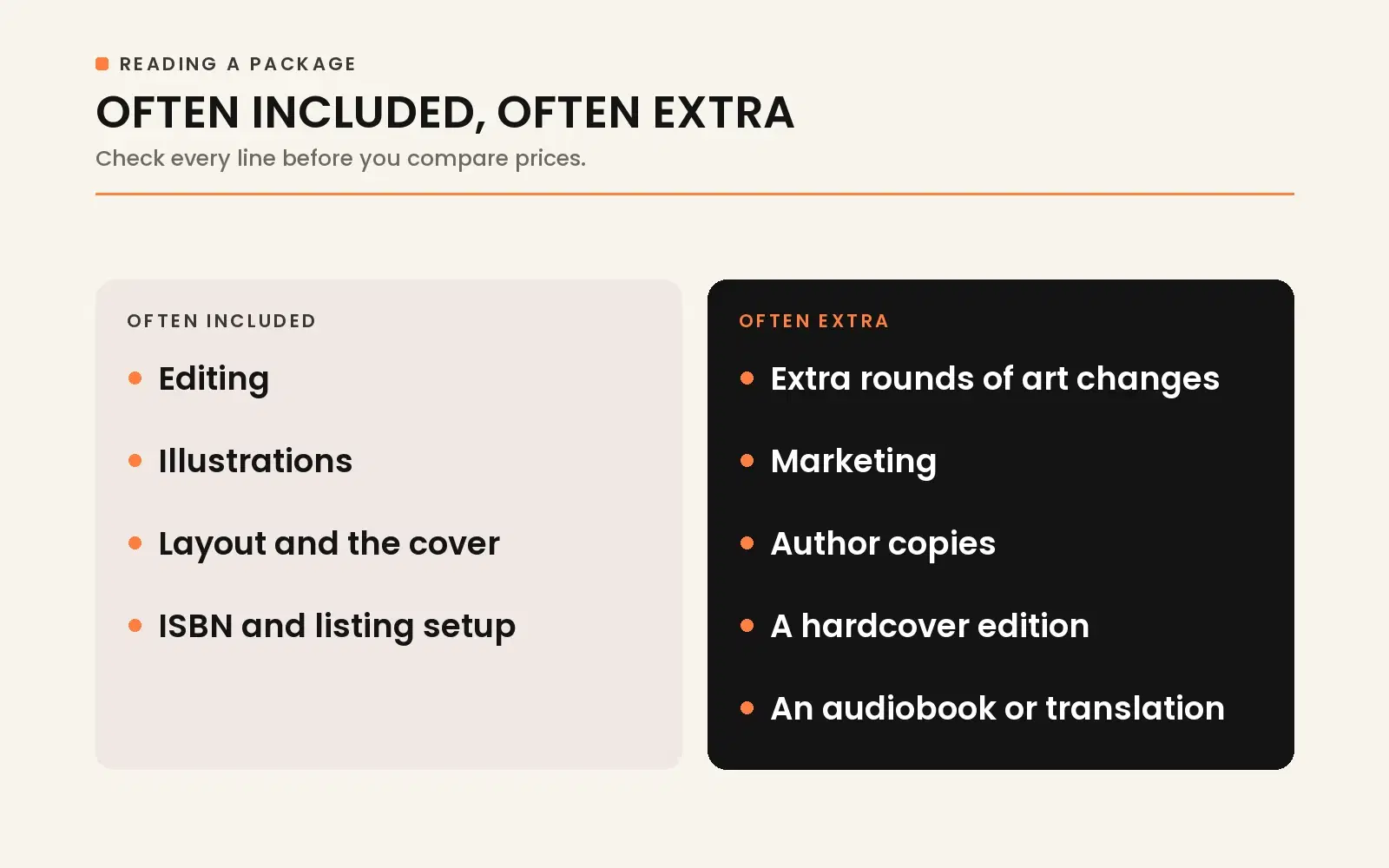
Items often left out of a children's book package, or limited, are more rounds of art changes, marketing and extra author copies. Extra editions, such as a hardcover, an audiobook or a translation, are often sold as extras too. So are clear written terms on your files and rights, which a package page may not mention at all. An extra isn't a trick. It's simply work the package didn't cover, and paying for extra work is perfectly normal. The aim is to know about it before you sign, so the total never surprises you halfway through your book.
Extra Rounds of Changes to the Art
Children's book packages usually allow a set number of rounds of changes, and the illustrations are where that limit matters most. Changes past the allowance are often charged as extra work. So before you sign, ask how many rounds you get, how they split between the sketches and the final art, and what counts as one round.
The stage matters because the same change can mean very different amounts of work. Imagine deciding that the puppy in your story should be spotted rather than brown. At the sketch stage, that's a few pencil lines on a rough drawing. On finished color art, it can mean repainting the puppy on every spread he appears in, which is close to making new art.
Adding a whole new scene late in the book isn't a revision at all. It's a new illustration, so expect it to be treated as extra art rather than one of your change rounds.
The easiest time to change your mind is early, while the pictures are still rough. Sketching the whole book as a storyboard before any final art lets you see every spread together. You can settle the story while a change still means only a pencil sketch.
Is Marketing Part of a Publishing Package?
Marketing is sometimes part of a publishing package, but the word can mean very different things. It might be a short guide, a written book description or a planned campaign that someone actually runs for you. Publishing and marketing are two separate jobs. Publishing makes your book and lists it, while marketing helps readers hear that it exists.
When a package lists marketing, ask what exactly will be done, who will do it and for how long. A page of tips, an author page set up on Amazon and a few months of promotion are three very different things. All three can still be called marketing on a package page.
One honest point belongs here too. No package can promise sales. A listed book still needs readers to find it, and that depends on far more than the package. If marketing matters to you, treat it as its own decision rather than one more tick on the publishing list.
Are Author Copies Included in the Package?
Many packages include a few printed copies of your book, and some include none. Ask how many you'll get, in which format, and what you'll pay for each copy you order later. Author copies are printed copies of your own published book that you buy for yourself. On Amazon KDP, for example, author copies are offered to you at the print cost, and you're free to give them away or resell them.
For a children's author, the price of later copies usually matters more than the few that come included. Think of a teacher who wrote a picture book for her class. She'll want copies for a school visit, a reading at the local library and gifts for the family. She'll keep ordering them for as long as the book is in print.
So ask whether you'll order extra copies through the company or straight from the platform. That choice can change what each copy costs you. The answer usually depends on whose account the book sits in, and that's a detail to settle early.
A Hardcover Edition Is Often Extra
Many children's book packages are built around a paperback, and a hardcover edition is often an extra. That's because a hardcover is a second edition with its own work behind it. A hardcover needs its own cover file, its own ISBN and its own print-ready files. Amazon KDP treats a hardcover as a separate format with a separate ISBN and its own cover guide.
An ebook may be included or sold as an extra, depending on the package. Check that line as well. A hardcover is worth thinking about for a children's book. It suits gifts and library shelves, and it stands up well to being read again and again.
The simplest way to avoid a surprise is to list every format you want before you compare anything. Then both packages are priced for the same editions, and a hardcover can't turn up later as an add-on you didn't expect.
An Audiobook or a Translation Is a New Project
An audiobook or a translated edition usually sits outside a standard children's book package. Each one is a new piece of work rather than a small add-on. An audiobook needs a narrator and a recording. A translation needs a translator and then a new layout, because the new words have to fit around the same pictures.
That second point is easy to miss in a picture book. Say you'd like a Spanish edition of your book for a bilingual family. The Spanish text may run longer than the English on the same page. If it does, it may no longer fit the space the illustrator left for the words. Every page then has to be checked and set again, and the new edition needs its own listing, too.
Even if you don't want either one now, it's worth checking that your agreement leaves you free to make them later. That way the choice stays yours if a family, a school or a library asks for one down the road.
Who Owns the Files and the Rights When the Work Is Done?
The copyright in your words generally stays with you. The rights to the art, and the files you receive, depend on what your written agreement says. So look for three things in any package agreement. Check which files you get at the end, what it says about the rights to the illustrations, and whose account the book is listed in.
The files come first. Some packages hand over only the print-ready files, while others also give you the editable layout files and the separate art files. The editable files are the ones you'd need to fix a typo, add a new edition or print somewhere else later.
The art comes next. Copyright generally belongs to the person who created a work, unless the artist signs a written transfer or the art counts as a work made for hire. The U.S. Copyright Office's guide to works made for hire explains when that second case applies. A specially ordered work counts as one only in certain categories, and only when both sides expressly agree to it in a signed written agreement. So paying for the pictures doesn't settle who owns them. The written agreement is what settles it. This is general information rather than legal advice, so for anything that worries you, ask a lawyer to look over the contract first.
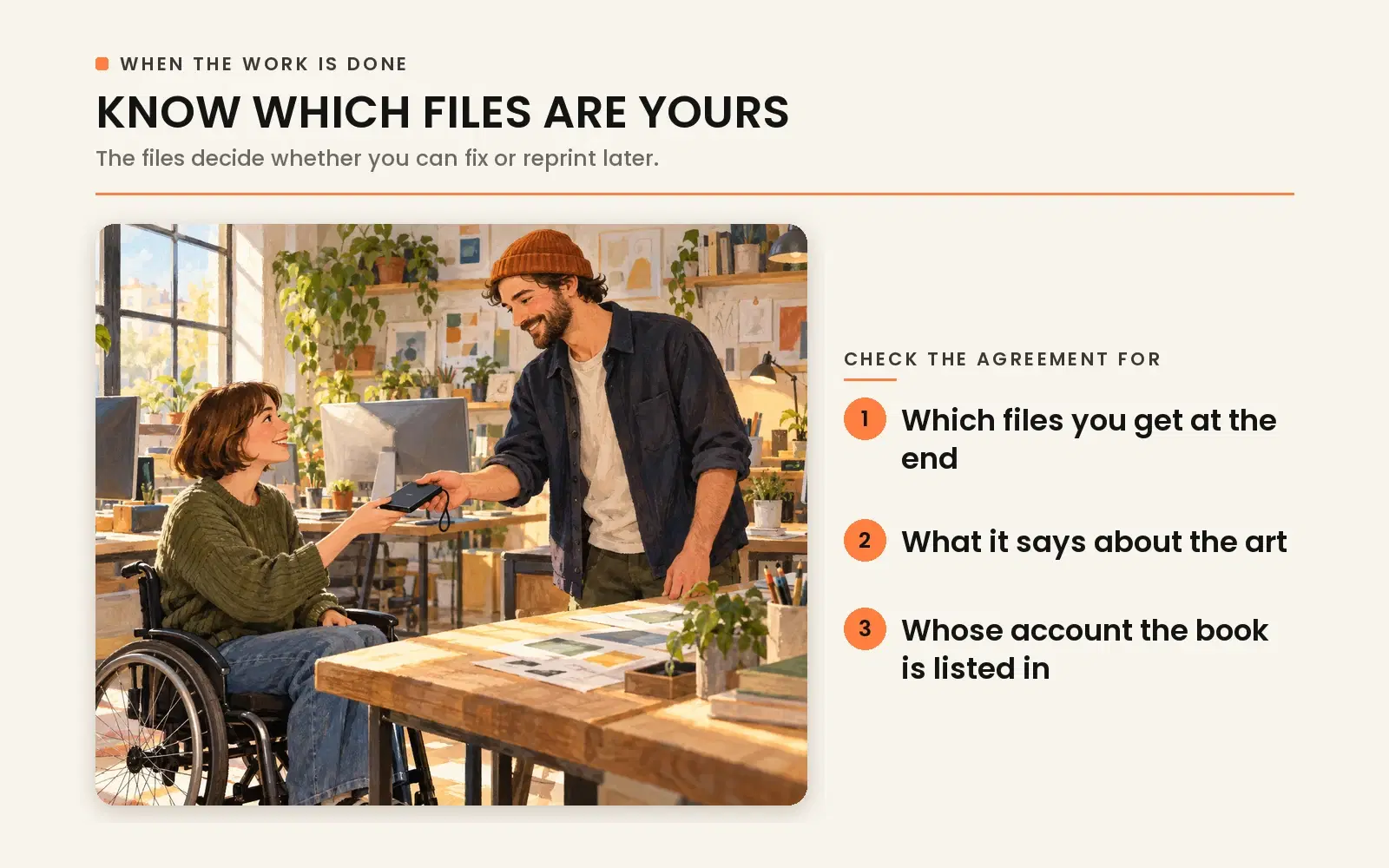
The account comes last. On Amazon KDP, the account holder controls the book's content, design and price, and earns the royalties on each copy sold. That's why it matters whose name the account is in. Get the answers to all three in writing before any work starts. If a package takes rights or a share of your sales without saying so plainly, that's a different matter. A separate guide explains how to tell a legitimate children's book publishing company from a scam.
How to Compare Two Packages Line by Line
The fairest way to compare two children's book packages is to write them side by side against the same list. Then fill in what each one actually covers for your book. A longer list isn't a better one. A short list that covers every job your book needs is worth more than a long one full of lines you'll never use.
Use the table below as your worksheet. Copy the first column, then fill in the middle column once for each package you're comparing.
| What to compare | What to write down for each package | Why it matters for a children's book |
|---|---|---|
| The book it's priced for | Word count, number of spreads, trim size | A quote for a shorter book isn't a quote for yours |
| Illustrations | New art or yours, how many, what counts as one | A spread and a spot picture are different jobs |
| Changes to the art | Rounds at sketch and at final art | Late changes take the most work |
| Editing | Which kind, and how many passes | A proofread won't fix a story problem |
| Formats | Paperback, hardcover, ebook | Each print format needs its own cover and ISBN |
| ISBN | How many, and in whose name | It decides the publisher name tied to your book |
| Proofs | Printed or on screen, and how many | A printed proof shows the real paper, trim and binding |
| Where it's listed | Which platforms, and in whose account | Listed means a store can order it |
| Author copies | How many, and your price for more later | You'll want copies for gifts and school visits |
| Marketing | What's done, by whom, for how long | Advice isn't the same as a campaign |
| Files and rights | Which files you get, what the art terms say | You'll need them to fix, reprint or move |
A blank cell is a question to ask, not a reason to assume anything. The package that fits is the one that covers the jobs your book needs, in words you can understand.
Ask Both Companies to Price the Same Book
Two package quotes only compare fairly when both are for the same book. So give both companies the same few details. That means your finished word count, the number of spreads, the formats you want and whether your art already exists.
Here's why it matters. A package priced for a short paperback with your own art can't be compared with one priced for a fully illustrated hardcover. That's true even if both arrive as a single number. The first will look like the better deal, but it's really a quote for a different book.
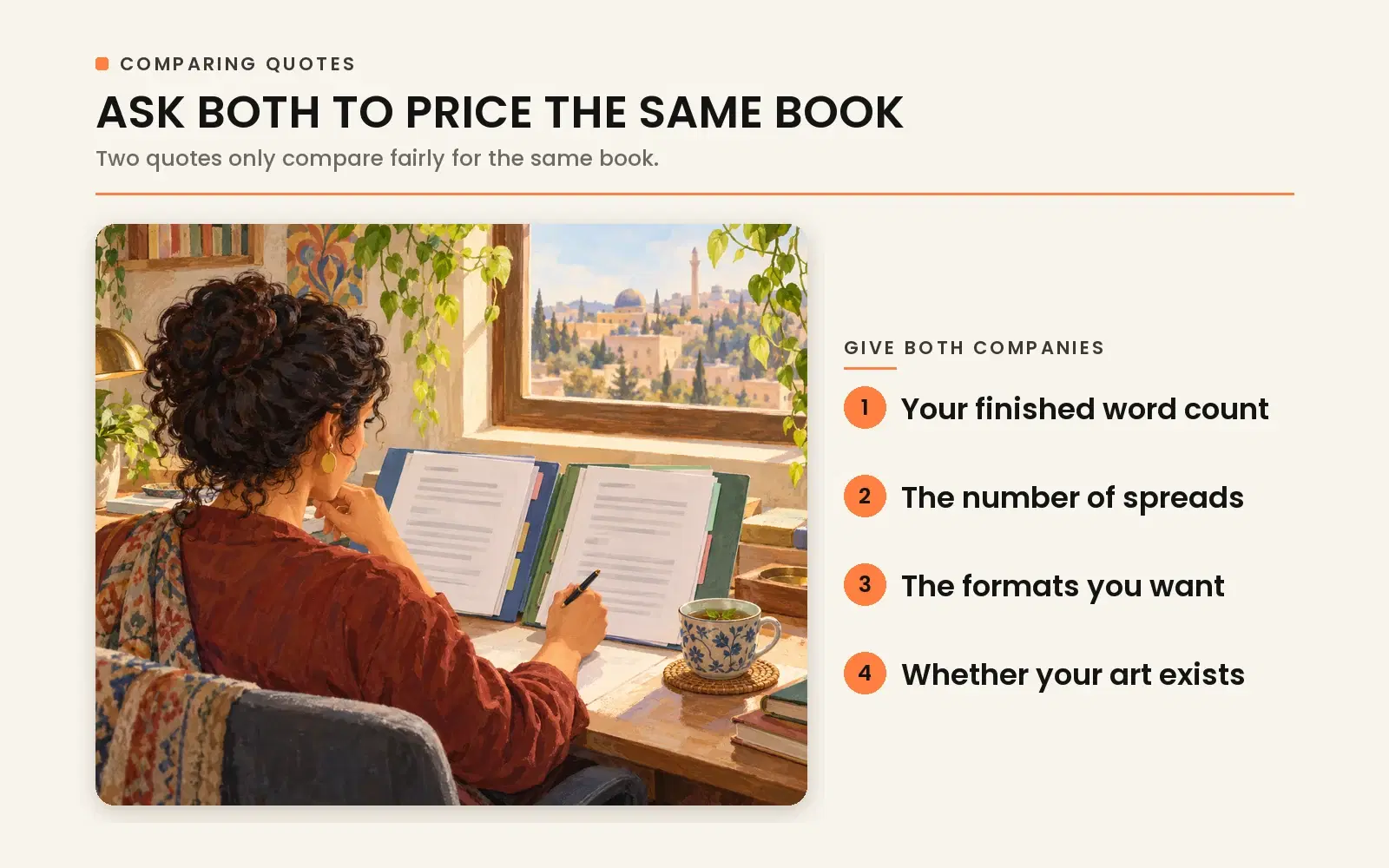
Once both quotes describe the same book, the differences between them finally start to mean something. To see what moves the total in the first place, take a look at every cost driver behind publishing a children's book.
What If a Line Isn't on the List?
If a package page doesn't mention something, treat it as not included until the company tells you otherwise in writing. A missing line isn't a warning sign. It's just a question to ask. Words like all-inclusive or complete describe how big a package is, not what's in it. Ask what they cover, line by line.
The easiest way to do that is to turn your comparison table into a short list of questions. Send the same list to each company. Keep the written answers with your agreement. Then if something comes up halfway through your book, you can check what was agreed instead of relying on memory.
How to Choose a Self-Publishing Company for Your Children's Book
The right self-publishing company for your children's book is the one whose package covers the jobs your book still needs, no more and no less. If this is your first book, that's the simplest test to hold on to, and it works with any company you speak to. Three plain rules make it easier to apply.
- Don't pay twice for what you already have. If your art is finished or your story has already been edited, look for a package that builds on that work instead of redoing it.
- Don't cut the lines a picture book needs most, such as enough rounds of art changes and a printed proof. Those are the lines that protect the finished book.
- Choose a package whose scope you can read and understand, with the answers to your questions in writing.
There's no single best package for every first book. The best package for your children's book is the one that fits that book, not the one with the longest list. Before you speak to anyone, these tips for hiring your first book writing company can help you prepare your questions.
What Book Writing US Takes On for a Children's Book
Book Writing US publishes picture books, early readers and educational books. When your manuscript is finished, our children book publishing services can take it the rest of the way, through editing, illustration, page design and the cover, printing and publishing.
If you have art already, it can come with you. If you don't, our children's book illustration services can create the pictures. When you're ready, reach out and tell us a little about your story.
Frequently Asked Questions
Is a publishing package the same as a book deal?
No, a publishing package isn't a book deal. In a book deal, a traditional publisher pays you for the right to publish your book. The Authors Guild notes that traditional publishers won't ask you to pay them up front. With a publishing package, you pay a company for the work of making and listing your book. Both are normal routes, and the right one depends on your book and your plans.
Who owns the ISBN, the publisher or the author?
An ISBN is tied to whoever is named as its publisher, so the answer depends on who supplies it. On Amazon KDP, an ISBN you've bought yourself lets you show your own imprint, which is the publisher name linked to that ISBN. A free KDP ISBN shows the imprint as "Independently published," and KDP says its free ISBNs can't be used anywhere else. If a package includes an ISBN, ask whose name it's registered to before the book goes live.
Can you add services to a package later?
Usually yes, since many companies sell extra work on its own. The catch is that adding a service after a stage is finished can mean redoing that stage. For example, extra illustrations added after the layout is done mean the pages have to be laid out again around them. So settle your formats and your art before the work starts. If you do add something later, get its scope in writing, just as you did for the package.
Do author copies count as sales?
No, on Amazon KDP author copies don't count as sales. KDP says you won't receive royalties for buying or reselling a proof or author copy, and those orders don't appear in your KDP reports. You're still welcome to resell author copies or give them away, for example at a school visit or a book fair. Just keep in mind that copies sold at events won't show up in your platform numbers.
Do publishing packages include an author website?
Some larger packages include a simple author website, and many don't. An author website is a marketing tool rather than part of making the book. That's why it's often sold on its own. If one is included, ask whose name the web address is registered in, and who can update the site once the package ends. A site you can't change or keep isn't much use a year later.
What is an author page on Amazon?
An author page on Amazon is a page about you and your books, and you create it through Amazon Author Central. KDP describes Author Central as the place to share up-to-date information about yourself and your books with readers. That can include a short bio and a list of your titles. Some packages list setting it up as a marketing extra. It's a handy page for a children's author. A parent who likes one of your books can find the rest in one place.
- What Is a Publishing Package?
- What Most Packages Include
- What Packages Often Leave Out or Charge Extra For
- How to Compare Two Packages Line by Line
- How to Choose a Self-Publishing Company for Your Children's Book
- What Book Writing US Takes On for a Children's Book
- Frequently Asked Questions