What Does a Children's Book Publisher Do for You, and What Do You Keep?
Short Answer: A children's book publisher turns your finished manuscript into a book a child can hold. It edits the story, guides the illustrator, lays out the pages and cover, sets up the ISBN, and gets the book printed and listed for sale. What you keep depends on the publisher and your agreement. A team you hire should leave the rights and final say with you, while a traditional house buys the right to publish and makes more of the calls.
You've finished your children's story, and you're probably asking, "What does a children's book publisher do, and why do authors need publishers at all?" A friend tells you that you need one, and a website offers to be one. Nobody explains what a publisher would actually do with your book, what you'd be paying for, or what you might be signing away.
That confusion makes sense, because "publisher" covers two very different kinds of company. Still, both do much the same work on a children's book. Once you can see that work clearly, it's much easier to ask the right questions. This guide explains what a book publisher does for you on a picture book or an early reader, one job at a time. Then it shows you which parts of the book stay yours. It's written for first-time authors, and just as much for parents and grandparents with a story to share.
Which Kind of Children's Book Publisher Do You Mean?
A children's book publisher can mean one of two kinds of company. A traditional publisher is a publishing house that buys the right to publish your book. The house pays for the editing, the art and the printing, and it pays you for the book. A publishing company you hire, often called a self-publishing company, is paid by you to do those same jobs. It works for you, on your book.
A grandparent comparing websites might ask, "What does a book publishing company do, and what does a self-publishing company do differently?" On a children's book, the jobs themselves are much the same, whichever kind you mean. Someone has to edit the words, direct the art and lay out the pages. Someone has to design the cover, set up the ISBN, prepare the files and get the book printed and listed.
What Does a Book Publisher Actually Do for a Children's Book?
When you hand over a finished picture book manuscript, a children's book publisher does seven jobs with it. They run from editing the story to getting the book listed for sale. Each one is explained below.
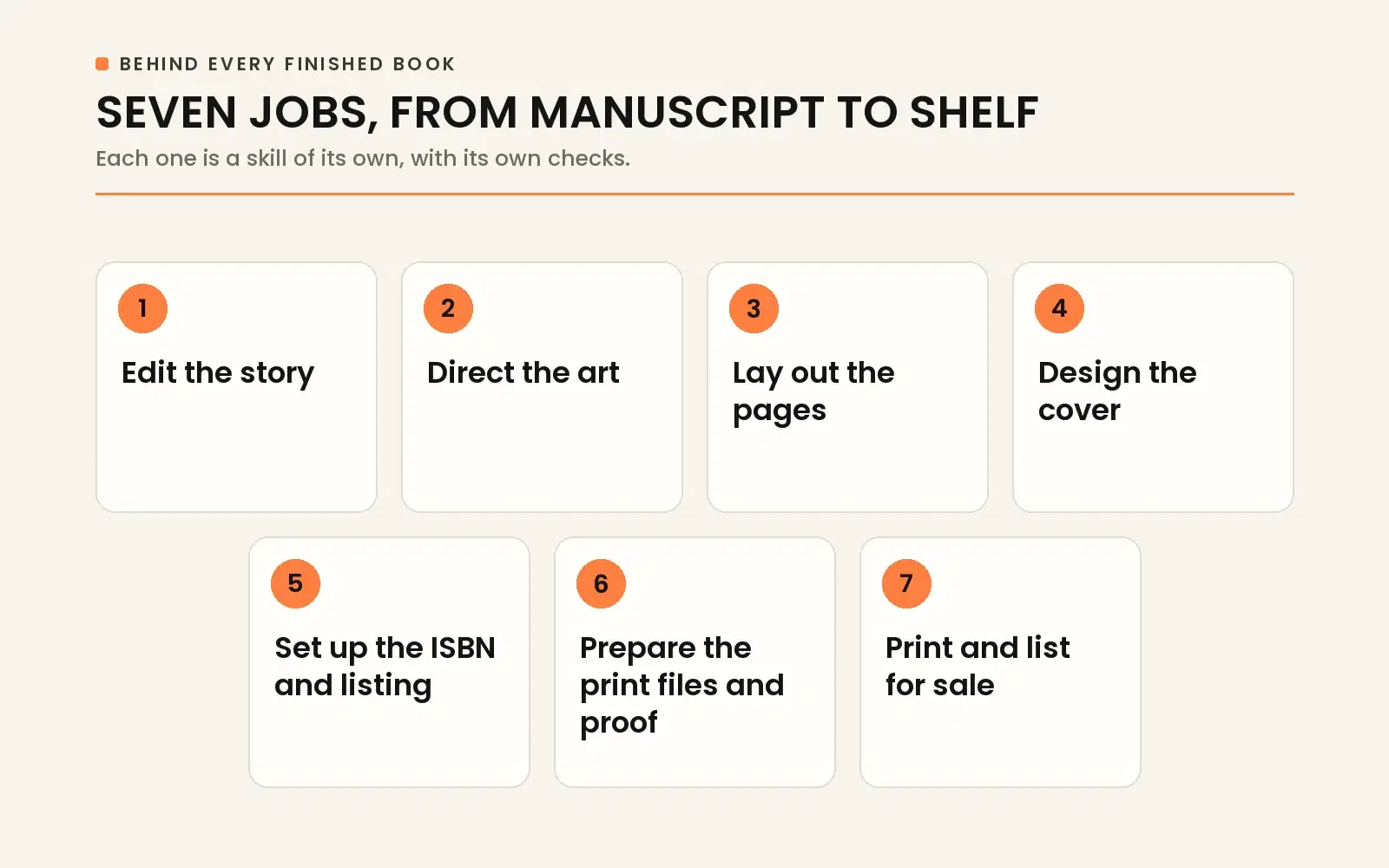
A children's book asks more of a publisher than a novel. The pictures and the words have to work as one on every page, so more hands are involved. Each job below is a skill of its own, with its own people and its own checks. Our guide to how children's book publishing works, stage by stage shows the order the work happens in.
Editing the Story for Young Readers
A children's book publisher does edit your story. The editing is done with young readers in mind, so the words work for the age of the child who'll hear or read them. That's a different job from editing a novel, even though the basic tools are the same.
In a picture book, an editor checks that the length suits the kind of book it is. Every word should be one a young child can hear and understand. The editor also listens for rhythm, because a picture book is read aloud, often many times over. Page turns get special care, since each turn should reveal something the child wants to see. And the editor cuts lines that describe what the pictures will already show, because in a children's book the art carries part of the story.
Early readers get an extra check. The editor makes sure the language suits the child's age and the structure stays simple, so a child can read alone and build confidence. Once the story works, a copy edit fixes grammar and consistency, and a proofread catches the last small slips. You can see what that careful polish adds in our piece on how expert proofreading and editing polish a book.
One practical tip is to settle the text before the art starts. The illustrator draws to your words, so a scene you cut later can take a finished picture with it.
What Is Art Direction in a Children's Book?
Art direction in a children's book is the job of guiding the illustrator. It makes sure every picture fits the story, the reader's age and the page it sits on. At a traditional publishing house, an art director does this job and also finds the illustrator. On a team you hire, someone should be doing it too, and it's fair to ask who.
Art direction starts with a style that suits the reader's age. A board book for a toddler and a picture book for a 6 year old need very different kinds of pictures. Art direction also keeps the main character looking the same on every page, often with the help of a character sheet. If the hero's hair, clothes or size drift from one spread to the next, a young reader notices.
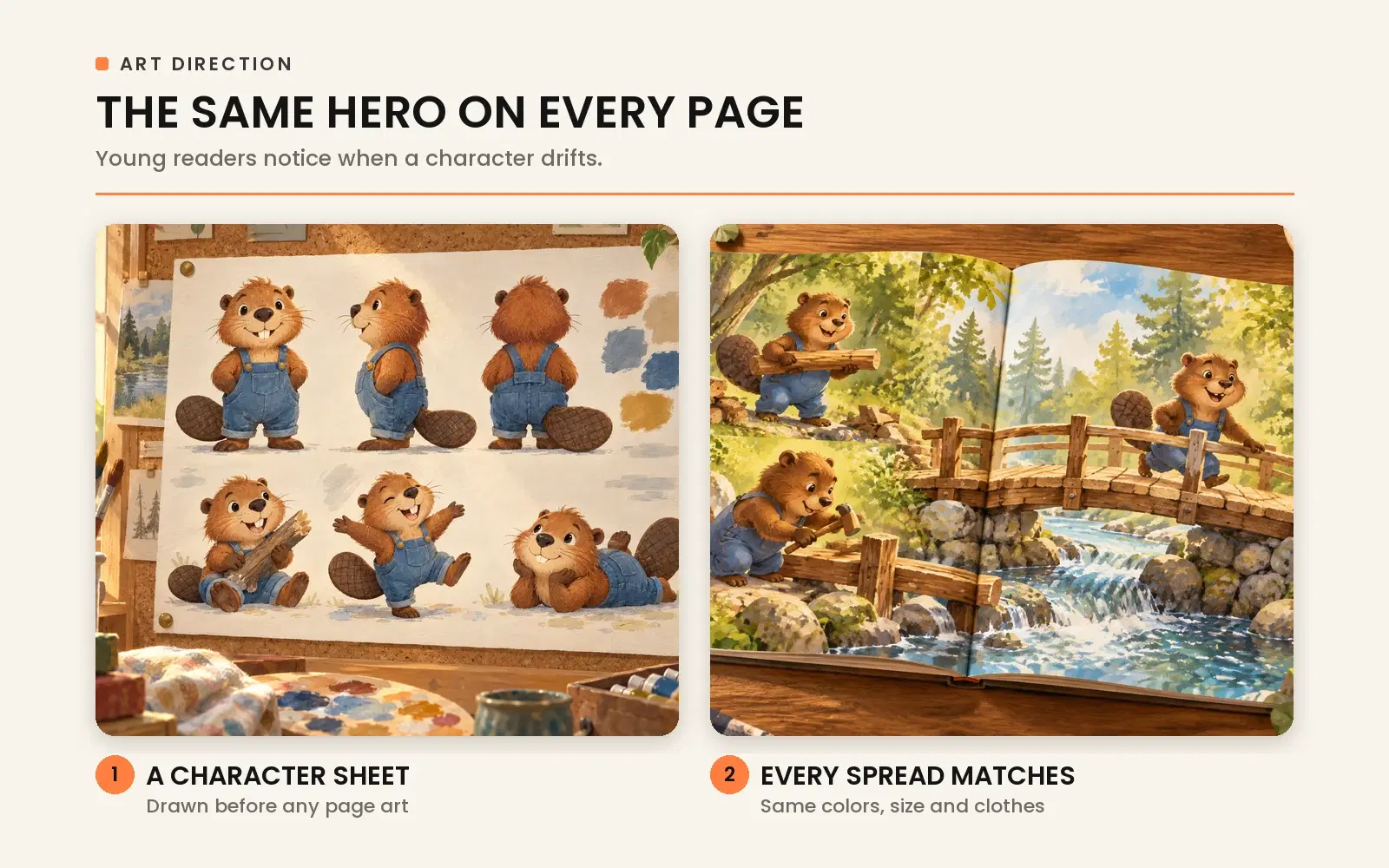
The art director checks rough sketches against the text before any final art is made, so problems are caught while they're easy to fix. The sketches also have to leave room for the words, so the text isn't squeezed into a corner or printed across a busy background. Every picture is drawn to the book's trim size, which is the finished size of the printed page. That's why the trim size and binding are usually settled before any illustration begins, since the art is drawn to fit them.
Art direction matters whoever draws the pictures. The art might come from an illustrator the publisher chose, from finished art you already own, or from an illustrator brought in for the project. Each one still needs someone checking that the pictures and the words tell the same story.
Laying Out Each Page and Setting the Type
Page layout and font choice are part of a publishing company's job on a children's book, so they aren't left to you. Page layout is the work of placing the words and pictures together on every two-page spread. Typesetting is choosing the font, the size and the spacing so a child can read the words easily.
Layout is harder in a picture book than in a novel, because the words usually sit inside the art. Text dropped onto finished pictures without a plan can land across a character's face. It can also disappear into the gutter, which is the fold in the middle of the book. A good designer places each line where it's easy to read and where it doesn't fight the picture. For a young reader, the line breaks matter as well, since a sentence split in an odd place is harder to read aloud.
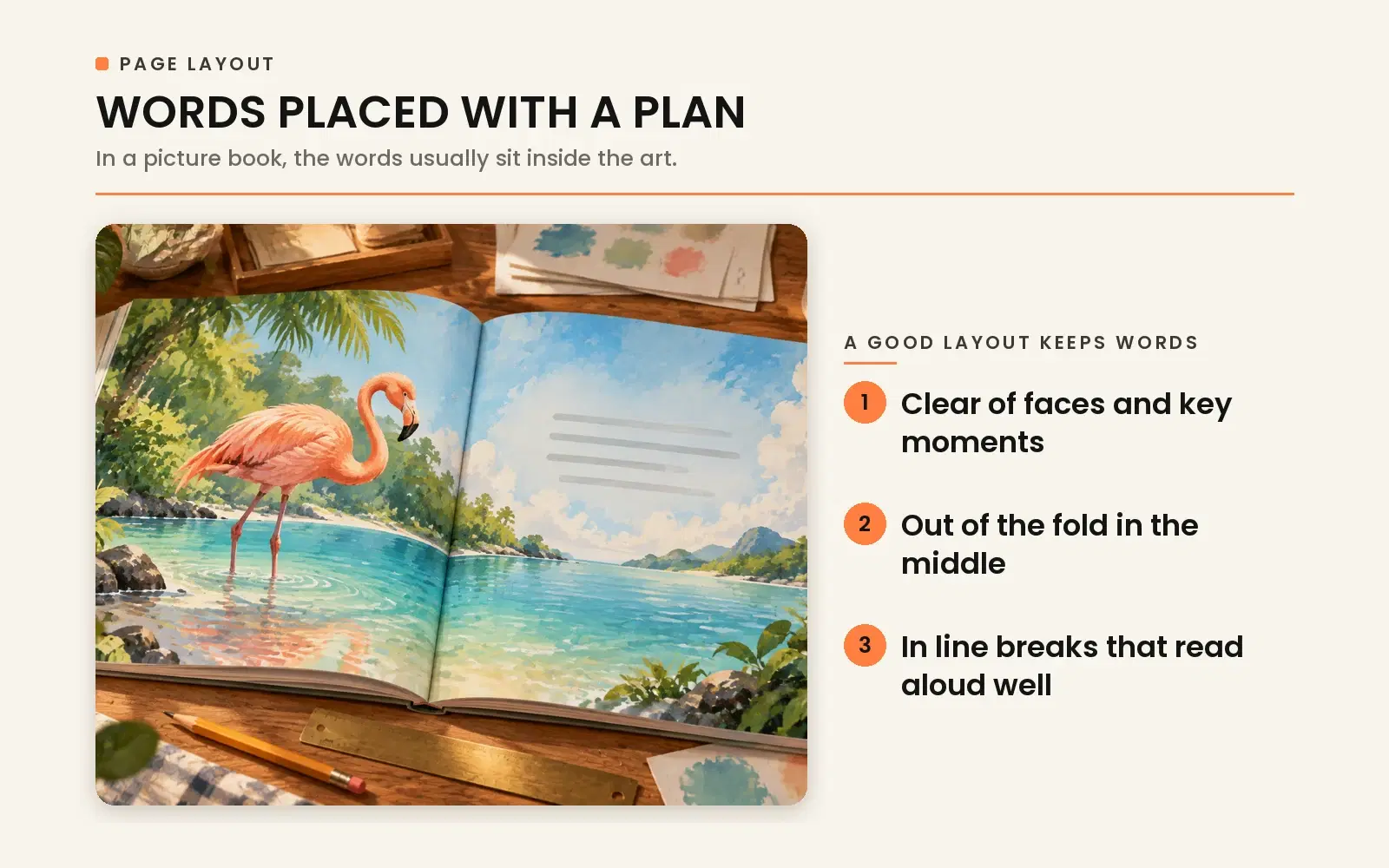
Changing the words after the pages are set adds the most work, because every page after the change has to be redone. So if you're still unsure about a line, it's far easier to fix it while the story is still just a document.
Designing the Front, Spine and Back Cover
A publisher handles the cover design of a children's book. That means the whole wrap, with the front, the spine and the back built as one piece. Amazon KDP, for example, asks for a paperback cover as a single file that holds the back, the spine and the front together. The finished cover has to work on a bookstore shelf and as a tiny picture on a phone.
A children's cover also has two audiences. The adult is usually the one paying, and the child is often the one pointing. So the front has to catch a child's eye, while the back cover copy is written for the grown-up. There's more on the cover choices that make parents and kids stop and look in our cover guide.
The spine is the part that's easy to forget. Its width depends on the page count and the paper. So the cover can only be finished once the inside of the book is final.
Setting Up the ISBN and the Listing Details
Whoever acts as the publisher sets up the ISBN. The name shown as the publisher is the imprint tied to that ISBN. So before a company publishes your children's book, ask whose name that imprint will carry.
An ISBN is a number that picks out one edition of a book, and each print format gets its own. So the paperback and the hardcover of the same picture book carry two different ISBNs. An imprint is the name of the publisher linked to an ISBN. With a free ISBN from Amazon KDP, the imprint appears as "Independently published" instead of your name. With an ISBN bought in your own name, your own imprint can show.
The listing details, which the book trade calls metadata, are the facts stores use to sort your book and readers use to find it. They include the title, the description, the categories and, for a children's book, the reading age. That last one matters more than it looks. Amazon KDP notes that a children's book without an appropriate reading age may not be eligible for children's categories. It also won't appear in age-specific search results in the Amazon Store.
Preparing Print Files and Checking the Proof
Print-ready files are the finished pages and cover, built to the printer's rules. A proof copy is a printed test copy you check before the book goes on sale. A publishing team prepares both, because a mistake in the files shows up in every copy that's printed.
The printer's rules cover things like the bleed, which lets a picture run right to the edge of the page. They also cover the trim size and the color settings. You don't need to learn these terms, but it helps to know someone has to get them right.
The proof matters most for color, because the ink and the paper decide how every picture really looks in print. Amazon recommends ordering a proof before you publish, to make sure the ink and paper you chose suit your book. A good children's book team treats that printed proof copy as the real test, and it's the version worth approving.
Printing the Book and Getting It Listed for Sale
The last job a children's book publisher does is printing your book and getting it listed where readers buy it, including Amazon. That job is what the book trade calls distribution. It's the part of publishing that turns finished files into a book someone can order.
There are two main ways the printing happens. Print on demand means a copy is printed when someone orders one, so nobody has to store boxes of books. A print run means a set number of copies is printed at once and kept until they sell. A large traditional house often keeps its books in a warehouse and sends them on to bookstores and online retailers.
Many independent children's books are listed through platforms such as Amazon KDP and IngramSpark. Amazon KDP prints books on demand and ships them to customers. IngramSpark says it connects books to libraries, retailers and online stores. An ebook edition can be listed alongside the print book, so a parent can buy whichever one suits the family.
Being listed means your book can be ordered. That isn't the same as readers finding it, which is a separate job from distribution.
The Parts of Your Book That Stay Yours
When you hire a team, your words, your final say and the money from sales should all stay yours. It's wise to see that in writing. The rights to the art depend on the written agreement, too. With a traditional publisher, you usually keep the copyright in your story but grant the house the right to publish it. Here's how each part works.
Does a Publisher Own the Rights to Your Book?
No, a publisher doesn't own the rights to your book unless you sign them over. If you hire a company to publish your children's book, you keep the rights, unless the agreement you sign says otherwise. The copyright in your words belongs to you as the author.
The U.S. Copyright Office's guide to copyright basics explains that copyright belongs at first to the author who created the work. That protection starts on its own once the work is fixed. In plain terms, your story is protected as soon as it exists on paper or on a screen.
A publisher gets only the rights you agree to hand over. A transfer of copyright generally has to be made in writing and signed. A traditional contract grants the house the exclusive right to publish your book, often for as long as the copyright lasts. Even so, most standard contracts register the copyright in your name. A team you hire should do its work without taking any rights at all, so it's worth checking that the agreement says so.
The pictures follow the same general rule. The copyright in the art generally belongs to the illustrator who made it. The exceptions are a signed, written transfer or art that counts as a work made for hire. That's a legal term for work where whoever hired the artist is treated as its author. Paying for the art doesn't, on its own, make its copyright yours. The Copyright Office is also clear that owning a copy of a work doesn't make you the owner of its copyright. So print files sitting in your inbox don't settle who owns the art, and the written agreement does.
Can a Publisher Change Your Book Without Asking?
A team you hire shouldn't change your children's story or pictures without your OK. You should approve each stage before the next one begins. You should also keep the last word on the text, the art and the cover. A traditional publisher works differently. A traditional contract usually lets the house decide the format, the design and the cover. The title named in the contract is often treated as a working title, too.
This matters because a good team will still speak up when something won't work for a child. In the end, though, it advises and you decide. Say your editor suggests cutting a line from the middle of the story because the picture on that page already shows it. You can agree, and the page may read better for it. Or you can keep the line because it's the one your grandchildren always shout out. Then a good team lays the page out around it.
The same goes for the pictures. If your main character doesn't look right in the sketches, you should be able to say so and see it changed. That kind of back and forth is normal. What isn't normal is finding a change you never agreed to on the final proof.
Where the Money From Sales Goes
When you hire a team, the store or platform pays out what each sale earns after taking its own share. That money should come to you. When you sign with a traditional publisher, the house collects the money from sales and pays you royalties, often against an advance.
With a team you hire, two plain questions settle it. Whose account will the book be listed in, since that's where the platform sends the money? And does the team take any cut of sales on top of its fee? Amazon KDP, for example, subtracts the printing cost from the royalty on each copy it sells. The account holder receives the rest.
With a traditional house, an advance is money paid to you before the book earns anything. It's usually paid in parts, often starting when the contract is signed. The advance counts against the royalties your book earns later, so royalty payments start once it has been earned back. No one can tell you in advance what a book will earn, but you can always find out where its money goes.
Do You Need a Publishing Company to Self-Publish?
You don't have to use a publishing company to self-publish your picture book. Platforms such as Amazon KDP and IngramSpark let an author publish directly. When you do that, you take on the publisher's role yourself, with every job in this guide to do or to hire out.
Authors still turn to publishing teams because of the seven jobs in this guide. That's what a publisher does for an author, and each job is done by people who do it every day. In an illustrated book, the hardest are usually the art direction, the layout of words inside pictures and the print files. They call for skills most writers have never had a reason to learn.
Whether self-publishing suits your book, and when paid help makes sense, is a bigger question. Our honest look at whether self-publishing a children's book is worth it walks through it. If you're thinking about budget, our guide to what drives the cost to publish a children's book explains what each job adds to the total.
What Should a Good Publishing Team Show You Before You Start?
A good children's book publishing team should show you finished books and explain its stages before you sign up. It should also tell you who does each job and say plainly what you'll own at the end. That's true whether you're a first-time author, a parent, or a grandparent making a picture book with a grandchild. Here's what to ask to see or hear.
- Finished children's books with their insides, not just their covers, so you can judge the layout and the print quality for yourself.
- The list of stages your book will go through, and what you'll be asked to approve at each one.
- Who does the art, the layout and the printing, and whether that happens in one place or is passed to other companies.
- Whose account the book will be listed in, and whose imprint will show as the publisher.
- Who owns the files at the end, and exactly what you'll receive when the book is done.
A good team answers these questions plainly and without pressure. If an answer stays vague, ask again, and ask to see it in writing before any work begins.
How Book Writing US Can Help With Your Children's Book
At Book Writing US, we work as children's book publishers for authors of picture books, early readers and educational books. We help turn a finished manuscript into a finished book, with editing, illustration, page design and the cover, printing and publishing.
If you already have finished art, we can work with it. If nothing is drawn yet, the pictures can be made through our children's book illustration services. Tell us where your story is today, and we'll gladly talk it through with you.
Frequently Asked Questions
Can you be your own publisher?
Yes, you can be your own publisher, and every author who self-publishes takes on that role. To have your own name show as the publisher, though, you need your own ISBN, since the publisher shown is the imprint tied to the book's ISBN. A free ISBN from Amazon KDP shows "Independently published" instead. If you buy your own, pick an imprint you'll be happy to see for years, such as your name or a small brand name.
Do publishers provide illustrators?
It depends on the kind of publisher. A traditional children's publisher finds the illustrator itself, through its art director, so a picture book author doesn't need to bring one. A publishing team you hire may have illustrators who work inside the project, or it may build the book around finished art you already own. If you do have art, say so at the very start, because it changes how the whole book is designed.
Do publishers market your children's book?
Some do, and how much depends on the kind of publisher. A large traditional house has its own marketers and publicists. Its contract also lets it use your name and the book's title in advertising and publicity. A team you hire may or may not include marketing, because marketing is usually a separate job from publishing. So ask exactly what's included before you assume anyone is promoting the book.
Can an author change publishers?
Usually yes, but how easily depends on the kind of publisher. With a team you hire, moving is simplest when you own your files and your rights. The ISBN may not move with you, though, because a free ISBN from Amazon KDP can only be used on KDP. With a traditional publisher, the contract decides when the rights come back to you. That's often done through an out-of-print clause, also called a reversion of rights clause.
Does the publisher of a book matter?
To the child reading it, the publisher doesn't matter at all. A 4 year old at bedtime cares about the story and the pictures, not the name on the spine. The publisher's name shows on the book's listing and its copyright page, so stores and buyers can see it. What matters most for a children's book is how well the seven publishing jobs were done, from the first edit to the final proof.
Do you have to have an editor to publish a children's book?
No, there's no rule that you must have an editor, and Amazon KDP simply expects you to upload a finished manuscript. A children's book is read aloud again and again, though, often by the same parent to the same child. So every slip in rhythm, grammar or spelling gets noticed. An editor who knows children's books catches those slips before they're printed into every copy.
- Which Kind of Children's Book Publisher Do You Mean?
- What Does a Book Publisher Actually Do for a Children's Book?
- The Parts of Your Book That Stay Yours
- Do You Need a Publishing Company to Self-Publish?
- What Should a Good Publishing Team Show You Before You Start?
- How Book Writing US Can Help With Your Children's Book
- Frequently Asked Questions