How to Fund a Children's Book With Grants, Crowdfunding and Sponsors
Short Answer: You can fund a children's book with children's book grants, crowdfunding, a sponsor, preorders you take yourself or your own savings. You can also use two or three of them for the same book. Grants are few and competitive, and none of these routes is certain. Each one also asks something of you, from a written plan to delivering every copy you promised on time.
Your story is written and you may even have a quote in front of you, but the money isn't all there yet. That's a very normal place to be, and it's usually when people start reading up on how to raise money to publish a book. The good news is that there's more than one way to pay for a children's book.
This guide goes through each funding route in turn. For every one, you'll see who it suits, what it asks of you and when the money actually arrives. None of these routes is certain, so it's smart to understand what each one expects before you go after the money.
How to Get Funding to Publish a Book
There are six main ways to fund a children's book. They're grants, crowdfunding, a sponsor, and a partnership with a school, library or nonprofit. The other two are preorders you take yourself and your own savings, spent one stage at a time. Knowing how to get funding to publish a book really starts with knowing what each route expects in return.
Each route comes with its own obligations, and the table below sets them side by side. Grants take two rows, because the two kinds ask for different things.
| Route | Who it suits | What it asks of you | When the money arrives |
|---|---|---|---|
| A state or local arts grant | Writers who can show strong work and meet that agency's rules | An application judged against others, and often public events such as a reading | After you're chosen, if you're chosen |
| A grant from a children's book organization | Members, and writers who match that grant's rules | Membership for some grants, plus a synopsis and a plan | After you're chosen, if you're chosen |
| Crowdfunding on Kickstarter | Authors with a network of supporters and art to show | A goal that covers the whole job, then every reward delivered | Only if the campaign reaches its goal, after it ends |
| A local sponsor | Books with a local subject or a clear community link | A short proposal, a thank-you in the book and copies for the sponsor | When you've both agreed in writing |
| A school, library or nonprofit partner | Books that serve a literacy or community purpose | Shared decisions, with the partner's mission first | When the partner's funding comes through |
| Preorders you take yourself | Authors with a firm date and readers waiting | Shipping by the date you gave, or refunds | When each buyer pays |
| Your own savings, one stage at a time | Authors who can wait a little longer | Patience, and a plan for which stage comes first | Whenever you're ready for the next stage |
Look down the last column before you choose, because a route that pays out after the book is finished can't pay for the art.
Work Out What You Need Before You Ask for Money
Every funding route starts with the same two things. You need a clear number for the part of the book you're paying for, and enough of the book to show. A grant panel, a crowd of backers and a local sponsor all want to know what their money will do.
The funders say this on their own pages. Kickstarter tells creators to set a goal that covers what it takes to complete the project, not what they'd like to raise. The Society of Children's Book Writers and Illustrators wants a publication timeline and a one-page business plan from anyone applying for its self-publishing grant. A sponsor will simply ask what their money pays for.
So decide which stage each source of money is paying for. Picture a grandmother with a finished bedtime story and a quote for the illustrations. If she asks a local shop to help pay for "the pictures," the owner has something clear to say yes to. Asking for help with "my book" is much harder to agree to. If you're not sure what makes up your number, there's a separate guide to every cost driver behind publishing a children's book.
Something to show usually means a settled manuscript and one or two sample pages or a storyboard. A storyboard is a rough page-by-page plan of the words and pictures. It's worth reading why a storyboard comes before the finished art before you decide what to show a funder.
Are There Grants for Children's Book Authors?
Yes, there are grants for children's book authors, but there aren't many and they're competitive. Children's book grants often come from two places, your state or local arts agency and organizations for children's book writers and illustrators. Many accept applications only during set windows, and the biggest federal arts funder gives its main grants to organizations, not to individual authors.
Grant lists online go stale quickly, because amounts, deadlines and rules can change from one year to the next. It's more useful to know where grants come from, so you can check each funder's own page for what's open now.
Start With Your State Arts Agency
Your state arts agency is the natural first place to look for a writing grant, and the National Endowment for the Arts itself points people there. State arts agencies support individual artists through a variety of grants and services, paid for by a mix of federal, state and private money.
Fellowships are a common type of state grant. They're meant to encourage new creative work and help artists build their careers. They also typically come with public engagement requirements, which can mean something like a reading or a workshop. Publication is among the activities that state grants to individual artists have supported.
Some state money reaches writers through a local arts agency or another group that passes grants on to artists. Each state sets its own priorities, so who can apply, and when, differs from state to state. You can find your own agency on the National Endowment for the Arts list of state and regional arts organizations.
What a state grant asks of you is easy to say and real work to do. Read the agency's guidelines closely, apply within its window and plan for any public events that come with the money.
Grants From Children's Book Organizations
Children's book publishing grants also come from writers' organizations, such as the Society of Children's Book Writers and Illustrators (SCBWI). SCBWI is a nonprofit membership organization for children's book creators. Its awards and grants support emerging authors and illustrators, both published and pre-published. One category is set aside for self-published and independently published writers and illustrators.
A few patterns show up across these grants. Some ask you to be a member when you apply. SCBWI's grant for independently published authors, for example, requires membership when you submit and when the award is announced. Others are meant for particular writers. One is for a work in progress from an unpublished author over 50, and another is for early career creators from underrepresented groups.
What these grants ask of you most is care with the rules. Read who each grant is for before you write a word of the application, because a strong application for the wrong grant won't get far.
Can You Get a Federal Arts Grant for a Children's Book?
No, not as an individual author. The National Endowment for the Arts (NEA) gives its main grants, called Grants for Arts Projects, to organizations. It says funding in that category isn't available to individuals. Its support for books goes through grants to nonprofit publishers, literary organizations and libraries.
The NEA used to give creative writing fellowships to individual writers, but that route is no longer open. The NEA's own literature page now describes those fellowships in the past tense, and they no longer appear among its grant programs. Some older grant lists still send writers to them, so it's worth knowing this before you spend time on an application.
The NEA points individuals toward their state arts agency and regional arts organization instead. For an individual author, federal arts money usually reaches a children's book only indirectly, through a state arts agency or a nonprofit partner.
Can You Get a Grant to Self-Publish a Children's Book?
Yes, some grants will help you self-publish a children's book, but many won't, so it's best to go in with honest expectations. Grants for self-published authors do exist. SCBWI's grant for independently published authors must be spent on self-publishing the book. Its list of uses includes hiring illustrators, editors and book designers, along with printing and shipping costs.
Other children's book grants ask for the opposite. SCBWI's Encouragement Fund, for example, says your previously published book must be traditionally published, so an author with only a self-published title can't apply. Neither kind is better than the other. They're written for different authors, and the rules tell you which one you are.
Grants are judged, not handed out. SCBWI says its self-publishing grant is awarded on the quality and professionalism of your synopsis and the strength of your business plan. At the NEA, advisory panels review applications and staff match the recommendations to the money available. Not every applicant receives a grant, so treat one as a part of your funding plan rather than all of it.
What Does a Grant Application Ask of You?
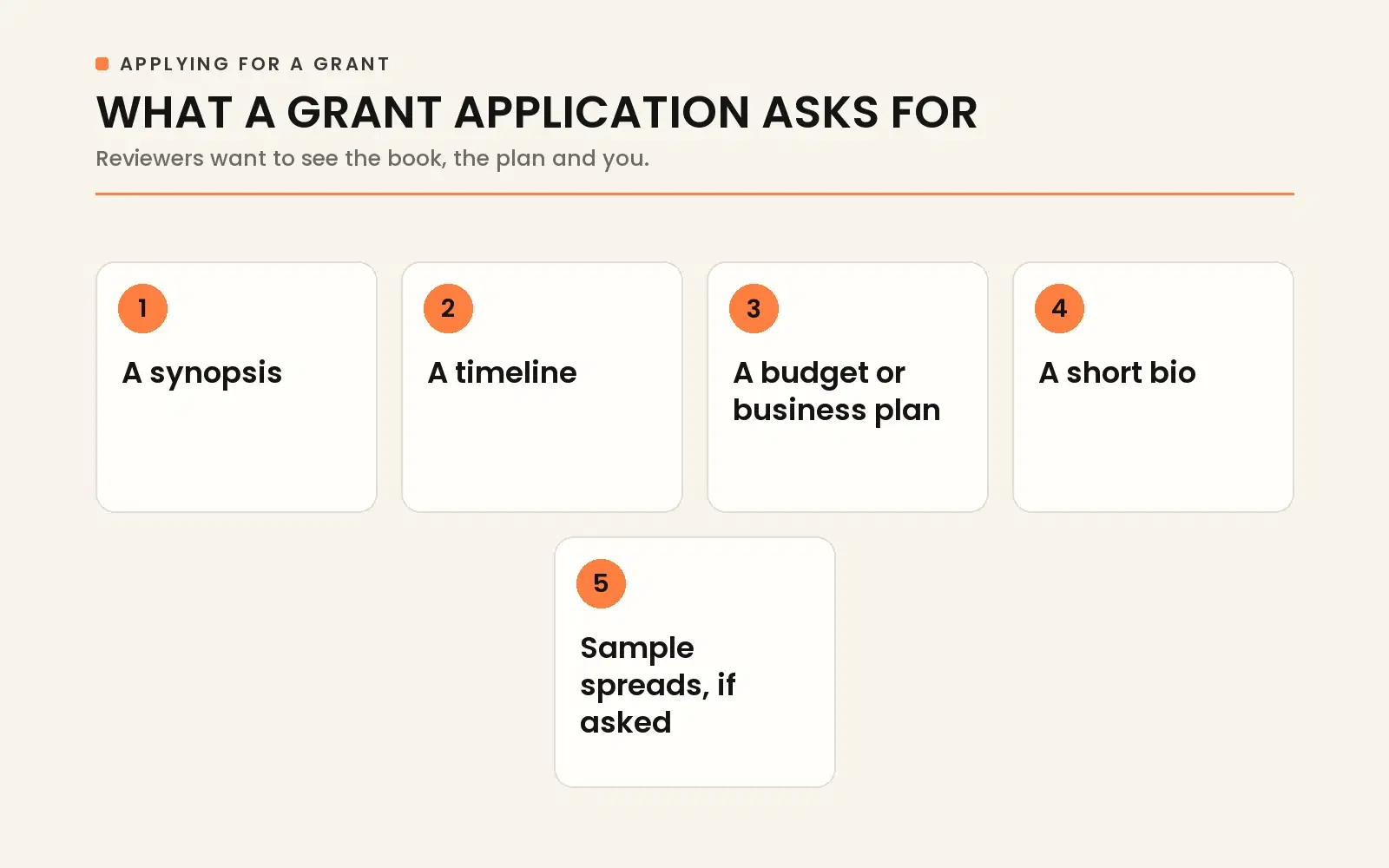
A grant application for a children's book usually asks for a short description of the book, a timeline, a short bio and a plan for the money. SCBWI's self-publishing grant, for example, asks for a cover letter, a short synopsis, your publication timeline, a short bio and a one-page business plan. Here's what each piece does for you.
- A synopsis tells reviewers what the story is about and who it's for.
- A timeline shows when each stage will happen and when the finished book will be ready.
- A budget or business plan shows exactly what the money will pay for, stage by stage.
- A short bio tells reviewers who you are and why you're the right person to make this book.
- If a grant asks for sample pages or art, choose the spreads, or pairs of facing pages, where the words and pictures work best together.
These pieces matter because your application is compared with others and with the money available. Think of a first-time author who sends a lovely synopsis and no plan for the money. The reviewers can't tell what the grant would change, so her application falls behind one that names each cost and each date.
The obligations don't end when the money arrives. Before you apply, read what the grant expects after the award, such as public events or rules on how the money must be spent. That way, you'll know exactly what you're agreeing to.
A Real Grant Shouldn't Ask You to Pay First
Be very wary of any grant that asks you to send money before you receive it. The National Endowment for the Arts has warned the public about people pretending to be NEA employees. They contact people through Facebook, email or phone to say they've won a grant but must pay money into an account to release it. They may call that payment a processing or delivery fee. The NEA says it never notifies anyone of a grant through Facebook and never asks for money before releasing grant funds.
Say a message arrives out of the blue telling you your picture book has won an arts grant. There's just a small fee to pay first. Don't reply and don't pay. Find the funder's website yourself and contact it directly before you do anything else.
How Does Crowdfunding Work for a Children's Book?
Crowdfunding children's books works by asking many people to each pledge money toward your book, and in return they usually get a copy or another reward. On Kickstarter, funding is all-or-nothing, which means no one is charged unless the campaign reaches its goal.
Kickstarter also says it isn't a store. Your backers aren't buying something that already exists. They're supporting a creative process and helping you make something new. That matters for a children's book, because every backer is trusting you to finish it.
Crowdfunding book publishing can suit a picture book, because backers get to see the art before the book exists. A few finished spreads and a clear main character show people exactly what they're helping to make.
What Kickstarter Asks of You Before You Launch
Before you launch a Kickstarter campaign, you set a funding goal and a deadline. Kickstarter says neither one can be changed once the campaign starts. That makes the goal the most important number in the whole campaign.
Kickstarter says your goal should be the amount you need to complete the project. That includes production, materials, shipping and the fees for running a project on Kickstarter. It also notes that the larger the goal, the lower the success rate. Its advice is to set a goal you know you can raise from your own network of family, friends, fans and followers.
If the campaign ends short of its goal, no money changes hands. Your backers aren't charged, you receive nothing, and you're welcome to relaunch the project later.
Kickstarter also has rules about what a project can be. It doesn't allow something that's already available elsewhere as a project's end goal. So a book you've already published and are selling can't be the thing you're raising money for. A new book can, and a book you already sell could be offered as one of its rewards. Money rewards and any return on investment aren't allowed.
What You Owe Your Backers After the Campaign
Once your Kickstarter campaign is funded, you're responsible for finishing the book and delivering every reward to the best of your ability. Kickstarter calls that a creator's basic obligation to backers, along with answering their concerns honestly.
Kickstarter also expects regular updates on your progress and early warning of any delay. It doesn't issue refunds itself, so refunds are up to the creator. If the money has already gone on printing or shipping rewards, a refund may not be possible.
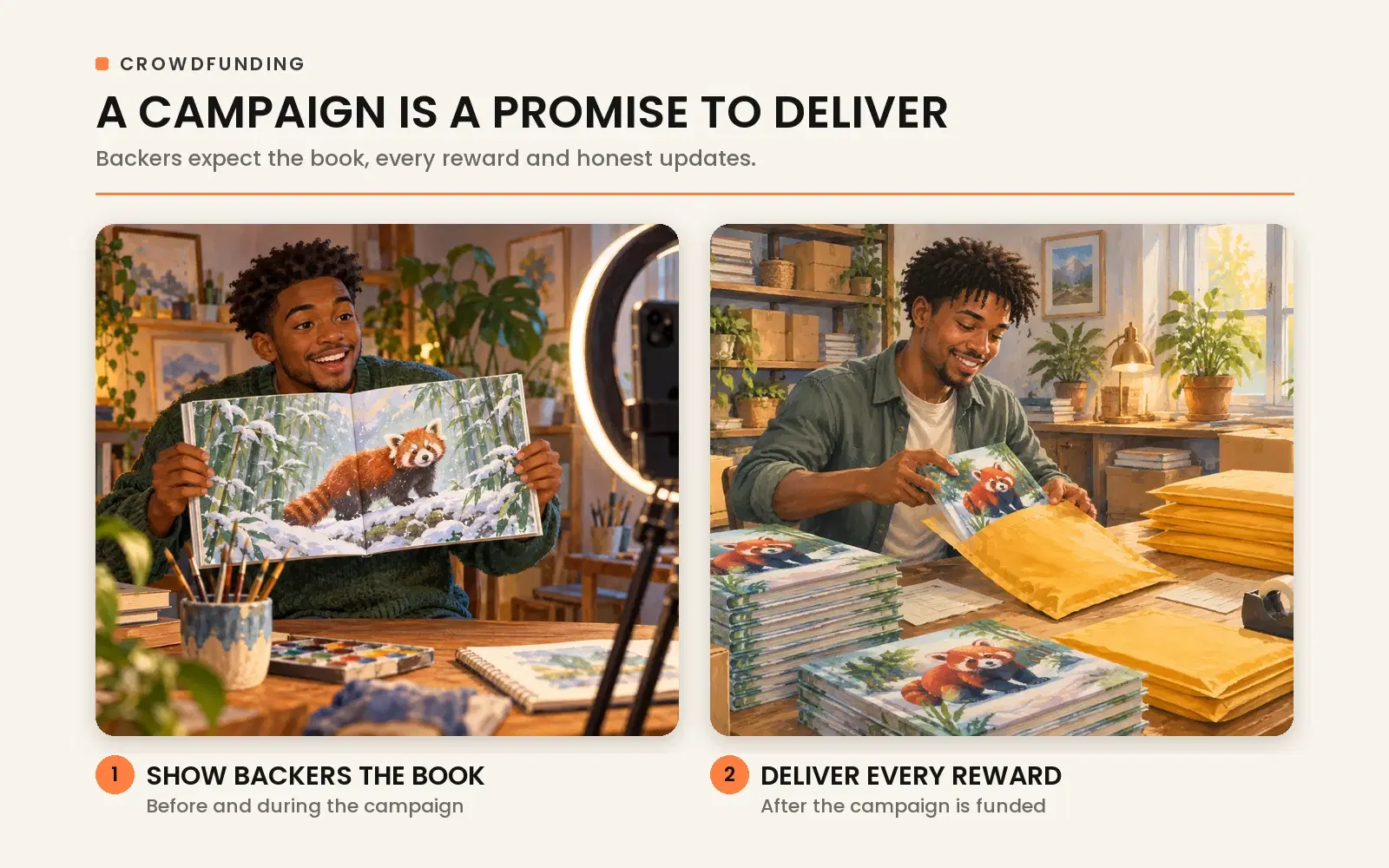
Rewards on Kickstarter children's books are usually copies of the book, limited editions or experiences, and every one of them costs something to make and send. Imagine a dad who promised signed hardcovers to his backers. Months after the money arrived, he's still printing, signing, packing and posting each copy. All of those costs had to fit inside his goal. Money raised this way is also generally subject to tax, which the questions at the end cover.
How to Get Sponsorship to Publish a Book
To get sponsorship to publish a book, you ask a local business, club or community group to pay toward it. The money might cover the printing, for example. It works when the book connects to something the sponsor already cares about.
Two examples show how that connection works. A picture book set in a town park might suit a local garden store. A story about brushing teeth might suit a family dental office. In both cases, the sponsor's customers are the same families your book is written for.
A sponsor usually wants something modest in return. That could be a thank-you in the book, some copies to give away or a reading at an event. What sponsorship asks of you is a short, clear proposal. It should say what the money will pay for, who the book is for and how the sponsor will be thanked.
It also asks you to hold one firm line, which is that the story stays yours. Say the dental office asks for its cartoon tooth to appear on every page. A picture book that reads like an advert loses the parents it needs, so agree on exactly how the sponsor is thanked before anything else.
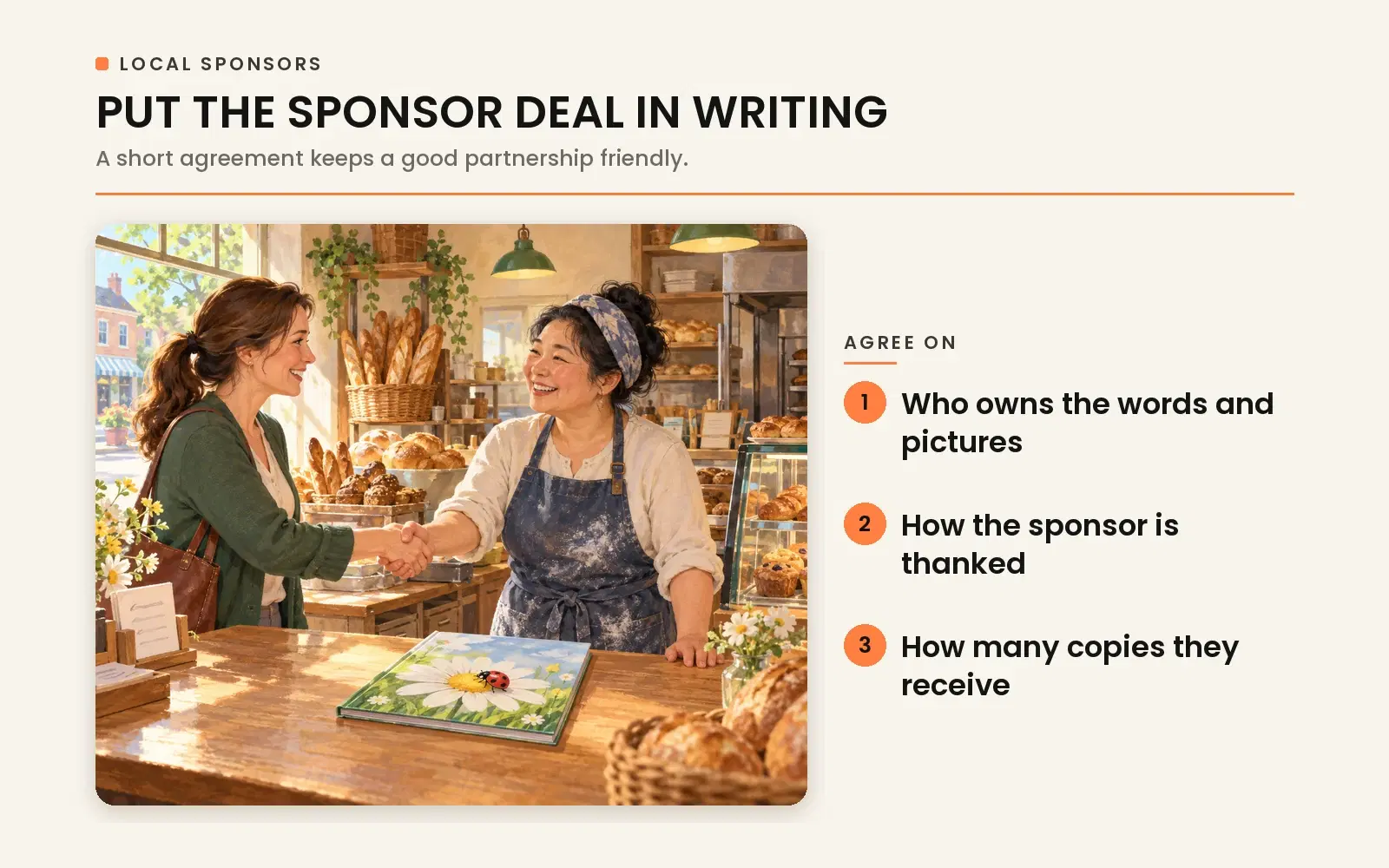
Put the Sponsor Deal in Writing
Before any money changes hands, write down what the sponsor pays, what they get and what they don't. A short written agreement protects both sides and keeps a friendly deal friendly. Make sure it covers these four points.
- Who owns the words and pictures. Copyright generally belongs to whoever created the work unless there's a signed written transfer or a work made for hire.
- Exactly how the sponsor is thanked, such as their name, their logo or a page at the back.
- How many copies the sponsor receives, and whether they can sell them or only give them away.
- What happens if the book is late, so a delay doesn't turn into an argument.
This is general information, not legal advice. For a bigger deal, it's worth having a lawyer read the agreement before you sign it.
Teaming Up With a School, Library or Nonprofit
Funding a children's book project through a school, library or nonprofit is possible when the book serves a community purpose. A literacy program and a library reading project are good examples. These organizations can sometimes apply for money that an individual author can't. The NEA's main grants category, for example, is open to nonprofit organizations but not to individuals.
Suppose a school librarian's reading club has written a picture book together. The children can't apply for an arts grant themselves, but the school, the library or a nonprofit it works with may be able to.
What this route asks of you is to share the decisions. The partner's mission comes first, and the partner may want a say in the story and the timeline. You'll also need to agree in writing who owns the book and who can print and sell it. It suits authors writing for a particular community, not authors who want full control.
What Is a Fiscal Sponsor?
A fiscal sponsor is a nonprofit that receives charitable gifts for a project that isn't a nonprofit itself. It then grants that money on to support the project. In effect, the fiscal sponsor becomes the project's administrative home.
A fiscal sponsor usually suits a book with a charitable purpose, such as books for a literacy program. It's less suited to a book you plan to sell for yourself. It also comes with conditions. The fiscal sponsor keeps the right to decide how the money is used, and it's common for it to charge an administrative fee. Some funders won't accept an application through a fiscal sponsor at all, and the NEA's main grants category is one of them. An accountant or a nonprofit adviser can tell you whether this setup fits your book.
Can Preorders Pay for Your Book Before It's Printed?
Only one kind of preorder brings in money before a children's book exists, and that's the preorder you take yourself. Amazon KDP pre-orders are for eBooks only, not paperbacks or hardcovers, and you're credited for those sales after the eBook is released. So Amazon KDP pre-orders can't pay for printing a picture book.
A Kickstarter pledge isn't a preorder either. Kickstarter says backers are helping create something new rather than pre-ordering something that already exists. The table below puts the three side by side, because they're easy to mix up.
| Kind of advance money | When you get it | What you must deliver | If you miss your date |
|---|---|---|---|
| A Kickstarter pledge | After the campaign ends, and only if it reached its goal | The finished book and every reward you promised, with updates along the way | You keep backers informed, and any refund is your decision |
| An Amazon KDP pre-order | After your eBook is released | Your final eBook file, uploaded before Amazon's deadline | The pre-order is canceled and customers are told |
| A preorder you take yourself | When each buyer pays you | Each copy, by the date you gave | You ask each buyer to accept the delay, or refund them |
Taking Preorders Yourself Comes With a Shipping Promise
When you take money for a book that isn't printed yet, you're making a promise about when it will arrive. The Federal Trade Commission's mail order rule says a seller needs a reasonable basis for any shipping date it gives. If it gives no date at all, it needs a reasonable basis for believing it can ship within 30 days.
If you then can't ship on time, you have to ask each buyer to agree to the delay. If a buyer doesn't agree, the rule says you must promptly refund the money for the unshipped copies, without being asked.
Readers who order signed copies online or by phone might pay months before the books come back from the printer. The safest habit is to set your date only after the files are approved and the printing is booked. Keep a simple record of who paid, how much and when. If you're selling a lot of copies this way, have someone qualified look over your plan.
Saving Up and Funding Your Book One Stage at a Time
You can pay for a children's book bit by bit as you save, because the book is made in stages anyway. You simply start each stage when the money for it is ready, and nobody else has a say in the timing.
The usual order is simple. The manuscript is settled first, then the art is made, then the design and page layout are done, and the printing comes last. With print on demand, copies are made as they're ordered, so you don't pay for a whole print run before a single copy sells. You can also start with one format, such as a paperback, and add another later.
Picture a teacher who saves through the school year. She pays for the illustrations first and the layout over the summer, then orders printed copies once the files are ready. Some parts of publishing can cost nothing at all. It's worth knowing which parts of publishing a children's book can really be free before you start saving. A beginner's guide can also help with planning your budget and timeline for a first book.
Saving is slower than the other routes, but it's the only one where you don't owe anyone anything. There's no goal to hit, no backer to update and no sponsor to thank.
Using More Than One Route for the Same Book
You can combine a grant, a crowdfunding campaign and a sponsor for one children's book. Every route adds its own promises, though, so check that they don't clash. These three clashes are worth checking before you say yes to anyone.
- A sponsor who wants the only thank-you page, when your backers were promised their names in the book.
- A grant with public events on dates that collide with the weeks you'll spend posting rewards.
- One timeline promised to a funder, your backers and your preorder buyers, with no room left for a delay.
A simple habit helps you avoid all three. Keep one list of everything you've promised, to whom and by when, and check it before you agree to anything new.
Getting Your Book Made Once the Money Is in Place
Once the money is in place, the next job is turning your manuscript into a finished book. Book Writing US helps authors with that part, through editing, illustration, page design and the cover, printing and publishing. It works on picture books, early readers and educational books. It can use art you already have, or have the pictures drawn through its children's book illustration services.
If you're ready to publish your children's book, or you'd like a clearer idea of what your book needs, get in touch. Whoever you work with, ask for a written quote that shows what each part covers, because that's the number your funders will want to see.
Frequently Asked Questions
Are there grants for first-time authors?
Yes, some grants are open to first-time authors. SCBWI's awards and grants support emerging children's book creators, both published and pre-published. Its Karen Cushman Late Bloomer Award, for example, is for a work in progress from an unpublished author over 50. Other grants ask for a book that was already traditionally published, so read each grant's rules before you apply. State arts agency rules vary too, so check what your own state offers new writers.
Can you get a grant to write a book, not just publish it?
Yes, some grants support the writing itself rather than the publishing. State arts agency fellowships are meant to encourage new creative work. SCBWI's Work-in-Progress Awards help children's book writers and illustrators finish a specific project that isn't under contract yet. One of those award categories is picture book text, so an unfinished picture book manuscript can be eligible. As with every grant, check who can apply and when before you start.
Are there children's book printing grants?
Yes, some grants will pay toward printing as one of their allowed costs. SCBWI's grant for self-published authors lists printing and shipping among the ways its money can be used. State grants to individual artists have also supported publication. When you look for children's book printing grants, check each grant's list of allowed costs and make sure printing is on it before you apply.
Is crowdfunding money taxable?
Yes, crowdfunding money can be taxable. The IRS says money received through crowdfunding may be taxable, and it tells anyone receiving the money to keep complete and accurate records. Kickstarter says funds raised on its platform are generally subject to taxes, and it recommends talking to an accountant or tax advisor. Keep a record of everything you raise and spend on the book, and ask a tax professional about your own situation.
Can you crowdfund a children's book you haven't finished yet?
Yes, you can, and new projects are exactly what Kickstarter is for. Kickstarter won't accept something already published and on sale as a project's end goal. Your backers still need a reason to trust you, though, so show them a settled manuscript, some sample art and a clear plan. You also need to be sure you can finish the book, because delivering the rewards becomes your job once the campaign is funded.
Is crowdfunding the same as asking for donations?
Not quite, because with reward crowdfunding your backers get something back, such as a copy of the book. Kickstarter doesn't allow money rewards or any return on investment, so the reward is the book or something connected to it. A donation is usually given with nothing expected in return. The IRS says contributions given out of generosity, with nothing received or expected back, may be gifts, so the two can be treated differently for tax.
- How to Get Funding to Publish a Book
- Work Out What You Need Before You Ask for Money
- Are There Grants for Children's Book Authors?
- Can You Get a Grant to Self-Publish a Children's Book?
- What Does a Grant Application Ask of You?
- How Does Crowdfunding Work for a Children's Book?
- How to Get Sponsorship to Publish a Book
- Teaming Up With a School, Library or Nonprofit
- Can Preorders Pay for Your Book Before It's Printed?
- Saving Up and Funding Your Book One Stage at a Time
- Using More Than One Route for the Same Book
- Getting Your Book Made Once the Money Is in Place
- Frequently Asked Questions