Can You Publish a Children's Book for Free, and What Does Free Cost You?
Short Answer: You can publish a children's book for free, but only partly. Setting up your book on Amazon KDP or IngramSpark costs nothing, both platforms offer a free ISBN, and copyright protection is automatic. What isn't free is making the book, which means the art, the editing and the page layout, plus every printed copy you order. Free usually trades money for your time, your name as the publisher and how finished the book looks.
If you're wondering how to publish a children's book for free, you probably have a finished story, a tight budget and at least one friend who says Amazon is free. That friend is partly right. Putting a book up for sale can cost nothing at all. But that's only one small part of publishing a children's book.
This guide shows you which parts really cost nothing and what each free option quietly trades away. It also shows where the money tends to turn up anyway, so it doesn't catch you by surprise. None of this is meant to put you off. It's meant to help you spend only where your book truly needs it.
Which Parts of Publishing a Children's Book Are Really Free?
Four parts of publishing a children's book can genuinely cost you nothing. They're setting the book up on a print on demand platform, a free ISBN from that platform, copyright protection and a Library of Congress Control Number. Free children's book publishing is real for these four parts, but each one comes with a string attached. The table below puts each free item next to its string, so you can see both at once.
| What's free | What you get | What comes with it |
|---|---|---|
| Setting up a book on Amazon KDP | Free tools to publish your book, printed on demand | The printing cost comes out of each sale, and you upload finished files |
| Setting up a book on IngramSpark | No cost to open an account or set up a book | No editing, typesetting or design, and charges later for things like revisions and printing |
| A free ISBN from Amazon KDP | An ISBN for your paperback or hardcover | It works only on Amazon KDP, and the imprint shows as "Independently published" |
| A free ISBN from IngramSpark | An ISBN while you set up your book | IngramSpark owns it, it can't move to another platform, and the imprint shows as Indy Pub |
| Copyright | Protection from the moment your work is written down or drawn | Registering it is a separate step with a filing fee |
| A Library of Congress Control Number | A number assigned before publication, at no charge | You send the Library a copy of the finished book |
Setting Up on Amazon KDP and IngramSpark Costs Nothing
Setting up a children's book on Amazon KDP costs nothing, and neither does setting one up on IngramSpark. Amazon KDP prints each copy on demand and takes its printing cost out of that sale. That means you don't pay anything upfront, and you don't have boxes of books to store. The answer to "Is IngramSpark free to publish?" is yes, at least for the setup. IngramSpark says there's no cost to create an account or set up a new book. Uploading a print book or an ebook is free too.
Here's the part the word "free" leaves out. These platforms print, list and sell a finished book, but they don't make it. IngramSpark says plainly that it doesn't offer editing, typesetting or design services. Their free tools help with files, but they don't edit your story, draw your pictures or lay out a picture book for you. Amazon KDP expects you to upload a finished manuscript. Neither one will tell you that the words on page 9 sit right across your main character's face. The platform simply prints the file it's given, exactly as it is.
So the setup really is free. The real work, and usually the money, goes into the files you upload.
What Does a Free ISBN Cost You?
A free ISBN costs you no money, but it does cost you your name as the publisher and the freedom to move your book. An ISBN works as your book's ID number, with a separate one for each edition. Amazon KDP's free ISBN can only be used on Amazon KDP. With it, the imprint on your book will read "Independently published" rather than a name you choose. The imprint is the publisher name tied to the ISBN, and it's the name that stores and readers see.
IngramSpark's free ISBN comes with tighter strings. IngramSpark says it owns that number, and the number can't be transferred to another account or used on any other publishing platform. The publisher name that may show on websites is Indy Pub, not you.
An ISBN you buy yourself comes from Bowker, the U.S. ISBN agency, and it does cost money. In return, it lets you list your own imprint, such as a business or brand name, and it isn't tied to one platform. Since a paperback and a hardcover each need their own ISBN, you'll face this choice once for each format. It's worth deciding before you publish, because switching later means publishing a new edition.
Copyright and a Library of Congress Number Are Free Too
Copyright for your children's book is free, and so is a Library of Congress Control Number, though each one comes with a condition. In the United States, copyright protection exists automatically from the moment your work is fixed, which simply means written down or drawn. You don't have to pay anyone to own the copyright in your story or your pictures.
Registering that copyright with the U.S. Copyright Office is a separate step, and that's the part that costs money. The application needs a filing fee and a copy of the work. Registration isn't mandatory, though, so it's a cost you can weigh up rather than one you're forced to pay.
A Library of Congress Control Number is the number linked to the library catalog record for a book. Through the Library of Congress Preassigned Control Number program, you can get one before publication at no charge. In return, the Library requires you to send a copy of the book as soon as it's published. The program is open only to U.S. publishers, and an author who publishes their own book must list a U.S. place of publication in it. So even the free number needs a printed copy, and someone has to pay to print it.
Is Self-Publishing Free, or Only Free to Start?
Self-publishing is free to start, but it's rarely free to finish. Uploading a finished book is the free part, and making the book is the part that costs. So when people ask whether they can self-publish a children's book for free, the honest answer depends on how much of the making they can do themselves.
A children's book shows this split more clearly than almost any other kind of book. A novel is mostly words on plain white pages. A picture book puts art on nearly every page and sets the words inside that art, one page turn at a time. Almost all the work that turns a manuscript into a picture book happens before a platform ever sees your file.
The only way self-publishing stays free from start to finish is if you can do every one of those jobs yourself, and do them well enough for print. That includes the writing, the pictures, the editing, the page layout and the cover. When an author expects their book to cost nothing, the first question worth asking is who's drawing the pictures. That one answer usually tells you whether free is realistic.
Where the Real Costs Hide in a Children's Book
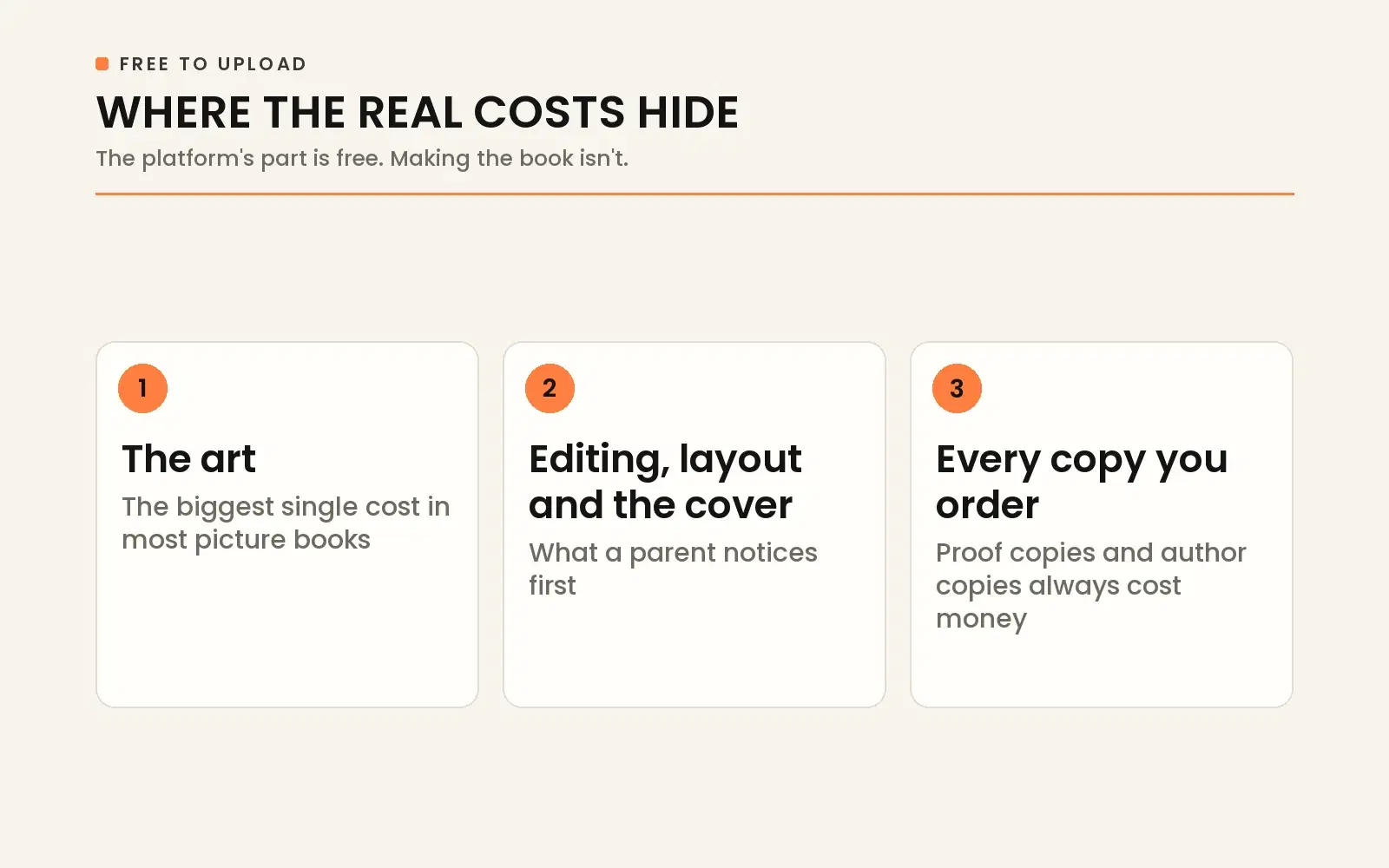
The real costs of a children's book hide in three places. They're the art, the editing, layout and cover work that finish the book, and the printed copies you order for yourself. The art and the finishing work don't show up on a platform's pricing page, because making the book isn't the platform's job. Printed copies do show up, but only as a cost per copy, which is easy to overlook. To see how each of these choices moves the total, read our guide to every cost driver in publishing a children's book.
Can the Art Be Free Too?
The art in a picture book can be free only if you already make print-quality pictures yourself. Every other free route saves money by giving up something a reader will notice, or something you may need later. Here's what each free route saves and what it can cost your book.
| Free art route | What it saves | What it can cost the book |
|---|---|---|
| Drawing it yourself | The biggest single cost in most picture books | The art has to be ready for print, and your main character has to look the same on every page |
| A friend or relative draws it | The illustrator's fee | The artist generally keeps the copyright unless it's signed over in writing, so settle ownership before the drawing starts |
| Free AI image tools | The fee and much of the drawing time | Copyright covers AI pictures only where a person decided the creative parts, and keeping one character the same on every page is hard |
| Free stock or clip art | Any drawing at all | Pictures that weren't made for your story, which anyone else can use too |
The art is where the money goes in a picture book because the pictures tell half the story. A finished page is also hard to redo, so a weak picture tends to stay in the book for good. If you or someone in your family already has finished art, use it rather than starting over. Designing a book around finished pictures is cheaper than paying for new ones. When there's no art yet, it's worth seeing what children's book illustration services involve before you decide to draw every page yourself.
Editing, Layout and the Cover Show When They're Skipped
Editing, page layout and the cover are the jobs a free route tends to skip. They're also the three things a parent notices first, often while just flipping through the pages. Here's what each one does, and what shows when it's missing.
- Editing matters even in a very short book, because a picture book gets read aloud again and again, and a clumsy line trips up the reader every single night.
- Page layout places the words where the art leaves room for them and lands each page turn in the right spot, which a free template can't plan around your pictures.
- The cover is what a parent sees first. It helps them decide quickly whether the book is worth picking up, which is why what makes a children's book cover work for parents and kids deserves real thought.
One tip saves more trouble here than any other. Lock your words before the layout starts. If the text changes after the pages are set, every page after the change has to be set again. It's an easy habit to avoid once you know about it, and avoiding it keeps your costs down.
Proof Copies and Author Copies Aren't Free
Proof copies and author copies of your children's book always cost money, even when the setup was free. On Amazon KDP, a proof copy is a test copy marked "Not for Resale," so you can check the book before it goes on sale. Author copies are prints of your live book, sold to you at the printing cost, plus shipping. You don't earn royalties on either one, and you pay for every copy you order for yourself.
IngramSpark also recommends ordering a printed copy of your book to make sure it prints as expected. For a picture book, that check matters a lot. Books printed in color cost more to print. A proof copy is also the only way to check how your colors actually print before your readers see them. Dark night scenes and small words set over busy art are good places to look closely. Plan for more than one proof copy, because each fix means ordering another copy to check it.
What Free Costs You Besides Money
Publishing a children's book for free costs you three things that money would otherwise buy. The first is your name as the publisher, which a free ISBN swaps for the platform's own label. The other two are your time and the room to change your mind later.
Your Time Covers Every Job You Don't Pay For
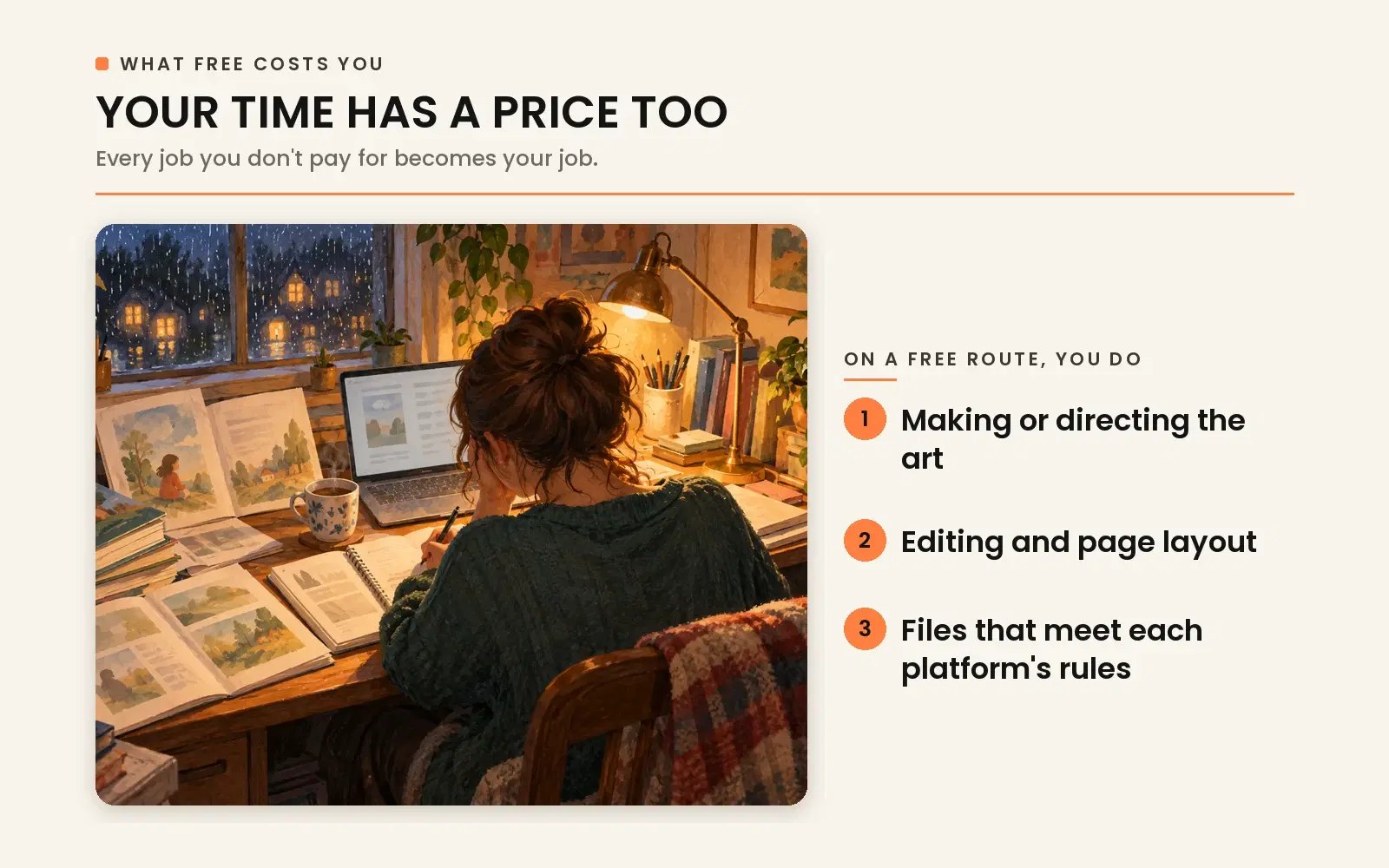
Publishing for free turns every job you don't pay someone to do into your job. That means making or directing the art, editing the words, placing them on each page and designing the cover. It also means preparing files that meet each platform's own rules, and learning those rules as you go.
None of that is impossible, and some authors really enjoy it. It's still real work, though, and it tends to happen in the evenings and on weekends. Picture an author who spends her weekends fixing a cover file that keeps getting rejected, when she'd much rather be writing her second book. Her time had a price, even though nobody ever sent her a bill.
If editing is the job you'd most like to hand over, it's worth seeing what expert editing and proofreading add to a book before you decide to do it alone.
Mistakes Are Harder to Fix Once the Book Is Live
Some choices lock in once your children's book is published, so a free start can be hard to undo. On Amazon KDP, an ISBN can't be changed after the book is published. Moving from the free ISBN to one you own means unpublishing the book and publishing it again as a new edition. IngramSpark's own guide lists fees tied to revisions. And a text change after layout means the pages have to be set again.
The simple fix is to settle a few things before you publish rather than after. Decide which ISBN you'll use, which imprint name you want and what your final text says. Then check a printed proof copy with care. Getting those four things right at the start is much cheaper than fixing them once the book is out.
Is Printing a Children's Book Ever Free?
No, printing a children's book is never truly free, because someone always pays for the paper and ink. Print on demand removes the upfront cost, but not the cost of each copy. When a reader buys your book, the printing cost comes out of that sale. When you order copies for yourself, you pay that cost directly.
So if you've been looking for a way to print a children's book for free, what you'll mostly find is free setup. When you see an offer of "free printing," check what it really covers. It often means free setup, while every copy still costs something to make.
Picture books feel this more than most books, because they're usually printed in color. Color costs more to print than black and white. On Amazon KDP, you choose color ink for the whole book if any of its pictures print in color. So a picture book with only a few color pages is still printed and priced as a color book. For a book that's only for family and not for sale, the choices are simpler. You'll find them in our guide to printing a children's book just for your family.
Traditional Publishing Costs No Money, but the Publisher Decides
Traditional publishing is the one route where you pay nothing to publish your children's book. The author watchdog Writer Beware explains how it works. A traditional publisher buys the right to publish your book on an exclusive basis and pays you a royalty on sales. In this route, the money flows to you rather than away from you.
What traditional publishing costs you instead is control, and in a picture book that mostly means the art. The publisher usually chooses the illustrator, not the author. The publisher then works with that illustrator through the sketches, the layout and the final pictures, and may not involve the author much along the way. If you've pictured your hero a certain way for years, that can be hard to accept.
Before any of that, a publisher has to choose your manuscript. That choice is theirs, not yours. So traditional publishing costs no money, but it isn't a route you can simply decide to take on your own. It starts with someone else saying yes.
When Is Free Good Enough for Your Children's Book?
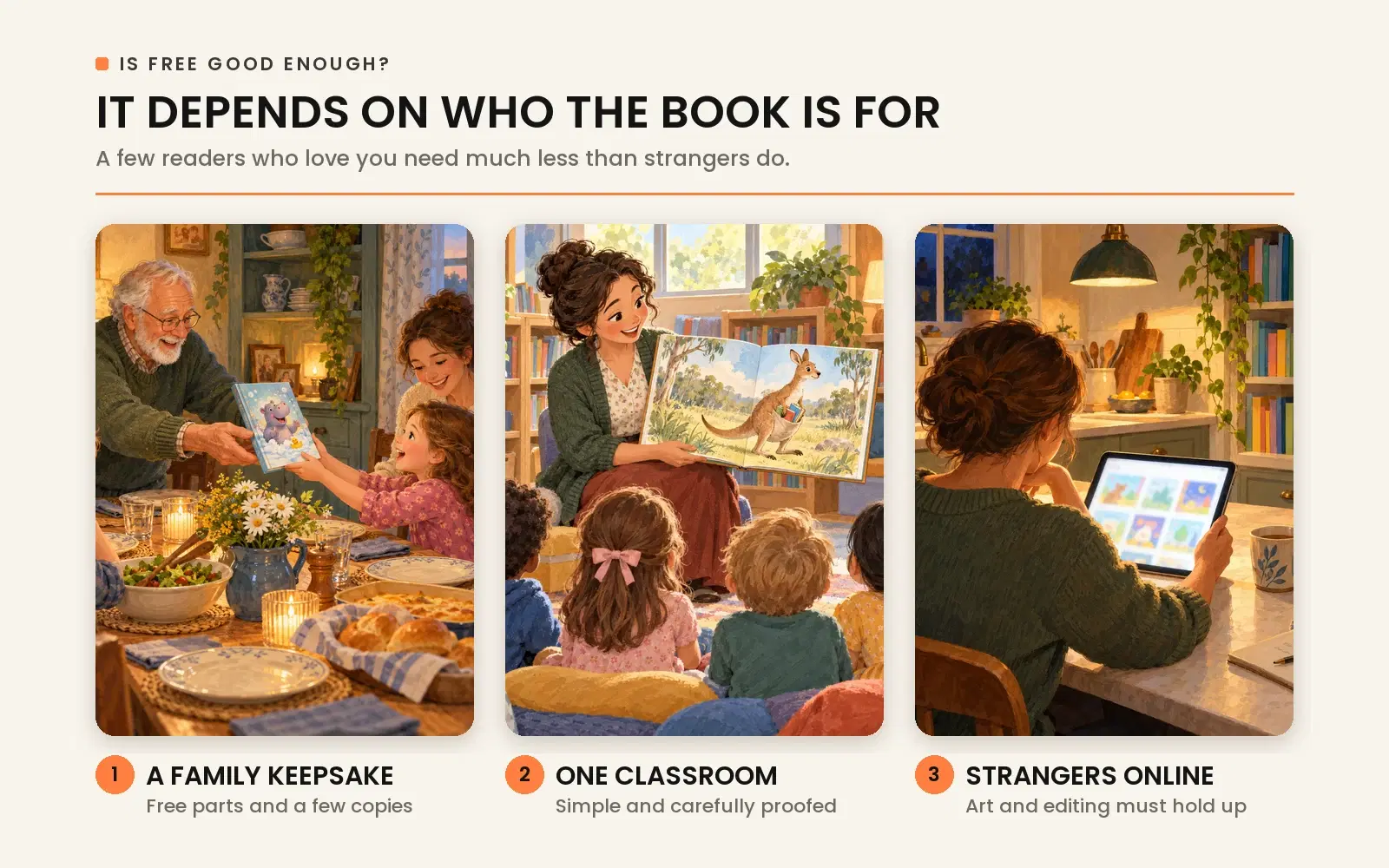
Whether free is good enough depends on what your children's book is for. A book for a few readers who already love you can get by on much less than a book that strangers are asked to buy. Before you choose a free route, this is the question to answer first.
- For a keepsake or a gift for family, the free parts and a few printed copies may be all you need.
- For one classroom, a library visit or a school event, a simple book that's been carefully proofed can work well.
- For a book you want strangers to buy online, the art and the editing have to hold up next to professionally made books.
- For a book you'd like on library and bookstore shelves, your own ISBN and imprint start to matter as well.
The cheapest way to publish a children's book is to keep the free parts free and spend only where readers look. Use free setup and print on demand rather than paying for a big print run up front. Then put your money into the art, the words and the layout, because those are what a parent actually sees. For the bigger question of whether this route suits you at all, read our honest look at whether self-publishing a children's book is worth it.
Getting Help With the Parts That Aren't Free
Making the book is the part of publishing that costs money, and it's where Book Writing US can help. Our children book publishing services cover picture books, early readers and educational books. The work runs from editing and illustration through page design and the cover, then on to printing and publishing. If you already have art, we can work with it, and if you don't, our illustration service can draw it.
Whether you work with a team or do it all yourself, settle your ISBN and imprint at the very start. Both are hard to change once the book is live. You're welcome to get in touch and tell us about the book you're making.
Frequently Asked Questions
Can I publish a children's book for free online?
Yes, you can publish a children's book online as an ebook without paying a platform anything. Amazon KDP gives you free tools to publish, and IngramSpark charges nothing to upload a print book or an ebook. An ebook also skips printing costs completely. The art and the editing still have to be done, though. An illustrated ebook also needs its pages set up so the words and pictures stay together. So the upload is free, while making the book still takes work or money.
Does IngramSpark charge anything after the free setup?
Setting up a book on IngramSpark is free, but some later steps do cost money. IngramSpark's own user guide lists charges tied to revisions, manufacturing, marketing services and distribution. Ordering printed copies costs money too. If you use IngramSpark's free ISBN, your book also has to go into IngramSpark's wholesale distribution program. It's worth reading the platform's current terms before you set up, so nothing surprises you later.
Can you publish a book without a publisher?
You can publish a book without a publisher by self-publishing it, which makes you the publisher. Amazon KDP invites authors to be their own publisher and says you keep ownership of your content. The publisher name that readers see depends on your ISBN, though. With a free platform ISBN, a label such as "Independently published" appears where your imprint would go. With an ISBN you buy from Bowker, you can list your own imprint name instead.
Can you publish a book with no money at all?
Only if you can write, illustrate, edit and lay out the whole children's book yourself, and you're happy with a free platform ISBN. Even then, checking a printed proof copy costs money. So the true no-money versions are an ebook you make entirely on your own, or a traditional publishing deal where the publisher pays. If you can spend on only one thing, spend it on the art.
Does it cost money to send a children's book to a publisher?
No, sending your children's book to a traditional publisher or a literary agent shouldn't cost you anything. Writer Beware says an agent who requires a reading fee is a warning sign. A traditional publisher pays the author, not the other way around. If anyone asks you to pay just to have your manuscript read, slow down. Ask more questions before you go any further.
- Which Parts of Publishing a Children's Book Are Really Free?
- Is Self-Publishing Free, or Only Free to Start?
- Where the Real Costs Hide in a Children's Book
- What Free Costs You Besides Money
- Is Printing a Children's Book Ever Free?
- Traditional Publishing Costs No Money, but the Publisher Decides
- When Is Free Good Enough for Your Children's Book?
- Getting Help With the Parts That Aren't Free
- Frequently Asked Questions