What It Costs to Publish a Children's Book, Every Cost Driver Explained
Short Answer: There's no single price to publish a children's book, because the total is built from a handful of choices you make. The art is usually the biggest, and the others include editing, cover and page design, and the format you print in. Fixed costs such as ISBNs are small next to those, and you can shape most of the big choices yourself.
You've finished your manuscript, searched "How much does it cost to publish a children's book?" and found answers so different that none of them helped. That's a very normal place to be. Children's book publishing costs are hard to pin down because they depend on choices you haven't made yet. Two of those choices are how many pages have pictures and whether you want a hardcover.
This guide explains every cost driver, why it moves the total and which ones you control, so you can read any quote with confidence. It starts from a finished manuscript. Writing the story and marketing the book have budgets of their own, so this guide leaves them out.
Why There's No Single Price for a Children's Book
The cost to publish a children's book depends on what the book is and how it's made, so no single number can describe every book. What your own book costs depends on its length, its art, its format and how it's printed. Those choices differ a lot from one book to the next.
Any average you find online mixes very different books together. It blends board books with middle grade novels, and art the author already owned with a whole new set of pictures. It also mixes books printed one copy at a time with books printed in big batches. A number with none of those choices behind it can't tell you much about your own book.
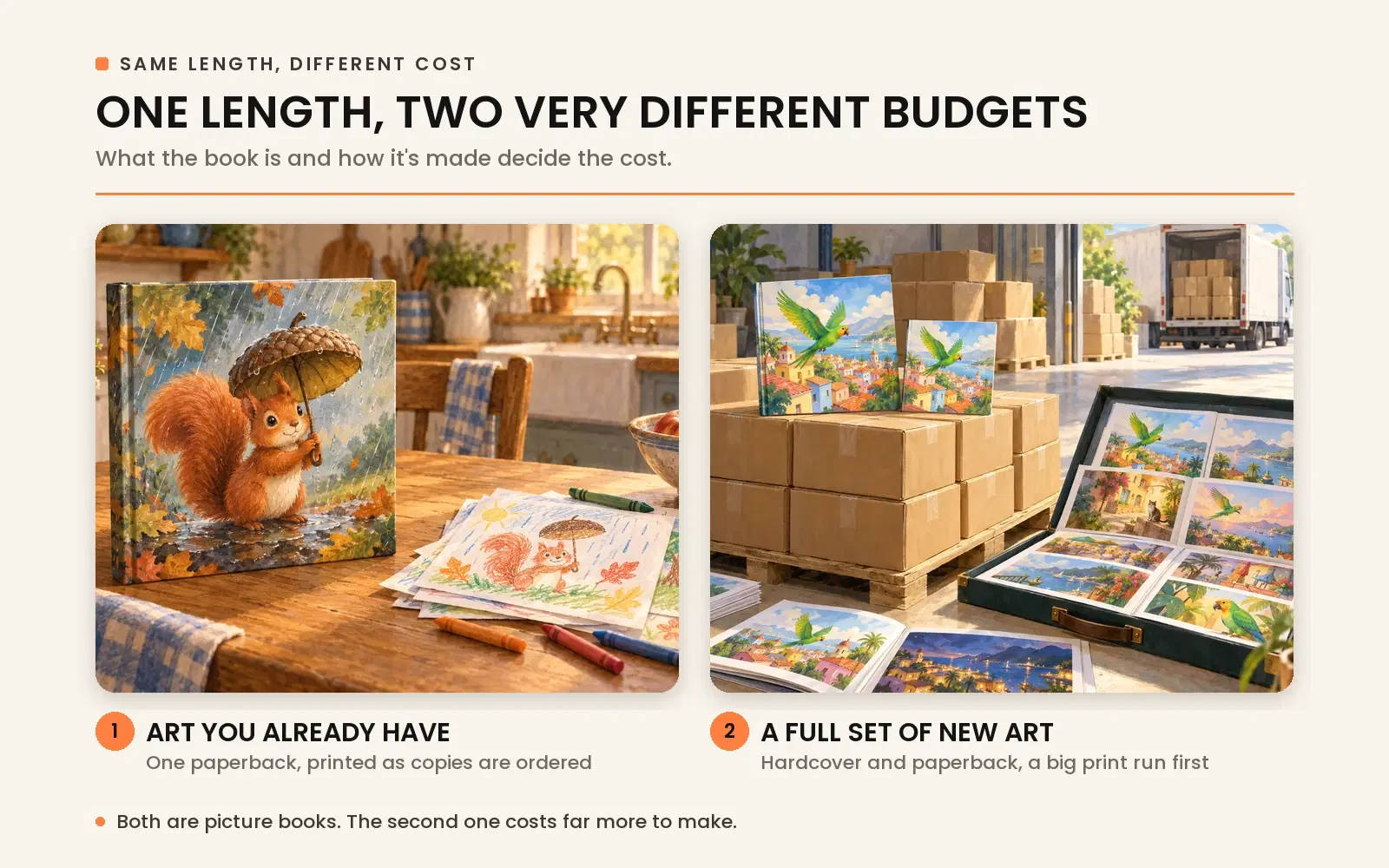
Here's a simple way to see it. Imagine two picture books of the same length. The first uses art the author already has and comes out as one paperback, printed as copies are ordered. The second needs a full set of new color spreads, a hardcover as well as a paperback, and a big print run before release. Both are picture books, but the second costs far more to make.
That's why a useful quote starts with questions about the book rather than the budget. This guide sorts every cost into three kinds. There's the cost of making the book, which you pay once. There's the cost of printing it, which you pay per copy or per print run. And there are small fixed costs, such as ISBNs, that come with each edition you plan to sell. Each of these costs belongs to a stage, and our guide to how children's book publishing works explains those stages in order.
Eight Things That Decide What You'll Spend
The full cost of publishing a children's book comes from eight things, and the art is usually the largest of them. The other seven are editing, cover design, page layout, late changes, the book's format, printing, and ISBNs with any extra editions. What a children's book costs from start to finish is simply those eight added together. The table below shows when you pay for each one and what you can control.
| What you pay for | When you pay for it | What pushes it up | What you control |
|---|---|---|---|
| Illustration | Once, before layout | More illustrated pages, more detail, new art | How many spreads, the style, bringing your own art |
| Editing | Mostly before the art, with a final proofread after layout | A draft that still needs story work | Arriving with a finished, read-aloud draft |
| Cover design | Once per format | A hardcover as well as a paperback | How many formats you publish |
| Page layout and typesetting | Once, after the art | More pages, more words on each page | Locking your text before layout |
| Changes after approval | Whenever they happen | Changes after the art or layout is done | When you make your changes |
| Page count, size, color and binding | Set once, felt on every copy | More pages, full color, hardcover | Your format choices |
| Printing and copies | Per copy or per print run | A print run paid up front, extra proof copies | Print on demand or a print run |
| ISBNs and extra editions | Once per edition | Each extra print format needs its own files and ISBN | How many editions you publish |
The first five rows are costs you pay while the book is being made. Your format is chosen once, but you pay for it again on every printed copy. Printing is paid per copy or per print run. The last row is a small cost for each edition. In most picture books, the page count, the number of illustrated pages and the print choices move the total the most. Each row gets its own section below, in the same order.
The Art Is the Biggest Cost in Most Picture Books
In a picture book, the illustrations are usually the largest cost, because the pictures tell much of the story and nearly every page needs one. That's why picture book publishing costs rise and fall with the art more than with anything else.
A spread is the pair of facing pages you see when a book lies open. An illustrator draws each spread by hand or on screen, and keeps your main character looking the same on every page. The art is also drawn to fit the exact page size your book will print at. That's a lot of skilled work on nearly every spread.
A children's book full of pictures costs more to illustrate and publish than one with only a few. Every extra picture is more drawing to pay for. A chapter book or middle grade novel is mostly text, with few pictures or none, so its art matters far less to the total. If a quote for your picture book looks high, start by looking at the art.
How Much Does It Cost to Illustrate and Publish a Children's Book?
The cost of the art depends mostly on how much drawing your book needs. Some children's book illustration jobs cost more than others because they hold more drawing, and a few of your choices decide how much. Here's what moves the cost of the art, and why.
- The number of illustrated pages comes first, because a full spread takes far longer to draw than a small spot picture.
- The amount of detail counts too, because busy backgrounds, crowds and textures add time to every page they appear on.
- Each character who appears again and again has to look the same every time, so a big cast means more careful work.
- Full color art is a bigger job than black and white line art, and it needs color checks before printing.
- The cover is drawn as a separate piece of art, so it adds its own work even when it shows the same character.
- Rounds of changes after the sketches are approved add work, because each change means redrawing something that was already finished.
The style you pick also changes how long each page takes, so it's worth comparing the main illustration styles for children's books before you decide. You have more control here than you might think. A quieter page can carry a small picture instead of a full spread, and your book won't feel thin because of it.
Bringing Your Own Art Can Lower the Cost
Bringing your own finished art can lower the cost of publishing a children's book. Building the design around pictures that already exist costs less than having a whole new set drawn. That's true whether the pictures came from you, your daughter, a relative or a friend. There's one condition, though, and it matters. The art has to be ready for print.
Ready for print means the pictures are drawn at the book's page size and are sharp enough to print well. They also need room at the edges, so nothing important gets trimmed off. If the pictures have to be redrawn or resized to fit, some of that saving disappears.
Ownership matters too, even for family art. In general, whoever draws the pictures owns the copyright in them. The main exceptions are a signed written transfer and a work made for hire, such as pictures an employee draws as part of their regular job. So it's wise to agree in writing who owns the pictures, even when your daughter or a friend drew them.
If you don't have any art yet, the whole set has to be drawn new, which is the job of children's book illustration services.
Editing Costs Depend on How Ready Your Manuscript Is
A short picture book manuscript still needs editing. At that length, what editing costs depends mostly on how much work your draft needs, rather than on its word count. A 400 word story with a shaky middle can need more help than a longer one that already works.
Editing matters in a picture book because every word gets read aloud, often many times over. The art is also drawn to fit the text. A problem left in the words ends up in the pictures. A rhyme that trips on page 5 costs a quick fix during editing. Fix it after the art is finished, and the new words may no longer match the picture, which can mean a redrawn spread.
Editing for a children's book usually happens in a few rounds, and each one takes a different amount of work.
- Developmental editing looks at the story itself, such as the plot, the pacing, the page turns and whether the ending lands.
- Copy editing fixes the words, the grammar and the consistency from one page to the next.
- Proofreading is the final check for small errors after the editing is done, usually once the text sits on the finished pages.
You control how ready your draft is when editing starts. Arrive with a finished story you've read aloud yourself, and settle the words before any art begins. The less your story still needs, the less the editing costs, and the safer your art is from changes later.
Cover Design and Page Layout Are Two Separate Jobs
Cover design and page layout are two separate jobs in a children's book, and each has its own cost. It's easy to assume the illustrator will handle the layout, or that the cover comes free with the pictures. Knowing what each job involves makes any quote much easier to read.
The cover has to work on the front, the spine and the back at the same time. The spine's width depends on the page count and the paper, so the cover can't be finished until those are settled. Each format also needs its own cover file, and print platforms such as Amazon KDP keep separate cover guides for paperbacks and hardcovers. So a paperback and a hardcover of the same picture book need two cover files, even when the fronts look exactly the same.
Page layout and typesetting is the inside job. It means placing the words on each illustrated page, choosing fonts that read easily, and keeping the text flowing from page to page. It also covers the pages at the front and back, such as the title page and the copyright page. Layout costs more when there are more pages, more words on each page, or text that keeps changing while the pages are being set.
You can keep both costs down the same way. Settle your format and your final words before layout begins, and the cover and the pages only have to be built once. When you read a quote, check whether the cover work covers one format or every format you plan to publish. It's also worth asking whether the layout includes the front and back pages.
Changes Cost More the Later You Make Them
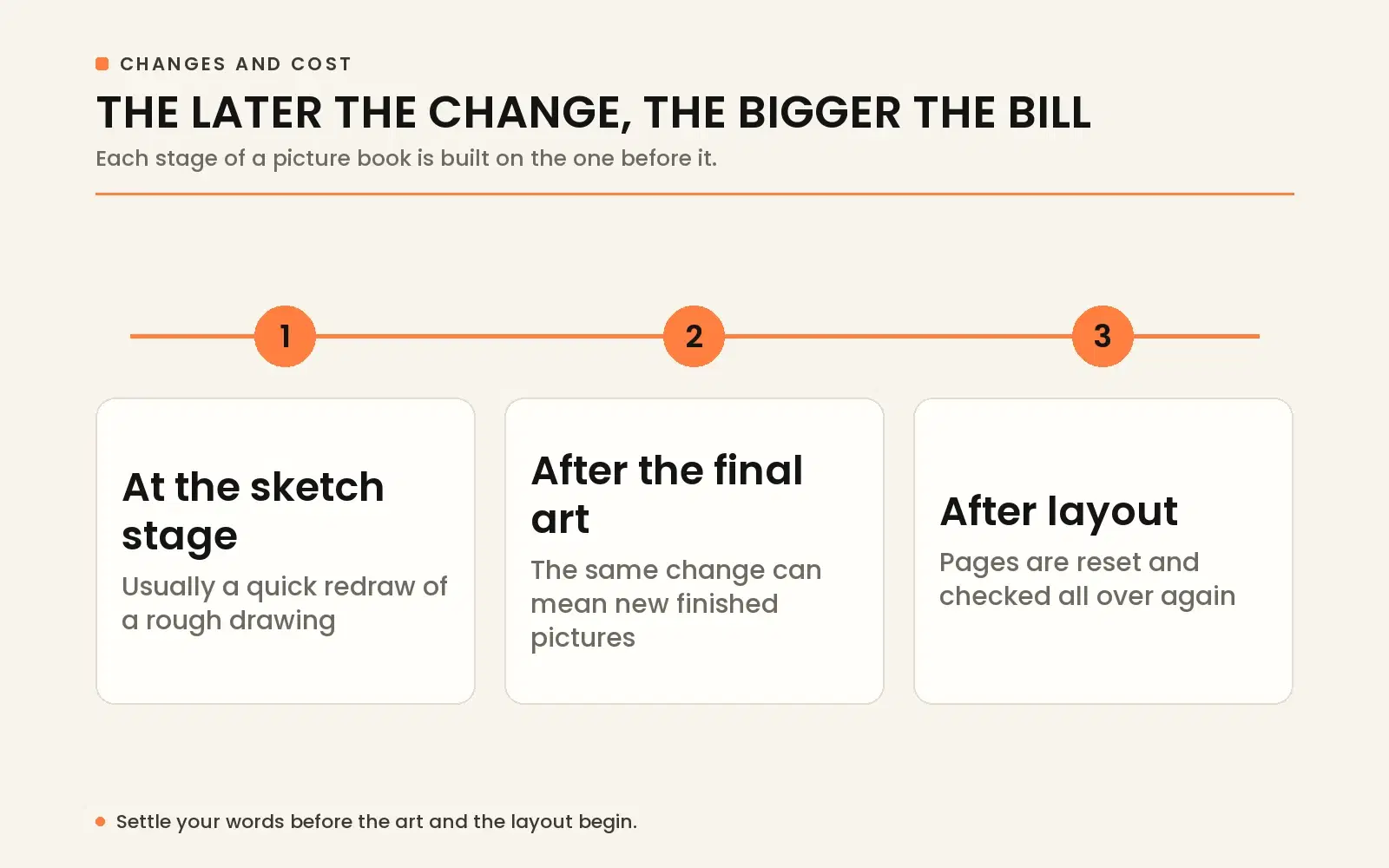
Changing the words after your picture book has been illustrated usually costs extra, and the later you make a change, the more it costs. That's because each stage of a children's book is built on the one before it.
Here's how the cost of one change grows as your book moves along.
- At the sketch stage, a change is usually a quick redraw of a rough drawing.
- After the final art is done, the same change can mean new finished pictures.
- After layout, the change can also mean resetting the pages and checking them all over again.
A small example shows how quickly this adds up. Moving one line of text from page 12 to page 13 sounds simple. But the picture on page 13 was drawn with space for different words, so the new line may cover part of the art. Now both pages need new layout, and page 13 may need a change to its picture too. Rewriting the text after typesetting has started is one of the costliest habits an author can have. Every page after the change may need its text set again. Then every one of those pages has to be checked again.
The good news is that this is the cost you can control the most. Planning every page in rough sketches first is worth the time, since a change to a sketch costs very little. Then give each step your full sign-off before the next one starts. A late change costs time as well as money. You can see what each stage adds to the calendar in our guide to how long it takes to publish a children's book.
How Do Page Count, Size, Color and Binding Change the Cost?
Full color and a hardcover both make a children's book more expensive, and that's because the format sets two costs at once. It decides how big the job of making the book is, and what every printed copy will cost. So you pay for a format choice twice, once while the book is made and again on every copy.
| Choice | What it changes while the book is made | What it changes on every printed copy |
|---|---|---|
| Page count | More pages to illustrate and lay out | More pages to print |
| Trim size | The art is drawn to fit the page size | Trim size helps set the printing cost |
| Full color or black and white | Color art and color checks | Color printing costs more |
| Hardcover, paperback or board book | A different cover file for each | A hardcover costs more to manufacture than a paperback |
| Paper | Little or no change | Paper type helps set the printing cost |
Amazon KDP says its printing cost depends on the trim size, the page count, the ink type and the paper type. The same page says bleed settings and cover finish don't affect the printing cost. So on Amazon KDP, the finish you pick for your cover won't change what each copy costs to print. Its print options page also says plainly that books printed in color cost more. That same page tells you to pick a color ink option if any images in your book should print in color. So a picture book with color art is printed and priced as a color book.
Page count is the format choice that touches the most costs. Every extra spread adds a picture to draw, two pages to lay out and more paper to print. A story that ends one spread sooner saves a little in all three places.
Settle the format early to keep this cost in check. Trim size and binding are best chosen before the illustration starts, because the art is drawn to fit them. Changing the size afterward can mean resizing, or even redrawing, the pictures.
When Do You Pay for Printing?
With print on demand, you don't pay up front to print copies of your children's book. Each copy is printed when someone orders it, and the printing cost comes out of that sale. Amazon KDP works this way, and it says that means you don't pay any costs up front or carry any inventory. IngramSpark is another print on demand service used for children's books.
A print run works the other way around. With offset printing, you pay for a whole batch of copies before any of them sells. Each copy only works out cheaper when the batch is big enough to cover the setup work. So the money goes out, and the boxes need somewhere to live, long before the first reader buys a copy.
Some copies cost you money either way. A proof copy lets you check the colors and the pages before your book goes on sale. Author copies are the ones you buy for events, school visits and gifts. On Amazon KDP, you pay the book's printing cost for each proof or author copy you order, plus shipping. Say you order a proof copy and find your main character's skin tones printing much darker than you planned. That small cost just kept the mistake out of every copy your readers will buy.
Paying nothing up front for printing isn't the same as publishing for free, though. The art, the editing and the design still have to be paid for before any copy exists.
What ISBNs, Copyright and Extra Editions Add to the Bill
ISBNs and copyright are small costs next to the art of a children's book. Each print edition you plan to sell needs its own ISBN, while registering your copyright is a choice rather than a requirement. Some of these small costs have free options. Our guide on whether you can publish a children's book for free explains them, along with what each one trades away.
An ISBN is the number that identifies one edition of a book, and Bowker is the ISBN agency for the United States. Amazon KDP says each format, such as a paperback or a hardcover, needs its own ISBN. Ebooks are an exception, since Amazon KDP makes the ISBN optional for them. So every print edition you add for sale brings another ISBN. A book you won't sell or distribute doesn't need one. IngramSpark, for example, can give a book like that a stock number for printing only.
The U.S. Copyright Office's Copyright Basics guide says your copyright exists automatically as soon as your original work is written down or drawn. The same guide says registering a work isn't mandatory, though registration is needed before you can enforce your rights in court. So registration is a cost you choose, not one you must pay to publish.
Extra editions are where these small costs multiply. Each format you add, such as a hardcover next to your paperback, brings its own files, its own cover and its own ISBN. An ebook adds its own files and cover too. The choice you control here is simple. Publish the editions you really expect to sell, and add others later if readers ask for them.
Who Pays, You or a Publisher?
Every children's book has the same kinds of costs behind it, and the route you take decides who pays them. In traditional publishing, the publisher pays to make your children's book, and you aren't asked to pay the publisher. The Authors Guild says plainly that traditional publishers will not ask you to pay them up front.
Self-publishing makes you the publisher, so the bill for every cost in this guide is yours. That's true whether you do a job yourself, hire a freelancer or work with a publishing company. The honest answer to "How much does it cost to self-publish a children's book?" is all eight cost drivers above. Add them up for your own book to get your total.
What Goes Into a Children's Book Publisher's Quote?
A children's book publishing company you hire charges for the jobs it takes on. Its quote is built from the cost drivers in this guide. That's different from a traditional publisher, which doesn't charge the author at all. To give you an accurate quote, a publishing company needs to know what your book is and how ready it is. Here's what to have ready before you ask.
- The kind of book and its reader age, such as a picture book, an early reader or an educational book.
- Your finished word count, so the team can see how much text sits on each page.
- The page count or number of spreads you have in mind, even if it's only a rough idea.
- Whether any art already exists, and if it does, whether it's ready for print.
- Which editions you want, such as a paperback, a hardcover or an ebook.
- Where you'd like the book to be sold, for example online, in bookstores or at school events.
- How settled your text is, because a story that's still changing will change the quote too.
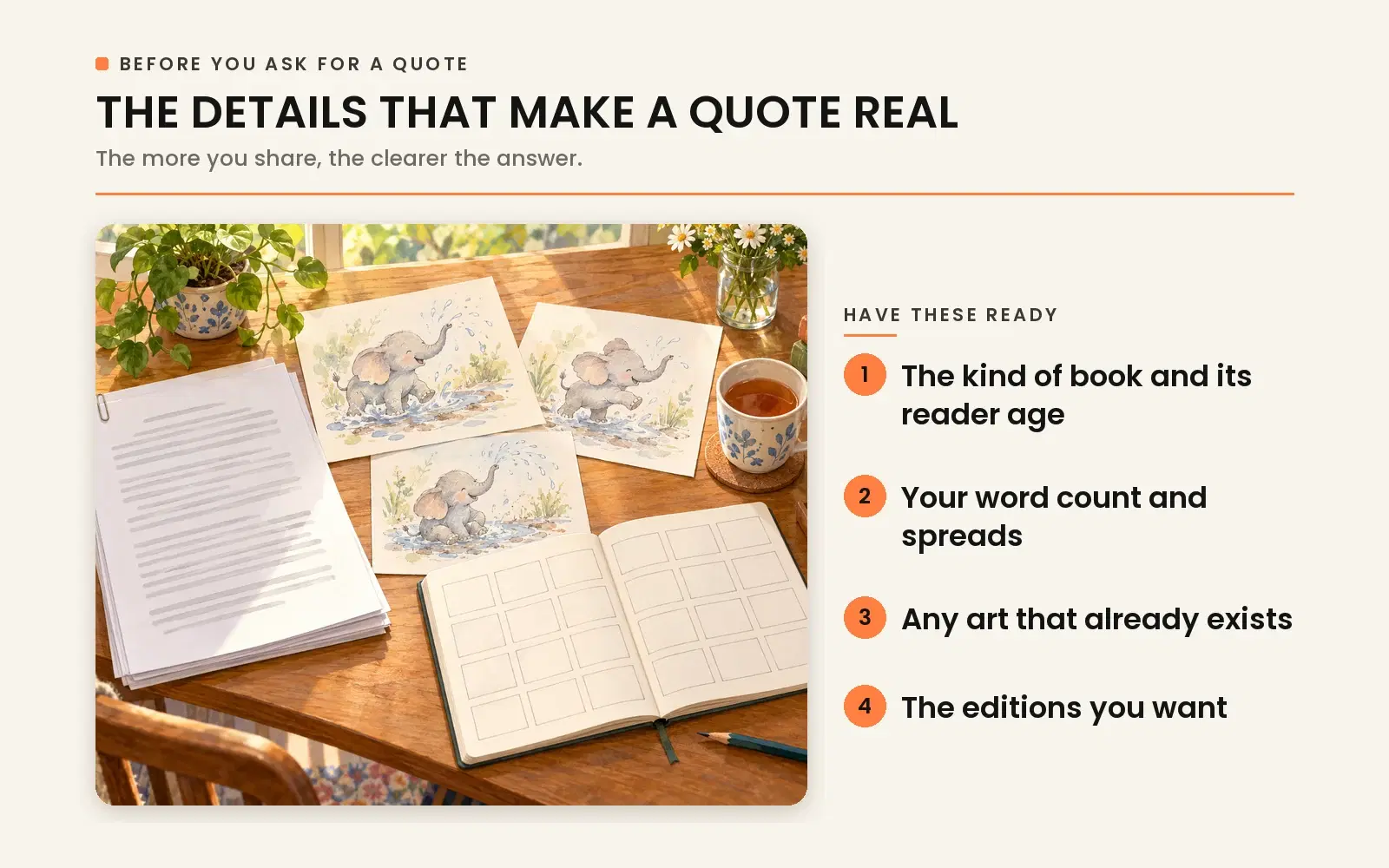
A clear quote should show you which of these drivers it covers, so you can compare like with like. The detail you give changes the answer you get. Ask about "a 32 page picture book" and you'll get a vague answer. Ask about "a picture book with 14 spreads, new art, a paperback and a hardcover" and you'll get a real one.
Book Writing US can help with the jobs in this guide. We take a finished manuscript through editing, illustration, page design and the cover, then printing and publishing. Our work covers picture books, early readers and educational books. We can use art you already have, or have the pictures drawn through our illustration service. When you're ready to publish your children's book, bring the details from the list above and get in touch.
Frequently Asked Questions
How much does it cost to make a children's book if you haven't written the story yet?
Making a children's book from an unwritten story costs more than publishing a finished one. Writing the story, or hiring someone to write it, is a separate job with its own cost. The cost of publishing usually starts once the manuscript is finished. Publishing covers what happens next, which is the editing, the art, the design, the printing and getting the book listed for sale. If your story isn't written yet, budget for the writing separately, so the two costs don't get mixed together when you compare quotes.
What does a children's book publisher charge for that a printer doesn't?
A children's book publishing company you hire charges for making the book. A printer charges only to turn a finished, print-ready file into copies. A publishing team handles the jobs before that point, such as editing, illustration, layout and the cover. It usually gets the book listed for sale as well. So a printer's quote and a publisher's quote aren't two prices for the same thing, because they cover different work.
Is there a cost calculator for publishing a children's book?
A calculator can help with part of the cost, but it can only add up the choices you enter. Amazon KDP offers a Printing Cost & Royalty Calculator, but it only works out printing costs and royalties. It doesn't include the art, the editing or the design, so it can't show what the book costs to make. For the full picture, you need a quote built from your book's real details, such as its page count, its art and its editions.
Does a board book cost more to publish than a picture book?
Not always, because a board book's costs are different rather than simply higher. A board book usually has fewer pages and fewer words, so there's less to write, edit and illustrate. Its thick, rigid pages need specialist construction, though, and they usually aren't a standard print on demand option. Amazon KDP, for example, prints paperbacks and hardcovers, and its hardcovers start at a page count most picture books never reach. So a board book usually means a specialist printer and a print run you pay for before the book sells.
How expensive is it to publish a children's book compared with a novel?
An illustrated children's book, such as a picture book, usually costs more to publish than a novel. It needs three things a novel mostly doesn't. The first is full color art on nearly every page. The second is color printing, and Amazon KDP notes that books printed in color cost more. The third is a layout that places the words onto the pictures page by page, so the text and the art work together. A novel is mostly text, printed in black ink, with pages that flow on from one to the next.
- Why There's No Single Price for a Children's Book
- Eight Things That Decide What You'll Spend
- The Art Is the Biggest Cost in Most Picture Books
- Editing Costs Depend on How Ready Your Manuscript Is
- Cover Design and Page Layout Are Two Separate Jobs
- Changes Cost More the Later You Make Them
- How Do Page Count, Size, Color and Binding Change the Cost?
- When Do You Pay for Printing?
- What ISBNs, Copyright and Extra Editions Add to the Bill
- Who Pays, You or a Publisher?
- What Goes Into a Children's Book Publisher's Quote?
- Frequently Asked Questions