Publishing a Children's Book for Your Grandchildren, Private Keepsake or Public Book?
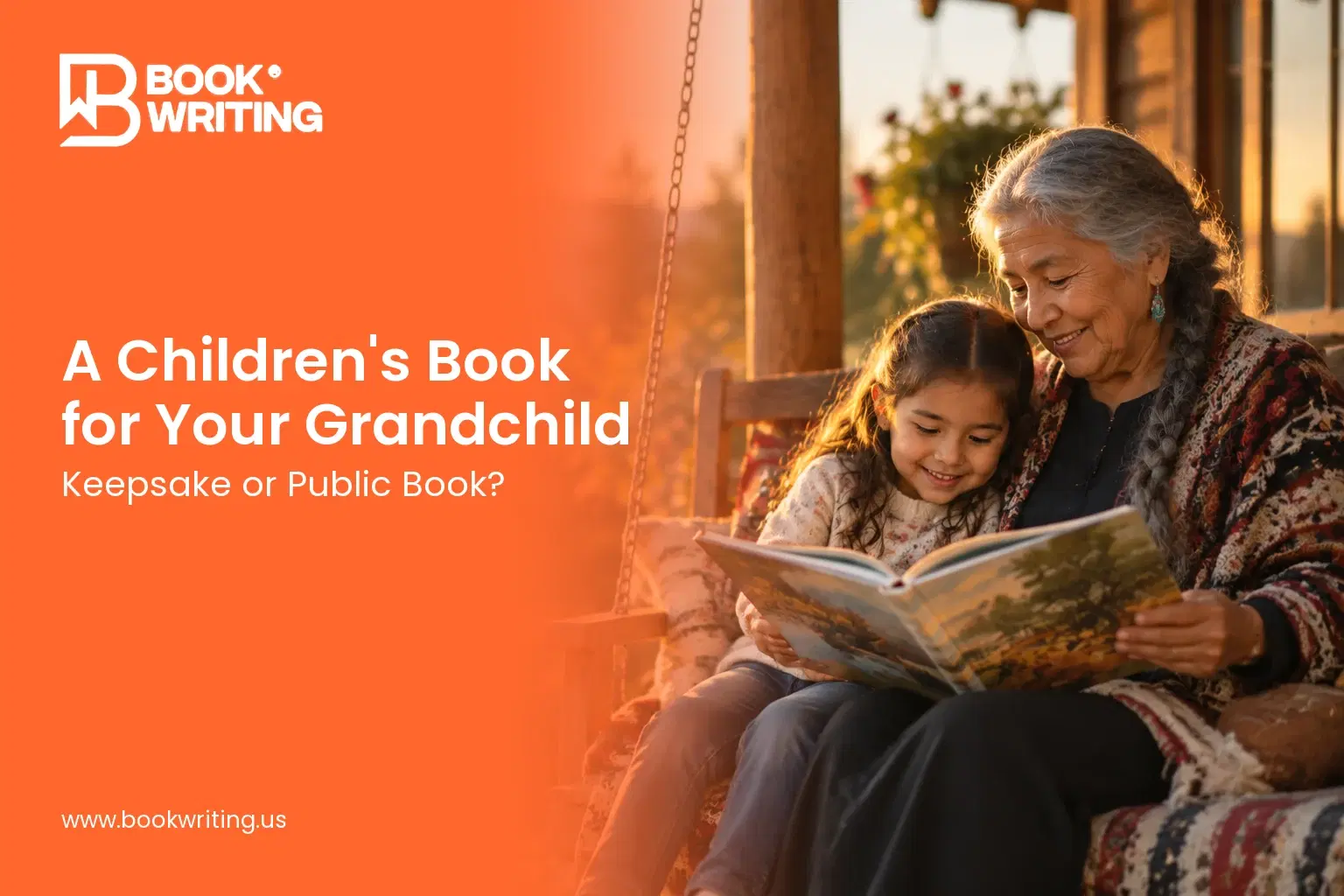
Short Answer: A private keepsake suits a book made for your family, with real names, family photos and inside stories, printed only for the people you love. A public book suits a story that would delight children who've never met you. It works best when you and your grandchild's parents are happy for strangers to see it. Some grandparents do both, with a family edition and a public edition.
Most grandparents start by asking, "How do I publish a children's book for my grandchild?" The honest first answer has nothing to do with printers or Amazon. Before any of that, you'll want to decide who the book is really for.
This guide walks you through that choice in plain words. You'll see what a private keepsake involves, what changes when a book goes public, and how to make the book feel like it's truly about your grandchild. There's also help with names and photos, the dedication and keeping the book safe for the next generation.
There's no wrong answer here. And if you're not sure yet, you can make the choice in a way that leaves the door open.
Keepsake or Public Book, Which One Fits Your Family?
A picture book you've written for your grandchild should stay a private keepsake when it's about your family and meant for your family. It can become a public book, sold on Amazon or in stores, when the story works on its own. The family also has to be comfortable with strangers reading it. If you'd describe your project as "a book for my grandchildren" rather than "a book for kids," that's a strong sign it's a keepsake.
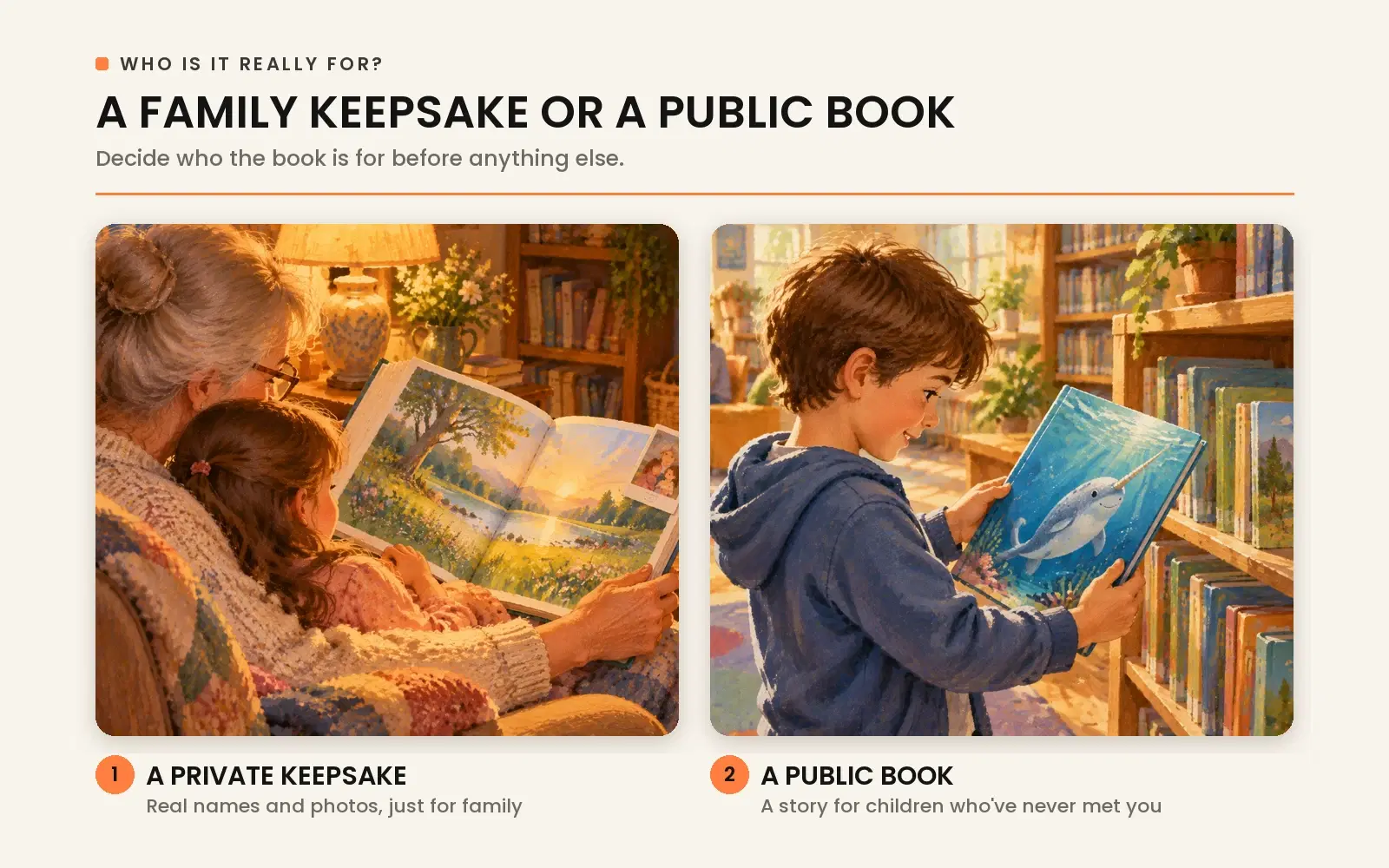
A grandparent's book for grandchildren can end up private or public, and three simple questions will usually settle which.
- Who do you picture reading it? If it's your grandchild on your lap, that points to a keepsake. If it's a child in a library you'll never meet, that points to a public book.
- Does the story need your family to make sense? A story built on Grandpa's fishing boat and a cousin's nickname will charm your family and may puzzle everyone else.
- How would your grandchild's parents feel about it being public? Their answer matters as much as yours, because it's their child's name and face.
Sometimes the answer is both, a personal edition for the family and a gentler version the rest of the world can enjoy. Here's how the two routes compare on the questions that come up most.
| Question | Private keepsake | Public book |
|---|---|---|
| Who can read it | Only the people you give copies to | Anyone who finds it in a store or online |
| Does it need an ISBN? | No | Yes, for store and online sales, one for each print format |
| Real names and family photos | Use them freely | Think twice, because shoppers can preview part of the book |
| Can you take it back? | Yes, it never left the family | Only partly, because copies already sold stay out there |
| What the story has to do | Delight your grandchild | Also work for children who have never met you |
What a Private Keepsake Involves
A private keepsake book is printed only for your family and never listed for sale, so you don't need an ISBN for it. An ISBN is a number that identifies one edition of a book so bookstores, libraries and distributors can find it. A keepsake book never goes to any of them, and the other sale parts fall away with it.
- No ISBN or barcode, since no store will ever scan the book.
- No store listing, book description or search keywords to write.
- No retail price to choose and no sales to keep track of.
What doesn't get smaller is the work your grandchild will actually see. The story still needs shaping, the pictures still need drawing, and the pages still need laying out so words and art sit well together. A keepsake gets read aloud far more often than most books on a store shelf, so it deserves the same care.
Say you're making a keepsake book for granddaughter Mia's fifth birthday. She won't care whether the book has a barcode. She'll notice, though, if the girl on page 8 doesn't look like the girl on page 2. For binding, paper and how many copies to order, see what printing a family-only children's book involves.
It also helps to know what a keepsake story book isn't. It isn't a fill-in memory journal, and it isn't a ready-made personalized book that drops a child's name into a stock story. When you make a book for your grandchild from scratch, the story itself is yours.
What Changes When Your Book Goes Public
A public children's book gets an ISBN, a store listing that anyone can search, and an author name on the cover and the listing. It also goes through the full publishing journey, from editing and layout to review and release. Our guide to how children's book publishing works, stage by stage walks through each step of that journey.
Bowker is the official ISBN agency for the United States, so that's where authors buy their own ISBNs. Amazon KDP, Amazon's self-publishing service, also offers a free ISBN for books it prints, though that free ISBN can only be used on KDP.
Some grandparents publish under a pen name, such as a family nickname like "Grandma Bee," so the family surname stays off the listing. A pen name is simply the name an author chooses to publish under instead of their legal name. For a grandparent, it can even feel warmer than the real one.
Strangers Can Read Pages Before They Buy
If you publish your grandchild's book on Amazon, strangers can see some of the inside pages before they buy it. Amazon KDP switches on its Read Sample preview automatically when a book is published. For a paperback or hardcover, the sample is 20 percent of the book. Amazon's help pages also say you can't hide specific pages or chapters from that sample.
In a short picture book, a fifth of the book is a real share of the story. Your grandchild's name, a family photo or the dedication page could easily fall inside it.
So in a public edition, treat every page as one a stranger might read. Keep anything that identifies your grandchild out of the book entirely. If the preview still worries you, Amazon says an author can ask it to remove the Read Sample feature from a book.
Going Public Is Hard to Take Back
You can take a children's book off sale on Amazon later, but you can't take back the copies people have already bought. Amazon KDP's help pages explain that unpublishing a book means new copies can't be sold on Amazon. Used copies, though, can still be sold by third parties. So once a public book is out, it stays out in some form.
Those copies sit on shelves in other people's homes, and some of them may be resold. That's why the best time to talk it through with your grandchild's parents is before release, not after. If anyone in the family has doubts, start with a private keepsake, because you can always publish later.
Can You Do Both, or Start Private and Publish Later?
Yes, you can do both, and two routes work well for grandparents. You can make a family edition and a public edition of the same book. Or you can print a keepsake now and leave the door open to publish later. Either way, a little planning at the start saves a lot of redrawing at the end.
A Family Edition and a Public Edition
One children's book can become two editions. The family edition keeps the real names and photos for the people you love, and the public edition takes the private details out. The story stays the same, and so does most of the art. Often only a few pages need to change.
- Your grandchild's name, real in the family edition and a character name in the public one.
- Family photos, which go in the family edition only.
- The dedication, personal in the family edition and short and general in the public one.
- Any detail that places your family, such as your town, a street sign or a school name.
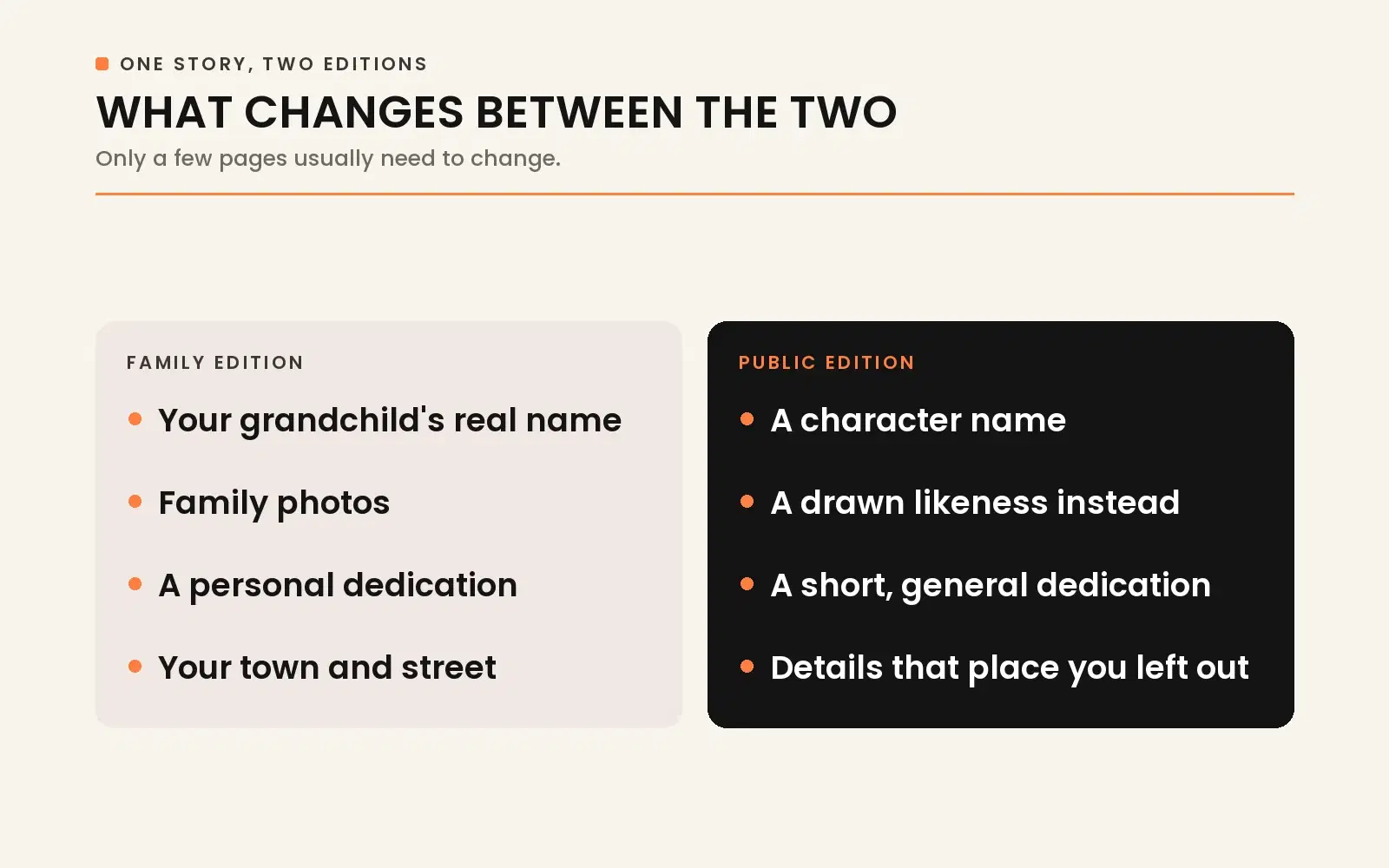
Two editions work because a drawn likeness shows far less than a photo does. A drawn character can look just like your grandson to everyone who loves him, while a stranger simply sees a boy in a story.
The trick is to plan both editions before the art is drawn. It helps to tell the illustrator up front which pages will change, even if the public edition may never happen. Those pages can then be kept simple to swap, and everything else stays the same in both versions.
What to Settle Now If You Might Publish Later
If you might publish your grandchildren's book someday, settle three things now. They're the rights to the pictures, the rights to any photos you use, and the parents' blessing. Each one is easy to sort out at the start and hard to fix once the book is finished.
Start with the pictures, because the U.S. Copyright Office explains that copyright belongs at first to the person who created the work. So the copyright in the art generally belongs to the illustrator. That usually changes only with a signed written transfer, or with a written agreement that makes the art a "work made for hire." In that case, the art belongs to the person who hired the illustrator from the start. It helps to agree in writing who owns the art before the first sketch, even with a friend or relative.
Photos work the same way, since the copyright in a photo usually belongs to whoever took it. A school or studio portrait may need the photographer's permission before it goes into a public book.
Last come your grandchild's parents. A public book puts their child's name and face in front of strangers, so their yes matters most of all. Pictures, photos and parents are simply the three things worth settling before any grandparent's book goes public.
What Makes a Book Feel Like It's About Your Grandchild?
Three things make a book feel like it's truly about your grandchild. Put your grandchild at the center of the story, and use family stories only you know. Then choose a plan that fits how many grandchildren you have. Writing a book for grandchildren is different from writing for children in general, because your reader already knows the main character and the author.
If you're new to writing, a first-time author's guide to writing a book covers the basics of getting a first draft down. What follows here is the part that makes a grandparent's book personal.
Your Grandchild as the Main Character
To make your grandchild the main character of a children's book, tell the story from your grandchild's side. Give them a problem early, and let them solve it themselves. The grown-ups, grandparents included, should stay in the background. Children love books where a child like them does the brave or clever thing.
Maybe you've been thinking, "I'd love to make a book for my grandson that feels just like him." A few clear photos taken in good light help any illustrator capture how your grandchild really looks. The likeness often comes through most in small things, like a cowlick, a favorite hat or the way a child stands.
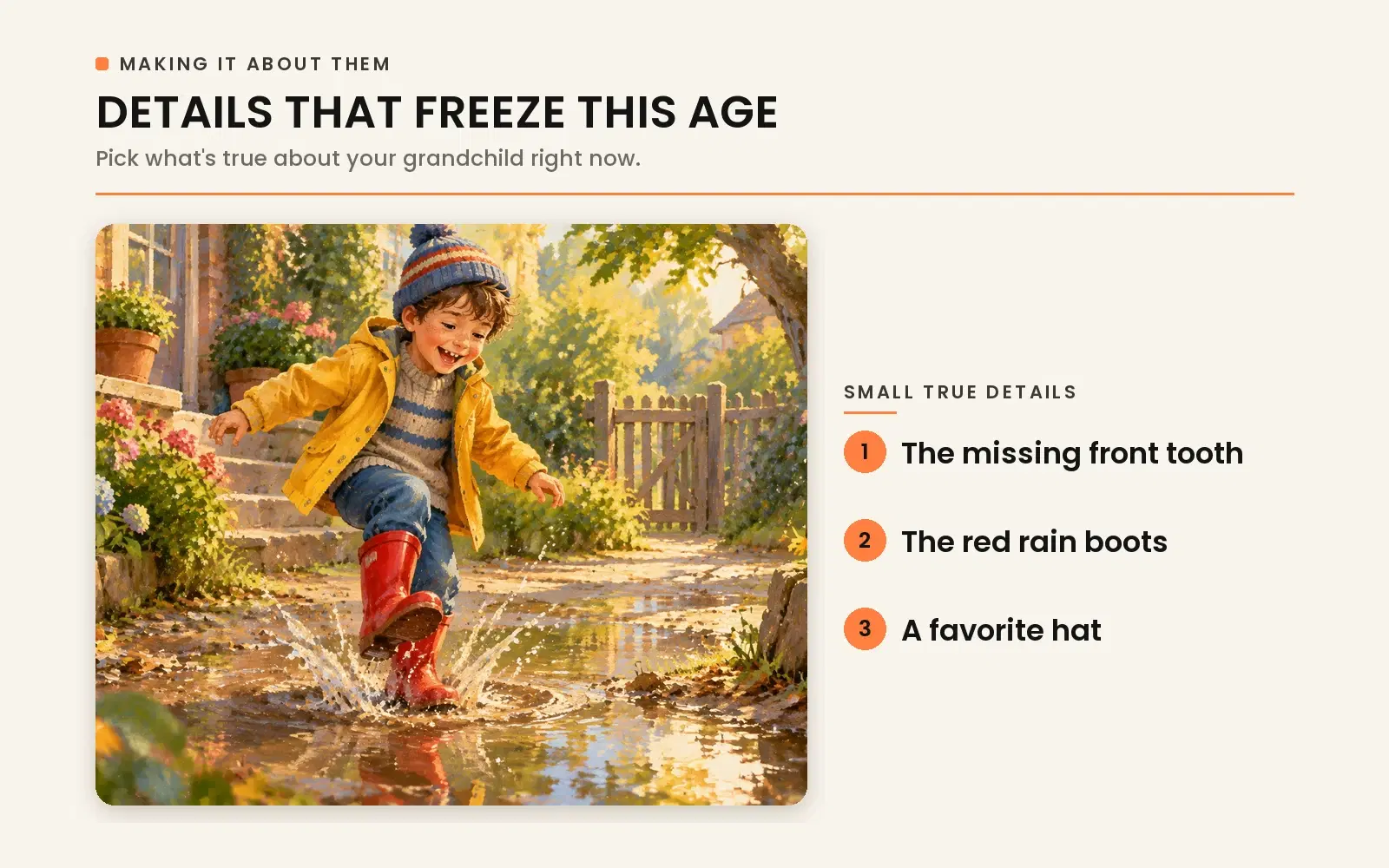
There's another reason to choose details with care. The book freezes your grandchild at this age. So pick what's true right now on purpose, such as the missing front tooth, the red rain boots or the stuffed rabbit that goes everywhere. Your grandchild will read the book again when they're older and remember exactly who they were.
Your grandchild's voice matters as much as their looks. Let the main character say the things your grandchild really says, like a favorite silly word or the question they ask every night. Then the book will sound like them as well as look like them.
Family Stories Only You Can Tell
The family stories that belong in a grandchild's book are the small, specific details only a grandparent knows. Those details are what make the book impossible to buy anywhere else. A story doesn't need to be big to work, but it does need to be yours.
- A story from your own childhood, told as an adventure your grandchild could have.
- A family place, such as the kitchen, the farm or the front porch.
- A pet everyone in the family still talks about.
- A family saying, or a word from the family's first language.
- A tradition your grandchild already knows, like pancakes every Sunday morning.
One real family detail on a page goes further than five. Too many details crowd the story, and a young child loses the thread. Keep it a children's story, too. A full memoir or family history is a different book, and it's worth writing on its own if you have that much to tell.
One Book for All Your Grandchildren, or One Each?
If you have several grandchildren, one shared book and one book each can both work well. The choice usually comes down to fairness and to the grandchildren who haven't arrived yet. One book with all the cousins together keeps things even, since everyone appears in the same story.
Say you have a grandson and a granddaughter, and you're wondering, "Should I write one book for both, or a book for my granddaughter and another for my grandson?" One book each, as a small series, lets every child be the star of their own story. It also leaves room for a grandchild born later, who might otherwise feel left out of a book made before they arrived. If you go with one each, keep the look, size and format the same, so the books sit together on a shelf like a set.
Is It Safe to Use Your Grandchild's Real Name and Photos?
Using your grandchild's real name and photos is fine in a private family keepsake. In a public book it needs real thought, because anyone can buy or preview a public book and it stays out there for years. That makes it a privacy question more than a writing one.
Your grandchild's parents get the final say on their child's name and face in public. Ask them before anything is published, and ask older grandchildren too. A 10 year old may feel very differently about a book that seemed sweet when they were 4.
In a public edition, it's safest to leave these out.
- Your grandchild's full name together with your town.
- The name of their school or day care.
- Their date of birth.
- Real photos, since a drawn likeness does the same job without showing their face.
Photos taken by someone else raise one more question. A school picture or studio portrait, for example, may need the photographer's okay before you print it in a public book. A pen name for you and a character name for your grandchild keep the story warm without putting the family on display.
What Should the Dedication Say?
The dedication in a book for your grandchildren should be one or two warm sentences in words a child understands. Name them, say something true about them, and add a wish for them. The dedication page sits near the front of the book, so it's one of the first things your grandchild will see.
Here are a few lines to show the idea.
- For Leo, who asks the best questions. Never stop asking.
- For Ava and Sam, my two favorite reasons to tell a story.
- For Rosie, who made me a grandma. May you always love a good book.
Keep it short enough to read aloud in one breath. Your grandchild will hear it every time the book is opened, so simple words last longer than clever ones.
Keep the Most Personal Words Handwritten
The most personal message in a grandchild's book is best written by hand inside each family copy, while the printed dedication stays short and general. A printed dedication appears in every copy of the book. In a public book, that means strangers may read it in a store or in Amazon's preview.
A handwritten note belongs only to the copy it's in. Years from now, your handwriting on that first page may mean more to your grandchild than anything printed in the book.
Handing the Book Down as a Family Heirloom
Whether your book lasts as a family heirloom comes down to how the copies are kept and who holds the rights to the story. Small touches help too, like a signed and dated note at the back. You might also set one copy aside for each grandchild to keep when they grow up.
Keeping the Copies Safe for Years
To keep a book you made for your grandkids in good shape for decades, store the copies somewhere cool, dry and dark. The Library of Congress says most books are safe in a cool, fairly dry place. That means 70 degrees Fahrenheit or below, with relative humidity between 30 and 55 percent.
The Library of Congress also advises keeping books away from bright or direct light, which fades covers over time. If you box a copy, use a box labeled acid-free and lignin-free, as the Library of Congress suggests. Basements, attics and garages are poor places for books, because their temperature and humidity usually aren't right for them. They also carry a higher risk of leaks and floods.
A simple plan works well for most families. Keep one copy boxed and untouched as the family copy, and let your grandchild wear out another one with love. Binding and paper choices that help a book last belong to the printing side, which our family printing guide covers.
Who Owns the Story After You're Gone?
You own the copyright in your children's book from the moment the story is written down. After you're gone, it passes on like the rest of your property. The U.S. Copyright Office explains that copyright exists automatically once a work is fixed, which for a writer means written down. It also says that owning a copy of a book isn't the same as owning its copyright.
So a grandchild who inherits a printed copy doesn't automatically get the right to reprint or publish the story. According to the U.S. Copyright Office's copyright basics, you can leave a copyright to someone in your will, and without a will it passes under your state's inheritance laws.
For a book written today, copyright generally lasts for the author's life plus 70 years. This is general information, and a lawyer can help with questions about your own situation.
Getting Help With Your Grandchild's Book
You can get help with your grandchild's book whichever route you choose, and the route itself is yours to plan. You might want a family edition only, a public edition, or both, so it's worth deciding before anyone starts drawing. Whoever helps you, keep the final say on the story, the names and how public the book becomes.
If you'd like a hand with the making, Book Writing US takes a finished story through editing, illustration, page design, the cover, printing and publishing. We handle picture books, early readers and educational books alike. We can use art you already have, or you can have new art drawn through our children's book illustration services. To talk through your plans, connect with us about our custom children's book publishing.
Frequently Asked Questions
Does a book just for my grandchildren need an ISBN?
No, a book printed only for your grandchildren and never sold doesn't need an ISBN. An ISBN helps bookstores, libraries and distributors find a book, and a private family book never goes to any of them. You'd only need one if you later decide to sell the book in stores or online, and then each print format, such as paperback and hardcover, needs its own. Our guide to printing a children's book just for your family covers the print side.
Can my grandchild help make the book with me?
Yes, and it often makes the book even more special. Your grandchild can draw a picture for the back page, name the family dog in the story, or choose where the adventure goes. Those touches make it feel like their book too. A book your grandchild writes on their own is a different project, and our guide to publishing a book your child wrote covers that side.
Can I use family photos instead of illustrations?
Yes, family photos work well in a family edition, especially for very young children who love seeing faces they know. For a public edition, a drawn likeness is the safer choice, because it tells the story without showing your grandchild's real face to strangers. If a school or studio photographer took the photo, you may need their permission first, because the copyright usually belongs to them.
What if my grandchild is still a baby, or not born yet?
For a baby, a board book is a lovely place to start. Board books are made with thick, sturdy pages for children up to about age 3. You could also write a picture book your grandchild will grow into. If your grandchild isn't born yet, you can write the story now and add their name and likeness later. A letter at the back, written to be read when they're older, gives the book something to offer at every age.
Should I copyright the book I wrote for my grandchildren?
Your book is already protected by copyright from the moment you write it down, so there's nothing you have to do for a family keepsake. Registering with the U.S. Copyright Office is a separate step that isn't required and can be done at any time, and it matters most for a public book. Keep in mind that registration creates a public record, and that record includes the owner's name and address.
What's the difference between a picture book and a photo book for a grandchild?
A picture book tells a story with drawn illustrations, while a photo book arranges real photos, usually with short captions. A photo book suits a family keepsake, like a record of a summer at the lake. A picture book suits either route, because a drawn character can stand in for your grandchild and the story can work for any child. Some grandparents make both, one for memories and one for bedtime.
- Keepsake or Public Book, Which One Fits Your Family?
- What a Private Keepsake Involves
- What Changes When Your Book Goes Public
- Can You Do Both, or Start Private and Publish Later?
- What Makes a Book Feel Like It's About Your Grandchild?
- Is It Safe to Use Your Grandchild's Real Name and Photos?
- What Should the Dedication Say?
- Handing the Book Down as a Family Heirloom
- Getting Help With Your Grandchild's Book
- Frequently Asked Questions