How Children's Book Publishing Works, From Finished Manuscript to Printed Book
Short Answer: How to publish a children's book comes down to a set of stages that happen in a fixed order. The text is edited and locked first, then the size and format are chosen and the pictures are drawn. After that the pages are designed, a proof is checked, and the book is printed and listed for sale. A traditional publisher handles most of these jobs, while in self-publishing you take on the publisher's role, so you do each job or hire someone for it.
Maybe the story has been sitting in a drawer for years, or maybe you wrote it last month for a child you love. Either way, you're holding a finished manuscript and asking, "What does it take to publish a children's book, and how does the publishing process work?" Publishing a children's book for the first time can feel confusing, mostly because nobody explains the order things happen in. This is a guide to children's book publishing for beginners, so it follows your book in the order it's actually made. It starts with the final text and ends on the day your book goes on sale. At every stage, you'll see who usually does the work and what you'll be asked to approve.
What Happens Between a Finished Manuscript and a Printed Book?
After a children's book manuscript is finished, the children's book publishing process takes it through eight stages in a set order. Each stage waits for the one before it, because each one is built on work you've already approved.
Once your story is done, the next step usually isn't the pictures but the words, because every later stage is built on them. The table below shows the whole journey in one place, with who usually does each job and what you sign off.
| Stage | What happens | Who usually does it | What you approve |
|---|---|---|---|
| Manuscript | The text is edited, page breaks are marked and the words are locked | An editor, working with you | The final text |
| Size and format | The category, trim size, binding and color are chosen | The publishing team, with you | The size and format |
| Illustration | The style, main character, sketches and final art are made in rounds | An illustrator | The character, the sketches and the final art |
| Design and layout | The words are set on the art, and the front pages, back pages and cover are built | A designer | The page layouts and the cover |
| ISBN and registrations | Numbers are assigned and the copyright page is filled in | The publisher | The copyright page details |
| Proof | Digital pages are checked, then a printed proof copy | You, with the team | The final proof |
| Printing | Copies are printed on demand or in a print run | A printer | Nothing new, since the approved proof is what gets printed |
| Publishing | The book is listed for sale in print and as an ebook | The publisher | The listing |
How Does Publishing a Children's Book Work Differently From a Novel?
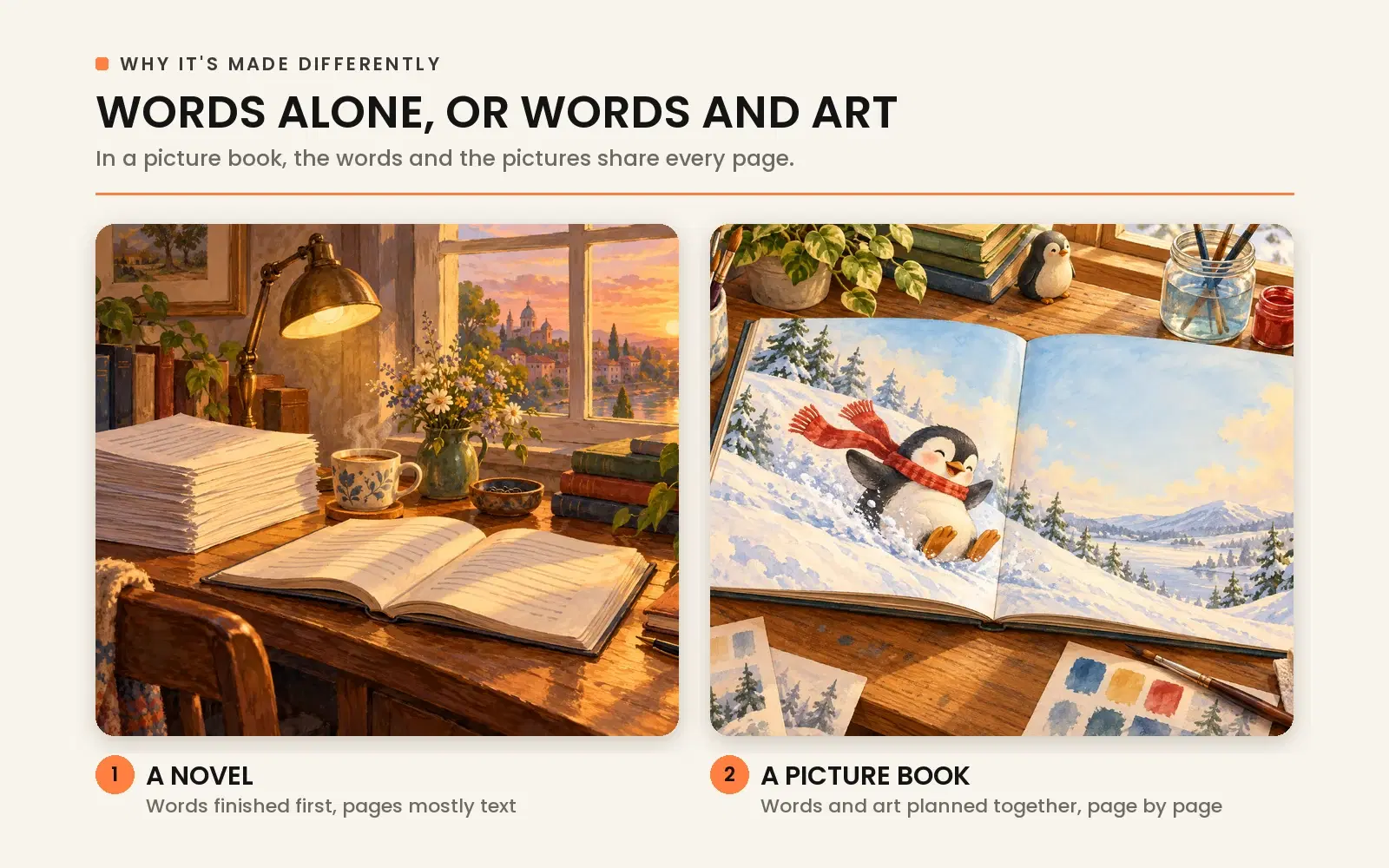
Publishing a picture book works differently from publishing a novel, because the pictures are part of the story rather than an extra. With a novel, the words are finished first and then set into pages that are mostly text. A picture book can't work that way, because its words and art share every page. Here's what that changes in practice.
- The pictures set the pace, because nearly every page needs its own finished art.
- The words and the art are laid out together, so the designer fits both onto each page.
- The page count is planned before any art starts, because the story is written to a fixed number of spreads. A spread is the two facing pages you see when the book lies open.
- Color usually runs on every page, which shapes the printing choices later on.
A novel can go into layout once its words are final. A picture book needs its art first, and the art needs final words.
Who Does the Work, You or a Publisher?
Every stage in the table happens on every route, whether a publisher takes on your book or you publish it yourself. What changes is who does the work and who pays for it. For the full list of jobs involved, see what a children's book publishing company actually does for you.
When a Traditional Publisher Takes It On
When a traditional publisher takes on your children's book, it handles the editing, the art, the printing and the selling. You don't have to find the illustrator yourself, either. For a picture book, the publishing house finds the illustrator once it takes on your book. That means you can send the text on its own. A retired teacher with a finished picture book text and no pictures, for example, doesn't need to hire an artist before sending it out.
In return, your book has to be accepted first, and few publishers accept manuscripts sent straight from authors. For most authors, getting a traditional publisher to take the book starts with finding a literary agent, who then offers it to publishers. You'll also approve less along the way, since the publisher makes most of the final calls on the art and design.
How Does Self-Publishing Work for a Children's Book?
Self-publishing a children's book means you take on the publisher's role. Every stage is then yours to do or to hire out. Platforms such as Amazon KDP even ask you for an imprint, which is the publisher's name tied to the book's ISBN. In practice, you have three choices. You can do the jobs yourself, hire each person separately, or have a publishing team run the stages while you make the decisions. Whether that suits you is a separate question, covered in our guide on whether self-publishing a children's book is worth it.
What Is the First Step in Publishing a Children's Book?
The first step in publishing a children's book is getting the text edited and locked, because everything after it is built on the final words. Many first-time authors ask, "How do I publish a children's book I wrote?", and the answer starts with the words, not the pictures.
An editor reads a children's text a little differently from an adult one. They check that the story works when it's read aloud again and again, that every word earns its place, and that the ending lands. Then the page breaks get marked, so each page turn falls on a moment that makes a child want to see what's next.
When the edits are done, you read the final version and sign it off. That's what locked means. From that point, the words stay as they are unless there's a very good reason to change them.
Why does locking matter so much? In a picture book, the words sit on the art, so a late change means every later page has to be reflowed. Say you add one line on page 6. That line can push text into the pictures on every page that follows, and each of those pages then needs fixing.
That's why it pays to settle your final text before any art starts. If your manuscript still needs a careful edit, our guide on how editing and proofreading polish a book explains what that work involves.
The Book's Size and Format Come Before the Pictures
You pick the size and shape of your picture book before any final art is made, because the illustrator draws every page to fit them. A wide spread drawn for one shape can't be squeezed into another without losing art at the edges. That's why trim size and binding are settled first, even though they feel like printing details.
The first choice is the category, since a picture book, an early reader and a chapter book are built very differently. Our guide to children's book categories by age explains each one. After that come the physical choices.
- The trim size, which is the finished size of each page.
- The shape, which can be wide, tall or square.
- Hardcover, paperback or both.
- Color on every page, or only on some pages.
Each of these choices has a reason behind it. A bigger, wide book suits a picture book that an adult reads aloud while holding it open. A smaller, tall book suits an early reader that a child holds alone. A hardcover suits gifts and libraries because it stands up to a lot of handling. If the book is a birthday present for a grandchild who'll drag it to bed every night, hardcover is usually the better pick. A paperback is lighter, and it's common for classroom and activity books.
How the Pictures Get Made, From Sketch to Final Art
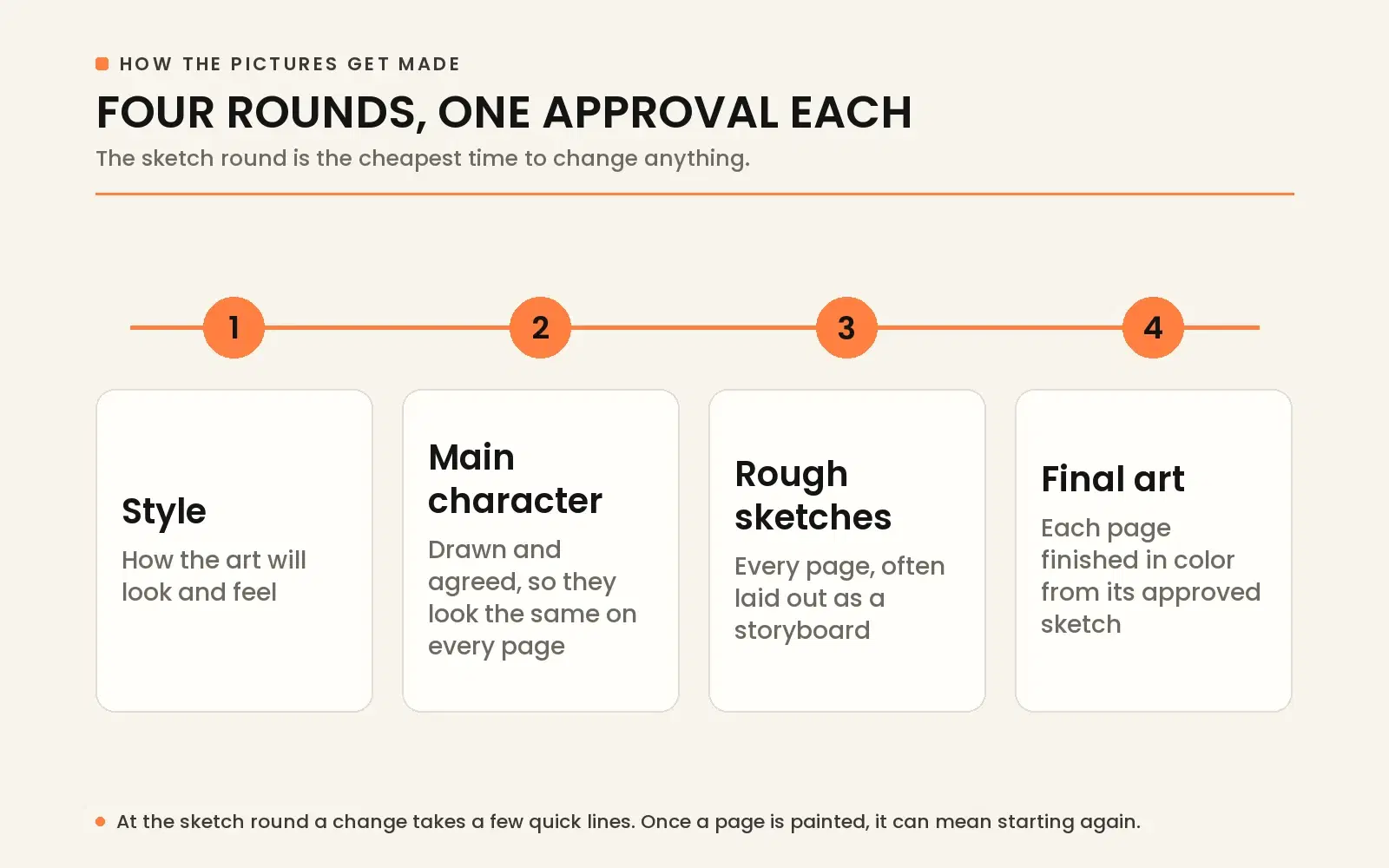
The illustrations for a children's book are made in rounds, and you approve each round before the next one begins. It starts with the style and main character, then rough sketches for every page, then the final art. Here's how the rounds usually go.
- First, the illustrator shows you the style, which is how the art will look and feel.
- Next, your main character is drawn and agreed, so they look the same on every page.
- Then rough sketches are made for every page, often laid out together as a storyboard.
- Last comes the final art, where each page is finished in full color from its approved sketch.
The rounds run in this order for a simple reason. At the sketch round, moving a character or changing a pose takes a few quick lines. Once a page is fully painted, the same change can mean starting that page again. So the sketch round is the best time to speak up about anything that doesn't feel right. A storyboard helps here, and our post on how a storyboard plans every page before the final art shows what that looks like.
One more thing should be settled before any drawing starts, and that's who owns the finished art. It's best agreed in writing, so there's no doubt later. If you don't have an illustrator yet, professional children's book illustration services can take on this stage for you.
What If You've Already Illustrated Your Book?
Yes, a children's book you've already illustrated can still be published, and your finished art joins the process at design and layout. Before that, it's worth checking that the art fits the chosen size and will print well.
That check covers a few plain things. The art has to match the shape of the book, and it has to be sharp enough to print clearly. Nothing important can sit right at the edge of a page, where it could be trimmed off. Once the art is ready, the pages are designed around the pictures you already have, instead of starting the art again.
Design and Layout Turn Words and Pictures Into Pages
In design and layout, a designer places your words on the art and picks a font your reader can manage. The designer also builds the front pages, the back pages and the cover. This stage is also called typesetting, and it's where your pages start to look like a real book.
The words are placed so they never cover a face or the key moment in a picture. The front pages include the title page and the copyright page. The ISBN is printed on the copyright page, along with a Library of Congress number if the book has one. The back pages often carry a short note about the author.
The cover is finished last, and there's a practical reason for that. A printed cover is one piece that wraps around the book, with a front, a spine and a back. Amazon KDP's cover help sizes the spine from the book's page count. So the full cover can only be finished once the pages are final. At the end of this stage, you approve the page layouts and the cover.
The Proof Is Your Last Easy Chance to Change Things
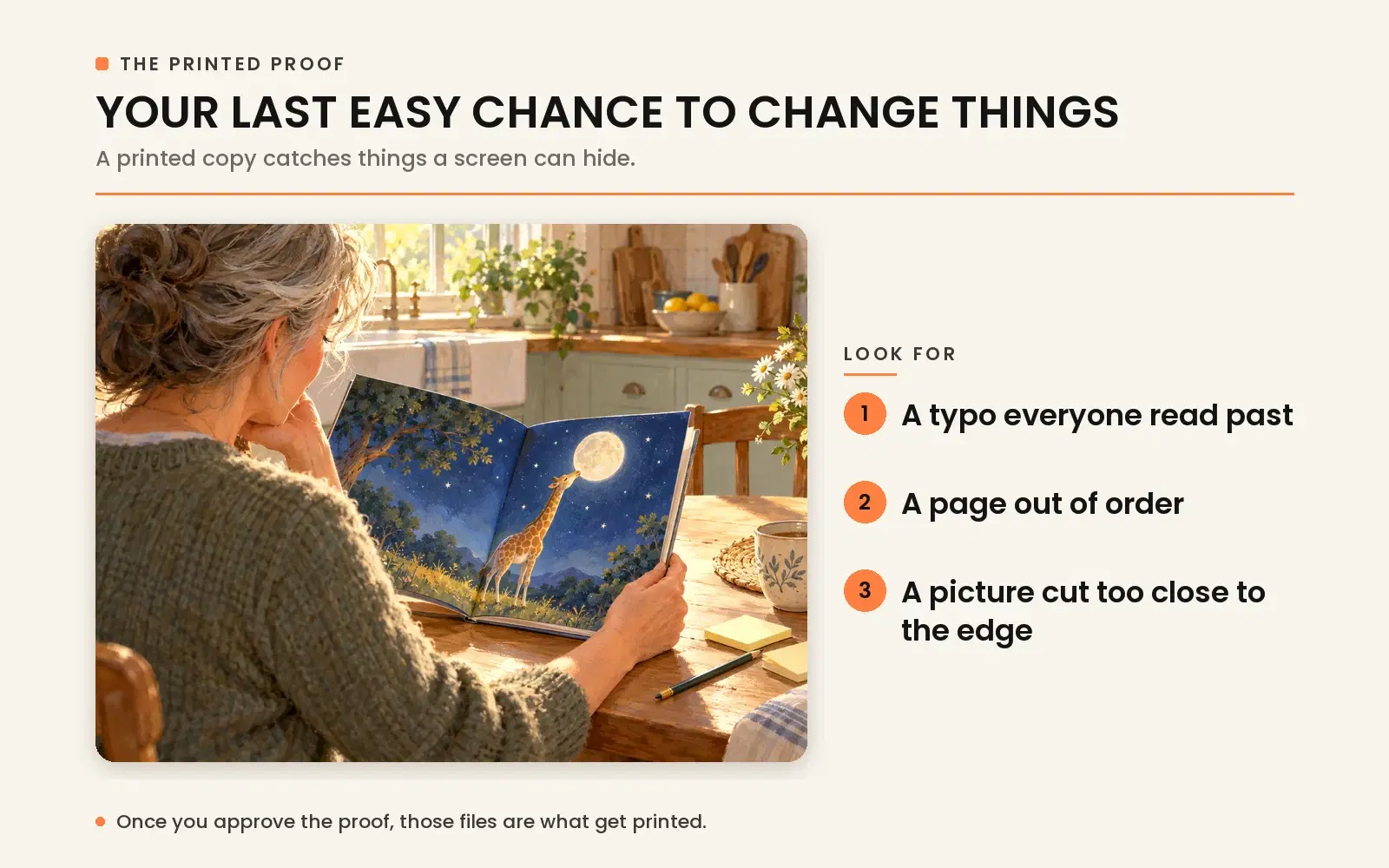
A proof is a test version of your finished children's book, first as digital pages and then as a printed proof copy. It's the last point where a change is still quick and cheap, so it's worth checking slowly.
You check the proof with the team, and your sign-off matters more than it might seem. Once you approve the proof, those approved files are what get printed. Anything you miss at this stage will be in every copy.
A printed proof often catches things that everyone read past in the files. You might spot a typo, a page that's out of order, or a picture cut off too close to the edge. A grandfather might read his story many times over in the files, then find a doubled "the" the moment he holds the printed copy. Holding the proof also lets you read your book the way a child will, turning real pages one at a time.
Where the ISBN, Copyright and Library of Congress Number Fit In
The ISBN, the copyright details and the Library of Congress number for a children's book can be sorted out any time before the proof. They're often handled while the pages are designed. That's because each of them, when the book has one, goes on the copyright page inside the finished book. Your story is also protected by copyright on its own, from the moment it's written down.
- An ISBN is a number that identifies one edition of a book, and each format gets its own. On Amazon KDP, the paperback and the hardcover each need their own ISBN, while an ebook can go without one. In the United States, ISBNs come from Bowker, the official ISBN agency.
- Copyright protects your story as soon as it's created. Registering it with the U.S. Copyright Office is voluntary, but you'll need to register before you can sue over a U.S. work.
- A Library of Congress Control Number is a catalog number the Library of Congress can assign before a book comes out. When a book has one, it's printed on the copyright page.
All three are settled before the proof, so the copyright page you check is the same one that gets printed. None of them changes how your book looks, but each one has to be right before printing.
Printing One Copy at a Time or a Whole Batch
A children's book is printed in one of two ways. With print on demand, one copy is printed each time someone orders it. With a print run, many copies are made at once and stored until they're sold. Print on demand means there's no stock sitting in your garage, because each copy is made after it's ordered.
Amazon KDP and IngramSpark both print on demand. A print run can make more sense for books you plan to sell in person or in bulk.
So the choice comes down to where readers will buy it. If most copies will be ordered online, print on demand means you never have to store stock. If you're planning school visits and want a box of books to sign and sell afterward, a small print run may suit you better.
Either way, the printer works from the files you approved at the proof stage. Nothing new about the book is decided now, apart from how many copies to print and where they go.
Publishing Day, When Your Book Goes on Sale
Publishing day is when your finished files go to the selling platforms, your book's listing goes live, and readers can order a copy. The listing carries the title, a short description, the age range and the categories that help the right readers find it.
Amazon KDP sells your book in Amazon's store. IngramSpark connects a book to libraries, retailers and online stores, including Amazon, Apple and Barnes & Noble. You can also list an ebook edition alongside the printed one, so readers can choose the version they like.
The main choice you make here is how the listing describes your book. Pick the age range your story was really written for, and write a short description that tells a parent what the book is about. Those two details help the right families find it.
Which Stages Take the Most Time and Money?
In a picture book, illustration usually takes the most time and the biggest share of the budget, because every page is drawn and approved. The most expensive habit is changing the text after the pages are laid out, since that undoes finished work on every page after the change.
The order of the stages is what keeps both under control. When the text is locked early and the size is set before the art, each stage builds on the last one instead of undoing it.
Two of your own choices move the time and money the most. They're the number of pages and how many of them carry full art. So if you're still deciding how many spreads will be fully illustrated, settle it before the illustrator starts.
For the full picture, our guides explain what it costs to publish a children's book and how long each stage of publishing takes.
How We Take Your Manuscript All the Way to Print
Book Writing US helps authors turn a finished manuscript into a finished book. Our children book publishing services cover the editing, the illustration, the page design and the cover, the printing and the publishing. Your book can be a picture book, an early reader or an educational book. If you already have finished art, we can work with it, and if you don't, the pictures can be drawn through our illustration service.
Tell us where your book is today, whether that's a finished manuscript, a folder of sketches or files that are nearly ready to print. We'd be glad to talk it through with you.
Frequently Asked Questions
Is printing a book the same as publishing it?
No, printing and publishing are two different jobs. Printing makes physical copies of a book. Publishing makes the book available to readers, with an ISBN, a listing and a way to buy it. A printer will print almost anything you send, but having copies printed doesn't mean your book is published. Publishing is the step that puts your book in front of readers who don't already know you.
Does a self-published children's book count as published?
Yes, a self-published children's book is a published book. It's listed for sale, it usually has an ISBN, and anyone can buy it. The main difference is who takes on the publisher's role, which in self-publishing is you. The name shown as the publisher depends on whose ISBN the book uses. With your own ISBN, you can show your own imprint, while a free ISBN from Amazon KDP shows the words "Independently published" instead.
Can you make changes to a children's book after it's published?
Yes, small fixes can usually be made to a children's book after it's published, but each change means updating the files and checking a new proof. That's why it pays to catch mistakes at the proof stage. Bigger changes are a different matter. On Amazon KDP, a new edition with significant changes needs its own ISBN, so it's treated as a new version.
How do I get my children's book published online?
You get your children's book published online by listing it for sale on websites such as Amazon, where readers order it. Print copies are still printed and shipped to each reader, and you can list an ebook edition alongside the printed one, too. The stages before that stay the same, so the book still needs editing, art, design and a proof first.
What happens after your children's book is published?
After your children's book is published, copies are printed as orders come in, and you can order author copies for gifts or events. The book is now out in the world, but readers still have to find it. Getting it noticed is a job of its own, usually called the launch or book marketing. It starts once your listing is live.
- What Happens Between a Finished Manuscript and a Printed Book?
- Who Does the Work, You or a Publisher?
- What Is the First Step in Publishing a Children's Book?
- The Book's Size and Format Come Before the Pictures
- How the Pictures Get Made, From Sketch to Final Art
- Design and Layout Turn Words and Pictures Into Pages
- The Proof Is Your Last Easy Chance to Change Things
- Where the ISBN, Copyright and Library of Congress Number Fit In
- Printing One Copy at a Time or a Whole Batch
- Publishing Day, When Your Book Goes on Sale
- Which Stages Take the Most Time and Money?
- How We Take Your Manuscript All the Way to Print
- Frequently Asked Questions