Publishing a Book Your Child Wrote, What Parents Need to Know
Short Answer: Yes, you can publish a book written by a child, and your child can be the named author. Your child owns the copyright in their own words. You, as the parent or guardian, hold the publishing account and sign anything that needs an adult, because Amazon KDP asks account holders to be at least 18. Decide early on keepsake or public, and on real name or pen name, because both choices are hard to undo.
Maybe it started as a stapled story at the kitchen table, or a notebook your child filled over the summer. Maybe it's a finished draft on the family laptop. If you've found yourself telling friends, "My child has written a book," you already know what your child will ask next. When will it be a real book?
This post walks through the decisions a parent makes along the way. It covers who signs, who owns the words, how public the book gets, what name goes on the cover and how to polish the story without taking it over. It isn't a click-by-click publishing guide. It's the thinking you'll want to do before anything is uploaded or printed.
Can a Child Publish a Book on Amazon?
Yes, a child can publish a book as the author. Amazon KDP's age rule is for the person who holds the account, not for the author, and the U.S. Copyright Office says minors may claim copyright. A six-year-old can be a child author just as truly as a sixteen-year-old can. On Amazon KDP, a minor can't hold the account or accept the terms, so an adult takes care of that part.
The simplest way to think about it is as two roles. Your child is the author, the person who wrote the story and whose name can go on the cover. You, as the parent or guardian, act as the publisher on paper. That means you hold the account, agree to the terms and handle anything to do with money.
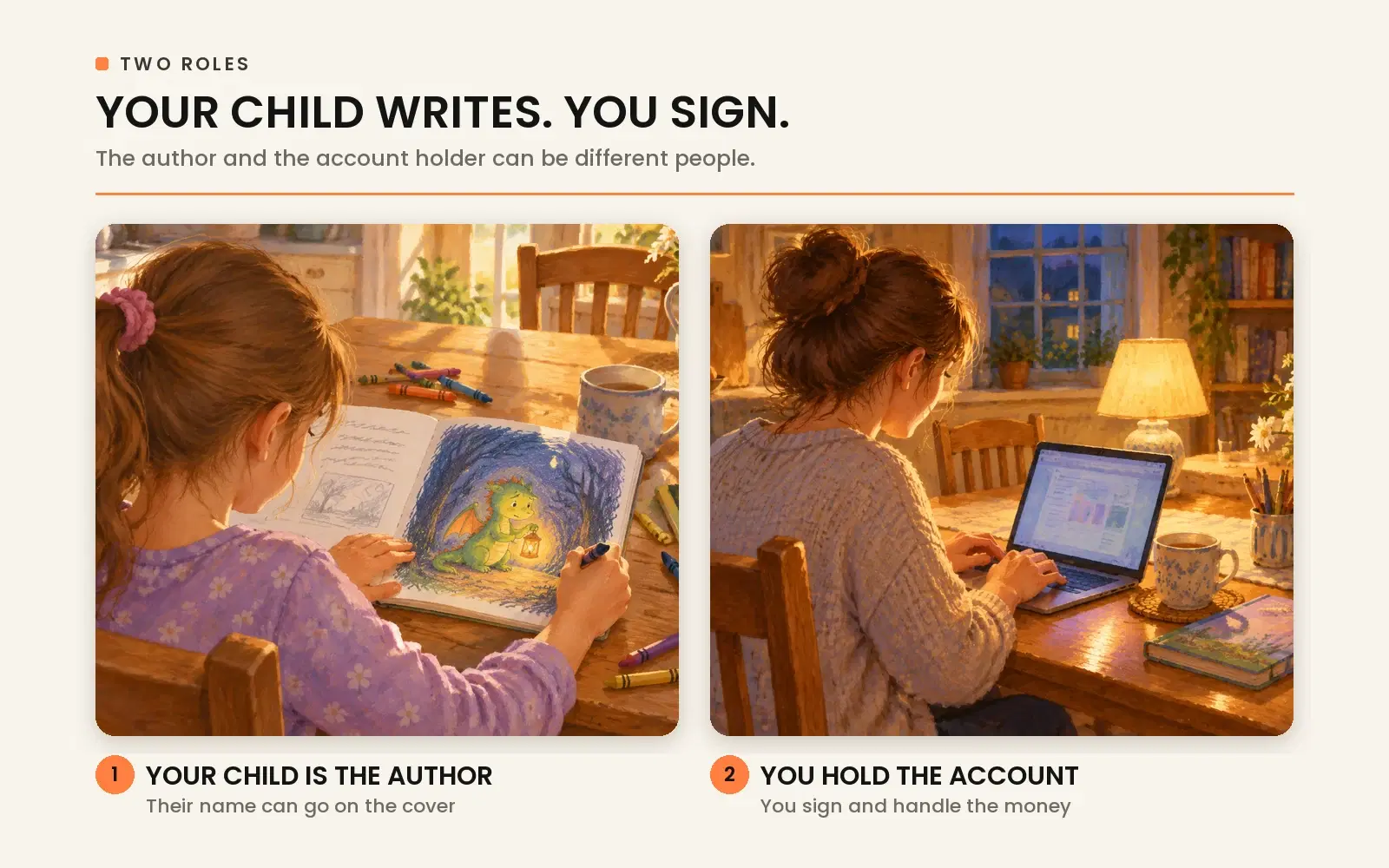
Picture a nine-year-old who wrote a story about a dragon who's scared of the dark. The cover can carry her name, and the book is truly hers. The account behind it carries her mom's or dad's name, though, because that's the person a platform can hold to an agreement.
That split between author and publisher runs through every choice in this post. So when a relative asks, "Can a minor publish a book?" you can say yes, as long as an adult handles the business side. The next section shows how Amazon's own terms put it.
How Old Do You Have to Be to Publish a Book?
To publish a book on Amazon KDP, you have to be at least 18, or older if the age of majority where you live is higher. The age of majority is the age when someone legally becomes an adult. Amazon's KDP terms also ask that the account holder be able to form a legally binding contract. The same terms say a parent or guardian of a minor can open a KDP account and be the publisher of the minor's book.
So the answer for your family is simple. Your child can't open the account, but you can open it and publish their book for them. Amazon describes this route itself, so your child's book can go on Amazon with you holding the account.
Other platforms, printers and distributors set their own terms. Before anyone in your family signs up for a service, read the part of its agreement that says who can hold an account. It's usually short, and it saves you from finding out halfway through.
Your Name on the Account, Your Child's Name on the Cover
When you publish your child's book through your own KDP account, your name sits behind the book and your child's name sits on it. The account holds your legal name, your address, your payment details and your tax information. KDP's help pages ask for your real name in the account information so it can issue payments and tax forms correctly.
The book itself is a separate thing. Its author name field carries your child's name or a pen name, and that's the name readers see on the store page. If an editor or an illustrator helped, KDP lets you credit them as contributors. That way the people who shaped the book get named without being called the author.
There's one more rule worth knowing. KDP's terms say you can keep only one account at a time. If you already publish your own books, your child's book will live in that same account, right next to yours. Decide how you feel about that before anything is uploaded.
What Happens When Your Child Becomes an Adult?
When your child becomes an adult, their book usually stays in the KDP account it was published from. KDP's help page says it can't move specific books from one account to another. Accounts can be merged, but a merge moves all the published books in the old account, not just one title.
That matters most if your account also holds your own books, because there's no clean way to hand over only your child's. So think about the day your child becomes an adult before you publish, not after. The good news is that the copyright was your child's all along. What changes at the age of majority is who can sign and decide, not who owns the words.
Your Child Owns the Copyright in Their Own Words
Can a child own copyright? Yes, and they usually do from the first page. In the United States, copyright exists automatically once a story is fixed, which means written down or typed, and it belongs first to the author who created it. So a story your child wrote belongs to your child, not to you, even though you're the one holding the account.
The U.S. Copyright Office's answer on minors and copyright is short and clear. It says a minor can claim copyright and that the Office registers works by minors. It also says state laws may regulate business dealings around a copyright a minor owns, and it points people to an attorney for those questions. In plain words, the story is your child's, but any contract about it may also be covered by your state's laws.
One more point surprises a lot of parents. Owning the notebook isn't the same as owning the copyright, and the Copyright Office's Circular 1 says owning a copy of a work doesn't give you the copyright in it. Registering the copyright is optional, because your child's copyright exists without it. Everything here is general information, not legal advice, and for state law questions the Copyright Office itself suggests an attorney.
When Your Help Makes You a Co-Author
Typing up the story, fixing the spelling and asking your child questions is help, not authorship. Things change when a parent rewrites large parts or makes art meant to go with the words. Circular 1 says that when two or more people create one work and mean their parts to merge into a single whole, they're joint authors. A joint work belongs to all of them.
So if you rewrite whole pages, or draw pictures made to sit with your child's text, the book may become partly yours in a real legal sense. That isn't wrong, but it's worth being honest about whose book it is. Art is its own question too. Pictures generally belong to the person who drew them, whether that's an illustrator, a grandparent or a family friend. Handing those rights to someone else generally has to be done in writing and signed. The big exception is a work made for hire, where whoever hired the artist is treated as the legal author and owner.
A book a whole class writes together is a bigger project of its own, with many young authors and many families to agree. For one child's book, the simplest rule is to help with everything around the story and leave the story itself to your child.
Should Your Child's Book Stay in the Family or Go on Sale?
A keepsake book is printed for family and friends and never listed in a store. A public book is listed where anyone can find it, buy it, see your child's name and leave a review. For a child author, the real question is how public you want your child's name to be. It's also worth asking how your child would feel about a review from a stranger.
Ask your child what they picture. Some kids dream of handing copies to grandparents and teachers, and a keepsake book does that beautifully. Others want to see their book in a store, which is a bigger step for a young author. If you're unsure, there's a gentle middle path. Print keepsake copies first, and decide about a public release later.
If you're wondering how to print a book written by a child just for the people who love them, our guide to printing a children's book just for your family covers that side. Grandparents who write for their grandchildren face the same choice, and our guide to a grandparent's keepsake or public book weighs it in more depth.
A Public Book Is Hard to Fully Take Back
If you publish your child's book and regret it later, you can stop new sales, but you can't call back the copies people already bought. KDP's help pages say that once you unpublish a book, Amazon stops selling new copies, but other sellers can still resell used ones. KDP's terms add that taking a book off sale only applies going forward, not to customers who bought it before.
The author name is fixed too. KDP's help pages say the author name can't be changed once a book is published, so a real name used today stays on that book. That's why it helps to start private when you're unsure. A keepsake book can always become public later, but a public book can't become fully private again.
Real Name or Pen Name for a Young Author
A child author can use a real name or a pen name, and both are fine. The right choice depends on how public the book will be and how your child might feel about it at 15 or 25. A real name brings pride, and family, friends and school will recognize it. A pen name brings privacy, and it gives your child room to keep this book apart from anything they write later.
Amazon KDP allows a pen name as long as it's appropriate and stays consistent across the author's work. Whatever you choose has to be settled before the book goes live, because the author name can't be changed after publishing. Most families weigh three options.
- Your child's full real name suits a keepsake book, or a public book your family is happy to have online.
- A partial name, such as a first and middle name or a first name and last initial, gives you pride with some privacy.
- A pen name suits a public book when privacy matters most, or when your child wants a writer's name of their own.
Let your child help choose, but from a short list you're already comfortable with. Kids often love inventing a pen name. That fun can be part of what makes the book feel like theirs.
What a Pen Name Hides, and What It Doesn't
A pen name hides your child's name from readers, but not from every record. KDP says that when you use a pen name, your real name stays anonymous and isn't published on its website. Its terms also say Amazon may share the account holder's legal name and contact details under its privacy notice, for example to comply with the law, whatever author name you use.
A copyright registration is another place names show up. If you ever register the copyright, the U.S. Copyright Office says the registration becomes a public record, and most of it is available online. The Office suggests using a non-personal address, phone number or email instead of your home details. So a pen name keeps your child's real name away from casual searches, which is what most parents worry about. A registration is different, because it names the owner, and the Office won't later swap a name on that record for a pen name. Choose the details on it with care.
Where Your Child's Details Can Show Up in a Book
A book has more places for personal details than most parents expect, and each one is a choice you get to make. The table below shows where these details usually go, with a safer choice for a young author in each.
| Where it shows | What usually goes there | A safer choice for a young author |
|---|---|---|
| Front cover and spine | The author name | A first name, a partial name or a pen name |
| About the author page | A short bio, often with age, town or school | Hobbies and favorite things, with no town or school |
| Author photo | A photo of the author | A drawing by your child, or no photo at all |
| Dedication page | The names of the people the book is for | First names only, or a family word like "Grandma" |
| Copyright page | A copyright notice with the owner's name and the year the book first came out | A short form of your child's name, or the pen name they're known by |
| Online store page | The author name, the book description and reader reviews | A description about the story, not about your child's life |
| Copyright registration record | The claimant's name and contact details, which become public | A non-personal address, phone number or email |
A warm bio can still say plenty. It can tell readers that your child loves dragons, soccer or the family dog, without saying where they live or go to school. A drawing your child made, or a character from the book, can stand in for an author photo and still feel personal.
Keeping the Book in Your Child's Own Words
When you polish your child's book, edit for the reader, not for an adult's taste. The charm of a book a child wrote is the way a child says things. The words that sound young are usually the ones worth keeping, because they're the reason the book sounds like your child.
A few habits keep the book theirs. Save the original draft before anyone changes a word. Explain each suggested change to your child, and let them say yes or no. If you bring in an editor, look for one who treats your child as the writer, because a good edit for a young author protects their voice rather than replacing it.
What a Good Edit Fixes, and What It Leaves Alone
A good edit fixes whatever gets in a reader's way and leaves alone whatever makes the story your child's.
An edit should fix these things.
- Spelling and punctuation mistakes that would trip up a reader.
- A character's name that changes halfway through the story.
- A sentence a reader can't follow, even after reading it twice.
- Text that runs too long to fit on the page next to its picture.
It's usually best to leave these alone.
- Your child's own word choices and jokes, even the odd ones.
- A plot that wanders a little, the way kids' stories often do.
- An unusual ending that your child loves.
- The title your child picked.
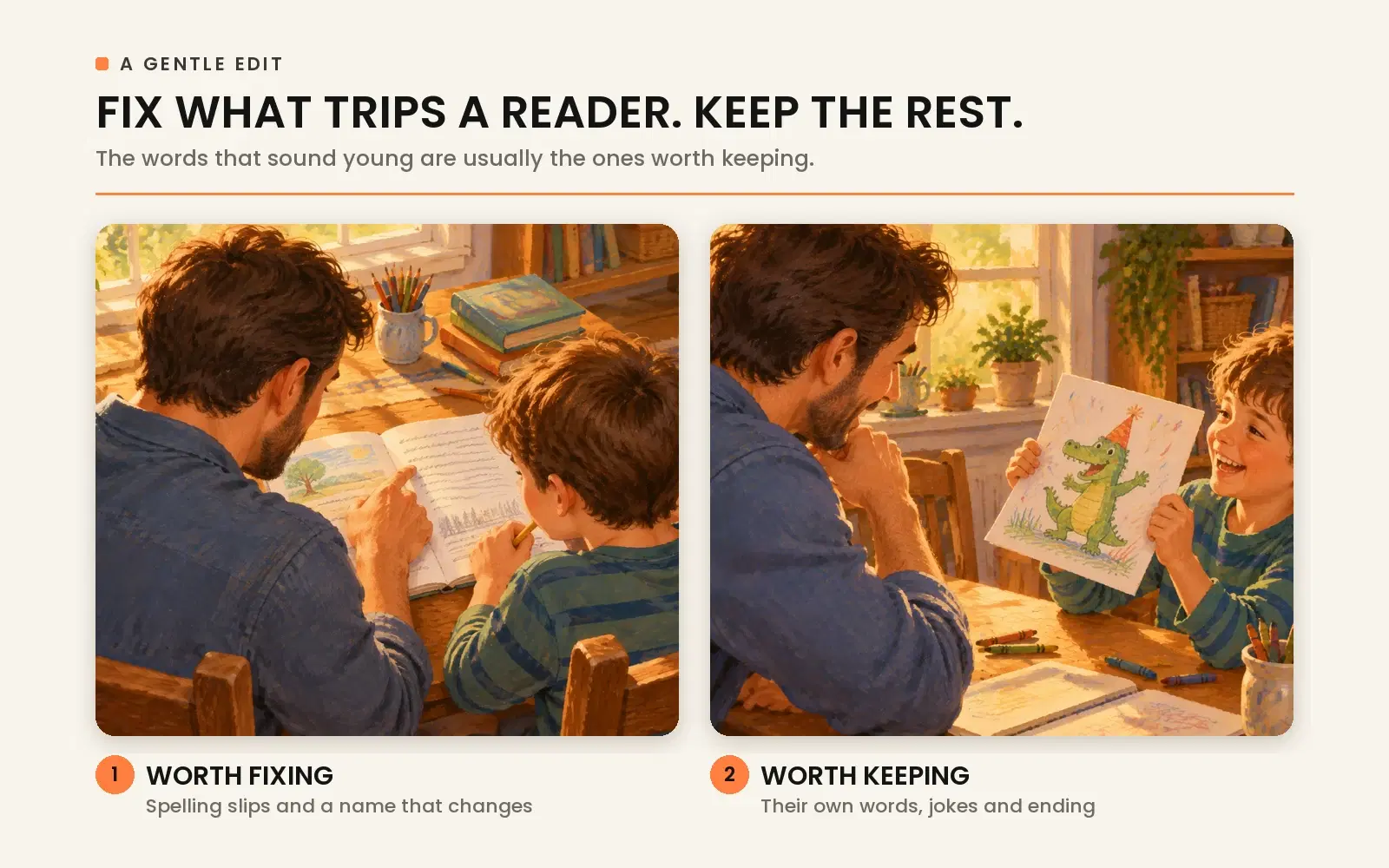
When you're not sure, ask whether a change helps a reader follow the story or only makes it sound more grown up. Our post on what editing and proofreading change in a book explains how those two kinds of work differ.
Should the Pictures Be Your Child's Own Drawings?
The pictures can be your child's own drawings, an illustrator's work, or a mix of both. In a picture book the pictures carry much of the story, so talk it through with your child before you decide. Most families choose one of three routes.
- Your child's drawings are used as they are, captured cleanly so they print well.
- An illustrator draws from your child's sketches, so the characters still look like the ones your child imagined.
- Your child's art fills the inside and the cover, with professional layout and lettering around it.
If an illustrator draws the pictures, they can be credited as a contributor. As the co-author section explains, the art generally stays with the person who drew it. That changes with a signed written transfer, or when the art is a work made for hire. So whoever draws the pictures, agree on who owns the art and the files in writing before the drawing starts. If you'd like a professional to draw them, children's book illustration services can take that job on.
Which Decisions Belong to Your Child, and Which Are Yours
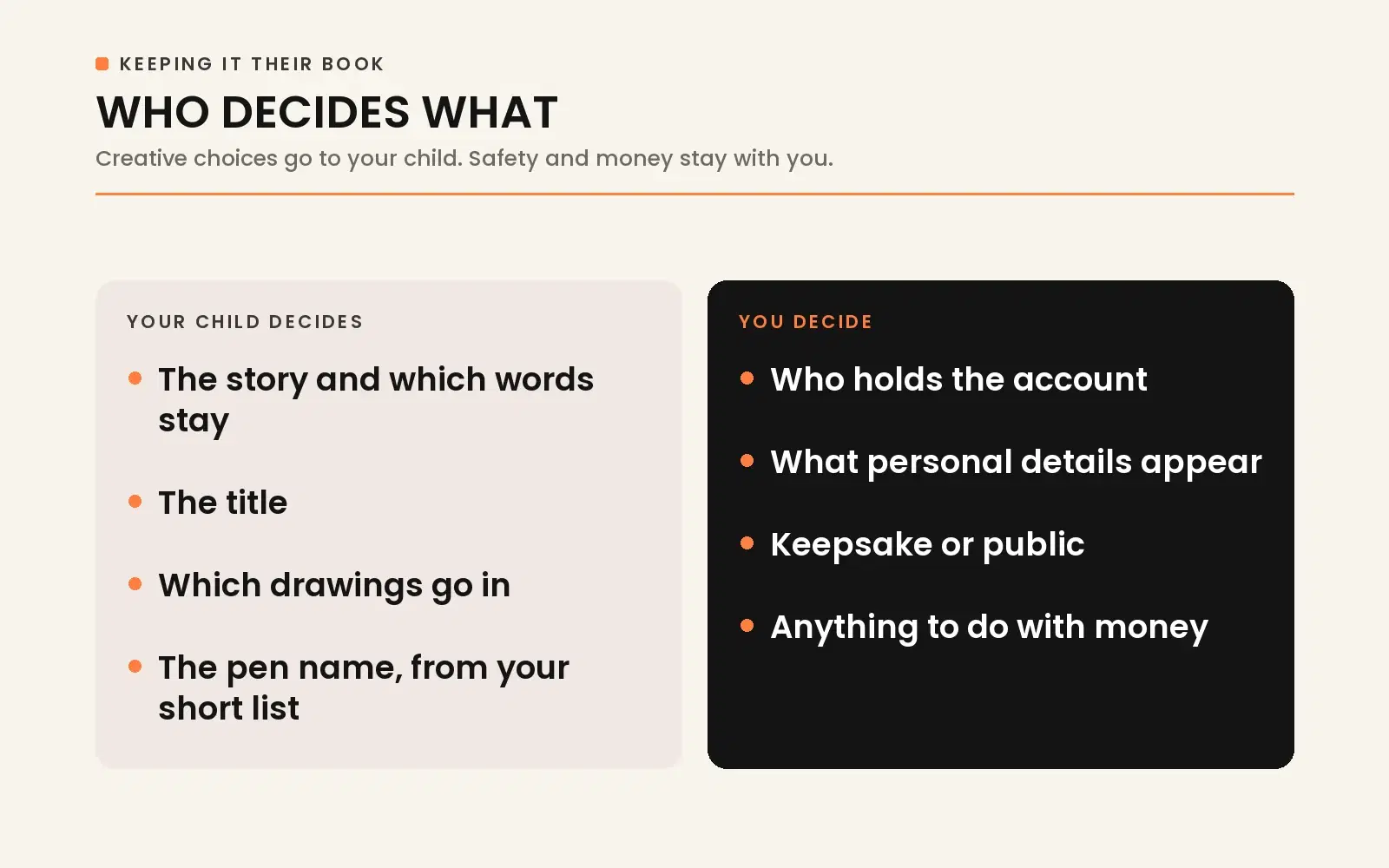
If you want to help your child publish a book without taking it over, split the decisions between you. Creative choices go to your child. Safety, legal and money choices stay with you.
These choices belong to your child.
- The story, and which of their words stay after editing.
- The title of the book.
- Which drawings go in, and which one is their favorite for the cover.
- The pen name, chosen from options you're comfortable with.
These choices stay with you.
- Who holds the account and signs any agreement.
- What personal details appear in and around the book.
- Whether the book stays a keepsake or goes public in the end.
- Anything to do with money, and when to ask an attorney or an accountant.
How much your child takes on depends on their age. A six-year-old might pick the cover colors and give the final pages a happy thumbs up. A twelve-year-old can read the proof copy and say yes or no to each edit. A teenager can take on more of the choices, with you still holding the account. And if your child finishes this book already dreaming up the next one, our guide to writing a children's book is a lovely place to start together.
Turning Your Child's Story Into a Finished Book
Turning your child's story into a finished book takes a gentle edit, the pictures, a page layout and a proof copy to check. After that comes printing for the family or publishing for the public. Each of those is a stage of its own. Our overview of how children's book publishing works walks through the whole journey from manuscript to printed book.
Book Writing US is a children's book publishing company that works on picture books, early readers and educational books. We help authors go from a finished manuscript to a finished book, with editing, illustration, page design and the cover, printing and publishing.
Authors can bring art they already have, or have the pictures drawn through our illustration service. If you have questions before you decide how to publish your children's book, get in touch.
Frequently Asked Questions
Does my child need to register the copyright?
No, your child doesn't need to register the copyright for it to exist. Copyright protection starts automatically once the story is written down or typed. Registering is optional, and the Copyright Office does register works by minors. For works from the United States, registration is needed before the copyright can be enforced through a lawsuit. Keep in mind that a copyright registration creates a public record, and most of it is online. So think about which name and contact details go on it.
Can a child get a book published by a traditional publisher?
Yes, a traditional publisher can publish a book a child wrote. Your child's book would go through that publisher's own selection process first, like any other manuscript. If a publisher makes an offer, you as the parent or guardian should stay closely involved. The U.S. Copyright Office notes that state laws may regulate business dealings involving copyrights owned by minors, and it points people to an attorney for those laws. So it's wise to get that advice before anything is signed.
Who gets paid if a book written by a child sells?
The account holder gets paid, and when a parent holds the account, that's you. On Amazon KDP, payments and tax forms go to the real name in the KDP account information. That's true even when the cover shows your child's name or a pen name. So any money from sales lands with you, not directly with your child. If money does come in, an accountant can explain how it's taxed.
Can I make a book out of my child's drawings?
Yes, a book made from your child's drawings makes a lovely keepsake book. It can mix the artwork with short captions in your child's own words. The drawings are your child's own creative work, just like their stories. The same name and privacy choices apply, so think about what goes on the cover and the dedication page.
Can my child enter a young authors contest instead of publishing?
Yes, a young authors contest or a school young authors program is another good way to share a story. Before your child enters, read the contest's rules carefully. Look for what the organizer may do with an entry, such as printing it, posting it online or using your child's name and photo. Those rules tell you where your child's story, name and photo could end up.
Is it easy to publish a book written by a child?
The upload itself is the quick part of publishing a book written by a child. The real work comes before it. That means a gentle edit, the pictures, the page layout, a proof copy to check, and the choices about names and privacy. With a young child, the adult does most of the practical work, while the child makes the creative calls. That balance keeps the finished book feeling like theirs.
- Can a Child Publish a Book on Amazon?
- How Old Do You Have to Be to Publish a Book?
- Your Child Owns the Copyright in Their Own Words
- Should Your Child's Book Stay in the Family or Go on Sale?
- Real Name or Pen Name for a Young Author
- Where Your Child's Details Can Show Up in a Book
- Keeping the Book in Your Child's Own Words
- Which Decisions Belong to Your Child, and Which Are Yours
- Turning Your Child's Story Into a Finished Book
- Frequently Asked Questions