Printing a Children's Book Just for Your Family, Not for Sale
Short Answer: You can print a children's book for your family without publishing it, but the copies they keep should come from a real book printer. A private book can skip the parts that exist to sell it, such as the ISBN, the barcode, a price and a store listing. What still matters is everything your family will hold, from the words and pictures to the binding, plus a safe copy of the files. If you've been looking up how to print a children's book at home, your home printer is best kept for one test copy.
Most people who want a family book aren't planning to run pages through the printer in the spare room. They want a real book for home, one they can give to their own kids, grandkids, nieces or nephews. Maybe you've written a bedtime story and thought, "I'd love to print a book for my child that looks like the ones on their shelf." This guide covers what a family-only book can leave out and what it still needs. It also covers the ways to get it printed, how many copies to order and what to keep for later.
Can You Print a Book Without Publishing It?
Yes, you can print a book without publishing it. Printing makes physical copies of a book, while publishing makes a book available to the public, usually for sale. A family children's book only needs the first of those two things.
The difference matters because most of the work and paperwork in publishing exists to get a book in front of strangers. When you print a book for family, nobody needs to find it in a store or search for it online. You still end up with real, bound copies. You simply leave out the parts that are there for selling.
If you're curious about the full road a public book travels, our guide to how children's book publishing works follows it from finished manuscript to printed book. A family book only travels part of that road, and it's the part this guide is about.
Does Giving Copies to Family Count as Publishing?
Giving printed copies of your book to family members generally doesn't count as publishing it in copyright terms. The U.S. Copyright Office's guidance on publication treats a work as unpublished when the copies stay within a small circle instead of going to the public. One example it gives is an exchange between family members.
The same guidance also describes something courts call a limited publication. That's when copies go to a clearly chosen group for a limited purpose. The people who get them have no right to pass them on or sell them. The Copyright Office says a limited publication isn't publication either. In the Copyright Office's guidance, sharing copies within your family is treated differently from offering a book to the public.
Your story is also covered by copyright as soon as it's written down, whether it's ever published or not. None of this is legal advice, just what the Copyright Office's own guidance says.
What a Private Family Book Can Skip
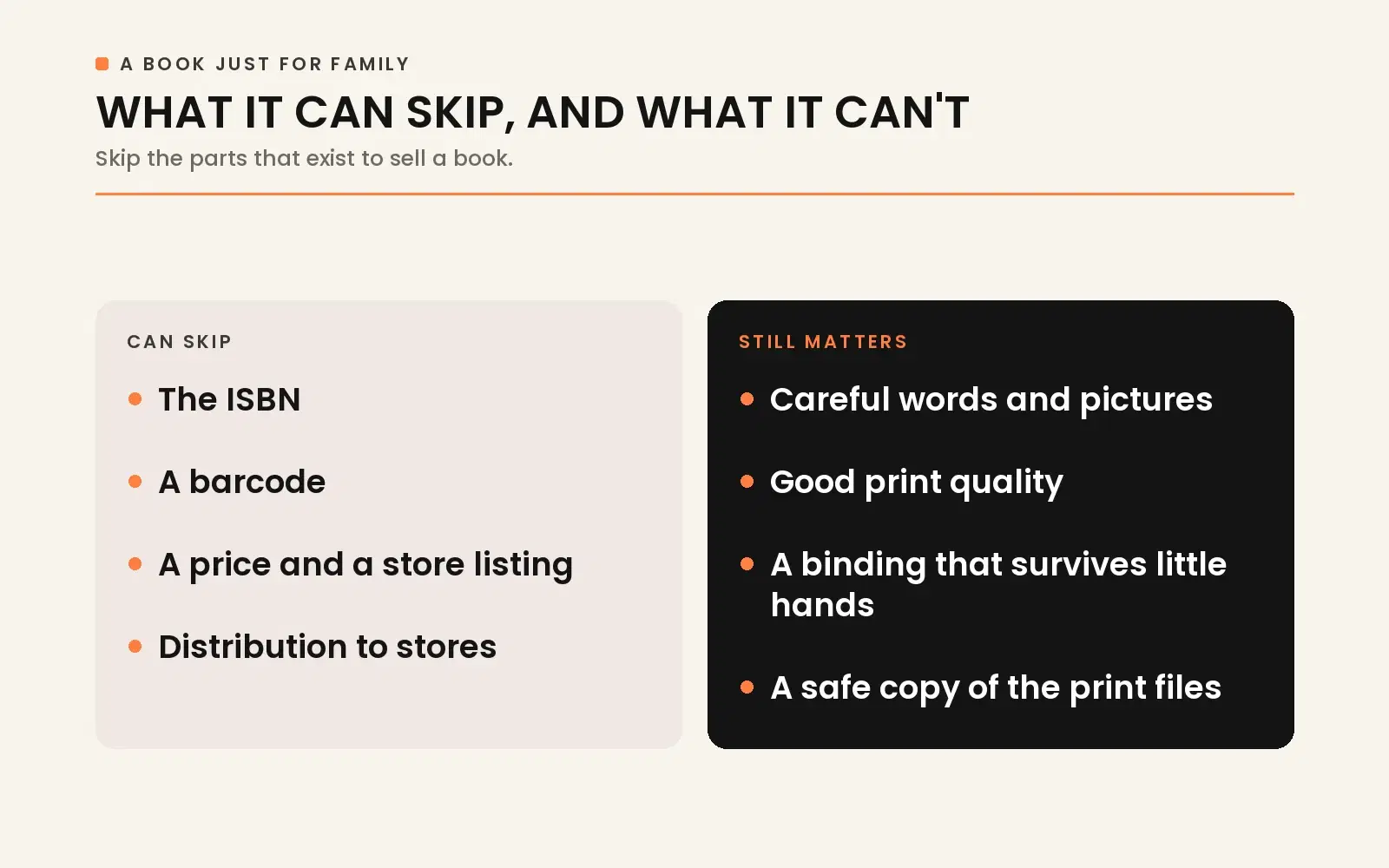
When you self-publish a book for family only, you can skip everything that exists to sell the book or help stores and libraries find it. Here's what those selling parts are and what each one does.
- An ISBN, the number that identifies one edition of a book so stores and libraries can order it.
- The barcode on the back cover, which lets a store scan the book at the register.
- A list price and a store listing on Amazon, Barnes & Noble or another retailer.
- Distribution to bookstores and libraries, so they can order copies.
- Sales details such as a book description, categories and search keywords.
- A Library of Congress Control Number, which the Library assigns before publication to titles that may be added to its collections.
Leaving these out doesn't make your book any less real. It just means your time and money can go into the parts your family will actually see and touch, which come next.
Do You Need an ISBN for a Book You Won't Sell?
No, a book you won't sell doesn't need an ISBN. An ISBN identifies one edition of a book so bookstores, libraries and online retailers can order and track it. Bowker is the agency that issues ISBNs in the United States. If your book is never going on sale, that number has no job to do.
Print platforms have their own ways to handle a book that isn't for sale. IngramSpark offers a free SKU for a book that won't be offered for sale. A SKU is an ID number the printer uses inside its own system, and stores don't use it. Barnes & Noble Press has a Print for Personal Use option for copies you buy for yourself or for friends and family. It doesn't ask for an ISBN.
So if you want to print a book for personal use, you don't have to buy an ISBN at all. If you decide to sell the book one day, you can add an ISBN then, and the last section of this guide explains how that works.
Your Back Cover Doesn't Need a Barcode
A family book doesn't need a barcode on the back cover. The barcode carries the book's ISBN so a store's register can scan it, and a book that's never sold never meets a register. That leaves the whole back cover free for something more personal.
You could use it for a short dedication, a note to the child the book is for, or one more piece of art. Just know that some platforms print their own small code on private copies. Barnes & Noble Press personal use copies carry a SKU barcode with no price, and the platform adds its barcode to the back cover. An Amazon KDP proof copy carries its own unique barcode too. So if you print with either one, leave a little room on the back for that code.
What Still Matters When the Book Isn't for Sale
Once you skip the selling parts, what's left is everything a child actually touches. That's the words, the pictures, the printing and the binding. These are the parts that make a family book worth keeping, so they're where your care should go.
A family book also has a tough audience. It may be read aloud every night for months, often by the same grown-up to the same child. Every typo gets heard again and again, and every muddy picture gets looked at again and again.
The Words and Pictures Still Need Care
A children's book made only for your family still needs careful editing and good pictures. The child won't know or care that it's a private book. They'll only notice whether the story reads smoothly and whether the pictures make them want to turn the page.
Start with the words. Ask someone other than you to proofread the text, because it's hard to spot mistakes in a story you know by heart. Then look closely at the pictures. Every image should be sharp at full size, since art that looks fine on a phone can turn blurry when it's printed across a whole page. Check that each picture sits next to the words it belongs with, so the story and the art show the same moment.
Give the cover real thought as well. It's the first thing the child sees and the part they'll reach for on the shelf. Our guide to what makes a children's book cover work explains what catches a young reader's eye.
Print Quality Makes It Feel Like a Real Book
A printed copy feels like a real book when three things come together. First, the paper is heavy enough that color doesn't show through from the other side. Second, the color looks close to what you saw on screen. Third, the art runs right to the edge of the page. When one of those is off, even a lovely story can look homemade.
Printers have a name for art that runs right to the edge of the page, and it's called bleed. Amazon KDP describes bleed as images or illustrations that reach all the way to the edge of the page. To get that look, the art is printed a little past the line where the page will be trimmed, and then the page is cut. That's why a well-printed picture book has no white frame around its pictures.
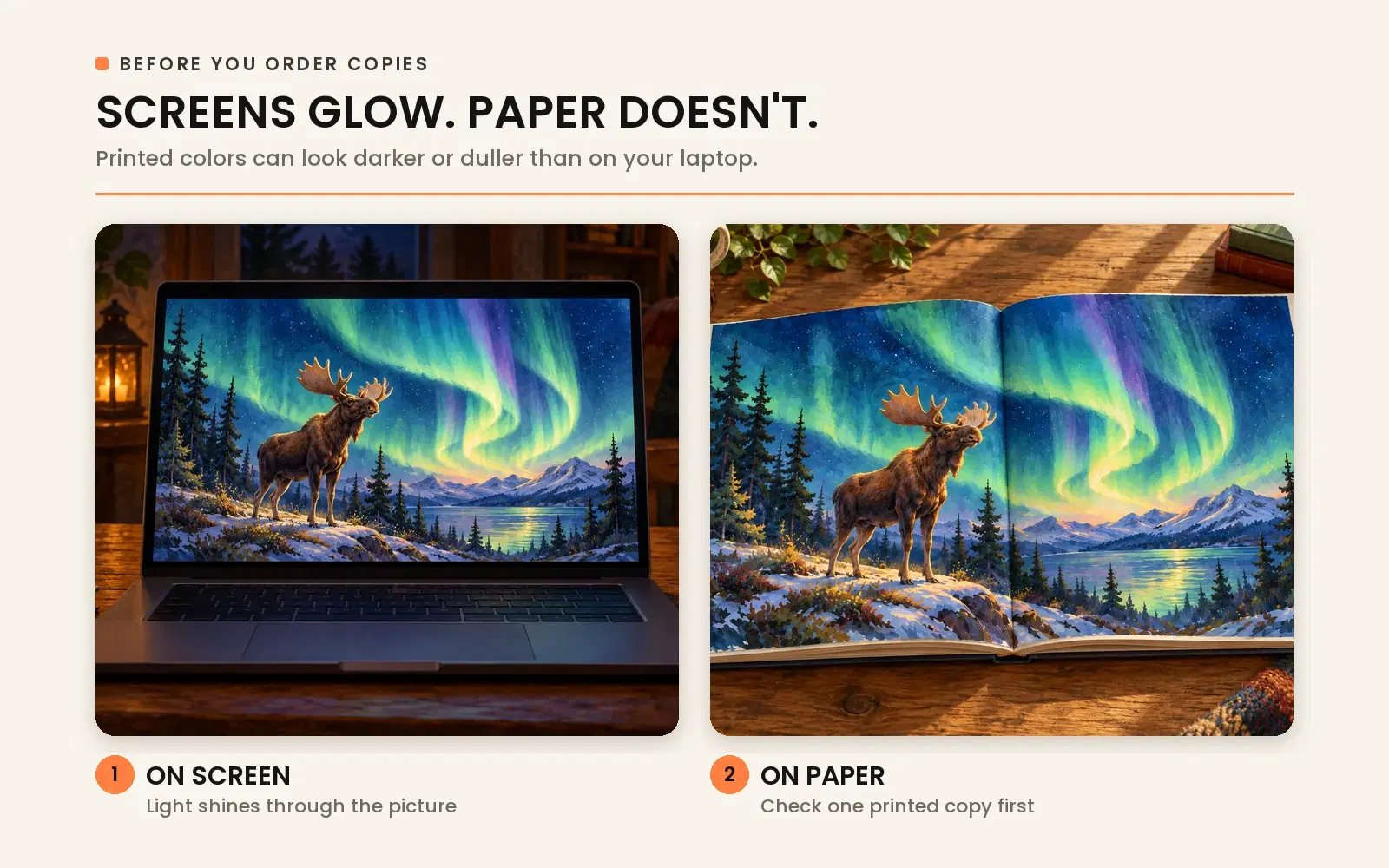
Color can also surprise you. A screen glows and paper doesn't, so printed colors can look a little darker or duller than they did on your laptop. The only sure way to check the paper, the color and the edges is to hold one printed copy before you order more. That first test copy is usually called a proof copy.
Hardcover Holds Up Best for a Keepsake
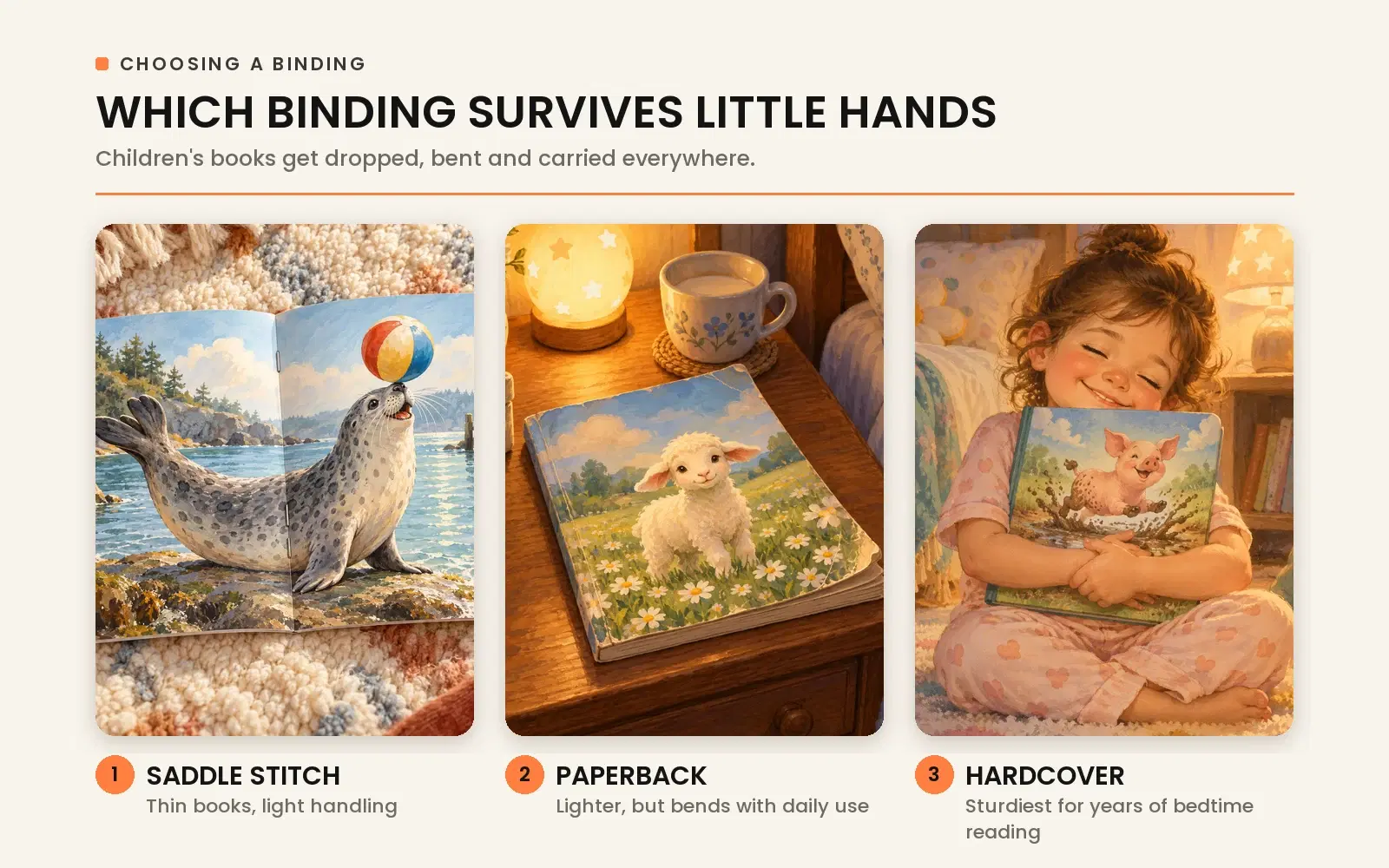
If the book will be read by small hands and kept for years, hardcover is usually the binding that holds up best. Children's books get dropped, bent back, chewed and carried around, so the binding does a lot of work. Here are the three common bindings and how each one tends to hold up.
- Saddle stitch, where folded pages are stapled through the fold. It suits a thin book, but it has limits on page count and on how much handling it can take.
- Paperback, where the pages are glued into a soft cover. It's lighter, but the cover can bend and wear with daily use.
- Hardcover, where stiff boards wrap around the pages. It's the sturdiest of the three and the one most likely to survive years of bedtime reading.
If you want to print a hardcover children's book, page count matters more than most people expect. Amazon KDP hardcovers must have between 75 and 550 pages. A picture book is usually 32 pages, far shorter than that. So a short picture book in hardcover will often need a printer other than KDP.
One Copy, a Small Run, or a Professionally Made Keepsake
The best way to get your family book printed depends on two things, how many copies you need and how finished you want the book to be. If you're hoping to spend as little as possible, our guide on whether you can publish a children's book for free explains what the free routes trade away. The table below puts the four common routes side by side.
| Route | Copies it suits | What the finished book is like | Best for |
|---|---|---|---|
| Home printer | One test copy | Everyday paper, a white edge around most art, no binding of its own | Reading the story aloud and catching mistakes |
| Print on demand | One copy or a few at a time | A real paperback or hardcover, printed when you order it | Small families and easy reorders later |
| Short run printing | A planned batch | Matching copies, with more paper and binding choices | Many households at once, such as a reunion |
| Professionally made keepsake | Any number, once the files are ready | Edited, illustrated and designed before it's printed | A book meant to last as an heirloom |
The sections below look at each route more closely, starting with the smallest order of all.
Can You Print Just One Copy of a Book?
The answer to "Can you print a single copy of a book?" is yes, and that includes a children's picture book. Print on demand prints each copy only when it's ordered, so an order for a single copy is completely normal. Many families order print on demand books for personal use for exactly this reason, since they only need a copy or two.
Amazon KDP is the name many families know, so it helps to understand how its copies work for a private book. KDP lets you order a proof copy before a book is published. But a proof carries a "Not for Resale" watermark and a unique barcode with no ISBN. An author copy on KDP is a print of your live book, which means the book has to be published first. So on KDP, the only way to get copies without the proof mark is to put the book on sale.
Platforms built with personal copies in mind avoid that problem. Barnes & Noble Press lets you order personal use copies starting from a single book, though it only ships them within the United States. IngramSpark's free SKU is also made for a book that won't be sold. And because print on demand works from the same file every time, you can order one more copy later instead of guessing now.
When a Small Print Run Makes Sense
A small print run makes sense when many households each need a copy at the same time, such as a family reunion or a holiday gift for everyone. Instead of ordering copies one at a time, you order one planned batch, and every copy is printed together.
That has two benefits. First, the copies match each other, which matters when cousins compare their books side by side. Second, the whole batch arrives together, so every household can get its copy on the same day. The trade-off is that you pay for the whole batch up front and keep the extra copies yourself.
Offset printing is the other way to print in bulk. It uses printing plates and setup work, and the U.S. Government Publishing Office warns that this setup makes each copy very expensive on a short run. So offset only pays off for a much larger run than most families will ever need.
Is a Home Printer Good Enough for a Keepsake?
A home printer is good enough for a test copy, but it usually isn't good enough for the keepsake itself. A home printed copy is a great way to read the story aloud, check how the pages turn and catch mistakes before you pay for real copies.
For the copy your child keeps, though, a home print falls short in the ways that matter most. Everyday printer paper is thin, so color shows through. There's no trimming step, so full-page art is hard to get right to the edge. And loose or stapled sheets won't stand up to years of bedtime reading the way a bound book does.
So if you're deciding how many copies of a children's book to print at home, the honest answer is one. Print that rough copy to test the story, then have the real copies made by a book printer.
When It's Worth Having the Keepsake Made for You
It's worth having a professional team make your family book when you have the story but not the time, the art or the design skills. It's also worth it when you want to print a children's book as a gift that will last as an heirloom.
A team adds the parts that are hardest to get right alone. An editor polishes the story so it reads smoothly aloud. An illustrator draws the art and keeps the main character looking the same on every page, which matters more than it sounds. If a grandfather's little tugboat is red on one page and blue on the next, his grandson will point it out. A designer then lays out the words and pictures on each page and prepares the print-ready file. That's the finished file a printer uses to print the book.
Book Writing US helps authors take a finished story all the way to a finished book. Our custom children's book publishing covers editing, illustration, page design, the cover, printing and publishing for picture books, early readers and educational books. We can work with art you already have, or our children's book illustration services can draw the pictures for you. If you'd like to talk about your story, we'd be happy to hear from you.
How Many Copies Should You Print for Your Family?
If you're wondering how many copies to order, count readers, not buyers. Think about who the book is written for and who will want one once they see it. A simple way to count is to work through this list.
- One copy for each child or household the book is written for.
- One copy for you.
- A spare or two to replace the copy that gets torn, lost or left out in the rain.
- A few for relatives who'll ask for their own once they've seen it.
Then let your printing route decide how careful you need to be. With print on demand, you can reorder any time from the same file, so there's no need to order extras now. With a short run, it's wiser to order generously. A second small run later can cost more per copy than adding a few copies to the first, because each run has its own setup. It also helps to think a few years ahead. A new baby or a cousin's child may want a copy of their own one day.
Keep Your Print Files So You Can Reprint Later
Your family book really lives in its files, not in its copies. Copies wear out and go missing, but as long as you have the files, you can print the book again. These are the files worth keeping.
- The print-ready file for the inside pages.
- The cover file.
- The original full-size art, before it was placed on the pages.
- The editable layout file, so you can change a name or a date later.
Keep them in two places, such as your computer and a cloud folder, so one lost device doesn't take the book with it. If a printer or a design team made the files for you, ask for copies of the final versions when the project ends. It's worth doing now, because it's easy to forget until years later, when a copy has fallen apart or a new grandchild has arrived.
Going Public Later Means Adding What You Skipped
You can print a children's book privately for your family now and still publish it for sale later. Going public means adding back the parts this guide said you could skip. Those are an ISBN, a barcode, a price, a book description and a store listing. The book itself can stay the same, built from the same files you kept.
IngramSpark says this plainly. If your book starts with its free SKU and you change your mind about selling it, you can assign an ISBN to the title then. Whether your family should share the book publicly at all is a bigger decision. If you're a grandparent weighing it, our guide to choosing a private keepsake or a public book walks through it.
Frequently Asked Questions
What is a keepsake book?
A keepsake book is a book made to be kept and handed down, not sold. It's usually personal to one family and written with one child or one group of children in mind. What makes it a keepsake is the care that goes into it and the plan to keep it for years. That's why a sturdy binding, good paper and a safe copy of the files matter so much for this kind of book.
Can you sell a book without an ISBN?
You can't sell a book through bookstores or online retailers without an ISBN, because they use the number to order and track it. IngramSpark, for example, says you need an ISBN if you want your book available in bookstores or with an online retailer. The ISBN is tied to those sellers, so a family book that you only hand out yourself never needs one.
What's the difference between a proof copy and an author copy?
On Amazon KDP, a proof copy is a test print you order before the book is published so you can check it. It carries a "Not for Resale" watermark and a unique barcode with no ISBN. An author copy is a print of your live book, which means it's already published, and you're free to give it away or resell it. For a private family book, a proof copy is the only one of the two you can get without listing the book for sale.
How much does it cost to print one copy of a book?
The cost of printing one copy depends mostly on the page count, whether the inside is in color, the binding, the trim size and shipping. On Amazon KDP, the printing cost of a copy is usually a fixed cost plus a cost for each page. The number of copies you order isn't part of that sum. That's why one copy usually costs about the same per copy as a few. A full-color hardcover picture book will cost more to print than a short black and white paperback.
Can you print a children's board book for just one family?
Printing a board book for one family is harder than printing a paperback or a hardcover. Board books have thick, rigid pages made for babies and toddlers, and they need specialist construction. The main print on demand platforms, Amazon KDP and IngramSpark, offer paperback and hardcover books, so a board book usually means finding a specialty printer. If that isn't practical, a sturdy hardcover is often the closest choice for very young readers.
- Can You Print a Book Without Publishing It?
- What a Private Family Book Can Skip
- What Still Matters When the Book Isn't for Sale
- One Copy, a Small Run, or a Professionally Made Keepsake
- How Many Copies Should You Print for Your Family?
- Keep Your Print Files So You Can Reprint Later
- Frequently Asked Questions