Can You Publish a Children's Book With AI Illustrations or AI Text, and Who Owns It?
Short Answer: Yes, you can publish a children's book with AI illustrations or AI text on Amazon KDP, as long as you disclose the AI to KDP. Owning it is a separate question, because U.S. copyright law doesn't protect pictures or words an AI tool made from your prompts. Your own words, your own art and the way you arrange the pages can still be protected. IngramSpark is stricter than KDP and won't accept books made only with AI.
Many first-time authors ask, "Can you publish a children's book with AI illustrations?" once an AI app has made the pictures for their story. The honest answer comes in two parts. Being allowed to sell a book and owning what's inside it aren't the same thing. Publishing platforms such as Amazon KDP and IngramSpark decide the first part for their own books. Copyright law decides the second part, and it often surprises people who spent weeks on their pictures. This guide takes each part in turn, in plain words. It's general information about how things stand in the United States, not legal advice for your own book.
Is It Legal to Sell AI Children's Books on Amazon?
Yes, you can sell AI children's books on Amazon, because Amazon KDP's content guidelines accept books with AI-generated text and pictures. KDP asks for two things in return. First, you tell KDP about any AI-generated content when you publish. Second, you make sure the book respects other people's rights, including their intellectual property.
Think of a grandmother who used an AI app to make the pictures for her grandson's bedtime book. She can list that book on KDP. She just needs to answer KDP's question about AI honestly when she publishes it. People in her spot often ask, "Can I use AI images for my children's book?" Yes, you can. Does Amazon KDP allow AI-generated images on the cover too? It does, and KDP counts the cover as well as every picture inside.
What KDP's yes doesn't tell you is who owns those pictures. KDP's rules only decide what can go on sale in Amazon's store. Who owns the pictures is a copyright question, and a lot of online answers blur the two. Copyright is where most of the surprises are.
Can I Publish a Children's Book Written by AI?
Yes, you can publish a children's book written by AI on Amazon KDP, and AI text follows the same rule as AI pictures. If an AI tool wrote the words, KDP counts them as AI-generated, even after you've edited them heavily. That means you tell KDP when you publish. The words the tool wrote aren't protected by copyright, while the words you wrote yourself are yours.
KDP's line is about who created the words, not about how much you changed them afterwards. Its content guidelines say text from an AI tool stays AI-generated "even if you applied substantial edits afterwards," so rewriting doesn't change the label. That means a story an AI chatbot drafted still needs to be disclosed, even if you rewrote it line by line. A story you wrote yourself is different. If an AI tool only checked your spelling, the story is AI-assisted, and KDP doesn't ask you to disclose that.
Here's an everyday way to picture it. Say a dad writes a 400-word bedtime story about his daughter's first day of school. Then he asks an AI tool to fix the commas. That story is his, and the AI only helped. Now say the same dad asks an AI tool for a first-day-of-school story and edits whatever comes back. That version is AI-generated. Only the creative changes he made himself could ever be protected as his.
Who Owns AI-Generated Art?
Under U.S. copyright law, nobody holds a copyright in pictures an AI tool made on its own from your prompts. The U.S. Copyright Office says AI output can be protected only where a human author decided enough of the expressive parts. It also says prompts alone aren't enough. So the question of who owns AI-generated art has a surprising answer. You have the file, but there's no copyright in the picture for anyone to own. That gap matters, because copyright is what lets an owner decide who may copy, sell or adapt a work.
A federal court has backed the same rule. In March 2025, a federal appeals court ruled that the Copyright Act requires every work to be authored "in the first instance by a human being," not by a machine. The Supreme Court declined to hear the appeal in March 2026, so that ruling stands. The same court also said this rule doesn't block protection for work made with the help of AI. A person just has to be the author.
That's where AI art copyright law in the United States stands today. The Copyright Office explains its thinking in a report series called Copyright and Artificial Intelligence. You can read the U.S. Copyright Office's reports on copyright and AI on its own site.
An AI tool's terms of use can say you own what it makes for you, as between you and the company. A company can only hand over rights that exist, though. It can't create a copyright the law doesn't give. The Copyright Office's Copyright Basics guide makes a similar point about any work, since owning a copy of something doesn't give you the copyright in it.
Why Typing Prompts Doesn't Make You the Artist
Typing prompts doesn't make you the author of an AI picture, according to the U.S. Copyright Office, because the tool decides how your words turn into an image. The Office compares a prompt to the instructions you'd give an artist you've hired. You describe what you'd like to see. The machine decides how those instructions come out in the picture.
The clearest real example is Zarya of the Dawn, an 18-page comic book whose images came from an AI tool. Its author described writing hundreds or thousands of prompts to get the pictures right. In a February 2023 decision letter, the Copyright Office said it didn't question her time and effort. Even so, that effort didn't make her the author of the images. The Office explained that it won't weigh the time, effort or expense that went into a work when it decides whether the work is protected.
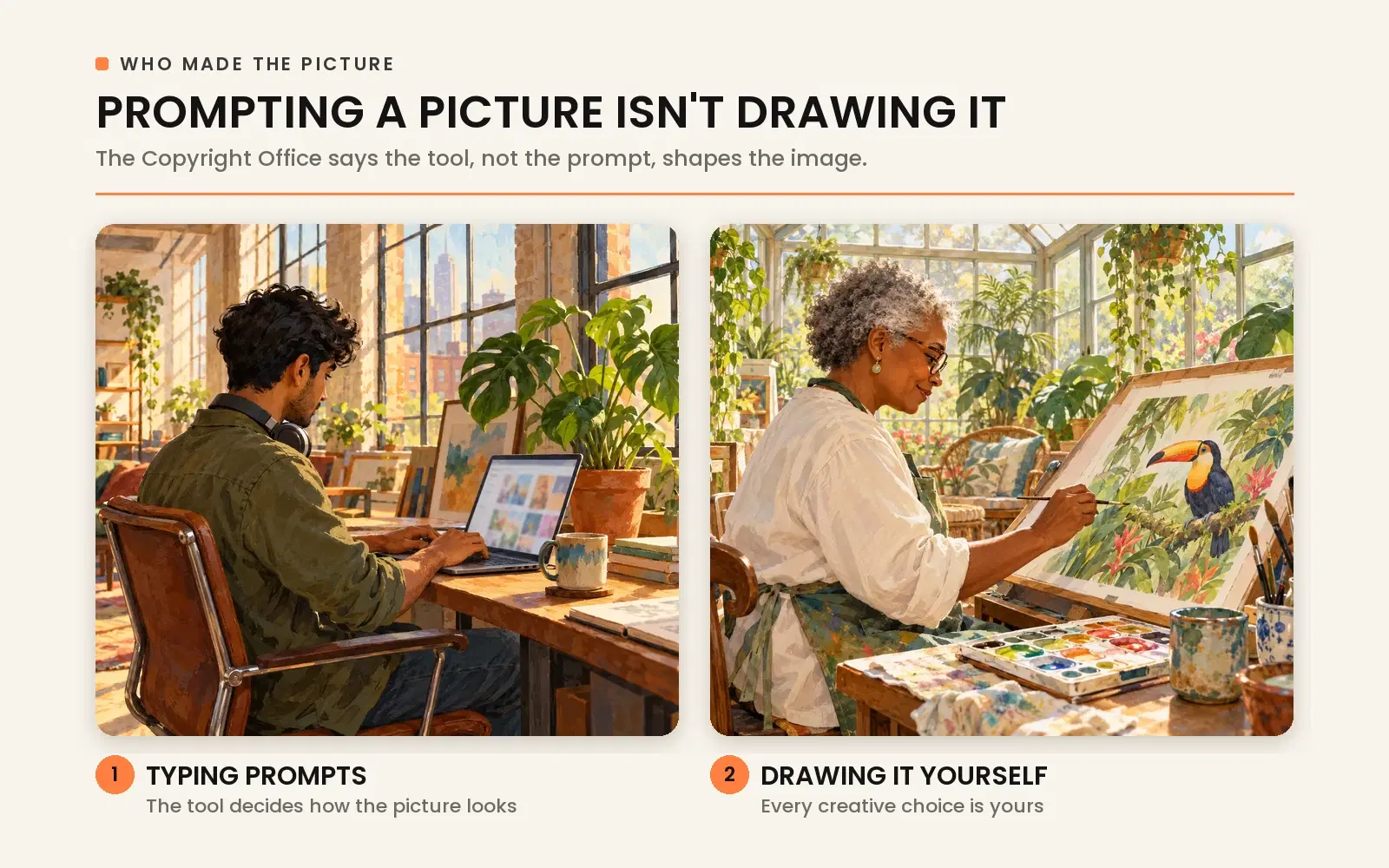
That's hard news if you've spent weeks on your prompts. Picture a retired teacher who tried 200 versions of a smiling turtle before she found the right one. Choosing that picture took real care. By the Office's reasoning, though, the turtle still isn't hers under copyright. So if you're asking whether you can copyright AI illustrations, the answer is no for the pictures themselves when a tool made them from prompts.
Is AI-Generated Art Public Domain?
In practice, purely AI-generated art works much like public domain material in the United States. The U.S. Copyright Office says purely AI-generated material isn't protected by copyright. Its glossary describes the public domain as works of authorship that copyright doesn't protect. The Office hasn't used the words "public domain" for AI output itself, but the practical effect is similar. That means a picture made purely by AI generally has no copyright owner at all.
For you, that has a practical side. Someone else could reuse the exact pictures from your book, and copyright wouldn't give you a way to stop them. Your own words and the way you put the pages together are a different matter, because a person made those. If a picture's look matters to your plans, it helps to know this before you build a book around it.
What You Can Own in a Book That Mixes AI and Human Work
In a children's book that mixes AI and human work, copyright can protect everything a person made. It just won't protect the AI pictures on their own. So the honest answer to whether AI children's books can be copyrighted is "partly," and the human parts are the ones that count. The U.S. Copyright Office says putting AI material inside a larger human-made work doesn't stop the human parts from being protected. Here's what a person can own in a picture book like that.
- The words you wrote yourself, from the first line to the last page.
- Pictures you drew or painted yourself, even if an AI tool later changed their colors, because your drawing still shows.
- Changes to an AI picture that are big enough to be your own creative work, though only those changes are protected.
- The selection and arrangement of your words and pictures, which means the way you chose them and put them in order.
Zarya of the Dawn shows how this works in a real book. The comic book mixed its author's own text with AI images across its 18 pages. The Copyright Office protected her text. It also protected the way she selected and arranged the words and images, but it didn't protect the images themselves. The Office's January 2025 report on copyrightability calls text plus AI images "a relatively common scenario" in the applications it sees. It adds that "multiple similar registrations" have been made since that first case. That kind of protection covers the book as a whole, not each AI picture on its own.
Art you made yourself keeps its protection even when an AI tool touches it. Imagine a grandmother who paints her own watercolors and uses an AI tool only to brighten the colors. Her paintings still show in the final pages, so her own art stays protected.
What a Copyright Application Asks About AI
You can still apply for copyright registration for a book that contains AI material. The U.S. Copyright Office asks you to say the AI material is there and to claim only the parts a person made. You also shouldn't list the AI tool, or the company behind it, as an author or co-author just because you used it. The Office's guidance calls this a "duty to disclose" AI-generated content, along with a brief note on what the human author added.
If you're unsure how to describe your book, a general statement that the work contains AI-generated material is enough to begin with. The Office says it'll contact you when it reviews the claim. In some cases, it says, using an AI tool won't raise any question about human authorship, and it'll tell you nothing needs to be left out. Getting this right matters. The Office warns that a registration which leaves AI-made material uncorrected in the public record risks losing its benefits. Copyright is only one legal piece of a book, and the other legal steps in publishing a children's book covers the rest, such as ISBNs and contracts.
What Does the KDP AI Disclosure Cover?
The KDP AI disclosure covers AI-generated text, images and translations, and in a children's book the images include your cover. Amazon KDP asks you to tell it about them when you publish a new book. It asks again when you edit and republish an existing one. KDP's guidelines say AI-generated images include "cover and interior images and artwork," so every AI picture in the book counts, from the front cover to the last page. Translations count too. If an AI tool translated your story into another language, KDP treats that translation as AI-generated.
That rule reaches further in a picture book than in a novel. A novel might have an AI cover and nothing else. A picture book usually has art on nearly every page. If an AI tool made the cover, one full-page illustration or a small drawing beside the text, that picture falls under the KDP AI disclosure.
KDP also puts the checking on you. Its content guidelines make you responsible for making sure all AI-generated and AI-assisted content follows KDP's rules. That includes other people's intellectual property rights. Telling KDP about AI doesn't hand that job over to Amazon.
The Difference Between AI-Generated and AI-Assisted
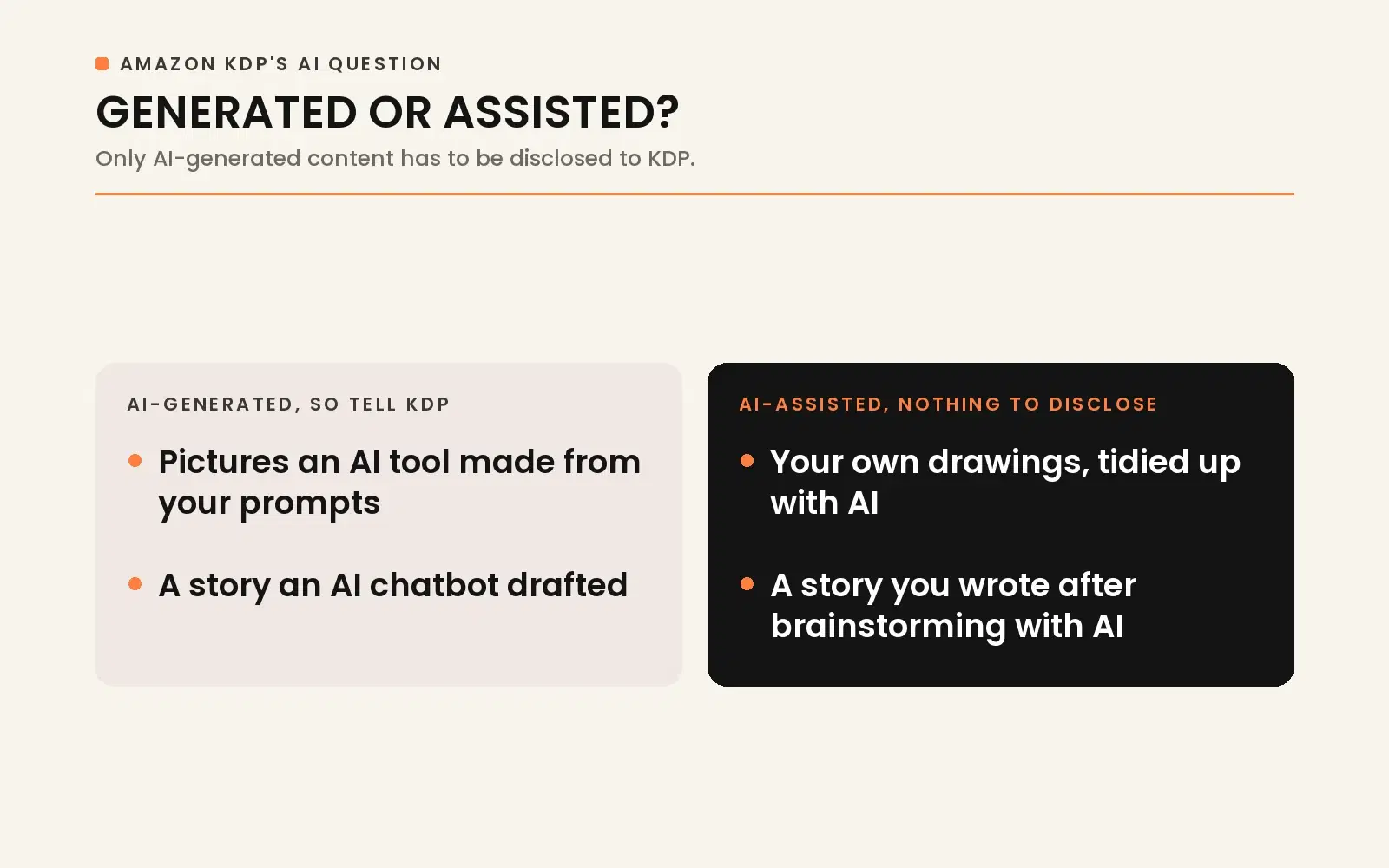
KDP draws the line between AI-generated and AI-assisted content by asking who made it. If an AI tool created the words or pictures, KDP calls them AI-generated, even after heavy editing, and you tell KDP. If you made them yourself and used AI only to edit, check or improve them, KDP calls that AI-assisted. The same goes if you used AI only to brainstorm ideas. KDP doesn't ask you to disclose AI-assisted work.
Here's how that works out in four common picture book situations.
- Pictures an AI tool made from your prompts, which you then touched up, are AI-generated, so you tell KDP.
- Your own hand-drawn pictures, cleaned up or recolored with an AI feature, are AI-assisted, so there's nothing to disclose.
- A story an AI chatbot drafted, which you then rewrote, is AI-generated, so you tell KDP.
- A story you wrote after using AI to brainstorm names and ideas is AI-assisted, so there's nothing to disclose.
A mom who sketched every page of her book in pencil might let an AI feature smooth the lines. Her book sits in the second group. The pictures started with her, so KDP treats the AI as a helper rather than the maker. If you can't tell which group your book belongs in, ask who created the actual words and pictures, you or the tool.
IngramSpark's AI Rules Are Stricter Than KDP's
IngramSpark sets stricter AI rules than Amazon KDP does. IngramSpark's content guidelines don't accept "works created solely using generative AI" at all. They do accept AI used only to assist, such as spell check and proofing. They also accept work where most of the writing or art came from people. Even work made with AI can be accepted when there's "significant and material human editorial review and contribution with proper attribution," which means a person has done real work on it.
In plain terms, a book made almost entirely with AI tools might be fine on KDP once it's disclosed. The same book could still be turned away by IngramSpark. That matters if you'd like to sell through IngramSpark as well as Amazon. IngramSpark's guidelines also say "proper attribution of creation must accompany all works," but they don't spell out what that attribution has to look like.
Picture a first-time author who made every page with AI and plans to sell on both platforms. KDP may take her book once she discloses the AI. IngramSpark may not accept the same files. Knowing that before the art is made saves her a hard choice later.
When AI Pictures Look Like Someone Else's Work
An AI picture can come out looking like an existing character or someone else's artwork. If it does, the person who publishes it carries the responsibility. Amazon KDP and IngramSpark both put that duty on the author. KDP makes you responsible for respecting intellectual property rights. IngramSpark says your content mustn't infringe copyright, trademark, privacy or publicity rights.
The bigger fight over how AI tools were trained is still going on. As of the U.S. Copyright Office's May 2025 report on AI training, dozens of lawsuits were pending in the United States, focused on fair use. Fair use is the part of copyright law that allows some uses of a protected work without permission, in certain situations. The Office also said it plans to cover who's liable for AI output that infringes copyright in a later part of its report.
None of that is a reason to panic, but it's a good reason to look closely at every picture. If an AI picture reminds you of a famous cartoon character, leave it out. Do the same if it looks very close to art you've seen in another book. Check each picture at full size, background included, because a logo or a familiar face can hide in the small details. A mother making a book about her son's favorite superhero, for example, would do well to keep that hero's look out of her pages entirely.
Can You Own an AI Character for a Series?
You generally can't own the look of a character that an AI tool drew for you. That's because pictures made by AI from prompts aren't protected by copyright. An AI tool's terms of use can even warn that its output "may not be unique" and that other users may get similar results. So another author could end up with a character that looks a lot like yours, and copyright wouldn't let you stop them.
That matters more for children's books than for most others. A series, plush toys, a coloring book or a classroom poster all depend on one character being yours alone. Picture an author with a shy hedgehog named Pip. She hopes to write three more books and sell a Pip toy one day. If an AI tool made Pip's look from prompts, that look isn't protected. The name Pip isn't covered either, because copyright doesn't protect names or titles. Her stories about Pip, and the way she writes his personality on the page, are her own writing, and those can be protected.
A series also needs a character to look the same in every book. An AI tool makes each picture new from a prompt, so the face and colors can shift from one picture to the next. None of those versions is protected, either. The copyright in a character an illustrator draws starts with the illustrator. It becomes yours when the rights are signed over to you in writing, or when the art is a properly agreed work made for hire. If you're still deciding how your character should look, choosing an illustration style for your children's book is a helpful place to start.
What AI Can and Can't Give You as an Author
AI can give you pictures quickly and let you try out ideas. What it can't give you is a copyright in those pictures or a character that's yours alone. Whether that trade suits you depends on what you want your book to do. Here's how the three usual ways of making the pictures compare.
| How the pictures are made | Tell KDP? | Copyright in the pictures | Can others copy the pictures? | IngramSpark |
|---|---|---|---|---|
| An AI tool makes them from your prompts | Yes, they're AI-generated | None in the pictures alone | Copyright won't stop them | Only with significant human work and proper attribution |
| You draw them and use AI to tidy up | No, they're AI-assisted | Yours, as the artist | Not without your permission | Within its AI rules |
| An illustrator draws them for you | No, there's no AI to disclose | The illustrator's, unless signed over to you in writing or made for hire | Not without the owner's permission | Within its AI rules |
Neither choice is wrong. Some authors are happy with AI pictures for a family keepsake that only their grandchildren will read. Others want a book they can protect, build a series on and sell through more than one platform. Knowing which kind of book you're making is the easiest way to choose. Wherever the art comes from, it's one stage of a longer journey. The guide to how children's book publishing works, from manuscript to print shows where it fits.
Questions to Ask Before AI Goes Into Your Book
Before AI goes into your children's book, a few plain questions will show you whether the trade suits you. Answer them honestly, and the right choice for your book usually gets much clearer.
- Do you want to register copyright in the pictures, or only in your words?
- Might this character carry a series, toys or other products one day?
- Will you sell only on Amazon KDP, or through IngramSpark as well?
- Can you answer KDP's AI question honestly for the cover and every page?
- Do the tool's terms of use let you use its pictures in a book you sell?
- Could any picture be mistaken for a famous character or someone else's art?
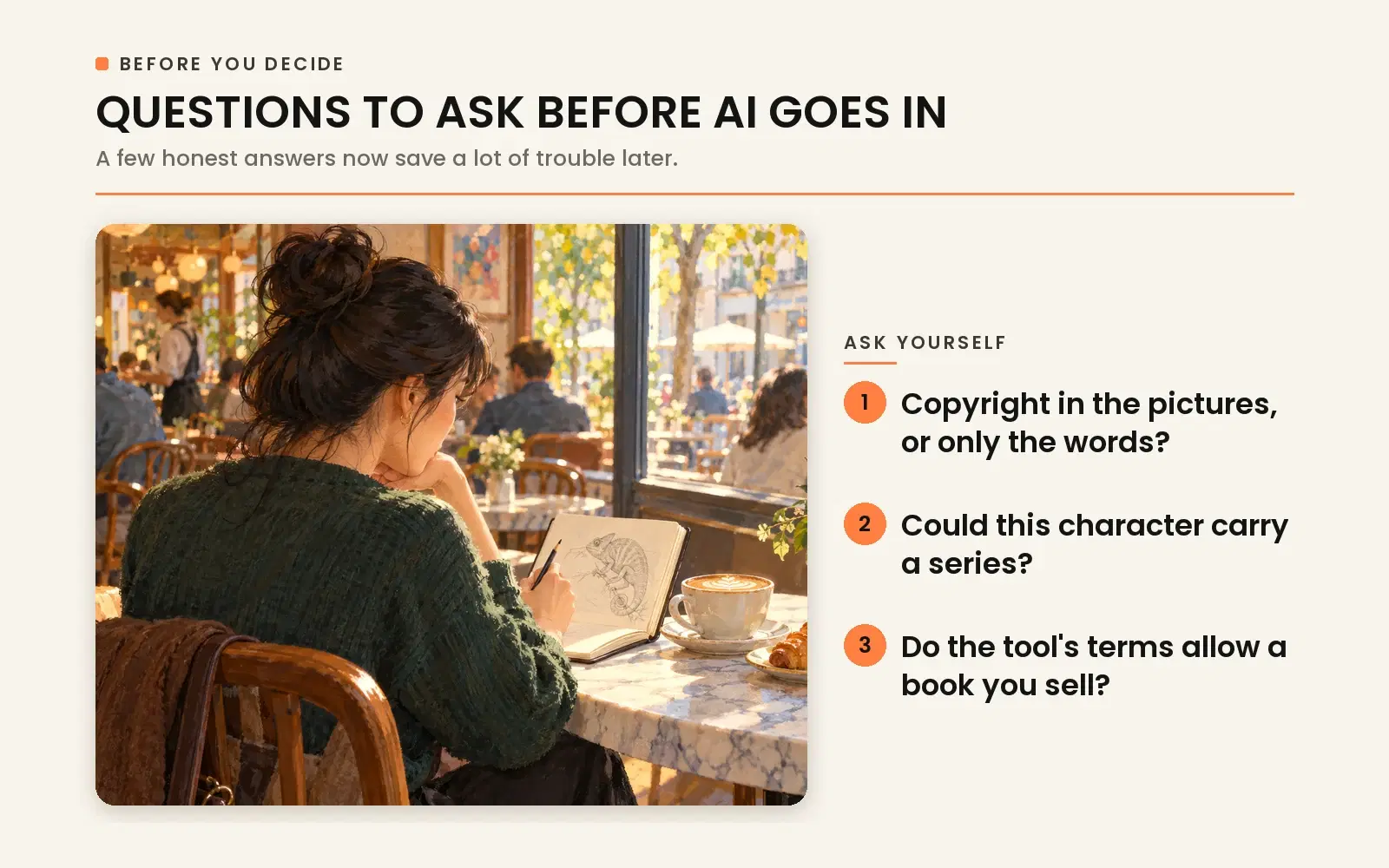
If most of your answers point toward owning and protecting the art, a human-made route fits better. If the book is a one-off gift, AI pictures may be all you need. Just remember to tell KDP about them if you publish there.
How Book Writing US Handles the Art in Your Book
Book Writing US helps authors turn a finished manuscript into a finished book. That covers editing, illustration, page design, the cover, printing and publishing. Its children book publishing services work on picture books, early readers and educational books.
If you already have art, Book Writing US can work with it. If you don't, the pictures can be drawn through its children's book illustration services. Whoever helps you, keep the final say on your book and get the ownership of the art agreed in writing.
Frequently Asked Questions
Can AI be listed as an author or co-author of my children's book?
No, not on a U.S. copyright registration. The U.S. Copyright Office says applicants shouldn't list an AI tool, or the company that provided it, as an author or co-author. Using a tool to make the work doesn't change that. You're the author of the parts you created yourself. The application asks you to point out any AI-generated material so it's left out of your claim. This is general information about copyright registration, not advice on your own application.
Can I legally create a children's book using illustrations from ChatGPT?
Generally yes, as far as the tool's own rules go. ChatGPT's terms of use say that, as between you and the company, you own the output. The company also hands over its own rights in the output "if any," which means it can only pass on rights it actually has. The same terms say you mustn't present the output as human-made when it wasn't. The pictures still aren't protected by copyright when ChatGPT made them from your prompts, and Amazon KDP asks you to disclose them as AI-generated. The same goes if you'd like to publish a children's book written by ChatGPT. Only the words you wrote yourself would be protected. This is general information, not legal advice.
Do I have to tell readers my children's book used AI?
Amazon KDP asks you to tell KDP, not your readers. The AI section of its content guidelines doesn't ask you to add a note for readers. IngramSpark's content guidelines go a step further, saying "proper attribution of creation must accompany all works" in its AI rules. Those guidelines don't spell out what that attribution has to look like. If you plan to sell through IngramSpark, read that line closely before your files are finished.
Can Amazon tell if a children's book was made with AI?
Amazon KDP's content guidelines don't explain how, or whether, Amazon checks books for AI. What the guidelines do say is that you must tell KDP about AI-generated text, images and translations. They also make you responsible for what you publish. So the simplest path is to answer KDP's AI question honestly for every book and every new version. Think of a grandfather who republishes his book with a new AI picture on the cover. He answers the question again, because KDP asks when you edit and republish too.
If I change an AI picture a lot, does it become mine?
Only your changes can become yours, and only when they're big enough to count as original creative work of your own. In the Zarya of the Dawn decision, the Copyright Office found some edits to a character's mouth "too minor and imperceptible" to be protected. Bigger creative changes can be protected, but the AI-made parts underneath still aren't. Amazon KDP also still counts the picture as AI-generated after substantial edits. That means you'd still tell KDP about it.
Is it okay to use AI to help write a children's book?
Yes, using AI to help with your own writing doesn't take away copyright in what you wrote. KDP doesn't ask you to disclose it, either. The U.S. Copyright Office says AI tools that assist rather than stand in for human creativity don't affect copyright protection. KDP calls this AI-assisted, which covers using AI to edit, check or brainstorm while you write the words yourself. The line is crossed when the tool writes the actual text, because KDP then counts it as AI-generated.
- Is It Legal to Sell AI Children's Books on Amazon?
- Can I Publish a Children's Book Written by AI?
- Who Owns AI-Generated Art?
- What You Can Own in a Book That Mixes AI and Human Work
- What Does the KDP AI Disclosure Cover?
- IngramSpark's AI Rules Are Stricter Than KDP's
- When AI Pictures Look Like Someone Else's Work
- Can You Own an AI Character for a Series?
- What AI Can and Can't Give You as an Author
- Questions to Ask Before AI Goes Into Your Book
- How Book Writing US Handles the Art in Your Book
- Frequently Asked Questions