What Legal Steps Does Publishing a Children's Book Involve?
Short Answer: Publishing a children's book legally comes down to a short list of steps, and most of them are paperwork rather than hurdles. You own the copyright the moment you write your story, and there's no publishing license you have to get first. The steps that need care are a signed agreement for the art, permission for anyone else's material and the ISBN. The others are an optional Library of Congress number, the safety rules for your book's format, and copies sent after release.
Maybe someone told you that publishing has a legal side, and the word "legal" made your stomach drop a little. That's a very normal feeling. It's especially common if you're a first-time author, a parent or a grandparent who simply wants a story in a child's hands. The good news is that the legal side of a children's book is short, and it happens in a sensible order.
This guide walks through each legal step, whether it's required, who usually handles it and when it happens. If you've wondered how to legally publish a book, most of the answer is ordinary paperwork done at the right moment. It's plain general information, not legal advice, so for your own situation a lawyer is the right person to ask.
The Legal Steps, in the Order Your Book Meets Them
The legal steps for self-publishing a children's book follow the order the book is made. They cover copyright, the illustrator agreement, permissions, safety rules, your imprint and the ISBN. After those come an optional Library of Congress number and mandatory deposit, which means sending copies once the book is out. Agreements about the art come before any drawing, permissions come before the pages are laid out, and the ISBN comes before you upload the book.
The order matters because a few steps close for good. A preassigned Library of Congress Control Number can't be given to a book that's already published. Rights to the art are also much easier to settle before the drawing starts than after it's done.
When you self-publish, requirements such as the ISBN and the art agreement are yours to arrange. The table below lists each one in the order you'll meet it, with whether it's required, who handles it and when it happens.
| Step | Is it required? | Who handles it | When it happens |
|---|---|---|---|
| Copyright | Automatic, and registering is optional | You, plus the U.S. Copyright Office if you register | From the moment you write, and you can register any time |
| Illustrator agreement | Needed if you want to own the art | You and your illustrator, in a signed writing | Before the first sketch |
| Permissions | Needed for other people's words, songs, art or characters, unless fair use applies | You and the rights owner | Before the page layout |
| Safety rules | Apply to children's products, and testing depends on the format | The book's manufacturer or importer | When you choose the format, before printing |
| Imprint and business name | Your choice, though a business name may need registering locally | You | Before you buy an ISBN |
| ISBN | Needed for print copies sold through stores | Bowker, or a platform's free ISBN | Before you upload the book |
| Library of Congress Control Number | Optional | The Library of Congress | Before publication only |
| Mandatory deposit | Required for books published in the U.S. | The copyright owner or publisher | After publication |
These legal steps sit inside the wider job of making the book, next to the editing, the art, the design and the printing. To see where they fit, follow the full publishing journey from manuscript to printed book stage by stage. The sections below stay with the legal side. Each one explains what a step asks of you and why.
Do Children's Books Have Their Own Copyright Laws?
No, there are no separate children's book copyright laws in the United States. A picture book is covered by the same copyright law as every other book. Your words are protected from the moment they're written down, and your pictures are protected from the moment they're drawn. When different people make the words and the pictures, each person generally owns what they made, unless they've agreed otherwise in writing or created the book together as joint authors.
That means the children's book copyright requirements are the same ones every author meets. There's nothing extra to file just because your reader is young. Registering with the U.S. Copyright Office is optional, but for a U.S. book you'll need a copyright registration before you can sue anyone for copying it.
Timing matters more than most people think. Registering before anyone copies your book, or within a short window after it's published, keeps more options open in court. You can still register at any time while the copyright lasts.
One old myth is worth clearing up. Mailing yourself a sealed copy of your manuscript, sometimes called a "poor man's copyright," doesn't register anything. The U.S. Copyright Office says the law has no provision for it and that it's no substitute for registration.
Copyright works the same way for young authors. The Copyright Office says a minor can claim copyright, so a story your child writes belongs to your child. The guide to publishing a book your child wrote covers the practical side. AI pictures or text raise a different question, answered in who owns AI pictures and text in a children's book.
A Copyright Notice Is Optional, but It Still Helps
A copyright notice isn't required on books published today, but the U.S. Copyright Office says it can still bring practical and legal benefits. The notice tells readers who owns the book. It also shows anyone who wants to ask permission exactly who to contact. For a published book, a notice can even make it harder for someone who copies it to claim they didn't know it was protected.
A standard copyright notice has three parts, and it usually sits on the copyright page near the front of the book.
- The © symbol or the word "Copyright."
- The year the book was first published.
- The name of the copyright owner, or a name the owner is generally known by.
A copyright notice isn't a substitute for registration, though. The notice tells people who owns the book, while a registration certificate creates a public record of who wrote it and who owns it.
Titles and Character Names Aren't Covered by Copyright
Copyright doesn't protect titles, names or short phrases, and that includes the name of a character. So two picture books can share a title, and nobody owns a character's name through copyright alone. What copyright protects is your story and your pictures, meaning the way you told the tale and the way it was drawn.
Say you've named your picture book after your granddaughter's nickname. Then you find another book online with the very same title. Copyright doesn't stop either book from existing. Some names and titles can be protected as a trademark, which is a separate system, and the U.S. Patent and Trademark Office is the place to ask about it. That question usually comes up with a series name an author plans to build on for years.
For a single book, the practical tip is simple. Pick a title you love that doesn't copy a famous one. That way, a parent searching for your book never lands on somebody else's by mistake.
The Illustrator Agreement Decides Who Owns the Art
Paying an illustrator doesn't make you the owner of the pictures in your picture book. Copyright in art belongs at first to the illustrator who created it. It stays with them until a signed, written agreement says otherwise. That's why the illustrator agreement is the most important legal paper in most picture books.
Picture a retired teacher who pays a freelance artist in full, gets every file by email and never signs anything. The copyright in that art still belongs to the artist. It gets awkward the day the teacher wants a second edition, a matching sequel or a tote bag with the main character on it.
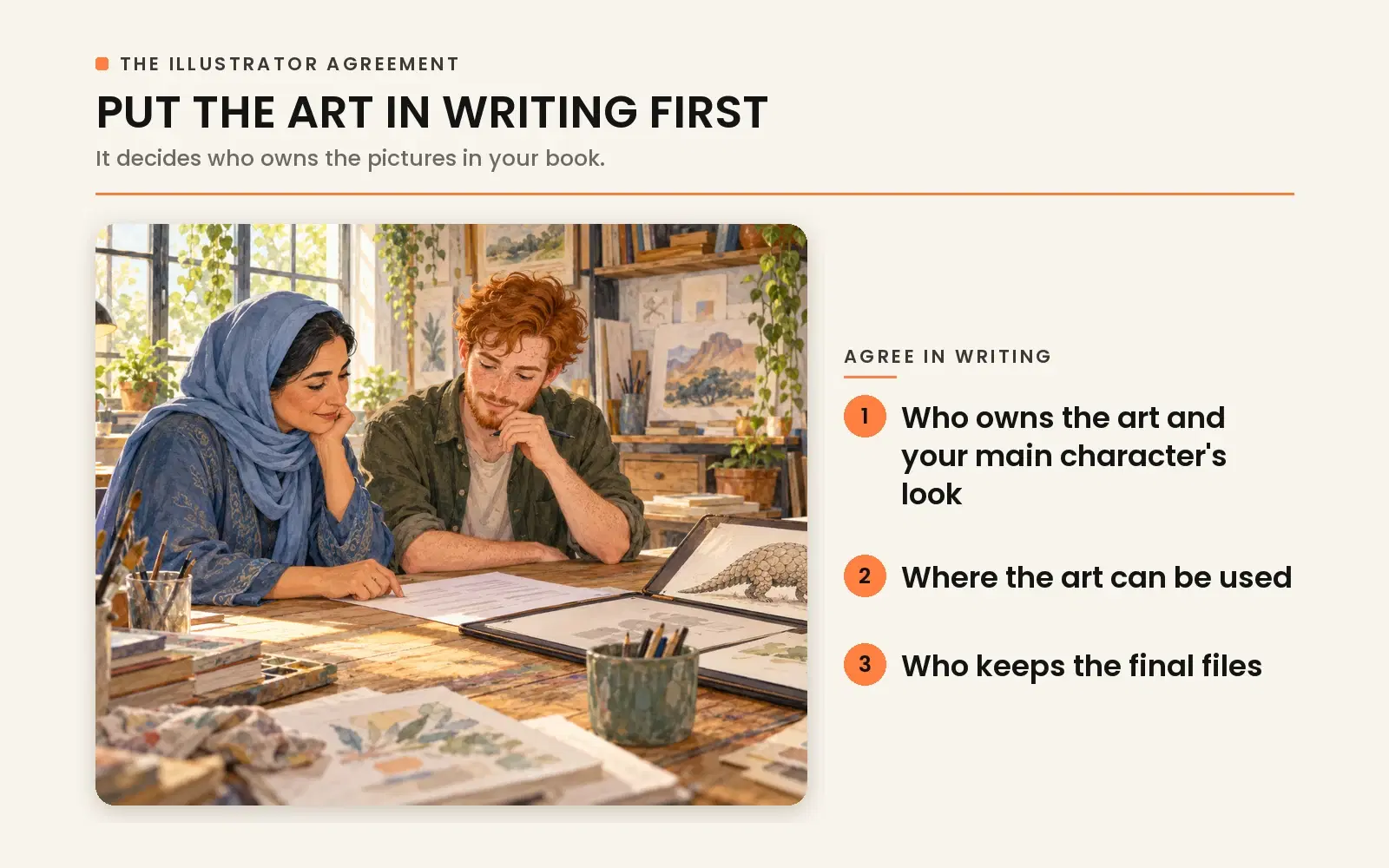
Whether you hire a freelancer or use children's book illustration services, the agreement should settle a few plain points before the first sketch.
- Who owns the copyright in the art, including the look of your main character.
- Where the art can be used, such as inside the book, on the cover, in later editions and in marketing.
- Who keeps the final files once the work is finished.
Ownership of the art can reach you in two ways. One is a work made for hire, and the other is a written transfer.
What Does Work Made for Hire Mean for a Picture Book?
In a picture book, a work made for hire is art whose legal author and copyright owner is the person who paid for it. The artist who made it isn't the owner. For a freelance illustrator, picture book art only becomes a work made for hire under strict conditions, which the U.S. Copyright Office's circular on works made for hire sets out. For art you pay a freelancer to make, all four of these have to be true.
- The art falls into one of the categories of work the law lists.
- There's a written agreement between you and the illustrator.
- The agreement says, in so many words, that the art is a work made for hire.
- Everyone involved signs it.
If any one of these is missing, the art isn't a work made for hire. One of the listed categories is a "supplementary work," and the law's description of it includes pictorial illustrations made to go with another author's work. Whether your book's art fits that category is something you and your illustrator have to work out, with a lawyer if you need one. The Copyright Office says plainly that it can't give legal advice about the status of a work.
When work made for hire doesn't fit, you still have a second route. Your illustrator can transfer the copyright to you in a written agreement that they sign. That transfer does the job on its own.
What Any Publishing Agreement Should Put in Writing
Any agreement with a publisher or a publishing company should put the key terms in writing. It should say which rights you're granting and for how long, who owns the finished files, and whose ISBN and imprint go on the book. An exclusive grant of rights generally has to be in a signed writing, so a friendly chat on the phone doesn't settle it.
The ISBN and imprint line matters more than it looks. An imprint is the publisher name linked to a book's ISBN, so whose ISBN is used decides which publisher name appears on your book. If you plan to publish more books under your own name one day, you'll want that settled before you sign anything.
It's also worth confirming who keeps the final print files and what you'll be handed when the work is done. Before you sign with anyone, read how to hire your first book writing company for the checks worth making. The guide to what a children's book publisher does, and what you keep explains which rights normally stay with you.
Do You Need Permission to Publish a Book?
You don't need anyone's permission to publish your own story and your own pictures. You do usually need permission to use someone else's copyrighted material inside your book. The U.S. Copyright Office's general rule is to ask the copyright owner first.
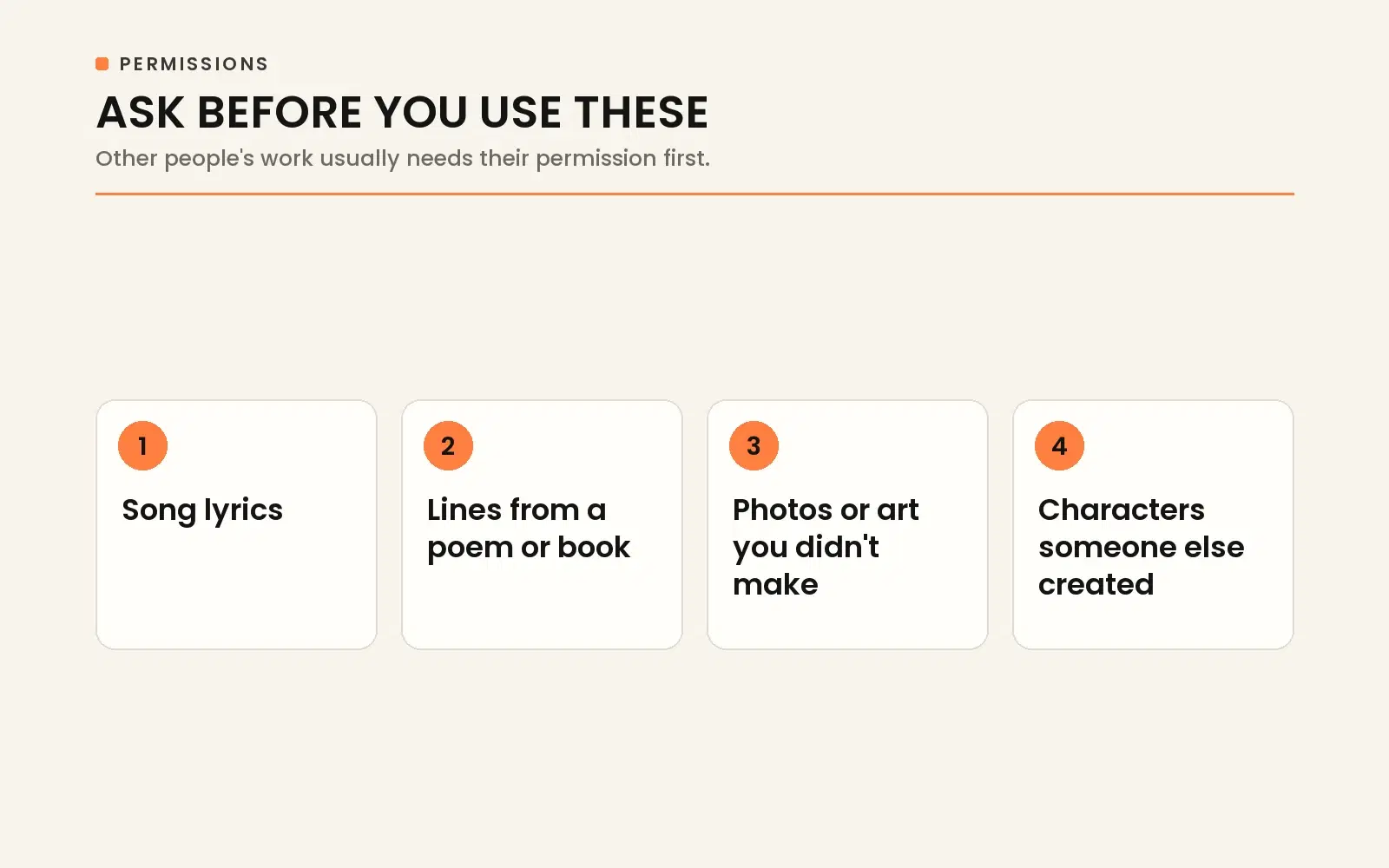
In a children's book, the material that needs permission is easy to spot once you know what to look for.
- Song lyrics, including a well-known chorus.
- Lines from a poem or from another book.
- Photos or art that you didn't make yourself.
- Characters that someone else created.
A question many authors ask is, "Do I need permission to use a quote in my book?" The honest answer is that it depends. There's no legal rule that makes a set number of words safe to use. Fair use is a legal rule that allows some uses of protected work without permission. Whether a short quote counts as fair use depends on all the circumstances. When in doubt, the Copyright Office recommends getting permission.
Imagine a bedtime book that ends with the chorus of a well-known pop song on its last spread. If the song's owner says no after the pages are laid out, that spread has to be redesigned from scratch. So ask before the layout starts, and keep your own rhyme ready as a backup.
Real People and Famous Characters Need Extra Care
A famous cartoon character belongs to its copyright owner, which is often a studio or publisher, so putting that character in your children's book usually needs the owner's permission. Only the copyright owner can make a new version of their work, or allow someone else to make one.
Real people raise a different kind of question. A real person's name isn't a copyright matter, but their privacy still counts. So does their right to control how their name is used for publicity. Amazon KDP's content guidelines make authors and publishers responsible for staying within the law. That includes other people's copyright, trademark, privacy and publicity rights. The U.S. Supreme Court has said a newspaper publisher has no special privilege to invade other people's rights and must answer for libel. So a children's book should never present something untrue about a real person as fact.
Say your picture book stars a grumpy neighbor who shares a real neighbor's name and street. It may be all in fun, but that neighbor might not see it that way. The easy fix is to invent your own characters, or to ask the real person first and keep their yes in writing.
Do Children's Books Have to Meet Safety Rules?
Children's books are covered by the Consumer Product Safety Commission's rules for children's products, though an ordinary book is exempt from lead content testing. The commission, usually called CPSC, gives a simple description of an ordinary book. It's printed on paper or cardboard, with inks or toners, and it's bound and finished in a conventional way.
The law behind these rules is the Consumer Product Safety Improvement Act, known as the CPSIA. It sets lead limits for children's products and generally requires testing by an accepted laboratory, unless an exception applies. It also calls for a Children's Product Certificate, which is a written statement that a children's product meets the safety rules that apply to it.
CPSC says the manufacturer or importer is responsible for issuing the Children's Product Certificate. When a book relies on the ordinary-book exemption, that certificate has to say so. If your book is printed abroad, the importer is the one responsible. Your practical step is a short conversation. Ask your printer, or whoever imports the books, how the certificate is handled for your book.
Why Board Books and Books With Extras Are Treated Differently
A board book for babies, or a picture book sold with a toy, can need lead testing because the ordinary-book exemption leaves it out. CPSC says the exemption doesn't include books designed or intended for children 3 years of age or younger. It also leaves out books with inherent play value, meaning books made to be played with as well as read. Any toy or other item sold or packaged with the book is left out too.
The age limit surprises a lot of authors. A board book is usually printed on thick cardboard, which sounds like an ordinary book. Yet it falls outside the exemption because of who it's made for. Say you're making a sturdy board book for your baby niece, with a little plush toy tucked into the box. Both the age and the toy take that book outside the exemption.
That's why the format is worth settling early. A board book, a bath book or a book with extras changes the safety step. Raise it with your printer before the art is finished, not after.
Do You Need a License to Publish a Book?
The United States has no federal licensing system for book publishers, so you don't need a license to publish a book. State and local governments also can't require authors or publishers to get a license for publishing that isn't commercial.
Selling is where ordinary business rules come in. If you sell your book as a business, your state or local government can treat you like any other business. That can mean a local business license and taxes. Picture a grandmother selling signed copies at her church fair every spring. Before she sets up her table, a quick look at her local government's business page tells her what applies. Whether to form a business, such as an LLC, is a separate decision that deserves its own research.
Your Imprint Is the Publisher Name Readers See
An imprint is the name of the publisher linked to your book's ISBN. If you buy your own ISBN, Amazon KDP lets you list your own imprint, such as a business or brand name. A free platform ISBN comes with the platform's own publisher wording instead.
Choosing your own imprint brings two small legal checks. First, Amazon KDP checks that your imprint matches the name on file with the ISBN agency, such as Bowker. If the two don't match, KDP won't publish the book. Second, your imprint might be a business name rather than your own name. In that case you may need to register it as a "doing business as" name, often shortened to DBA. The U.S. Small Business Administration says most states require you to register a DBA if you use one, and the rules vary by state, county and city.
Your imprint details also matter for a Library of Congress Control Number, which needs a U.S. city printed in the book as the place of publication. So choose your imprint name, and where it's based, before you buy ISBNs. The steps after that will line up.
Your ISBN, Copyright and Library of Congress Number Are Separate Things
An ISBN, a copyright and a Library of Congress Control Number are three separate things with three different jobs. None of them creates or replaces another.
- An ISBN identifies one format of your book, so stores, libraries and readers can find the right edition.
- A Library of Congress Control Number links your book to a library catalog record.
- Copyright is ownership of your words and pictures, and it exists with or without the other two.
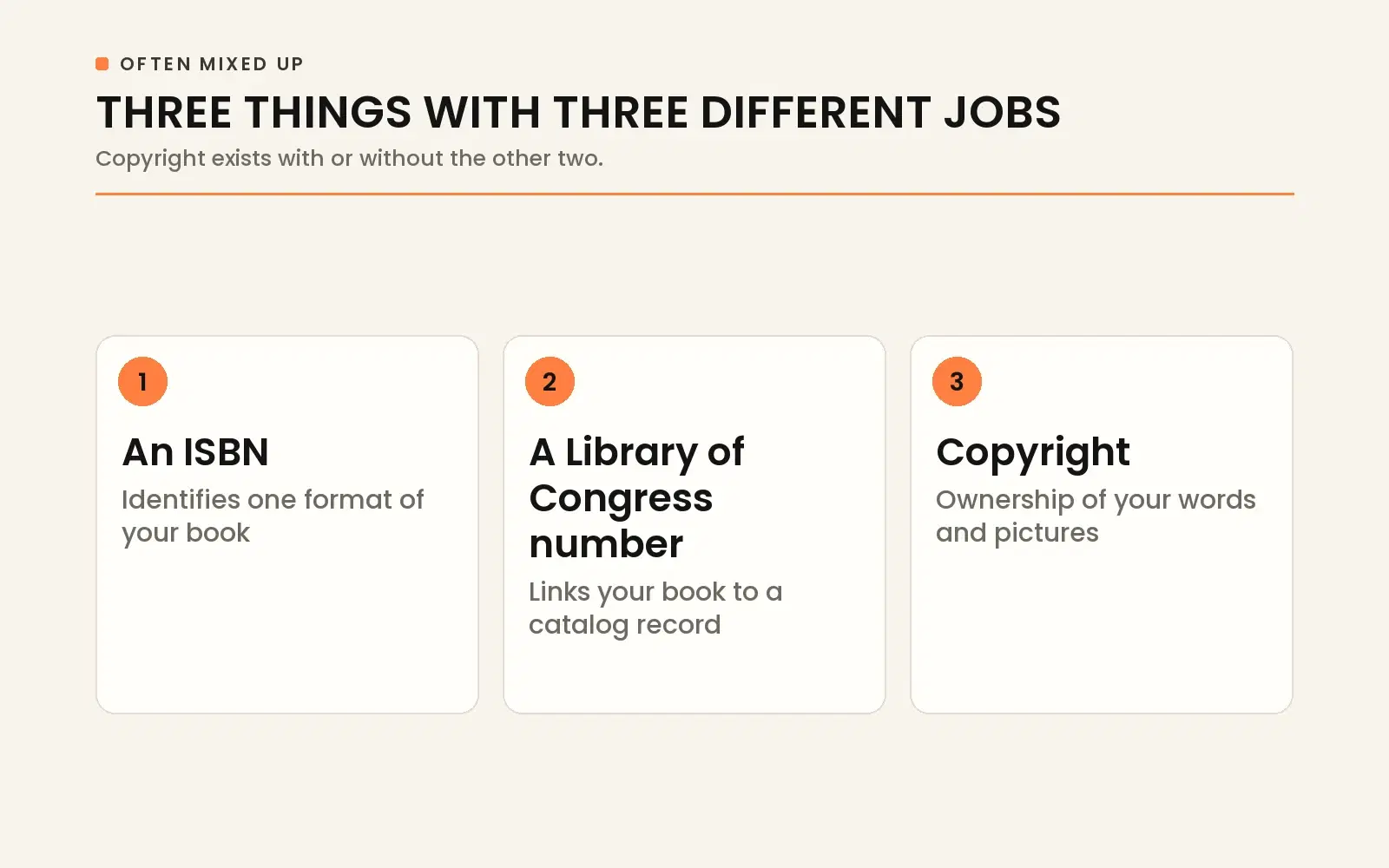
The Library of Congress says plainly that there's no relationship between its control number program and copyright registration. It also says ISBNs are in no way related to its control numbers. So getting an ISBN never gets you a control number, or the other way around.
An ISBN Identifies Your Book but Doesn't Protect It
An ISBN is not the same as copyright, and having one doesn't protect your book. An ISBN is an identifier that helps bookstores, libraries, distributors and readers find the right edition. Protection comes from copyright, which your book has whether it carries an ISBN or not.
Each print format needs its own ISBN, so the paperback and the hardcover of one picture book get different numbers. In the United States, ISBNs come from Bowker, the U.S. ISBN agency. Some platforms offer a free one of their own. The need for an ISBN comes from the way books are sold. IngramSpark says you need one to sell your book in bookstores or through an online retailer. Amazon KDP makes it optional only for ebooks and low-content books. The practical tip is to plan one ISBN for each format you'll really publish.
Which Children's Books Can Get a Library of Congress Number?
Many printed children's books can get a Library of Congress Control Number through the Library's Preassigned Control Number program. That includes short picture books, because the program makes an exception to its length rule for children's literature.
Some books can't take part, and a few of them are common in children's publishing.
- Books that are already published.
- Books published only as ebooks.
- Textbooks below the college level.
- Workbooks and other learning materials meant to be used up.
- Books that don't list a U.S. city as the place of publication.
So a short rhyming picture book can usually qualify, while a sticker activity book meant to be used up generally can't. The number is optional and it only works before publication. That makes it worth deciding early. The Library also asks for a copy of the finished book once it's out.
Mandatory Deposit Means Sending Copies After Publication
Books published in the United States are subject to mandatory deposit. That means sending copies to the U.S. Copyright Office for the Library of Congress after publication. The rule applies to the copyright owner or whoever holds the right to publish, even if the copyright was never registered.
Mandatory deposit isn't a condition of copyright protection, so your copyright doesn't depend on it. The Copyright Office can, however, demand the copies at any time after the book is published in the United States. If you register your copyright, the copies you send with your registration can meet the rule. Books published only online are exempt unless the Copyright Office asks for them.
A Library of Congress Control Number comes with its own separate copy, which doesn't count toward mandatory deposit. The easiest way to stay on top of both is to set these copies aside from your first order of author copies.
Where the Legal Steps Meet the Publishing Work
Most legal steps lean on the making of the book. The art agreement comes before the sketches, and permissions come before the layout. The copyright page details come before the proof, and the format comes before the safety step. When those line up with the production work, the legal side of your book stays small and calm. If your story is still being written, the beginner's guide for first-time authors is a friendly place to start.
If you'd rather have help with the making of your book, Book Writing US helps authors turn a finished manuscript into a finished children's book. That covers editing, illustration, page design and the cover, printing and publishing. We work on picture books, early readers and educational books. We can work with art you already have, or have the pictures drawn through our illustration service. If you're looking for children's book publishers for your story, we'd be glad to hear where your book is today.
Frequently Asked Questions
Is self-publishing legal?
Yes, self-publishing is legal in the United States, and it simply means you act as your own publisher. There's no federal license for book publishers. Amazon KDP openly invites authors to be their own publisher while keeping ownership of their content. If you self-publish, the legal steps for a children's book are the ones in this guide, from clearing the art rights and permissions to choosing an ISBN.
Do I need a lawyer to publish a book?
You can publish a book without a lawyer, and the U.S. Copyright Office lets the author file a copyright registration directly. A lawyer is worth it when something feels unclear. That might be a contract you don't understand, a work made for hire question or a story about real people. The Copyright Office can explain its rules, but it can't give legal advice about your own work. Everything in this guide is plain general information too, so for your own situation a lawyer is the right person to ask.
Can you copyright a book idea?
No, copyright doesn't protect an idea on its own. It protects the way you express the idea, meaning the words you write and the pictures you draw. So two authors can both write about a shy dragon who learns to share. Each one owns only their own telling of that story.
Can you publish a book under a pen name?
Yes, you can publish a book under a pen name, which is simply a name you choose to write under instead of your legal name. Names, including pen names, aren't covered by copyright, so there's nothing to register for the name itself. A copyright notice can use a name the owner is generally known by, so a pen name you're known by can go on your copyright page.
Can you be sued for writing a book?
It can happen, but mostly in a few specific ways that a careful children's book avoids. One is using someone else's copyrighted words, pictures or characters without permission. Another is a libel claim, which is why a story should never present something untrue about a real person as fact. A third is breaking a real person's privacy or publicity rights, which Amazon KDP makes authors responsible for. Writing your own story with characters you invent avoids most of these risks, and a lawyer can help if a question comes up about your own book.
Can you use a public domain fairy tale in a children's book?
Yes, a fairy tale in the public domain, meaning it's no longer protected by copyright, is free for anyone to retell. Your new words and pictures are protected, but the old tale stays free for everyone else too. A recent retelling or film version can still be someone else's copyright, so work from the old tale itself. Amazon KDP accepts public domain content. It won't accept a copy that adds nothing new when a free version is already in its store.
- The Legal Steps, in the Order Your Book Meets Them
- Do Children's Books Have Their Own Copyright Laws?
- The Illustrator Agreement Decides Who Owns the Art
- What Any Publishing Agreement Should Put in Writing
- Do You Need Permission to Publish a Book?
- Do Children's Books Have to Meet Safety Rules?
- Do You Need a License to Publish a Book?
- Your ISBN, Copyright and Library of Congress Number Are Separate Things
- Where the Legal Steps Meet the Publishing Work
- Frequently Asked Questions