Why So Many People Are Writing Children's Books
Short Answer: Why do so many people write children's books? They look short and easy, they're deeply personal, and anyone can publish one now. AI tools made the pictures quicker to make, and celebrities make it look like everyone's doing it. The shelf is crowded, but crowded isn't closed, and a book made for a real child still stands out.
Got a children's book idea you can't stop thinking about? You're in good company. Walk past any bookstore display or scroll any online store, and it can feel like everyone you know is writing one.
That's exciting and a little scary at the same time. If so many people are doing it, is the children's book market saturated? Is there any room left for yours?
Here's the honest picture, with no hype. First, the real reasons so many people write children's books. Then whether the market is actually too crowded, and what still makes a book stand out.
Children's Books Look Short, So They Look Easy
A children's book looks easy because it's short. You can read a picture book to a child before the kettle boils, so it feels like you could write one over a weekend.
The words look simple, too, so the writing looks simple. And you probably grew up with these books, which makes them feel familiar rather than tricky. It's a bit like a song that sounds easy until you pick up the guitar.
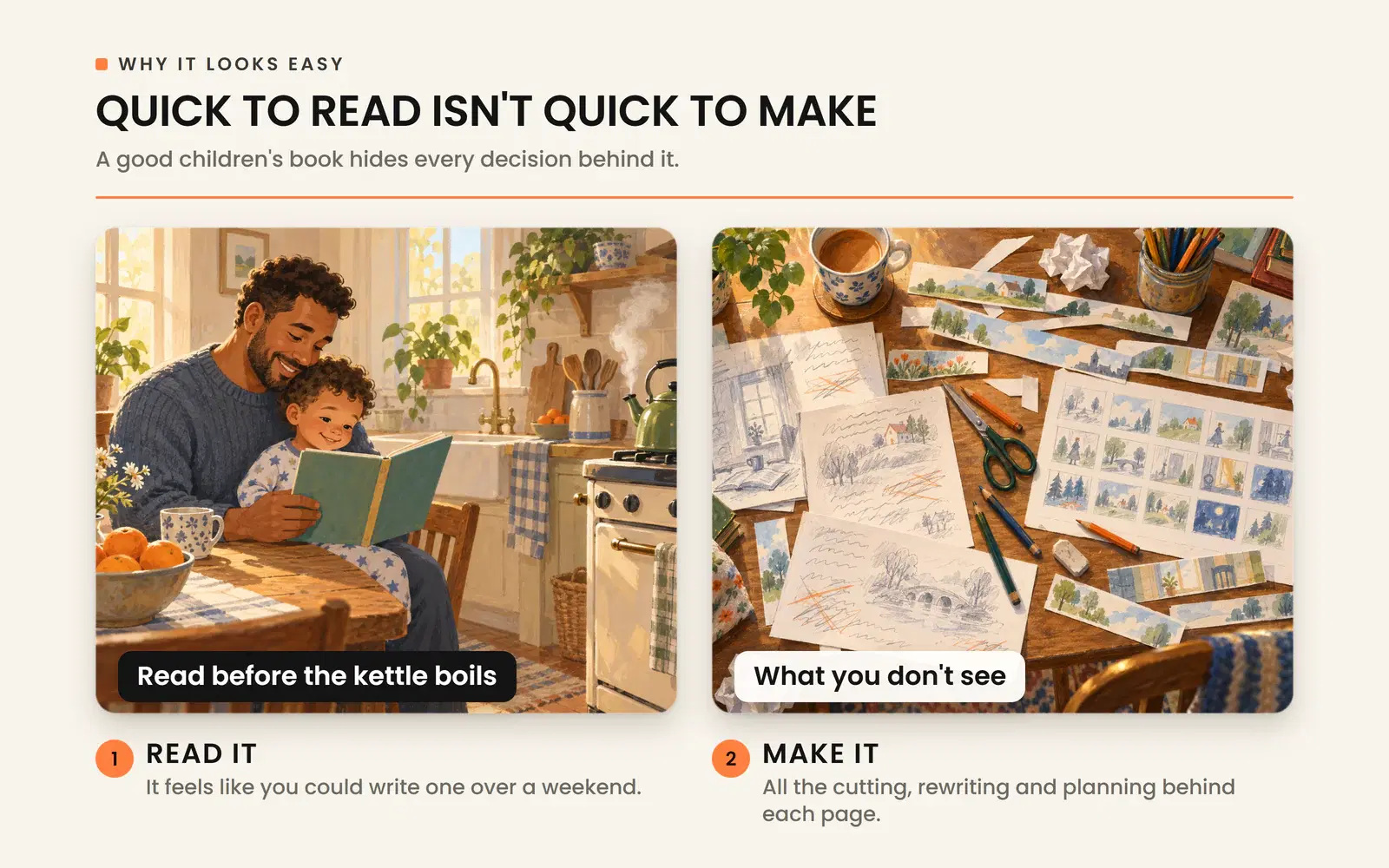
What you don't see is the work. A good children's book hides every decision behind it, all the cutting, rewriting and planning that went into each page. You only ever see the finished book, so it's natural to judge the job by how long it takes to read.
That belief is a big reason the shelf is so full. A book that looks quick draws in people who'd never try a novel, and they start with confidence instead of caution. Honestly, that's a lovely thing. It just means your book arrives at the same shelf as a lot of others.
Writing for a Child You Love
For a lot of people, writing a children's book is personal. It's for a grandchild, a son or daughter, a classroom full of kids, or the child you used to be.
Maybe you've told the same bedtime story so many times it's practically written already. Maybe a child in your life is facing something new, like a baby brother, a first day at school or a move to a new town. You went looking for the right book to hand them, couldn't find it, and decided to write it yourself.
That's one of the best reasons there is. We hear it from parents, grandparents, teachers and nurses, and the love behind these books is real. A novel asks you to go looking for a story. A children's book often arrives with its story already attached to someone you care about.
That's also why so many people start one, even people who never planned to write a thing. The reason comes first, and the book follows.
Keep one thing in mind as you write. A book made for one child also has to work for children who've never met you. A story full of family names and inside jokes can be precious at home and puzzling to everyone else. The personal books that travel furthest manage both, so they mean something at home and on a stranger's bookshelf.
AI Tools Made Children's Books Faster to Make
AI tools made it much faster to put a children's book together, and that's one of the newest reasons there are so many of them.
For a long time, the pictures were the hard part. Self-publishing and print on demand had already opened the door, so you didn't need a publisher's yes to hold a printed copy of your own book. But you still had to draw, or pay someone who could, and that kept a lot of ideas in a drawer. In a picture book the art tells as much of the story as the words do, so without it you don't have a book at all.
Now a tool can turn out pictures and text almost instantly. The gap between having an idea and having a file that looks like a book got much smaller, and the shelf got longer, fast.
What a tool can't do is make the choices that bring a child back to a book. Somebody still has to decide where each page turn lands. Somebody has to keep your main character looking like the same kid from cover to cover. Somebody has to match the words to your reader's age. And only you know the child the book is really for.
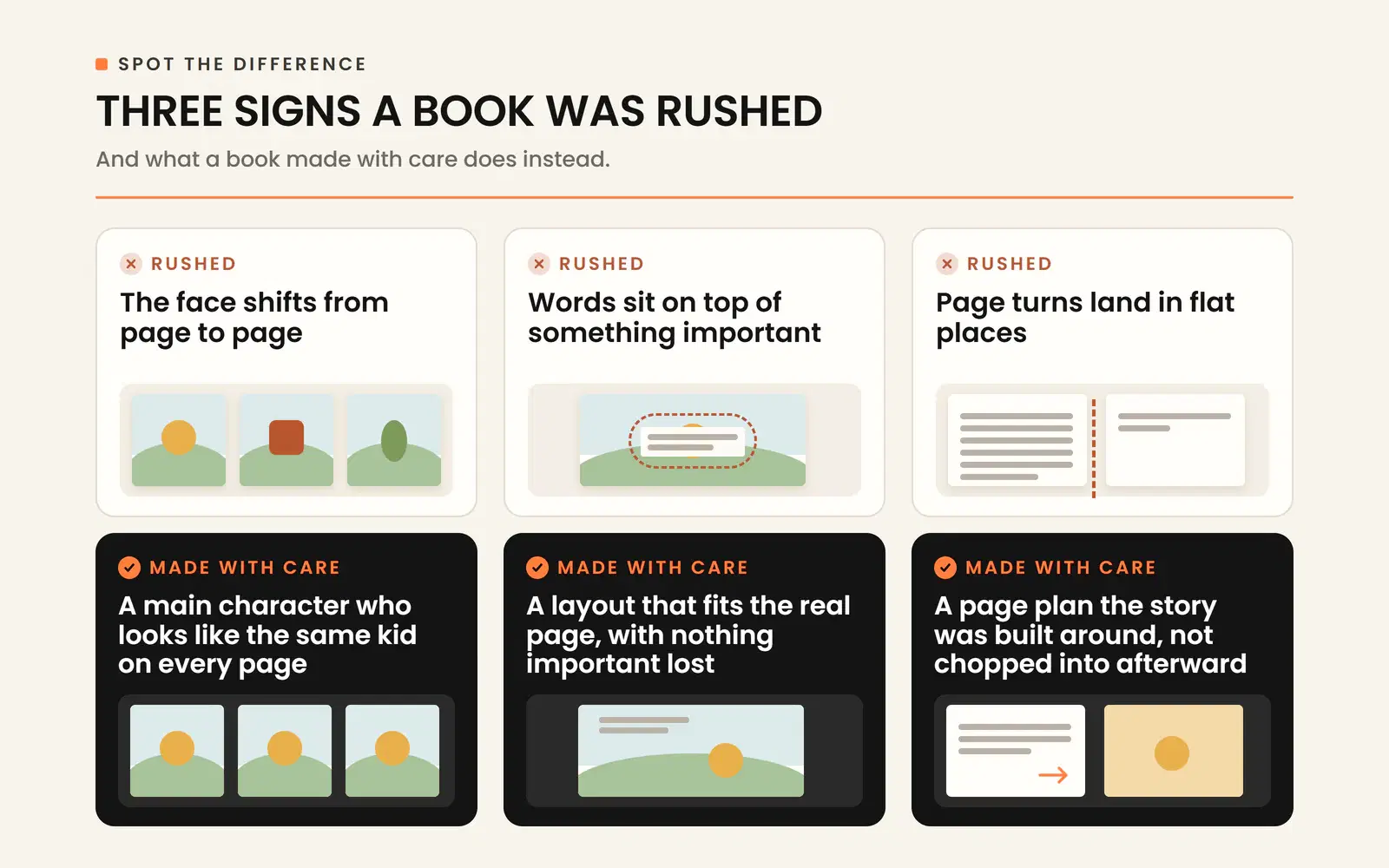
You can often spot a book that was rushed together this way. The main character's face shifts from page to page. The words sit right on top of something important in the picture. And the page turns land in flat places, because the story was written first and chopped into pages later.
One more thing is worth knowing if AI pictures are part of your plan. The U.S. Copyright Office's findings on AI and copyright say AI output is protected only where a person decided the creative parts, and typing a prompt isn't enough. Using AI as a helper doesn't take protection away from the parts you made yourself.
None of this is a reason to avoid the tools, and plenty of authors use them to play with ideas or get unstuck. The point is what changed. Making something that looks like a children's book got much easier. Making one a child asks for again didn't, and that gap is where a lot of the crowding lives.
Why Do Celebrities Write Children's Books?
Celebrities write children's books because they already have the hardest thing to get in children's publishing, an audience. A famous name gives a parent a reason to grab one book off a full shelf before they've even opened it.
For a publisher, that makes a known name a much safer bet than an unknown one, because the attention comes built in. The format suits a busy famous person, too. A picture book fits into a packed schedule in a way a memoir doesn't, and it makes a lovely gift with their name on the cover.
Here's the part that often gets missed. A famous name doesn't skip a single step of making the book. An editor still shapes the story, an illustrator still draws every page, and a designer still gets it ready for print. The name changes who notices the book. It doesn't change what the book takes to make.
There's a ripple effect, too. Celebrity picture books get talked about, and that makes writing one look like something you could do on the side. That's one more reason so many people give it a go.
So what does that mean for you? You're not really competing with celebrities for the same thing. They bring the attention with them, while your book has to earn it on its own. That means your title, your cover, your first page and your story do the job a famous name would do.
That's more doable than it sounds. Parents, teachers and librarians pick up books by authors they've never heard of all the time, because the book itself gave them a reason.
Is the Children's Book Market Saturated?
The children's book market is crowded, but it isn't saturated. Saturated would mean there's no room left for anything new. Crowded means there's room, but getting noticed takes more work.
If you've searched "are children's books oversaturated," you've probably found market reports packed with dollar figures. Those are written for investors. You're asking something different. Is there room for your book, and what will it take for the right reader to find it?
So, is the children's book market oversaturated? Not in the way the word suggests. Nothing about a crowded market stops you from writing, publishing or selling a children's book. Crowded isn't the same as closed. The cost of getting in didn't go up, but the cost of getting noticed did.
How saturated is the children's book market, then? Busy enough that a book has to be good to be found. Not so busy that a good book can't be.
Here's what crowding really changes for your book.
- Being found. Parents now find books through a search result, a display table or a friend's tip, not by browsing a short list.
- Time on the shelf. A book that doesn't find its readers early can get moved aside for one that might.
- The side by side test. Whatever book a parent picks up sits next to books made by professional teams, and the comparison takes a second.
None of those are walls. They're reasons to make your book specific and well finished, and both of those are in your hands.
Are Children's Books Still Popular?
Yes, children's books are still popular, and the reason is who buys them. The adult buying your book is buying it for a child, usually for a reason that has nothing to do with trends.
A birthday. A new baby on the way. A bedtime routine that needs a fresh favorite. A worry a parent doesn't know how to bring up. A topic your child's class starts next week.
Your readers keep arriving, too. Every toddler grows into the next stage of reading, and there's always a new baby right behind them. Adult books don't get a fresh set of readers growing up underneath them like that.
Schools and libraries keep children's books in steady use as well. They choose books for reading level and subject rather than hype, and they replace copies that wear out. And a children's book isn't read once and put away. If a child loves yours, they'll hear it night after night, which is its own kind of popular.
That rereading is also why parents get picky. They know they'll be reading your book out loud again and again, so they want one they'll enjoy, too.
Where the Children's Book Market Still Has Room
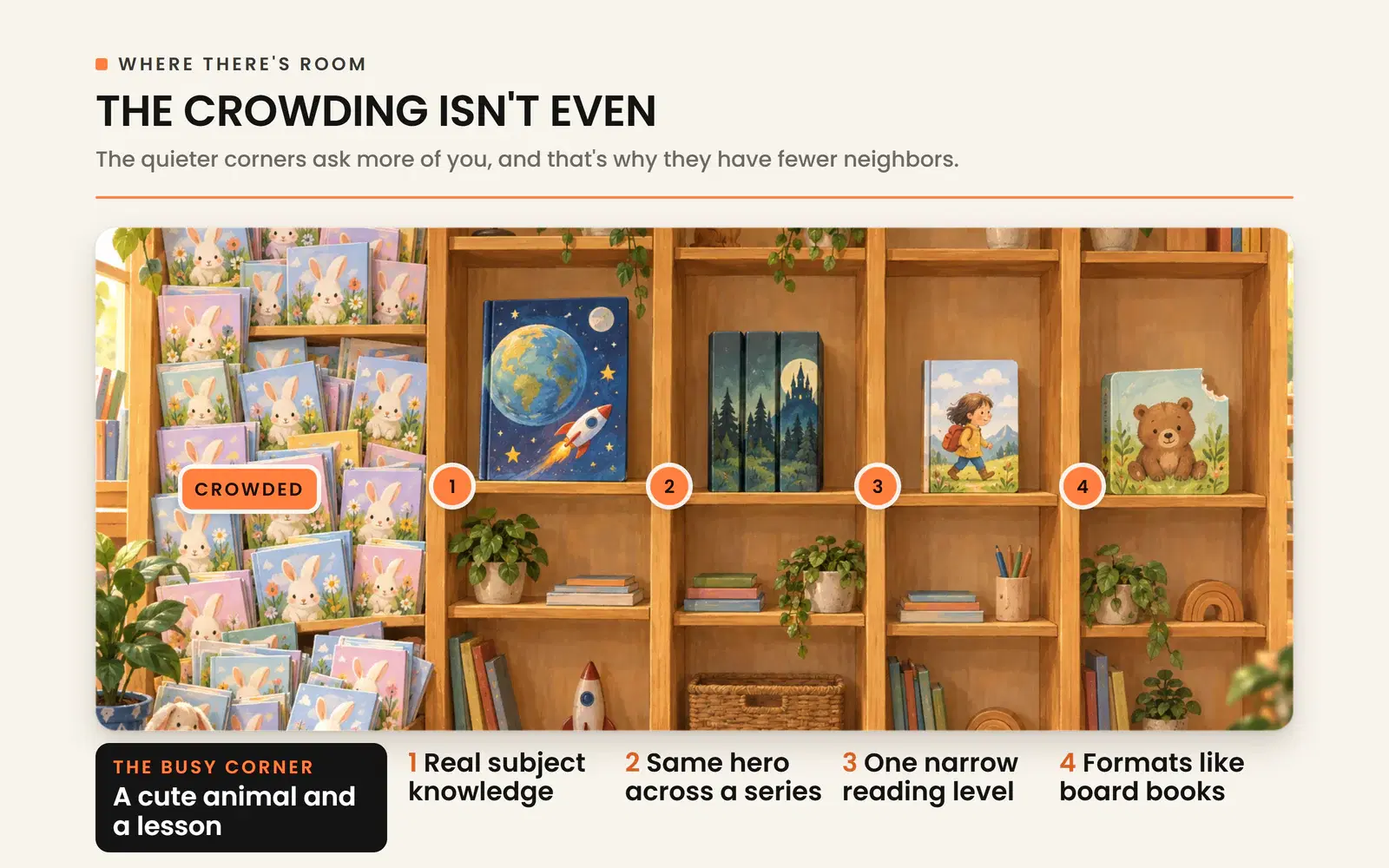
How competitive is the children's book market? It depends on which corner you're standing in. The crowding isn't even, and the quieter corners tend to hold the books that are harder to make.
The busiest corner is the gentle picture book with a cute animal and a lesson at the end. It needs no special knowledge and no unusual printing, so that's where a lot of first books land, and where yours would have the most company.
The quieter corners have something in common. They ask more of you.
- Books that need real subject knowledge, like a science topic or a hard family moment, where getting it right matters as much as making it cute.
- Books with a main character who has to stay the same person across a whole series.
- Books written for a narrow reading level, where every word and every page turn has to sit at the same stage.
- Books in a format most people never think about, like a board book tough enough for a teething toddler.
Picking a quieter corner isn't a trick. It means you're making a harder book, and that's exactly why it has fewer neighbors.
And if your idea sits in the busy corner, that's fine too. Plenty of lovely books live there. It just means your book has to be more specific to get noticed.
What Type of Children's Books Are in Demand?
The children's books that stay in demand are the ones parents, teachers and librarians keep coming back for. If you're wondering what type of children's books are in demand, look at why someone reaches for each kind.
Demand here means people asking for a kind of book, not whatever's topping a chart this month. Here's how the main types compare.
| Book type | Who it's for | Why adults keep coming back for it | What it has to get right |
|---|---|---|---|
| Picture books | Children who are read to, before they read alone | Bedtime and story time run on them, with a whole story in one sitting | Holding up when it's read aloud again and again |
| Early readers | Children starting to read on their own | They're the bridge from being read to, to reading alone | Simple words that still feel like a real story |
| Chapter books | Newly confident readers | They turn reading into a habit, and kids want the next one | A character worth coming back to, often across a series |
| Educational books | Kids learning a topic at home or in class | A subject comes up, and an adult needs something accurate a child will sit through | Getting the facts right first, then making it fun |
Notice what they share. Each type stays wanted because a specific person shows up with a specific need. So before you write a word, it's worth knowing which person your book is for and what they need from it.
If your idea could go more than one way, choose by the child, not by the shelf. The same story told to a preschooler and to a brand new reader turns into very different books.
How Hard Is It to Get a Children's Book Published?
Getting a children's book published is hard, and the reasons have less to do with your story than you'd think. It's less about how lovely your idea is and more about what a publisher has to take on to say yes.
Here's what your manuscript is really up against.
- A plan that already exists. Publishers map out their lists well ahead, with topics and reading levels already spoken for, so your manuscript lands on a plan, not an empty desk.
- The cost of the pictures. Saying yes to a picture book means paying for art, running rounds of approval on it, and waiting longer before a single copy exists.
- Both readers at once. The adult who pays wants a book they can stand reading every night, while the child just wants to hear it again.
- Every book already on the shelf. Children's books don't go out of date like a tech manual, so older favorites stay in the running for years.
None of that means your story doesn't matter. It means a publisher is weighing the whole book, pictures and all, before saying yes.
There's also another route. You can publish on your own terms, with help from children's book publishers who take care of the illustration, design, typesetting and printing. That skips the wait for someone else's yes, and with a good team, you approve each stage before the next one starts.
What it doesn't skip is the crowded shelf. Your book still has to hold its own next to everything else, so the finish matters just as much either way.
Selling a Children's Book Is a Different Job
Is it hard to sell a children's book? Yes, because the book has to win over more than one person before a child ever hears it.
First there's the adult who buys it. They find your book through a listing, a cover or a recommendation, often with a child tugging at their sleeve, and they decide fast.
Then there are schools and libraries. They buy for reading level, subject and how well a book holds up, not for marketing. It's the slowest way in, but a book that gets there tends to stay in use.
Last comes the child, who quietly decides everything. A book a child doesn't ask for again stops getting read, however good the listing looked.
Print on demand and selling direct, at school visits, book fairs and on your own website, changed which of these you can reach by yourself. They didn't turn them into one route. A great listing won't get you into a library, and a library shelf won't make a child love your book.
We often see authors pour everything into the listing and forget the schools, the libraries and the child it's all for. Each one needs its own attention.
What Still Makes a Children's Book Stand Out
What makes a children's book stand out on a crowded shelf isn't a big marketing budget. It's two things, and both get decided long before launch day. Your book is made for a specific child, and it's finished as well as the books it'll sit beside.
Made for a specific child means you can describe your reader. You know their age, the moment an adult reaches for the book, and why they'd ask for it again. Not a book for kids about kindness, but a book for a shy preschooler starting at a new school, read at bedtime the night before. A book for all kids is a book for nobody in particular, and a parent can feel that within a few pages.
The books that work also tend to dodge the usual first book mistakes. If you'd like to sidestep them too, we've rounded them up in our guide to what not to do when writing a children's book.
Finished as well as the books beside it is the part that's easiest to underestimate. It means your book goes through the same steps a professionally made book goes through.
- A page plan the story was built around, not chopped into afterward.
- A main character who looks like the same kid on every page.
- A layout that fits the real page size, with nothing important lost in the fold.
- Type set for your reader's age, not just for looks.
- A printed proof, so the colors on paper match the colors you approved.
None of that shows when it's done right. All of it shows when it isn't, especially to a parent who just put down a book that got it right.
Why So Many Children's Books Look Alike
So many children's books look alike because their authors solve the same problem the same way. Faced with a crowded shelf and a new kind of writing, it's natural to reach for the safest version, and you may feel that pull too.
That usually means a gentle story, a cute animal, a familiar setting and a lesson tied on at the end. Each choice makes sense on its own. Made together, by lots of people at once, they add up to a shelf of books that are hard to tell apart.
The lesson at the end is the big one. It feels like the whole point of a children's book, but it's rarely why a child asks for one again. We dig into why in what makes a good children's book.
The look matters just as much, because a children's book gets judged before anyone reads a word of it. If you want to see what makes parents and kids stop and look, our children's book cover design secrets walk you through it.
The good news is that sameness is a choice, not a rule, and you get to make it. Give your book a specific child, a real situation and a look of its own, and it already stands apart.
Getting Your Children's Book Ready for a Crowded Shelf
A crowded shelf asks your book to be finished as well as the books beside it. That's more of a production job than an inspiration one, and it's the part Book Writing US takes on.
We handle manuscript formatting, illustration and book design, typesetting and proofing, printing and production, and publishing and distribution. That leaves you free for the part only you can do, the story and the child it's for.
Already have artwork? We can build the design around it. Nothing drawn yet? Illustration can happen inside the same project, and the finished art flows straight into design, typesetting and print.
No one can promise how a market will treat a book, and we won't pretend to. What we can do is make sure the book that goes out is the one you meant to make.
Got an idea, a rough draft or a finished manuscript? Tell us where your book is today, and we'll walk you through what comes next.
Frequently Asked Questions
Is there a market for children's books?
Yes. Parents, grandparents, teachers and libraries buy children's books all year round, for birthdays, bedtimes, classrooms and big life moments. It's really a group of smaller markets, from baby board books to chapter books, and each one has its own buyer. Knowing which one your book is for matters more than the size of the whole thing.
Should I write a children's book?
Write one if you can picture the child it's for and the moment an adult would reach for it. That's a better test than whether the idea feels lovely. If you can also say why a child would ask for it again, you've got something worth building.
Do publishers take first-time children's book authors?
Yes. A first book isn't held against you, and new voices are part of how children's publishing stays fresh. What counts is whether your manuscript is built for a clear age group and shaped around its page turns. A track record might get you read sooner, but it won't stand in for a strong manuscript.
How are children's books marketed?
Mostly to adults, since they're the ones buying. That means the cover and the online listing, school and library visits, read aloud events, and reviews aimed at parents, teachers and librarians. The pictures do a lot of the work, because a sample page travels further than any description.
Is it worth writing a children's book?
It's worth it if you want this particular book to exist and you're ready to give it time. A children's book is quick to read and slow to make, with rounds of revision, illustration and proofing after you think you're done. Write it for a real child and a real reason, and that time tends to feel well spent.
- Children's Books Look Short, So They Look Easy
- Writing for a Child You Love
- AI Tools Made Children's Books Faster to Make
- Why Do Celebrities Write Children's Books?
- Is the Children's Book Market Saturated?
- What Type of Children's Books Are in Demand?
- How Hard Is It to Get a Children's Book Published?
- What Still Makes a Children's Book Stand Out
- Getting Your Children's Book Ready for a Crowded Shelf
- Frequently Asked Questions