AI vs Human Illustrator, What the Difference Means for Your Children's Book
Short Answer: The AI vs human illustrator question comes down to who controls the whole book, not how good one picture looks. An AI tool can make an appealing image in moments, but keeping the same character, the same look and every small detail right across the book mostly falls to you. A human illustrator reads your story, plans the pages and keeps your character steady, though the first pictures arrive more slowly. The better fit depends on what your book is for.
Maybe you've already made a few AI pictures of your main character and liked them more than you expected. Or maybe you've got an illustrator's portfolio open in another tab. Now you're wondering whether the wait is worth it. Either way, it's a fair question, and there's no single right answer for every book.
This guide lays out what actually changes for your book, and for you, with each route, without taking sides. Plenty of authors are happy with AI pictures, and plenty of others would never use them. What matters is knowing the trade before you start, so the choice you make suits the book you're making.
What's the Difference Between AI Art and Human Art?
The main difference between AI art and human art is who makes the choices. An AI image tool builds each picture from a written description, called a prompt. It works from patterns it learned from huge numbers of existing images. A human illustrator makes each choice on purpose, for your story and the child who'll read it.
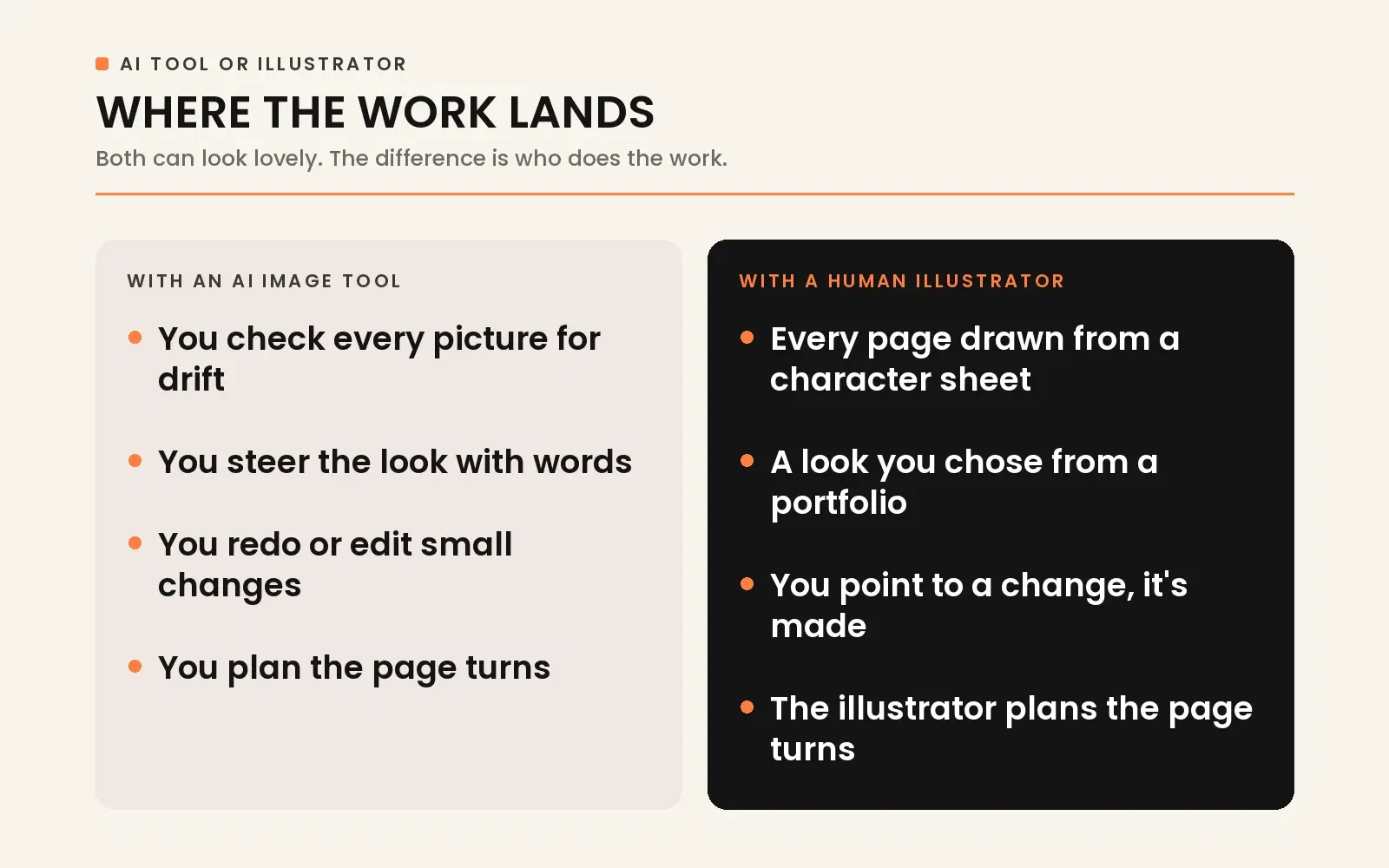
For a single picture, the gap can look small, and both can look lovely. The difference grows once you need a whole picture book. That's when the AI vs human illustration choice stops being about one image. It becomes a question about who keeps the character the same, who gets the look right, who handles changes and who plans the pages. Here's how that work splits between the two.
| What your book needs | With an AI image tool | With a human illustrator |
|---|---|---|
| The same character on every page | You check each picture and remake any that drift | The illustrator draws every page from a character sheet |
| A look made for your book | You steer the look with words, often over many tries | You choose an illustrator whose portfolio shows the look |
| One small, exact change | You ask again or edit, then recheck the page | You point to it, and the illustrator changes just that |
| Page turns and room for the words | You plan each page yourself | The illustrator plans them from your manuscript |
| The first pictures you see | Within moments of asking | After the illustrator reads your story and designs the character |
| Who checks every picture | You do | The illustrator does first, and then you approve |
Neither column is the right one for everybody. The table just shows where the work lands. With AI, you take on the job an art director does at a publishing house, directing, choosing and checking every page yourself. With an illustrator, you're still involved and you still approve the work, but a person carries most of that load.
Hand-Drawn Doesn't Have to Mean Paper
Hand-drawn children's book illustration doesn't only mean pencil, ink and paint on paper anymore. Many illustrators now draw on a tablet with a stylus. That digital illustration is still made by a person, one line at a time. Some mix the two, painting textures on paper and finishing the pages on a computer.
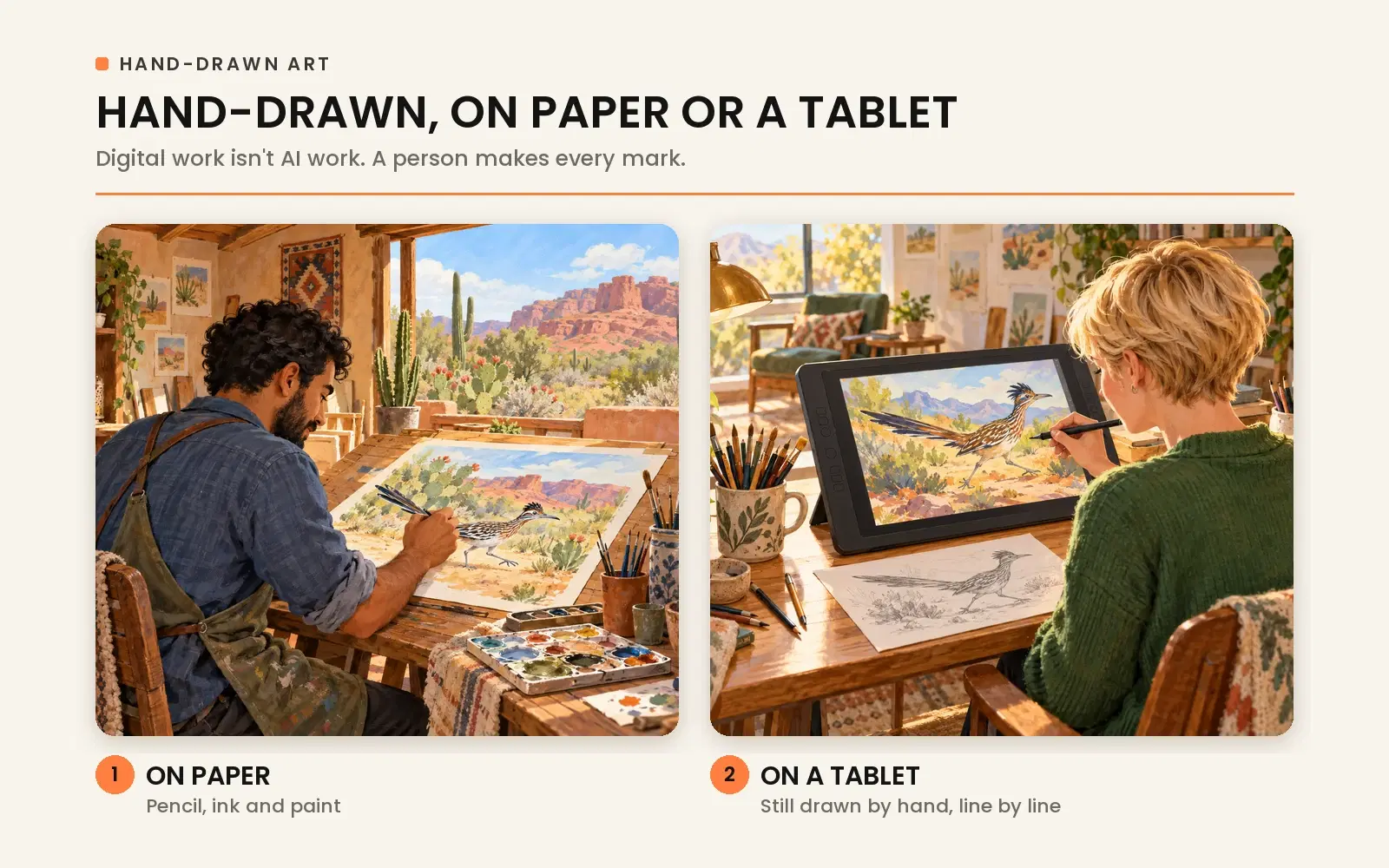
So the real line in the AI vs hand-drawn art debate isn't paper versus screen. It's who makes each mark and each decision. In a hand-drawn illustration, a person chose where every line goes, even if the final file was put together on a computer. With AI-generated images, the tool fills in most of the detail between your words and the picture.
That's worth keeping in mind when you look at portfolios. Digital work isn't the same thing as AI work, and an illustrator who draws on a tablet isn't taking a shortcut. What you see in a portfolio should show what that person's own hand can do, because that's what you'd be getting in your book.
Can AI Do Children's Book Illustrations?
Yes, AI tools can make pictures in many children's book looks, from soft watercolor to bold cartoons. They're quick to try, and they can show you an idea within moments of asking. That speed is a real strength. You can see a scene by day and then by night, or try your hero as a bear and then as a rabbit, before you settle on anything.
A book asks for more than single pictures, though. It needs a run of pictures that tell one story, and each one has to match its words exactly. That last part is where the work adds up. AI tools can add things you didn't ask for and leave out things you did. Depending on the tool, it can show in small details such as hands, buttons or lettering. It can show in the number of things in a scene, too.
Picture a kindergarten teacher making a counting book for her class. The page about five frogs on a log sometimes comes out with six frogs. Other times one frog sits half in the pond instead. In most books, a stray detail like that is a small thing. In a counting book, it's the whole point of the page. She ends up making the same picture again and again, counting frogs each time.
A children's book illustrated by AI can look finished at a glance. That's why every page needs a slow check against its words. None of this means AI can't be used for a picture book. It means the checking becomes your job, and a picture book has a lot to check.
Can ChatGPT Illustrate a Children's Book for Me?
ChatGPT and other general AI assistants with an image feature can make pictures for your children's book from a description you type. You describe a scene, look at what comes back and ask for changes in plain words. It feels a little like talking to an artist. It's also an easy way to see your story in pictures for the first time.
What a chat assistant leaves to you is the book around those pictures. You decide what each page shows and how many pictures the story needs. You check that the character looks the same from one picture to the next, and that each picture fits its page. You'll also need files that are large enough and the right shape for your book's printed size. That's worth checking before any page layout begins.
Keeping Your Character the Same on Every Page
Keeping your character the same on every page works differently with each route. A human illustrator usually designs your character first, puts it on a character sheet and draws every page to match it. With AI, each picture is made fresh. So you become the person who checks every page and remakes the ones that drift.
That drift isn't bad luck. A January 2025 report from the U.S. Copyright Office notes that many popular AI systems give different results from one request to the next, even with an identical prompt. Some tools let you repeat a result more closely, and they keep improving. Even so, the report adds that those systems can't always promise perfectly consistent results.
Character consistency also covers more than a face. It's the same clothes and the same height next to a big brother. It's the same spots on the family dog and the same red door on the house. A human illustrator keeps all of that steady as part of the job. With AI, it helps to keep a short list of those details beside you while you check each picture.
Think of a dad writing a story about his twin daughters, who look almost exactly alike. In real life, people tell them apart because one always wears a yellow hair clip. If that clip hops from one twin to the other between pictures, whether an artist or a tool made them, young readers lose track of who's who. It's a tiny detail, but the whole story rests on it. A character sheet with the clip drawn on settles it once, for every page.
Getting the Look You Have in Mind
A human illustrator gets the look you have in mind by starting from a style you can already see. Their portfolio shows how they draw, so you choose the look when you choose the person. From there, a skilled illustrator can shape that style around your story. They might make it softer for a bedtime book or livelier for a silly one.
AI tools can be steered toward a look with words, such as watercolor, cut paper or soft colored pencil. The results can be lovely. Getting one very particular look, though, and then keeping it on every page, can take many tries.
Say an author wants her whole book to feel like the patchwork quilts her aunt used to sew. She has photos of the real quilts, with their faded blues and tiny flowered squares. An illustrator can study those photos and build the book's colors and textures from them. With AI, she could upload the photos as references, and she'd still have to check that every page keeps the same faded blues and tiny squares.
Whichever way you go, pick one illustration style and keep it through the whole book. Not sure what to call the look you like? This guide to the main children's book illustration styles gives you names and examples to point to.
Changing One Small Thing
Changing one small thing is usually simple with a human illustrator. You point to the detail, and only that detail changes. Illustration agreements often say how many rounds of revisions are included, and a small fix fits easily inside one of them.
With AI, asking again from scratch can change more than you wanted. The new picture might fix the smile but move the tree, swap the shoes or shift the light. Newer tools can edit an uploaded picture and change only what you ask, though the results are still imperfect. Either way, check the fixed picture against the pages around it, so the change doesn't stand out.
Changes get harder when they're about a feeling, not an object. Imagine a mother writing about a shy girl whose big moment is raising her hand in class for the first time. She pictures that hand going up only halfway, still unsure. The AI keeps drawing a confident arm stretched straight up, and it takes several tries to get the halfway hand. An illustrator can often get that halfway hand from one note, because they've read the story and know what the moment means.
Your own changes count too. If you rewrite a scene after the pictures are made, an illustrator can adjust the sketch to fit the new words. With AI, you'll usually make that picture again from the start and then check it against everything else.
Planning the Page Turns and the Room for Words
A picture book is a sequence, so someone has to plan it before the final pictures are made. That person decides which moment gets a full spread across two pages. They decide where a surprise waits behind the page turn, and where the words sit on a calm part of the picture. A human illustrator reads your whole manuscript and plans all of that, often with a storyboard, before drawing a single final page.
With AI-generated images, those decisions fall to you, picture by picture. The tool makes the image you describe, but it doesn't know this picture sits on a right-hand page just before a big reveal. It doesn't know your words need a patch of quiet sky, either. You can plan all of that yourself. It's simply one more job that moves from the artist to you.
Some books depend on that planning completely. Picture an author whose bedtime story hides a little green mitten somewhere on every spread, for children to hunt for before lights out. The game only works if someone places the mitten on purpose, never in the same spot twice. It also can't be hidden so well that a sleepy child gives up. An illustrator plans those hiding places across the whole book at once. With AI, you'd be placing and checking that mitten in every single picture.
Pictures in a good picture book also add things the words don't say, like a cat quietly stealing a sandwich in the background. That kind of storytelling is a big part of what a children's book illustrator does besides drawing.
Do Illustrators Use AI?
Some illustrators use AI and many don't, so the only way to know is to ask. A few use AI-assisted features inside their drawing software, or try out early ideas with AI before they draw. Others don't use it anywhere in their work and say so plainly. There's no single rule across the whole field.
Ask before you hire, and ask what part of the work AI touches, if any. The same question can cover very different things, from cleaning up a line to making a whole background. Then put the answer in your written agreement. That's fair to you both, and it matters later, because publishing platforms may ask how the pictures in your book were made.
A clear, easy answer is a good sign, whatever it is. If something still feels unclear, it's fair to ask to see sketches or work in progress from an earlier book. This belongs on your list of questions to ask an illustrator before you hire, right next to the ones about changes and deadlines.
Which One Fits Your Book?
The route that fits your book is the one that matches what the book is for. The same author might choose AI pictures for one project and hire an illustrator for the next. So rather than deciding for every book at once, it helps to ask which route suits this one. Here are four common situations and how each tends to lean.
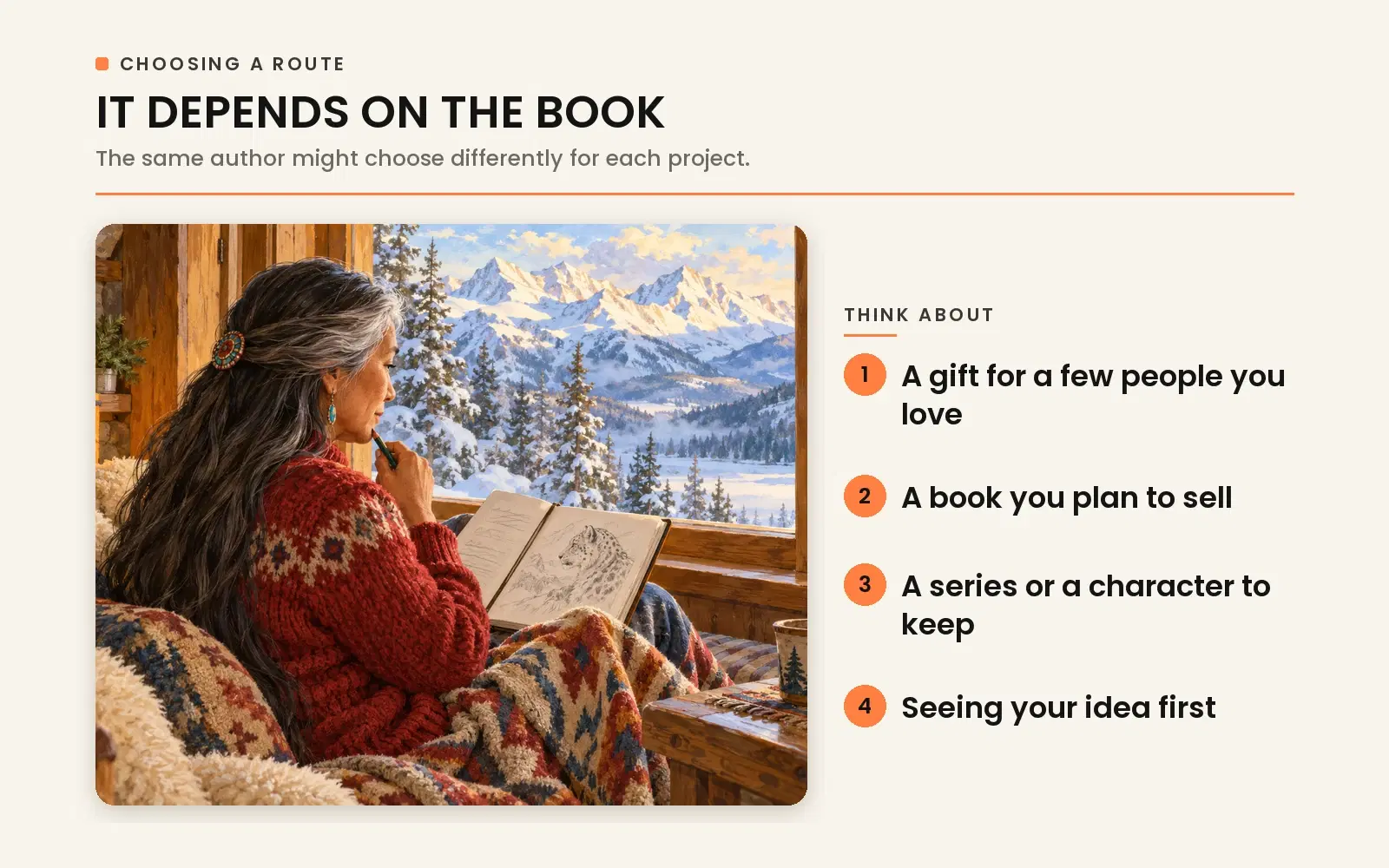
A Gift for a Few People You Love
For a one-off book that only a few people will ever read, AI pictures may be all you need. You'll just need to be happy checking every page yourself. Take an uncle making a single printed copy for his niece's birthday, all about the week she lost her first tooth. She'll love seeing herself in it either way. A human illustrator offers something different, a keepsake drawn just for that family. Some people treasure it for exactly that reason. Both are good choices, so it comes down to what you'd like the gift to feel like.
A Book You Plan to Sell
A book you plan to sell has to hold up next to other picture books, on a store shelf and on a product page. Strangers will compare it with books they already know. They're quick to notice a character who changes or a picture that doesn't match its words. That puts more weight on consistency, a settled look and careful checking. Either route also has to reach print quality. An illustrator usually plans the files for print from the start. AI pictures need checking for size and shape before the layout begins.
A Series or a Character You Want to Keep
A series needs the same character in every book, sometimes for years. That means steady pictures and clear ownership both matter more. An illustrator can carry your character from one book to the next with the same character sheet. With AI, you'd be matching new pictures to old ones each time. Copyright in art generally belongs to the person who created it, unless there's a signed written transfer or a work made for hire. Who owns a character made with AI is a separate question, and the guide on who owns AI pictures and what Amazon KDP asks you to disclose covers it in full.
When You Just Want to See Your Idea First
AI pictures can also work as a private sketchpad, a way to see an idea before you hire anyone. A few quick images can help you test a mood, try out a setting or find the words for what you've been imagining. That can make your first talk with an illustrator much clearer, because you'll know what you're after. Picture a dad with a story about a round little robot who learns to bake. He can't find the words for the look he has in mind, so he makes a few quick AI pictures of soft, rounded robots in a tiny kitchen and shows them to the illustrator he hires, who's happy to work from references. She can see what he means straight away, and her first sketches can start much closer to his idea. Treat pictures like these as notes to yourself rather than a finished plan, and stay open to what a trained eye suggests.
If You'd Like an Illustrator to Draw Your Book
If you'd like your pictures drawn for you, we offer children's book illustration services at Book Writing US. We make the art for picture books, early readers and educational books, taking a story from its main character through to the finished pages.
We can also pair it with our children's book publishing services if you'd like help turning the art into a finished book. You're welcome to reach out to us even if you're still weighing AI against an illustrator.
Frequently Asked Questions
Will AI replace children's book illustrators?
No one can say for sure. AI tools are changing quickly, and some illustrators have changed how they work because of them. For now, human illustrators still draw a great many picture books, while some authors choose AI pictures for theirs. For your own book, the useful question is a smaller one. It's which route suits this story and what you want it to do.
Do children care if a picture book was illustrated by AI?
Many young children respond to the story and the character first, and how the pictures were made is rarely their question. What they do notice is a character who suddenly looks different, or a picture that doesn't match what's being read aloud. Some parents and grandparents do care how a book was made. A few will ask, or look for a note about it. So it's worth thinking about who'll be buying your book, not only who'll be reading it.
Is it OK to use AI art as a reference for an illustrator?
Often it is, but ask first. Some illustrators are glad to see a rough AI picture that shows the mood or setting you imagine. They'll look at it the way they'd look at a photo or a quick sketch. Others would rather not work from AI images at all, and that's their call to make. Either way, a reference is only a starting point. The illustrator draws new, original pictures for your book rather than copying the AI image. So share it as a rough guide, not a picture to match exactly.
Can AI make a personalized children's book about my child?
Yes, some AI tools can make pictures of a character who looks a bit like your child. Some work from a description, and some from a photo. Before you upload a photo of your child anywhere, read what that tool does with uploaded pictures and how long it keeps them. The same checks from this guide still apply, because the character has to look like the same child on every page. A human illustrator can also draw a character inspired by your child from a few family photos.
Can an illustrator fix pictures that were made with AI?
Some illustrators will touch up or redraw AI pictures, and others won't take on that kind of work. If you've made AI pictures and want them to look more consistent, you'll usually choose between two paths. One is small fixes to the existing images. The other is having the book redrawn from the start. Redrawing gives you pictures made by a person, while fixing keeps the AI images underneath. Whichever you pick, tell the illustrator exactly how the pictures were made before any work begins.
- What's the Difference Between AI Art and Human Art?
- Can AI Do Children's Book Illustrations?
- Keeping Your Character the Same on Every Page
- Getting the Look You Have in Mind
- Changing One Small Thing
- Planning the Page Turns and the Room for Words
- Do Illustrators Use AI?
- Which One Fits Your Book?
- If You'd Like an Illustrator to Draw Your Book
- Frequently Asked Questions