What Does a Children's Book Illustrator Do, and Who Else Works on the Art?
Short Answer: A children's book illustrator creates the pictures that tell your story alongside the words, from the look of each character to the finished art on every page. The illustrator rarely works alone, though. At a publishing house, an art director guides the art, a book designer puts the words and pictures together on the page, and an editor looks after the text. When you self-publish, those jobs still need doing, and some of them land with you.
Many first-time authors ask, "What does a children's book illustrator do, apart from the drawing?" It's a good question to settle early. The answer shapes who you hire, what you ask them for, and which jobs are still waiting once the pictures are done.
This guide explains the illustrator's work one job at a time, and then the people who work on the art beside them. It isn't a list of stages in order, since that has a guide of its own. It's a plain look at who does what, so nothing important falls into the gaps between them.
What Is Children's Book Illustration, and How Is It Different?
Children's book illustration is art made to tell a story to young readers, side by side with the words. In a picture book, the words and pictures are meant to be read together as one, so each needs the other to make sense. The pictures in your book aren't decoration added at the end. They carry part of the story.
That's what sets it apart from other kinds of illustration. Merriam-Webster defines an illustration as a picture or diagram that helps make something clear or attractive. Your book's pictures have to do that for a reader who may not be able to read yet. They also have to hold up across your whole book, with the same characters showing up again and again.
A few other things make this work different. The pictures are drawn for a child's eye, so faces and feelings need to read clearly at a glance. They're drawn to fit a real page, with room left for your words. And they're made to be looked at many times. If you've ever read the same bedtime book aloud night after night, you know why.
What Does It Mean When a Book Is Illustrated?
When a book is illustrated, it has pictures made especially for it, to explain or decorate the words. In your book, that means the pictures were planned for those pages and that text, rather than borrowed from somewhere else.
How much the pictures do depends on the kind of book you're making. An illustrated chapter book might have one small drawing at the start of each chapter, while the words tell the story. In a picture book, the art carries much of the story, and a page may have no words at all. If you're wondering how many pictures your own book needs, there's a guide to how many illustrations each kind of children's book needs.
What Does an Illustrator Do for a Book, Besides Drawing?
An illustrator does far more for a book than draw nice pictures. The illustrator decides how your story looks, page after page, and makes a long list of choices you'd only notice if they were missing. Publishers look first for someone who can tell a story through pictures, and you should too. Most of an illustrator's jobs grow out of that one skill.
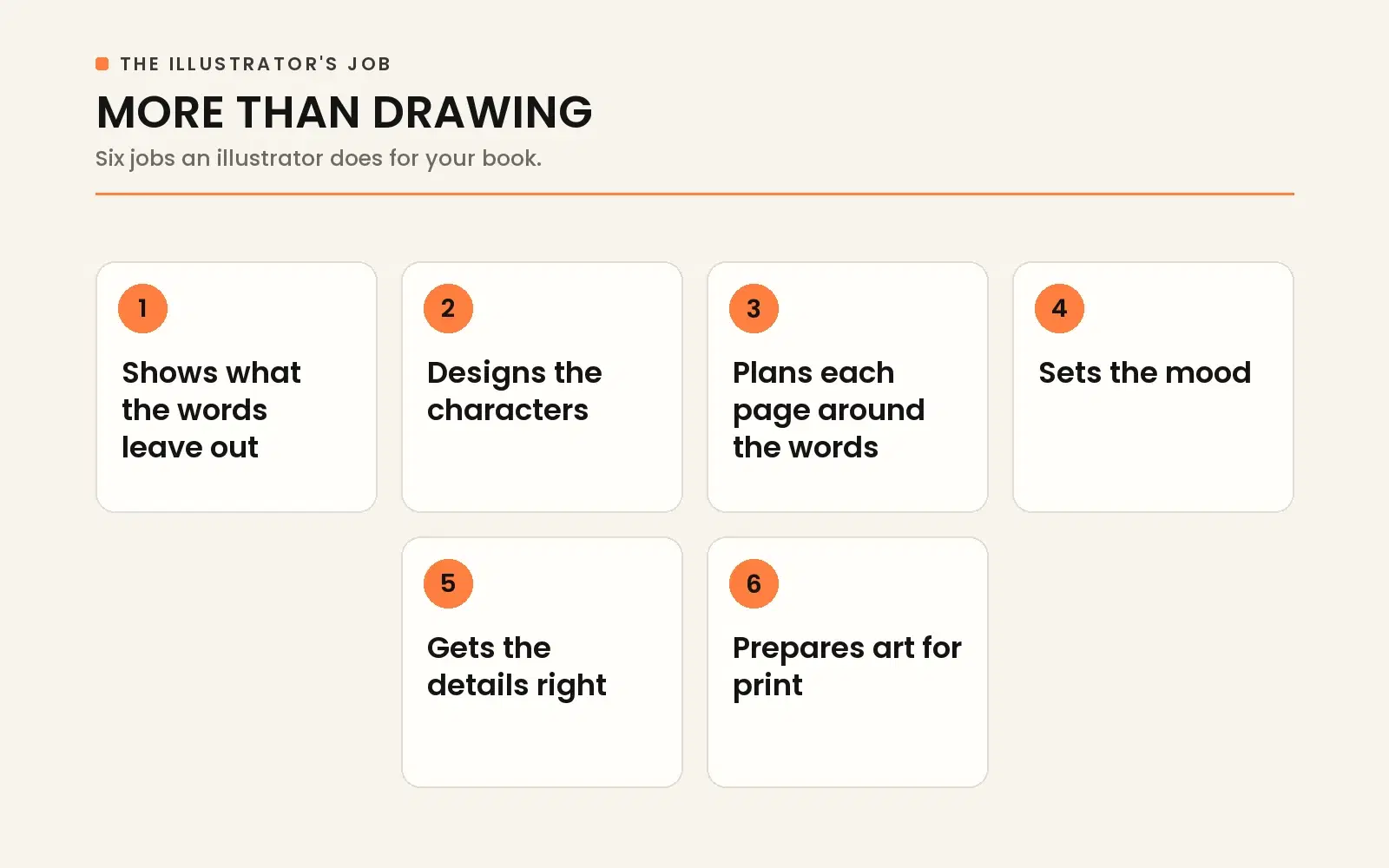
- Adding the parts of the story that the words leave out.
- Designing the characters and keeping them recognizable on every page.
- Planning each page around the words and the page turn.
- Setting the mood with style, color and medium.
- Looking up the details so they're right.
- Preparing finished art that can be printed.
Each of these jobs is explained below. The order they happen in is a separate question. You'll find it in the guide to each stage of a children's book illustration project.
Showing What the Words Don't Say
A picture book illustrator's biggest job is to show what the words leave out. Your text might say where the characters are going, while the pictures show how they feel about it, who's watching, and what's about to go wrong. That's why a good picture book can say so much in so few words.
Sometimes the pictures even disagree with the words on purpose. Children's book editor Harold Underdown describes stories where the text says one thing and the illustrations show what's really happening. Young readers love being in on a joke like that.
Picture a story about a big race in the woods. The words simply say that everyone was ready for the big race. But the picture shows every animal lined up at the start, except one small turtle. He's still sitting down, tying his shoe. The words never mention him. A child spots him anyway, and that tiny detail sets up the whole ending.
This is also why an illustrator reads your manuscript differently from the way you do. Where you see sentences, they see moments that could be shown. A line you're proud of might turn out to be the one the picture tells better.
Designing Characters a Child Knows on Sight
The illustrator turns the names in your manuscript into characters a child knows on sight. Your story might only name a character, like Grandma or a brave little mouse. The illustrator decides Grandma's height, her glasses and the way she stands. The same goes for the mouse's color and the shape of his ears.
A young reader follows your story by following those faces, so recognizing a character is one of the most important jobs the art has. That's why the illustrator's job doesn't end once the main character is designed. The character has to stay the same on every page, whether they're running, sleeping or crying, and whether the reader sees them from the front or from behind.
The illustration process guide covers when the main character gets designed and how you'll check it. What matters here is that keeping characters steady is one of the illustrator's core jobs. It's also worth checking when you look at someone's past work. Do their characters still look like themselves ten pages later?
Planning Every Page Around the Words and the Page Turn
An illustrator plans each page as part of a real book, not as a picture on its own. Every page has to leave room for your words, in a spot where they're easy to read. It also has to keep faces and important details away from the gutter, the fold in the middle of the book where the pages meet the spine. It's the same at the edges, where the paper gets trimmed.
Your illustrator plans the rhythm of the whole book, too. A quiet page might come just before a big, busy one, so the page turn feels like a surprise. A close-up can slow your reader down, and a wide scene lets them breathe. Most illustrators work this out with a storyboard, which is a set of small, rough drawings of every page laid out together. There's more on why the storyboard comes before the final art in the storyboarding guide.
Setting the Mood With Style, Color and Medium
The illustrator's style sets the feel of your book before anyone reads a word. Soft watercolor can make a story feel gentle and cozy, while bold, flat shapes in bright colors can make it feel loud and funny. A calm bedtime story calls for a very different look from a silly one about a burping cow. The medium matters too, whether the art is painted on paper, cut and glued as collage, or drawn and painted on a tablet.
Color does a lot of quiet work from page to page. It can make a scary moment feel a little safer, or make one happy page glow brighter than the rest. Choosing an illustrator is partly choosing a style, so it helps to know the words for what you like. The guide to children's book illustration styles walks through the main ones.
Getting the Details Right
Getting the details right is part of the illustrator's job, and it often takes more research than you might expect. Harold Underdown notes that when your story needs a certain setting, the illustrator will research it so the setting feels authentic. That can mean clothes, buildings, animals, vehicles or food from a particular place or time.
Picture a retired railroad conductor writing about the day his grandfather took him on a steam train, back when he was six. The illustrator will look up what that engine looked like, what a conductor's uniform was like then, and how a station waiting room was set up. If he still has an old family photo from that trip, it can help to share it as a reference. For historical fiction, nonfiction picture books and folktales, Underdown says visual references can be helpful. Photos from your own life can also help an illustrator get a place or a piece of clothing right, as long as you treat them as reference and let the illustrator tell the story.
Details matter because children notice them, and so will the grown-ups who read your book aloud. A wrong detail won't ruin a book, but a right one makes a world feel real. It also shows care, which readers of every age can feel.
Handing Over Art That's Ready to Print
When the pictures are done, the illustrator prepares them as high-resolution files that your designer and printer can use. The files have to match your book's size, with extra art running past the page edges wherever a picture fills the page. Art made on paper is scanned or photographed at high quality first.
This last job is easy to overlook, and it's where a lovely picture can still go wrong. A file that looks sharp on a screen can print soft, or get cut off, if it wasn't made for print. So it's worth asking early which files you'll get and in what form. The full list of files, and when they arrive, is part of the illustration process guide linked above.
What an Illustrator Usually Leaves to Someone Else
An illustrator usually doesn't handle the words, the page layout or the printing. Those jobs belong to other people, even though every one of them touches the art. If you're self-publishing, it's easy to find this out late, when your pictures are finished and your book still isn't. Here are the jobs that normally sit outside an illustrator's work.
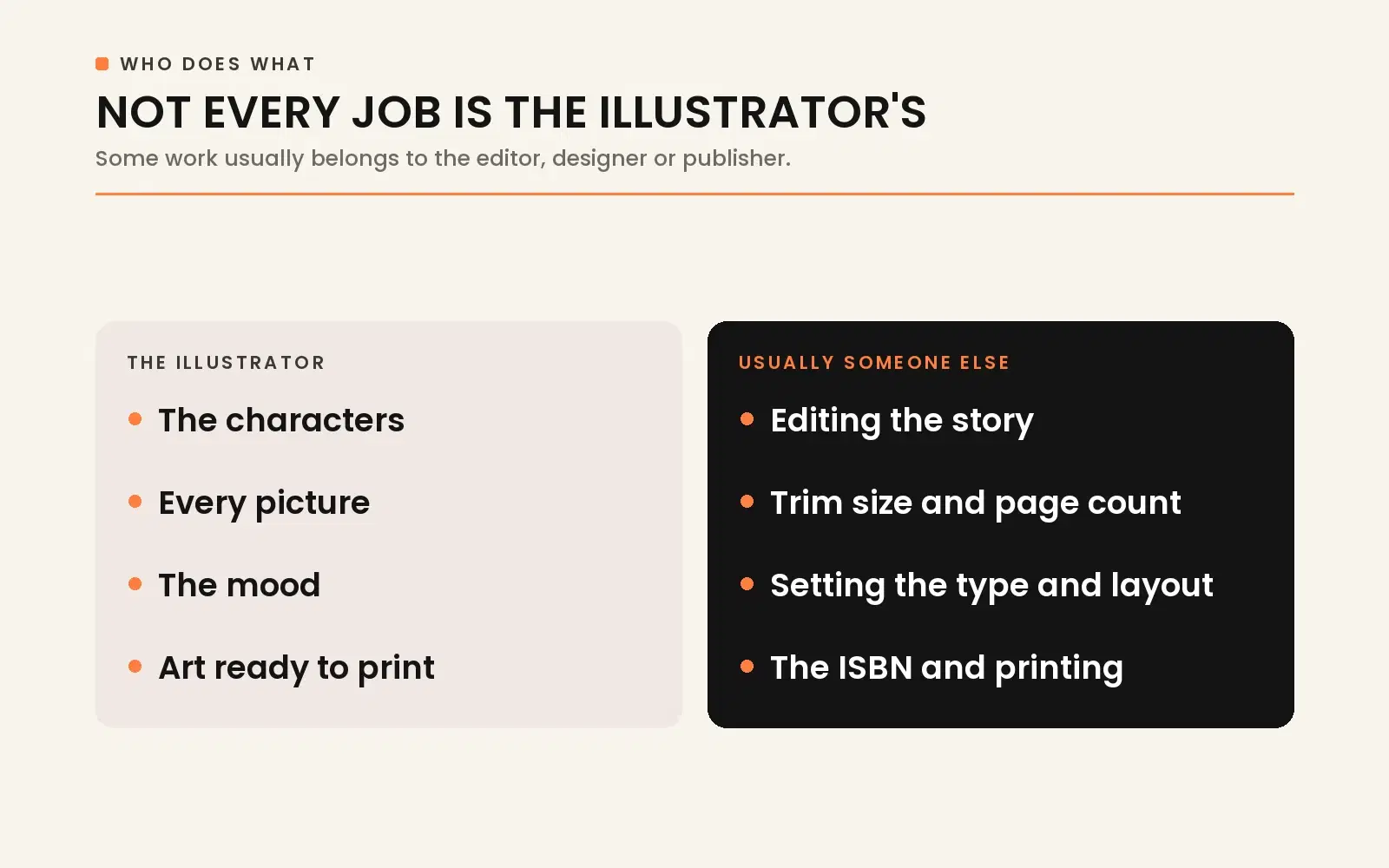
- Writing, rewriting or editing the story.
- Choosing the trim size, which is the finished size of the book, and the page count. Both are usually settled before the drawing starts.
- Setting the type, meaning the typeface, its size and where each line sits on the page.
- Page layout, which means putting the words and pictures together into finished pages.
- The cover's title lettering, spine and back cover text, even when the front art is the illustrator's.
- The ISBN, the copyright page, the printing and getting the book listed for sale.
Some illustrators do offer extras, like placing the text or designing the whole cover. Plenty don't, and there's nothing wrong with that. It just means you need to know who's covering each job before you start. Ask directly, and get the answer written into your agreement, so a gap doesn't surprise you at the end.
Who Else Works on the Art of a Children's Book?
Besides the illustrator, the art in a children's book usually passes through an art director, a book designer and an editor. At a traditional publishing house, each of these is a separate person or team. When you self-publish, you decide who covers each role, and one person may cover several.
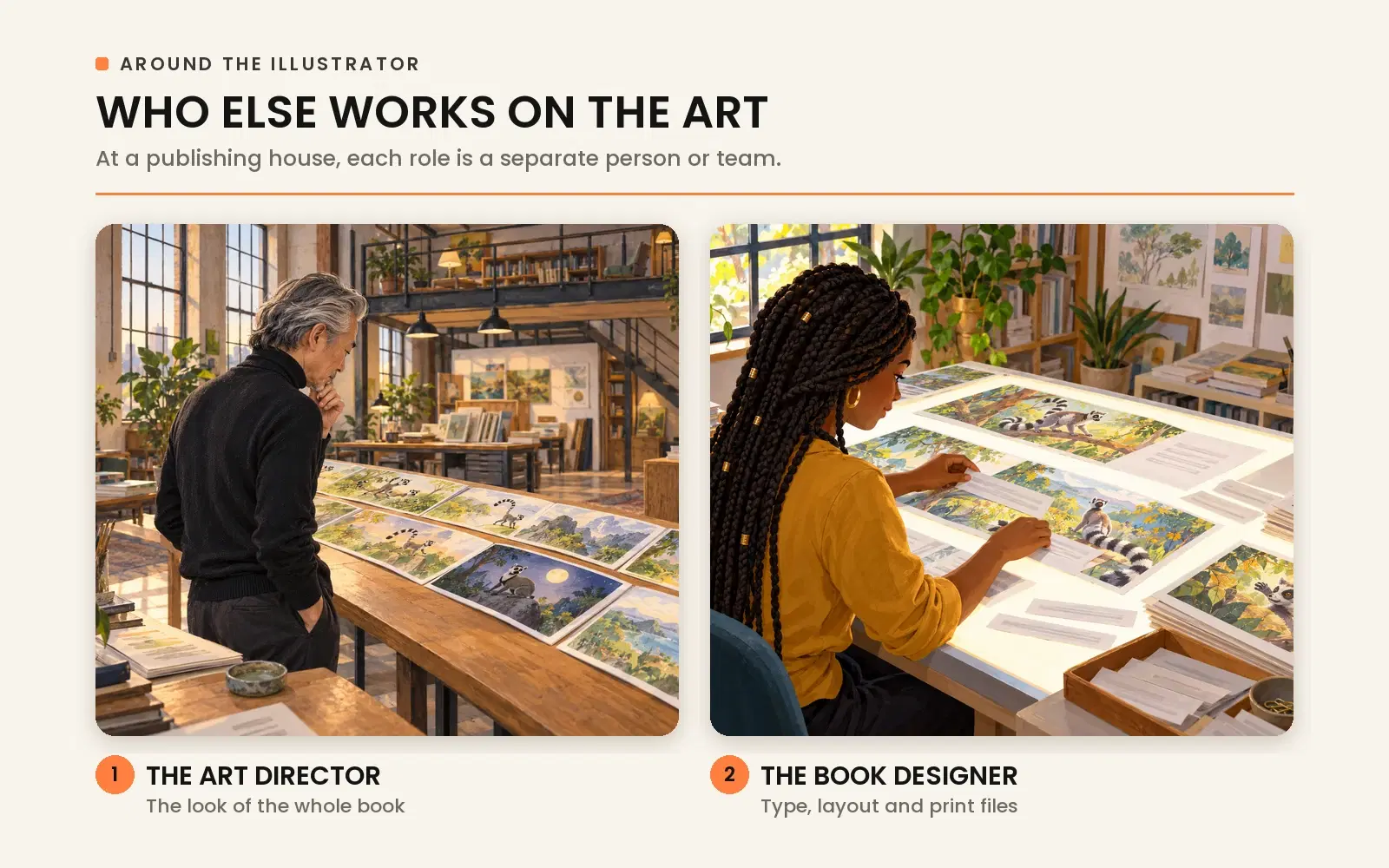
Here's how the roles compare side by side.
| Role | What they look after | At a publishing house | When you self-publish |
|---|---|---|---|
| Illustrator | Every picture, from the characters to the finished art | Hired by the publisher for that book | Hired by you, or through a team you hire |
| Art director | The look of the whole book, and how well the pictures tell the story | A staff role that often helps choose the illustrator | Usually you, unless a publishing team takes it on |
| Book designer | The type, the page layout, the cover's words and the print files | The design team | A designer you hire, or a publishing team |
| Editor | The words, and how well they fit the pictures | The editor who took on the book | An editor you hire, or a publishing team |
| Author | The story itself | Writes the text and sees less of the art | Writes the text and approves the art |
The table shows who usually does what, not a fixed rule. On a small team, one person may cover two roles, and some illustrators also design. What matters is that each job has someone looking after it, and that you know who.
What Does an Art Director Do in Publishing?
An art director in publishing looks after how a whole book looks, and makes sure the pictures and the design tell the story well. If a traditional publisher takes on your book, its children's book art director often helps choose the illustrator along with the editor. From there, the art director works with the illustrator on the sketches and the finished pages.
The art director doesn't usually draw the book. An art director at Penguin in the UK describes the role as overseeing everything that's going on, rather than doing the hands-on design. When sketches come in, the art director looks at the whole book and asks whether it works. Melissa Nelson Greenberg, then the children's art director at Cameron Kids, spoke about this in a 2018 interview. She said she could help with pacing, emotion, expression, perspective and composition when she looked at sketches.
Good art direction also knows when to step back. In that same interview, Greenberg stressed that the artist is the artist, and that her imprint was looking for that artist's own way of seeing. So an art director's notes guide the illustrator's choices rather than replacing them. That's a helpful model if you're self-publishing, because you may end up doing this job yourself.
What Does a Book Designer Do?
A book designer puts the words and the pictures together into finished pages and a finished cover. The designer chooses the typeface and its size, and decides where each line of your text sits on the art. They also set up the front, spine and back of the cover as one piece. Then the designer prepares the files the printer needs. At Penguin in the UK, designers work on both covers and interior text layouts, and one of them says the job means working closely with editors and art directors.
The book designer and the illustrator shape each other's work all the time. The illustrator leaves calm space in each picture for your words, and the designer sets them in that space so they're easy to read. A careful designer won't let a sentence land across a face or slip into the gutter.
Some of the decisions a designer helps with come before any drawing at all. Imagine a lifeguard writing a picture book about a very long sea snake who's shy about meeting the fish at the reef. A wide, low book might suit that story better than a tall one, so the snake can stretch across both pages of a spread. That page shape and trim size have to be settled first, because the illustrator draws every picture to fit them.
In self-publishing, you can hire a book designer on your own, or work with a publishing team that includes one. Either way, it helps to bring the designer in before the art is finished, not after.
Where the Editor Fits In
The editor looks after your words, and in a picture book that means looking closely at the pictures too. An editor reads the sketches against your text, cuts any line the art already shows, and flags any picture that doesn't match the story. The editor usually doesn't direct the art, but your words and the pictures have to agree before anything is finished. There's a full guide to what a children's book editor does that a regular editor doesn't, including how an editor works with sketches.
How Do Authors and Illustrators Work Together?
How authors and illustrators work together depends on how the book is being published. With a traditional publisher, they often don't work together directly at all. The editor and the art director sit in the middle, and the author and illustrator may have little contact. When you self-publish, you hire the illustrator yourself, so the two of you work together directly.
The traditional setup surprises many first-time authors, but it's done on purpose. It gives the illustrator room to bring their own vision to the story. The UK's Falmouth University says in its guide for new illustrators that communication usually goes through the editor and the art director. It adds that when an author and an illustrator work especially well together, it can turn into a long partnership across more books. Harold Underdown describes the same setup in the US, where a publisher works with the illustrator and may not involve the author much. If you'd like to know who chooses the illustrator in each route, that question has a guide of its own.
In either route, a few habits help your words and the pictures come together well.
- Finish your words before the drawing starts, so the illustrator isn't drawing a moving target.
- Mention only what the story truly needs the pictures to show, like a hidden clue the ending depends on.
- Leave the rest to the illustrator's imagination, because that's a big part of what you're hiring.
- Agree on who passes notes to whom, so the illustrator doesn't hear different things from different people.
Are you still looking for the right person? The guide on how to find and hire a children's book illustrator covers where to look and what to agree before the art begins.
When You're the Author and the Art Director
When you self-publish, you usually become the art director as well as the author. Nobody else is guiding the illustrator, checking that the pictures tell the story, or deciding when a page is right. That job doesn't disappear just because there's no publishing house involved.
Being the art director means making clear decisions and sticking to them. Imagine a beekeeper writing a picture book about a young bee who's scared of flowers. Early on, she has to decide whether her bees look true to life, with real stripes and wings, or round and friendly like cartoon characters. Either choice can work well. What doesn't work is changing her mind halfway through the book.
It also means knowing when to step back. You bring the story, the facts and your hopes for the book. The illustrator brings the drawing, and they'll often see a stronger way to stage a scene than the one you pictured. Thinking like an art director means asking whether a page tells the story, rather than whether it matches the image in your head.
You don't have to take all of this on alone. Some authors hire a freelance illustrator and direct the art themselves, while others work with a children book illustrator through a company. Either way, decide up front who's making the calls and who has the final say.
How an Author's Job Differs From an Illustrator's
As the author, you create the words of your children's book, and an illustrator creates the pictures. That's the simplest way to see the difference between author and illustrator. Both are creators, and in a picture book they're telling the same story in two different ways.
The difference matters most when it comes to ownership. As a general rule, copyright belongs to the person who created the work, so the author owns the words and the illustrator owns the pictures. That generally changes only with a signed written transfer, or when the art counts as a work made for hire. The U.S. Copyright Office's Circular 30 on works made for hire explains when that applies, and your written agreement with an illustrator should say clearly what you're getting.
Some people do both jobs. An author-illustrator writes the story and draws the pictures, and plenty of picture books are made that way. It's a real option if you can draw, but it's a big job, and it asks for more than good drawing. If you're weighing it up, there's an honest guide to whether to illustrate your own children's book.
What Is the Difference Between an Illustrator and an Artist?
Every illustrator is an artist, but not every artist is an illustrator. Merriam-Webster describes an illustrator as an artist who makes illustrations, such as for books and magazines. The difference is purpose. An illustrator makes art to go with a text, to a brief and a deadline, so it can be printed. Many other artists make art that stands on its own.
That difference matters when someone in the family offers to draw your book. Picture a brother-in-law who paints big, beautiful landscapes of the lake near his cabin. His paintings are lovely, and he's excited to help. But a picture book asks for different things. He'd need to draw the same small character many times, from new angles and in new poses, showing a whole range of feelings. He'd also have to leave space for your words and plan across the page turns.
None of that means he can't do it. It means the real question is whether he can tell a story in pictures, across a whole book, with a character who stays the same. His past work should show at least one character drawn more than once. For more on what to look for, see the advice on how to read an illustrator's portfolio.
Getting Your Story Drawn With Book Writing US
If you'd like a team to draw the pictures, we have children's book illustration services at Book Writing US for picture books, early readers and educational books, covering everything from the main character to the finished pages.
When you want the rest of the book made as well, we can pair that work with our children book publishing services. If you're still deciding who should take on which job for your book, you're welcome to reach out and ask us.
Frequently Asked Questions
Does copyright law count the illustrator as an author?
Yes, in copyright law the illustrator counts as the author of the pictures, even though everyday speech uses "author" for the writer. The U.S. Copyright Office says copyright initially belongs to the author who created the work. The exception is a work made for hire. When someone hires an illustrator for a picture, that generally takes a signed written agreement, and then the party that ordered the work is treated as the author. That's why the written agreement with your illustrator matters so much.
What is a book designer called?
A book designer goes by a few names, depending on the job and the company. You'll see layout designer, cover designer and interior designer, which in books means the inside pages, not a room. A typesetter is sometimes a separate person who mainly sets the text, while a cover designer works on the outside of the book. On a picture book, one designer often handles both the inside pages and the cover, though a bigger publisher may split that work across a team.
Is a children's book illustrator the same as a graphic designer?
No, a children's book illustrator and a graphic designer do different jobs, though some people do both. An illustrator makes the pictures. A graphic designer arranges type, pictures and space so a page or a cover communicates clearly, and on a book that role is the book designer. If you hire one person for both, check their past work for each skill separately.
Where does a children's book illustrator work?
Many children's book illustrators work freelance, often from their own studio or home, not in a publisher's office. The UK's Falmouth University notes that most children's book illustrators work as freelancers with contracts from publishing houses. That usually means being hired book by book, not kept on staff. It also means a busy illustrator may be working on more than one book at once, so it's worth asking about their schedule early.
Is an illustration always a drawing?
No, an illustration doesn't have to be a drawing. Picture book art can be painted in watercolor or acrylic, cut and glued as collage, built from photographs, or made entirely on a tablet. What makes it an illustration is its job, which is helping to tell the story. The medium is part of the style, and it's worth settling early, because your whole book should match.
- What Is Children's Book Illustration, and How Is It Different?
- What Does an Illustrator Do for a Book, Besides Drawing?
- What an Illustrator Usually Leaves to Someone Else
- Who Else Works on the Art of a Children's Book?
- How Do Authors and Illustrators Work Together?
- How an Author's Job Differs From an Illustrator's
- What Is the Difference Between an Illustrator and an Artist?
- Getting Your Story Drawn With Book Writing US
- Frequently Asked Questions