How to Find and Hire a Children's Book Illustrator
Short Answer: You find and hire a children's book illustrator by deciding what your book needs, looking where picture book artists show their work, and shortlisting people whose portfolios show one character drawn well across many pages. That's how to hire an illustrator for a children's book without guessing. Ask each finalist the same questions, and agree the scope, changes, payments, schedule and ownership of the art in writing before any drawing starts. If someone won't put those things on paper, keep looking.
If you've finished a picture book story and you're looking for a children's book illustrator for the first time, the search can feel wide open. There are thousands of talented artists online, and most of them draw beautifully. The hard part isn't finding someone who can draw. It's finding the one person who can draw your character the same way on every page, on your schedule, under terms you both understand.
This guide shows how to hire a children's book illustrator, from the first search to a signed agreement. You'll see what to settle first, where to look and how to read a portfolio. Then you'll see what to ask, what to put in writing and when to walk away. Keep one idea in mind as you read. You aren't buying one pretty picture. You're hiring a partner for a whole book.
What Should You Decide Before You Look for an Illustrator?
Before you contact a single illustrator, settle four things about your book, because each one changes who you should hire. They're the reader's age, roughly how many pictures the story needs, the style and mood you want, and how the book will be printed. Most illustrators ask new clients about these, and clear answers get you clear quotes.
The reader's age comes first because it sets the format. Board books are usually for ages 0 to 3, picture books for 3 to 8, and early readers for 5 to 8. An early reader usually has smaller pictures that sit beside the words, so it asks for a different kind of art than a picture book does. A board book needs bold, simple shapes a toddler can take in at a glance. So an illustrator who's wonderful at soft, detailed spreads may not be the right person for a chunky board book.
The number of pictures matters because it decides the size of the job. You don't need an exact count yet, just a rough idea of full spreads, single pages and small spot drawings. If you're unsure, this guide to how many illustrations a children's book needs will help you estimate it.
Style and mood narrow your search faster than anything else. Gather five or six picture books whose look you love, and write one line on what you like about each. For names to go with what you're seeing, the post on children's book illustration styles explains watercolor, collage, digital art and more.
Finally, know how the book will reach readers. A printed book needs a trim size, which is the finished size of each page, and the art has to be planned to fit it. If you only want an ebook, or you want both, say so from the start. That way the illustrator plans every picture at the right shape from the first sketch.
Put Your Book on One Page Before You Reach Out
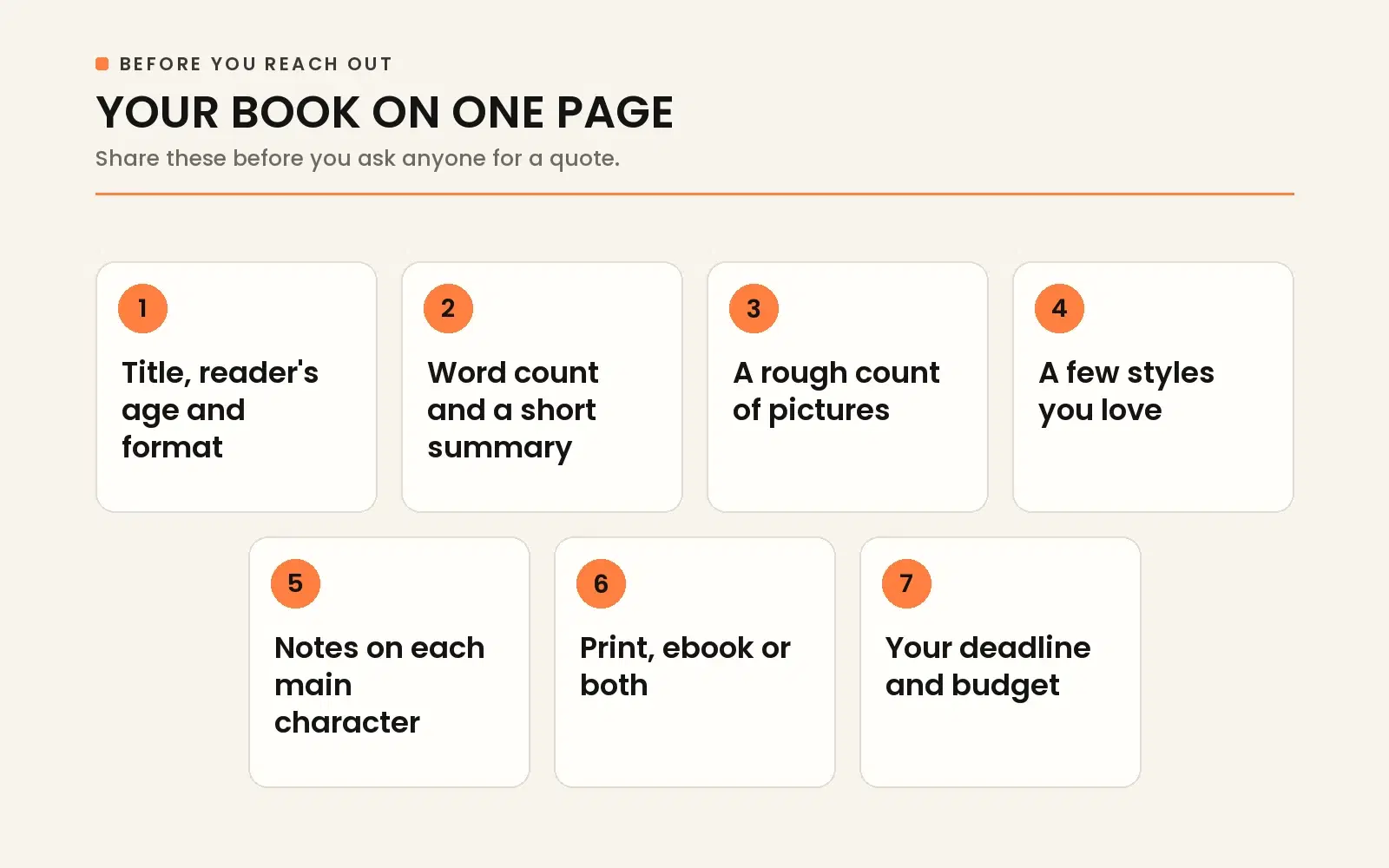
A one-page brief is a short summary of your book that goes to every illustrator on your list. That way, each one quotes the same job. Without it, one artist might price a handful of pictures while another prices a full book, and you won't be able to compare them. Your brief should cover these points.
- The title, the reader's age and the format, such as a picture book or an early reader.
- The word count and a short summary of the story, plus the full text if you're ready to share it.
- A rough count of spreads, single pages and spot drawings, and whether you need a cover.
- A few pictures whose style you love, each with a line on what draws you to it.
- A short note on each main character's age, looks and personality.
- Print, ebook or both, and the trim size if you know it.
- Your deadline and a budget you're comfortable saying out loud.
The budget line makes some authors nervous, but it saves everyone time. An illustrator can tell you honestly what fits inside it. If you'd like to understand what moves the cost of children's book illustration before you set that number, start there.
Where Can I Find a Children's Book Illustrator?
You can find a children's book illustrator in four main places. They're professional directories and illustrators' own websites, finished picture books at your library, social media and freelance marketplaces, and companies that offer illustration as a service. Each place gives you a different mix of choice and safety, so most authors use more than one.
Many first-time authors ask, "How do I find an illustrator for my children's book?" and then spend weeks scrolling without a plan. Here's how to find an illustrator for a children's book with far less scrolling. Start where picture book artists gather, build a list of eight or ten names, and only then start writing to people. Search wide first, then narrow your list on purpose.
Children's Book Illustrator Websites and Directories
Directories and children's book illustrator websites are the calmest place to start, because the artists there are showing work made for young readers. The Society of Children's Book Writers and Illustrators, known as SCBWI, is a member-based nonprofit for people who write, illustrate and translate children's books. Its Illustrator Gallery lists member illustrators with their contact details, their websites and a sample of their work.
Most working illustrators also keep their own website, with a portfolio page and a way to get in touch. Portfolio sites such as Behance hold many more. When you find an artist you like in a directory, visit their own site as well. It's often more up to date, and it usually lists the books they've already illustrated.
Finished Picture Books at Your Library
Your local library is a quiet but useful place to look, because every book on the shelf is finished work you can hold. Pull out picture books whose look you love, and find the illustrator's name on the cover or the title page. Then look that person up online. Illustrators who work mainly with large publishers may not take private projects. Plenty of others do, and their websites usually say whether they're open to new work.
Browsing the shelves also shows you how to find an artist for a children's book whose work truly suits your story. You're not judging one image on a screen. You're seeing how an illustrator carries a story across a whole book, and that's exactly the job you're hiring them for.
Freelance Marketplaces and Social Media
Social media and freelance marketplaces give you the widest choice, and they also need the most checking on your part. On Instagram, illustrators post new work often, and searching tags about children's book art turns up artists at every stage of their careers. Freelance marketplaces let you post your project and receive offers, sometimes within hours.
That speed is handy, but it cuts both ways. Anyone can post a portfolio, so check three things before you go further. Make sure the work is really theirs, that they've finished a whole book before, and that they'll sign a written agreement. The portfolio checks and red flags further down this guide matter twice as much here.
Freelancer, Studio or Publishing Company
When you're working out how to get a children's book illustrated, you have three main routes. You can hire a freelance illustrator directly or work with an illustration studio that has several artists. You can also use a publishing company that offers illustration alongside editing, layout and printing. Hiring a children's book illustrator feels quite different on each route, mostly in how much of the managing you do yourself.
| Option | Who keeps the schedule | What else it can handle | Often a good fit when |
|---|---|---|---|
| Freelance illustrator | You do | Usually the art only, sometimes the cover | You want one artist's style and don't mind managing the project |
| Illustration studio | The studio does | The art, and often the cover and character design | You want a choice of styles and someone else keeping things on track |
| Publishing company with an illustration service | The company does | The art, plus editing, layout, the cover and printing | You'd rather have one team take the book from story to print |
A freelance illustrator gives you the most direct contact with the artist, but you become the project manager. A studio adds structure, and a publishing company adds everything around the art, such as page layout and the print files. If that third route interests you, read about what a children's book publishing company does for you before you choose. Some of these companies also offer professional illustrators for hire.
None of the three routes is right for everyone. It comes down to how much managing you want to do, and how much of the book still needs help.
Does Your Illustrator Need to Live Near You?
No, your illustrator doesn't need to live near you. Much of today's picture book art is shared as digital files. Sketches go by email or a shared folder, and questions get settled on video calls. An illustrator in another part of the country can work as closely with you as one down the street.
Plenty of authors still search for an illustrator near them, and wanting to meet face to face makes sense. Picture a retired mail carrier in a small town who's written a story about the old covered bridge on his route. He hopes to find an artist at the library's craft fair so they can go over sketches together at the diner. The artist whose style truly fits his story lives two time zones away. After a few video calls, he finds that seeing sketches on a big screen works just as well.
Distance matters less than a few practical things. Check these before you rule anyone in or out.
- Time zones, so you both know when a quick question will get a reply.
- A shared language, because notes on sketches have to be understood exactly.
- How you'll pay, and whether a payment across borders adds fees or delays.
- Which country's law the written agreement follows, which matters more if something goes wrong.
If a local artist also fits your book, meeting in person is a lovely bonus. Just don't let a short drive decide the look of a book your family will keep for years.
How to Read a Children's Book Illustrator's Portfolio
A good children's book illustrator's portfolio shows the same character drawn many times, in different moods and places, on pages that leave room for words. One lovely picture tells you someone can draw. A run of pictures with the same character tells you they can carry a whole book, and that's the skill you're paying for.
Think of a nurse writing a picture book to help children through a hospital stay. She falls for an illustrator on Instagram whose rabbits and bears are beautiful, but every piece shows a new animal in a new scene. When she asks to see one character drawn five times, the illustrator can't show her any. Her story needs the same small bear to look scared, brave, sleepy and proud across a whole book, so she keeps looking.
What Does a Strong Picture Book Portfolio Show?
A strong picture book portfolio shows sequence, feeling and space, not just skill. Look for these six signs as you scroll through someone's work.
- The same character in at least three different scenes, with the face, colors and proportions staying the same.
- A range of feelings, because a character who can only smile can't carry a story with a problem in it.
- Full spreads across two pages as well as small spot drawings, since most picture books use both.
- Clear, calm areas where words could sit, because text set over busy art is hard for a child to read.
- A look that suits your reader's age, from bold and simple for toddlers to more detail for older children.
- Even quality from piece to piece, rather than one stunning image surrounded by weaker ones.
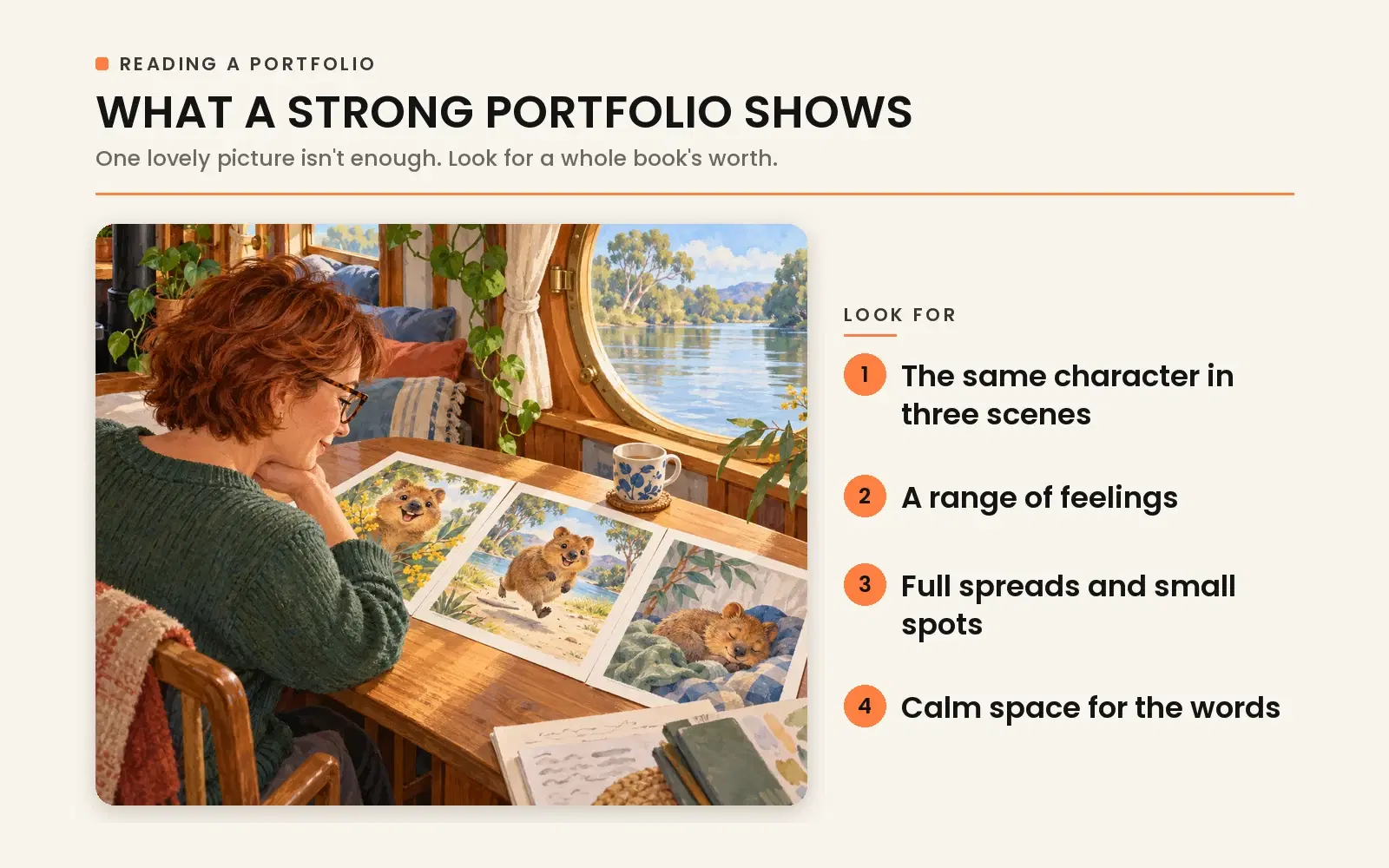
The fourth sign is the one most authors miss. As you look at each picture, ask yourself where the words would go. If you can't find a spot, the illustrator may not be used to leaving space for text, and that's worth raising before you hire them.
Ask to See a Finished Book, Not Just Favorite Pieces
A finished book is the strongest proof in any portfolio. It shows how an illustrator's work holds up in print and across every page of a story. Ask for the titles of books they've illustrated, then look them up, order a copy or read the preview pages online.
It's also fair to check that the work is really theirs. A reverse image search on one or two pieces takes a minute, and it can turn up the same picture under someone else's name. If you're unsure how a portfolio was made, ask plainly whether AI tools were used. An honest illustrator will answer that easily, and this post on how AI and human illustrators differ explains what the difference means for your book.
What Should You Ask Before You Say Yes?
Ask everyone on your shortlist the same questions so you can compare the answers side by side. The questions below cover experience, working style, time, money, files and anything special about your story. Each one tells you something a portfolio can't.
- Have you illustrated a children's book from the first sketch to the final files? A yes means they know how a whole book fits together.
- Can you show me one character you've drawn across a whole book? This is the consistency test in a single question.
- How do you work, from sketches to final art? Listen for a clear order of steps, from the character's first design through rough sketches to the finished pages.
- How many rounds of changes are included at each stage? Rounds of changes are the times you can ask for edits, and knowing the number avoids surprise bills.
- When could you start, and what else are you working on? A realistic answer is worth more than a fast one. This guide to how long illustrating a children's book takes shows what changes the timing.
- How do you price the work, and what does the quote include? Check whether it covers the cover, the spot drawings and the final files.
- Do you use AI tools anywhere in your work? You'll want an honest answer for your own records and for any platform that asks you about it.
- Will you deliver print-ready files at the right size and resolution? Amazon KDP, for example, asks for images of at least 300 DPI inside a paperback.
- Can you design the cover too, or should I plan for someone else? A cover that matches the inside pages makes the book feel whole.
- Have you drawn anything like the special parts of my story before? This is where you ask about a place, a culture, a disability or a time in history your book depends on.
That last question matters more than it looks. Imagine a mom writing a picture book in which the hero, like her own son, uses a wheelchair. She asks each illustrator whether they've drawn wheelchair users before and how they'd get the details right. One artist says she'd work from photos of the boy's actual chair and ask him what he'd like shown. That answer tells the mom more about the person than any portfolio piece could.
A Paid Test Sketch Tells You More Than a Call
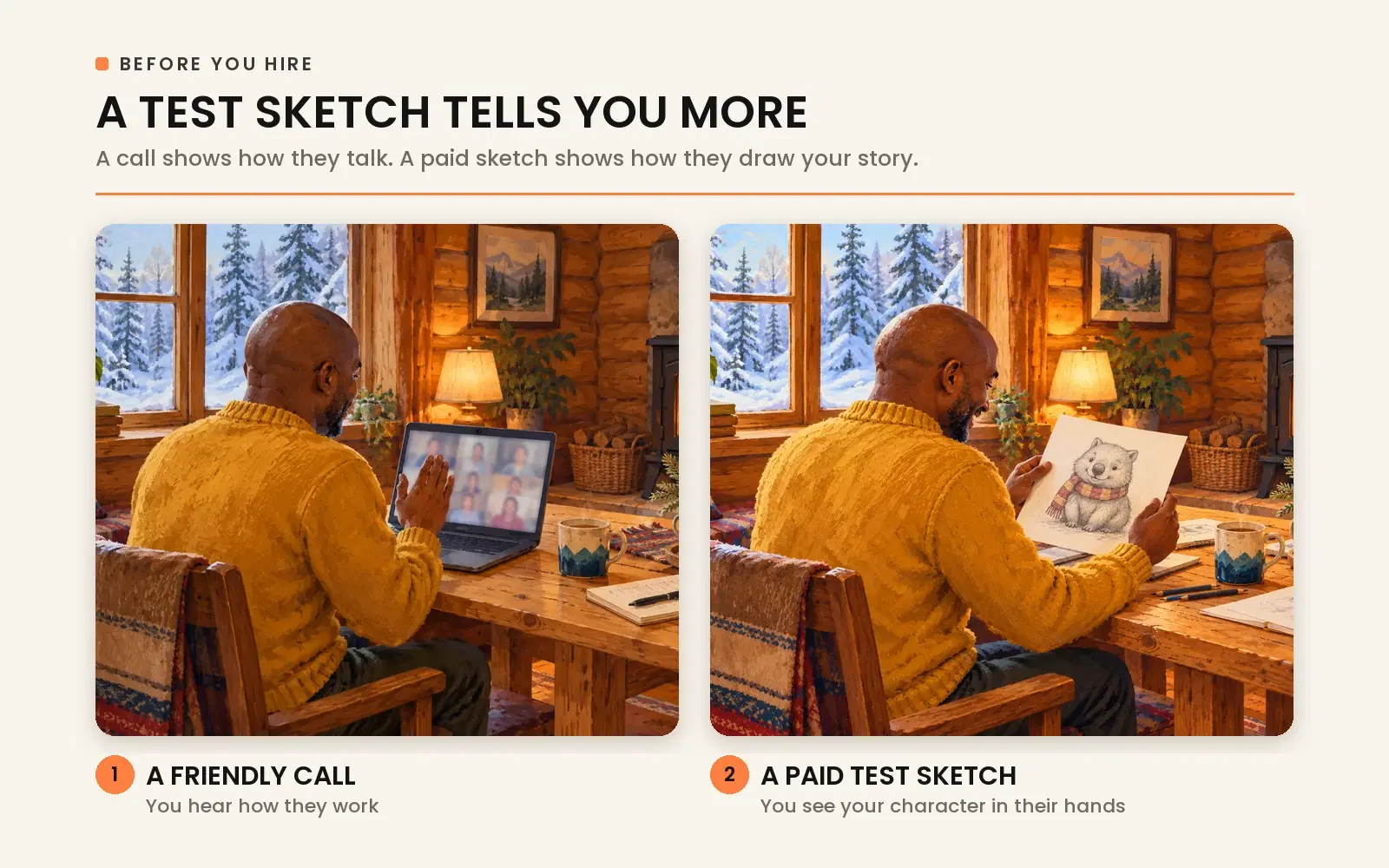
A paid test sketch is one drawing of your main character that you pay for before you hire an illustrator for the whole book. It shows how they read your story and how they take your notes. It also shows how your character looks in their hands, not just in their own portfolio.
Offer to pay for the sketch instead of asking for free test work. Plenty of professional illustrators don't do unpaid samples, and asking for one can put off exactly the people you'd most like to hire. A small paid sketch is fair to both of you, and if it doesn't work out, you've lost very little. If it does, you already have the first character sketch your book will grow from.
What Should You Agree in Writing Before the Art Starts?
You and your illustrator should sign a written agreement before any art starts. It should cover what's being drawn, how changes work, when things are due, how payment works and who owns the art afterward. A friendly email chain isn't enough. A signed agreement protects the illustrator as much as it protects you, and a good illustrator will expect one.
Your agreement should cover at least these points.
- The exact scope, meaning how many spreads, single pages and spot drawings, and whether the cover is included.
- How many rounds of changes come with the sketches and with the final art, and how extra rounds are handled.
- Dates for the sketches, the final art and the files, with a little room for real life.
- How much is paid, and at which finished stages.
- Who owns the copyright in the art, and where you can use it, such as the book, later editions and marketing.
- Whether you can use the main character in later books, toys or other products.
- How the illustrator is credited, for example on the cover and the title page.
- Which print-ready files you'll receive at the end, and in what format and resolution.
- Whether AI tools may be used, and how that will be shared with you.
- What happens if either of you stops partway, including any kill fee, which is a set payment for the work done so far.
Each of these points could fill its own page, and contract clauses deserve a closer look before you sign anything. How you give feedback on sketches matters too, and it's easier when the agreement already says how changes are asked for. If any clause confuses you, ask a lawyer to read it before you sign.
Who Owns the Pictures You Pay For?
Paying for the pictures doesn't by itself make you the owner of their copyright. Under U.S. law, copyright generally belongs to the person who created the work, unless there's a signed written transfer or the work counts as a work made for hire. The U.S. Copyright Office's guide to copyright basics also notes that owning a copy of a work doesn't give you its copyright, so holding the files isn't the same as owning the art.
That's why ownership belongs in your written agreement, in plain words. A work made for hire has specific conditions, and this post on the legal steps in publishing a children's book explains them in more detail. Another route is a written transfer of copyright, signed by the illustrator.
Ownership matters most when you're planning more than one book. Picture a retired firefighter writing three stories about an old fire truck named Rosie. If his agreement only lets him use the art in the first book, he may need new permission and a new payment later. That could come up before Rosie appears on the cover of book two, or on a mug to sell at the fire company's summer picnic. Settling that in the first agreement takes a few extra lines and saves a hard conversation later.
Pay in Stages, Tied to Finished Work
It's safer to pay an illustrator in stages, with each payment tied to a finished piece of work rather than to a date. One common pattern is a first payment to start, another when the sketches are approved, and the last when the final art and files arrive.
Stage payments protect both sides. The illustrator isn't working for months without pay, and you aren't paying for pages you haven't seen. Be wary of anyone who asks for the whole amount before a single sketch exists. Write the stages into your agreement so nobody has to remember them.
Which Red Flags Should Make You Walk Away?
Walk away from an illustrator who can't show finished books, won't sign a written agreement or wants full payment before any work exists. Those three red flags matter most, and the rest of this list will help you spot trouble early.
- No finished books, only single images, which leaves you guessing whether they can carry a story.
- Portfolio pieces in styles so different they look like several artists' work, which can mean some of it isn't theirs.
- A quote that arrives within minutes, with no questions about your story, your reader or your format.
- A refusal to sign a written agreement, or an agreement that never mentions who owns the art.
- A demand for the whole payment up front.
- Vague or changing answers about whether AI tools are used.
- A promise to finish a whole picture book in a very short time, which can mean cut corners or someone else doing the work.
- Pressure to decide today because a special offer is about to end.
- Slow, unclear replies before you've even hired them, which rarely get better once the work starts.
One red flag doesn't always mean dishonesty. A new illustrator may simply not have a finished book yet. In that case, a paid test sketch and a careful agreement can still make it work. Just go in with your eyes open.
Choosing Between Two Illustrators You Like
When two illustrators both fit your book, choose the one who understood your story more deeply, not the one with the prettiest portfolio. By this point both of them can draw, so the tie breaks on how each one works with you.
Say a piano tuner has written a story about a mouse who lives inside an old piano, and he's down to two artists. One paints soft watercolor scenes, and the other draws bold, bright digital pictures full of movement. Both test sketches are good. What settles it is that the second artist asked what the mouse hears when a key is struck and why that moment matters to him, then drew it, with the mouse leaping as the hammers swing. The first artist drew a lovely parlor with the piano standing in it.
If you're still stuck, compare the two on these points.
- Who asked more thoughtful questions about your story and your reader?
- Whose test sketch felt most like your characters?
- Who handled a small change calmly and without fuss?
- Whose schedule sounded realistic rather than eager?
- Whose agreement was clearer and fairer to both sides?
Price will be part of the choice too, but a cheaper quote only saves money if the book comes out the way you pictured it.
What Comes After You Hire
After you hire your illustrator, the work moves through a series of stages. It usually starts with character design and rough sketches, and it ends with final art and print-ready files. The post on each stage of a children's book illustration project walks through them in order. Your main jobs during that time are to answer questions quickly and to give clear, kind notes at the sketch stage, when changes are easiest. Kind, specific notes get better sketches, so decide how you'll give them before the first drawings arrive.
Having Your Book's Pictures Drawn by Book Writing US
If you'd rather not run the search on your own, we can help. At Book Writing US, our children's book illustration services cover picture books, early readers and educational books, and our illustrators create the pictures for the whole book, main character included.
Our illustration service can also work alongside our children book publishing services. If that sounds useful, get in touch and tell us about your story.
Frequently Asked Questions
How do you find an illustrator for a self-published book?
You find an illustrator for a self-published book yourself, because in self-publishing you choose, hire and pay the illustrator. That's the main difference from traditional publishing, where the publishing house's art director finds the illustrator for you. Since nobody else is in charge of the art, you also need to settle who owns it in writing. That's part of how to find an illustrator for a self-published book safely. If you're still deciding whether you need your own illustrator at all, that post covers both routes.
Can I find a children's book illustrator for free?
You can search for a children's book illustrator for free, but the illustration itself is paid work. Directories, illustrators' own websites, the library and social media all cost nothing to browse. Art students and newer illustrators may charge less while they build their portfolios, but a fair agreement and fair pay still apply. Be wary of any offer to illustrate a whole book for free, since free work often comes with no agreement and no clear ownership.
Should I tell an illustrator my budget before they quote?
Yes, sharing a budget range usually gets you a more useful quote. An illustrator can then tell you what fits inside it, such as fewer spreads, simpler backgrounds or spot drawings instead of full pages. Keeping it secret often leads to quotes you can't compare, or a long back and forth. You don't have to share your top figure, just a range you're comfortable with.
Can the same illustrator draw every book in a series?
Yes, and keeping one illustrator across a series is the simplest way to keep your characters looking the same from book to book. Ask early whether they'd like to stay on for later books, and make sure your first agreement lets you use the characters again. If the illustrator later becomes unavailable, clear reference drawings of each character and your ownership of the art make it far easier for someone new to carry on.
Should you hire an illustrator before your story is edited?
It's usually wiser to finish editing your story before you hire an illustrator. The words decide what each page shows. A change to the text after sketches start can mean redrawing pages and paying for extra rounds of changes. Settle the text, the page breaks you have in mind and the main characters first. Then an illustrator can plan the whole book around words that won't move.
What if the illustrator isn't working out partway through?
If the illustrator isn't working out, talk to them early and specifically, ideally at the sketch stage when changes are still simple. Many problems turn out to be misunderstandings that one clear note can fix. If things still don't improve, your written agreement should say how either side can end the project and what's owed for the work done so far. That's why the stop terms and any kill fee belong in the agreement before the first sketch.
- What Should You Decide Before You Look for an Illustrator?
- Where Can I Find a Children's Book Illustrator?
- Freelancer, Studio or Publishing Company
- Does Your Illustrator Need to Live Near You?
- How to Read a Children's Book Illustrator's Portfolio
- What Should You Ask Before You Say Yes?
- What Should You Agree in Writing Before the Art Starts?
- Which Red Flags Should Make You Walk Away?
- Choosing Between Two Illustrators You Like
- What Comes After You Hire
- Having Your Book's Pictures Drawn by Book Writing US
- Frequently Asked Questions