Children's Book Categories by Age, From Board Books to Middle Grade
Short Answer: Children's books fall into five main categories by the reader's age, from board books for babies up to middle grade for readers around 12. Board books suit ages 0 to 3, picture books 3 to 8 and early readers 5 to 8. Chapter books suit about 7 to 10, and middle grade suits 8 to 12. A picture book is just one of those categories, a book of usually 32 pages where the pictures and words tell the story together.
Many first-time authors start by asking, "What is the difference between a picture book and a children's book?" The names on the children's shelf can sound like insider words, but each one changes how your book gets made. Your category sets the page count, the amount of illustration, the print format and the reading age your book is listed under. So it pays to settle it before anyone starts drawing. Below, you'll find each category from board books to middle grade, along with a side by side table. You'll also learn how to tell where your book belongs, and there's a short note on young adult, too.
What Is the Difference Between a Picture Book and a Children's Book?
"Children's book" is the name for the whole shelf of books written for young readers. A picture book is just one format on it. In a picture book, the pictures carry the story at least as much as the words do, and there's art on every page. So if you've written a 600-word bedtime story to read aloud to your granddaughter, you've written a picture book. It's still a children's book too, since every picture book belongs to that bigger group.
The gap between the two terms grows as readers get older. In the longer categories, such as chapter books and middle grade novels, the words do most of the work and the pictures shrink or disappear. A 32-page story about a lost kitten and a 150-page school adventure are both children's books, but only the first one is a picture book.
Getting the name right also tells you what your book needs. A picture book needs a full set of illustrations, while a chapter book usually needs only a drawing or two per chapter. So when you talk to an illustrator or a publisher, name your exact category instead of just calling it a children's book. That phrase could mean a board book or a 200-page novel, and each one gets planned differently.
Is a Picture Book the Same as a Storybook?
People often mix up picture books and illustrated storybooks, but they aren't quite the same thing. In an illustrated storybook, also called a picture storybook, the words could stand on their own and the pictures add to them. A storybook also tends to carry more text, sometimes a full paragraph on a page. In a picture book, the story doesn't work without the art.
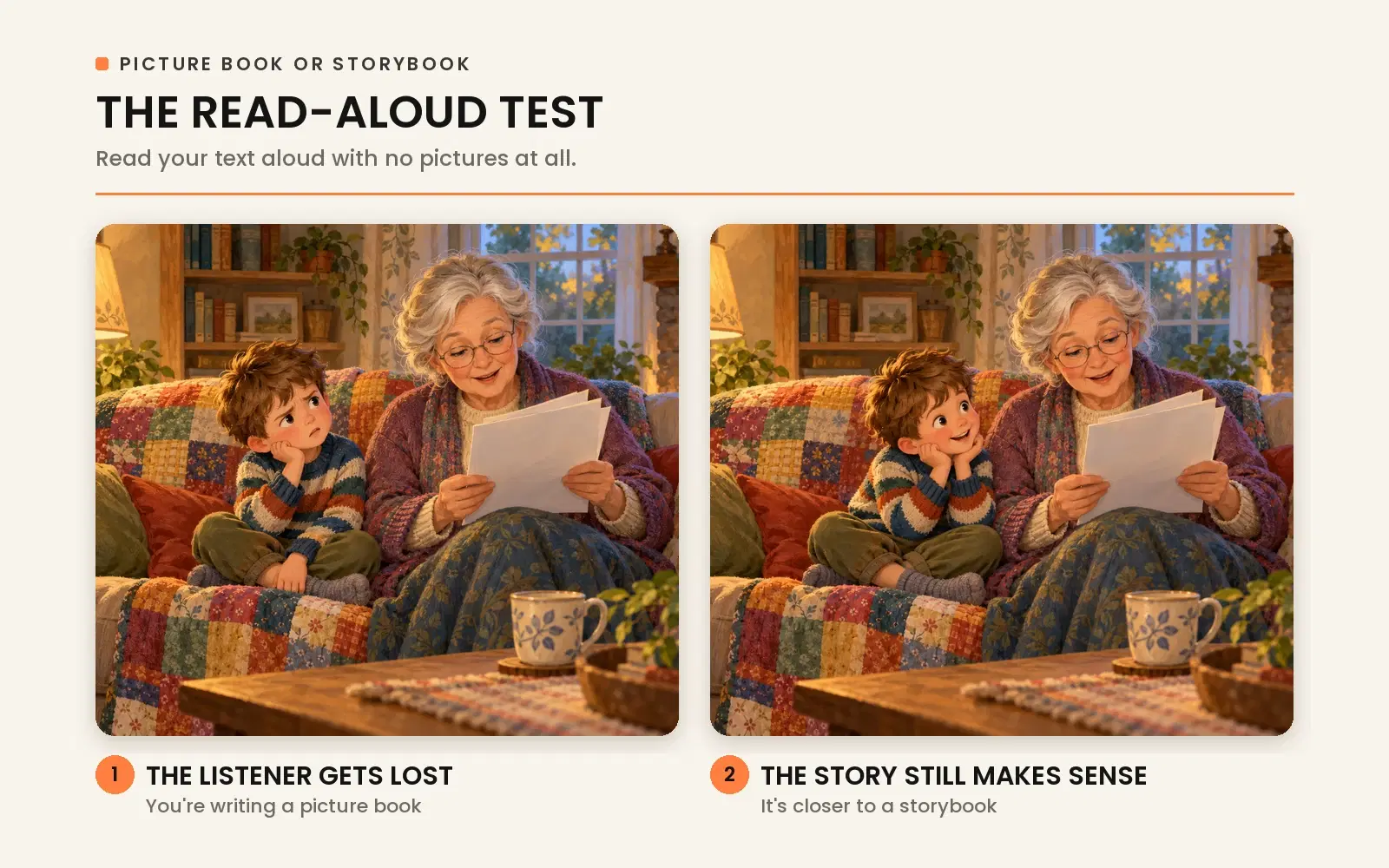
You can test your own story in a minute. Read your text out loud with no pictures at all. If a listener misses what happens, you're writing a picture book. If your story still makes sense, it's closer to a storybook. Many classic children's books are illustrated storybooks, though the format is less common today. Your answer changes how much text sits on each spread and how your illustrator plans every page.
Every Children's Book Category Side by Side
Here are the children's book categories by age, from the youngest reader to the oldest. For each one, you'll see the typical length in pages, how much art it carries and how it's usually printed.
| Category | Reader age | Typical length | Pictures | Usual print format |
|---|---|---|---|---|
| Board book | 0 to 3 | About 12 to 24 pages | On every page | Thick paperboard pages |
| Picture book | 3 to 8 | Usually 32 pages | On every page, usually full color | Paperback or hardcover |
| Early reader | 5 to 8 | About 32 to 64 pages | Helping the words along | Smaller trim, often a series |
| Chapter book | 7 to 10 | About 48 to 80 pages | One or two per chapter | Laid out like a short novel |
| Middle grade | 8 to 12 | About 80 to 200 pages | Few or none | Paperback or hardcover, mostly text |
| Young adult | 12 to 18 | Up to about 300 pages | Usually none | Listed as teen and young adult |
The ages overlap, and they shift by a year or two depending on who you ask. A 7 year old fits three rows at once, picture book, early reader and chapter book, so a birthday alone won't settle much. Pick the category that matches who reads your book and how. Amazon also uses its own age bands, which get their own section below.
Board Books Are for Babies and Toddlers
Board books are for babies and toddlers, from birth to about age 3. Every page is made of thick paperboard, so small hands can grab it, chew it and turn the pages without tearing them. A board book usually runs about 12 to 24 pages and has very few words, often well under 300. The answer to "What age are board books for?" also shapes how you write one. A toddler needs just a word or a short line on each page.
Amazon KDP can't print a board book, because it only prints paperbacks and hardcovers. IngramSpark's binding list doesn't include board books either. So your board book has to be made by a printer that works with paperboard. Many board books are created by publishers' own teams, and many others are reprints of picture books, sometimes with pages cut or condensed.
A board book is really a way of binding a book, not just a category. If you're torn on picture book vs board book, look at how much story you've got. A story that needs a real plot and more than a line on each page is a picture book first. A board book edition can follow later.
A Picture Book Splits the Story Between Words and Art
A picture book is for children about 3 to 8, and a grown-up usually reads it aloud while the child follows the pictures. The picture book age range is wide, but the format stays fairly steady. There's art on every page, and most picture book texts stay under 1,000 words. Larger trims suit picture books, since a grown-up holds the book open to read it aloud.
Because the art fills every page and is usually printed in full color, illustration is the biggest job in making your picture book. Each illustration goes from a rough sketch to final art, which is why the art often takes the longest, too. You can see how the stages add up in our guide to how long it takes to publish a children's book. The look of that art is a separate choice. You can compare the main children's book illustration styles before you talk to an illustrator.
Does a Picture Book Have to Be 32 Pages?
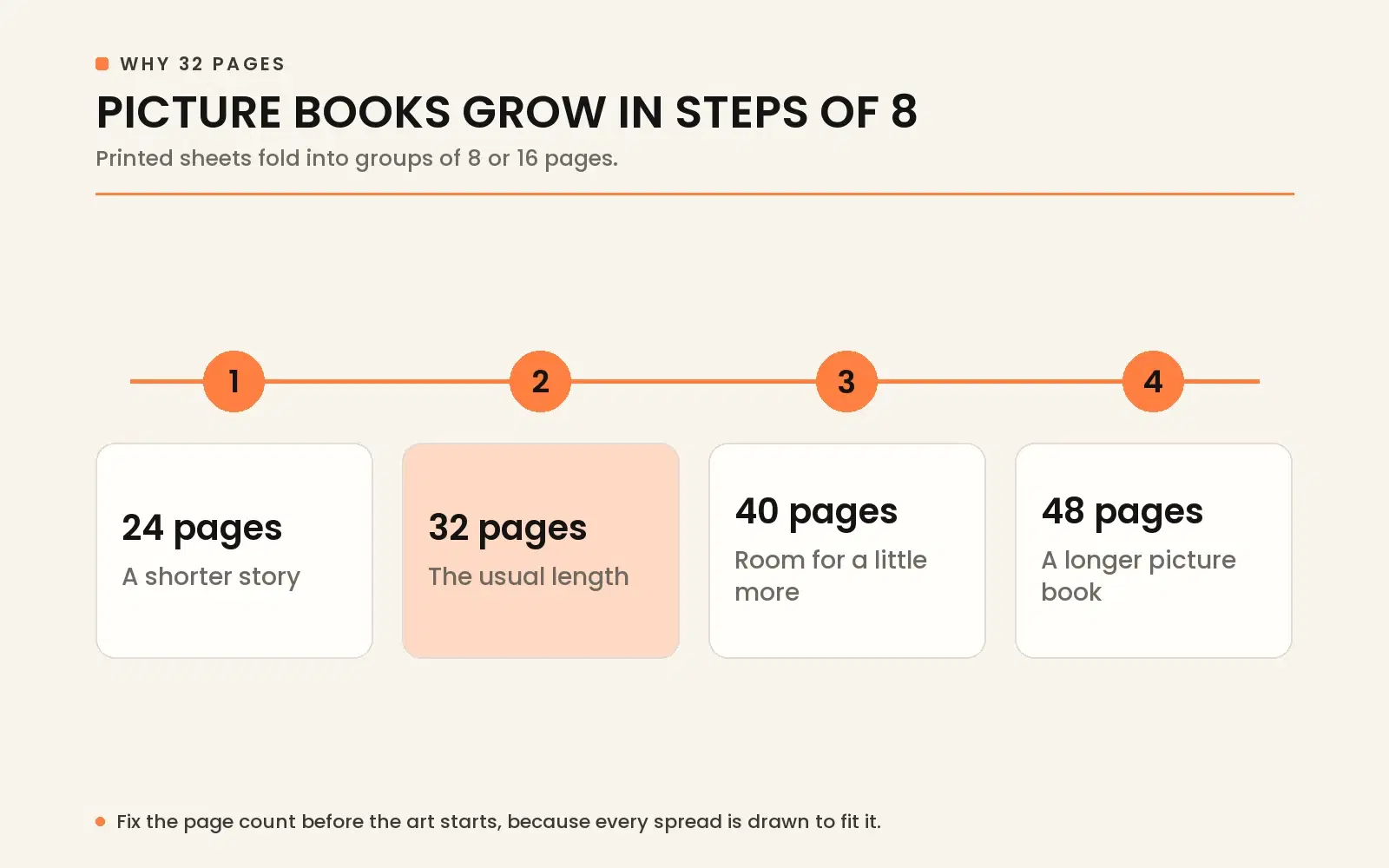
Picture books don't have to be 32 pages, but most are. Books are printed on big sheets that get folded into groups of 8 or 16 pages. That's why picture books come in steps such as 24, 32, 40 or 48 pages, with 32 as the usual length. So your picture book can run 24 or 40 pages if your story needs the room. Just fix the page count before the art starts, because every spread is drawn to fit it.
Amazon KDP prints hardcovers from 75 pages up, so a 32-page picture book can be a KDP paperback but not a KDP hardcover. If you had a hardcover in mind, this matters, because hardcovers suit gift and library buyers and stand up to repeat reading. KDP's premium color paperbacks start at 24 pages, so a short picture book still fits as a paperback. Your trim size gets chosen before the art too, for the same reason as the page count. How your 32 pages split into spreads is its own topic. Our post on storyboarding a picture book spread by spread covers it.
What Is a Wordless Picture Book?
A wordless picture book tells its whole story through pictures alone, with no written text on the story pages. Wordless books are a real category, published just like other picture books. Part of their charm is that children who can't read yet can still follow the story through the pictures.
Librarians value these books for a much wider group of readers. Children's librarians at the Association for Library Service to Children describe wordless picture books as a way into a story for readers of any age. They also see them as conversation starters for language learners.
For publishing, the big difference is who carries your story. Your illustrator tells the whole thing, so your manuscript is really a page by page plan of what each picture shows. The finished book still has a title page and a copyright page, just like a picture book with words. Each print format, such as a paperback or a hardcover, also needs its own ISBN.
Early Readers Are Read by the Child, Not to the Child
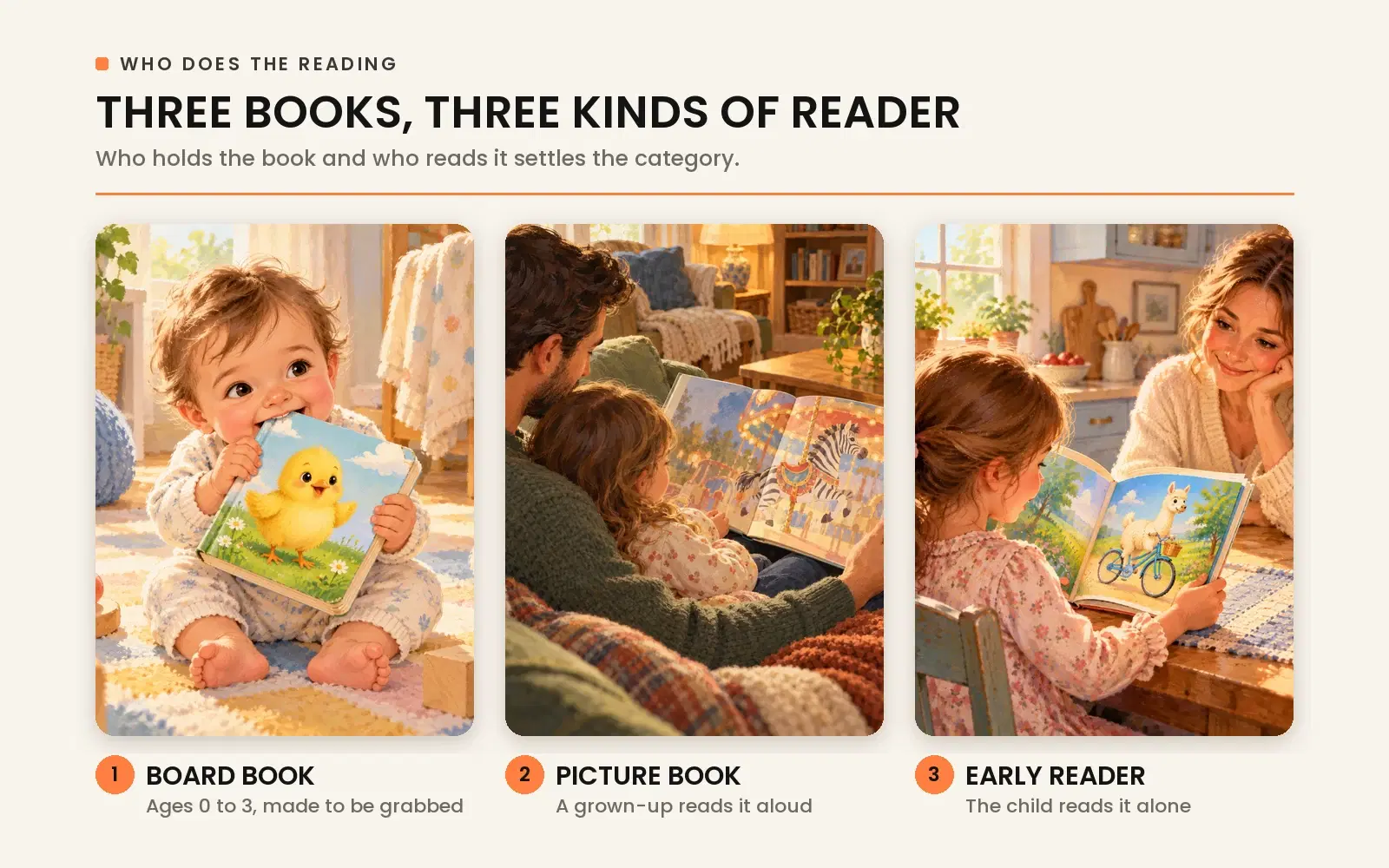
An early reader is a book a child reads alone while learning to read, usually around ages 5 to 8. The words are simple, the sentences are short, and the pictures help without carrying the story. So if your 6-year-old is learning to read and you want her to read the book to you, write an early reader. If you'll be the one reading it to her at bedtime, a picture book fits better.
If you're deciding picture book vs early reader, that one question settles most cases. A grown-up reads a picture book to a child, while a child reads an early reader alone, often out loud to a grown-up. There's also a middle step called an easy-reading picture book. It's 32 pages like a picture book, but its words and sentences are simple enough for a new reader.
The early reader format changes the publishing side, too. Early readers suit a smaller portrait trim that a child can hold, and they run about 32 to 64 pages. Most belong to a series, because kids who are just starting to read want more of the books they like. So if you're planning an early reader, think about book two before book one is finished. Reading levels and word lists are a topic of their own. For now, it's enough to know that the early reader age range matches the first few years of school.
Chapter Books Are for Kids Ready for a Longer Story
A chapter book is a short novel for children who can read on their own. The chapter book age range runs about 7 to 10. It's split into short chapters, often with just one or two drawings in each. A chapter book usually runs about 48 to 80 pages, with a lot more text than an early reader. It sits between early readers and middle grade. Most chapter books are fiction of moderate length and complexity, aimed at kids who've moved past early readers.
The big change from a picture book is that the words now carry the story. The art shrinks to a few small drawings, so your chapter book needs far fewer illustrations. Its pages look like a novel's pages, with the text doing most of the work. So when people compare picture book vs chapter book, this is the real difference, because it changes how much art you need.
To settle early reader vs chapter book, look at length and structure. You can read an early reader in one sitting, but a chapter book is built to be read over several. Short chapters matter as much as the total length, because they give a young reader a natural place to stop and come back later.
Middle Grade Is Where the Words Take Over
Middle grade novels are for readers about 8 to 12, run roughly 80 to 200 pages and have few or no pictures inside. If you've written a 25,000-word adventure for 9 year olds, you've most likely written middle grade, at the younger end. Middle grade for 9 to 11 year olds usually starts at around 20,000 words, so your story is already past that line. A 9 year old fits both the chapter book and middle grade bands, which is why the length and the story settle it.
When people weigh chapter book vs middle grade, length isn't the only thing that matters. A middle grade novel has a fuller plot, often with subplots and more backstory, and your reader is reading alone. So your book gets made much like any other novel. With so few pictures inside, most of the work goes into editing the words, and the cover becomes the main picture your reader sees.
The middle grade age range also splits in two. Younger middle grade sits close to chapter book length, while older middle grade runs longer and reaches toward young adult. Both ends can stretch a year or two past the usual 8 to 12. A true middle grade novel of 80 pages or more clears Amazon KDP's 75-page minimum for hardcovers. So paperback and hardcover are both open to you.
Young Adult Sits Just Past the Children's Shelf
Young adult books are for teens, about 12 to 18. Publishers and libraries use the term young adult to mean books for teens, and they count it as the oldest part of children's publishing. Libraries and stores sometimes give these books their own teen section, though. Amazon, for example, keeps its Teen & Young Adult categories apart from its Children's categories.
Young adult books are full-length novels, often up to about 300 pages, with more complicated themes than middle grade. The stories often deal with the challenges teens face, such as identity, friendships and finding their place in the world. Here's a simple rule of thumb for your own book. If the reader you picture is a teenager reading alone, you're writing young adult, not middle grade.
How Do You Know Which Category Your Book Belongs In?
You can usually find your book's category by asking who will hold the book and who will do the reading. That one answer settles most cases. The length and the amount of art follow from it. If you're still unsure, these four questions will help you check.
- Who reads it, a grown-up reading aloud or the child alone?
- Does your story still work if you take the pictures away?
- Could it be told in about 32 pages, or does it need chapters?
- How old is the child you picture holding it?
Say you've written a story about a girl who builds a treehouse with her grandpa. If you picture a 4 year old on your lap, it's a picture book. If you picture an 8 year old reading it alone after school, it's heading toward a chapter book.
If your answers point to two categories, choose by the reader rather than the word count. Settle it before anyone draws a page, because changing the category later means redoing the layout and often the art. Turning a picture book into a chapter book, for example, means rewriting it into chapters and dropping most of the pictures.
Once your category is clear, the rest of the process follows a set order. Knowing it early also makes your schedule easier to plan, since the time a book takes depends on its page count and art. Our guide to how children's book publishing works walks you through each stage, from the finished manuscript to the printed book.
Amazon Uses Its Own Age Bands for Children's Books
When you list a children's book on Amazon KDP, you can set a reading age. The field is optional, but it matters. Amazon's age bands don't line up exactly with the categories publishers use. Amazon asks you for a minimum and a maximum age. So a picture book for 3 to 7 year olds can simply span two of its bands, 3 to 5 and 6 to 8.
Amazon puts simple picture books with few or no words at 0 to 2, and picture books at 3 to 5. Early readers and first chapter books sit at 6 to 8, and middle grade at 9 to 12. Teen and young adult books go at 13 to 17.
The reading age matters more than it looks. Amazon says a children's book without an appropriate reading age may not be eligible for the Children's categories you picked. It also won't appear in age-specific search results. Once customers review your book, Amazon can update the reading age on your book's page based on their feedback. If that happens, you can't change the customer-recommended age through KDP.
That's one more reason to settle your category early and write to it. When the reading age you set matches the book you've actually written, your book can show up in the age-specific results parents browse. If you're unsure, pick the band that matches who does the reading, the same test that settles your category.
Settle the Category Before the Art Starts
Your book's category is the first real publishing decision, because the page count, trim size, art and Amazon listing all follow from it. Once you know who's reading the book, every choice after that gets simpler to make.
At Book Writing US, we help authors take a finished children's manuscript all the way to a printed book. That covers editing, illustration, page design, the cover, printing and publishing. We work on picture books, early readers and educational books. If you already have art, we can work with it, and if you don't, you can have it drawn through our children's book illustration services. When you're ready to publish your children's book, connect with us and bring your manuscript and a clear picture of the child you're writing for.
Frequently Asked Questions
Is a board book the same as a hardcover?
No, a board book and a hardcover are built differently. A hardcover has ordinary paper pages inside stiff covers, while a board book uses thick paperboard for every page, covers included. Many board books are reprints of picture books that already exist, sometimes with pages cut. So your story could come out first as a hardcover picture book and later as a board book.
Is a graphic novel a picture book?
No, a graphic novel isn't a picture book, even though both lean heavily on art. A graphic novel is a book-length story told in comics, with panels and speech bubbles carrying the action. A picture book pairs a short text with one picture on each page or spread, and a grown-up usually reads it aloud. Graphic novels for young readers are a category of their own.
Is a chapter book the same as a novel?
A chapter book is close to a novel, but publishers treat it as its own step. Chapter books are for readers about 7 to 10, and they sit between early readers and true novels. They have short chapters, simpler plots and a drawing or two in each chapter. Middle grade is usually where the word novel starts, because that's where the books get longer and the pictures mostly drop away.
What age is upper middle grade?
Upper middle grade, sometimes called older middle grade, is for readers about 10 to 14. That runs past the usual 8 to 12 middle grade band, because these books lead into young adult. They run longer than younger middle grade, often 128 to 200 pages or more. Lower middle grade sits at the other end, for readers around 7 to 9, and it's much closer to chapter book length.
Is an easy reader the same as an early reader?
Yes, an easy reader and an early reader are the same kind of book under two different names. You'll also see it called a leveled reader. Whatever the label, it's a book your child reads alone while learning to read. It has simple words, short sentences and pictures that help without telling the story.
What is a concept book?
A concept book explores an idea, such as colors, instead of telling a story. It's a special kind of picture book and the most common format for toddlers and younger children. The text is usually very short, so the pictures do most of the teaching. Since toddlers are also the board book age group, a concept book often works well as a board book.
- What Is the Difference Between a Picture Book and a Children's Book?
- Every Children's Book Category Side by Side
- Board Books Are for Babies and Toddlers
- A Picture Book Splits the Story Between Words and Art
- Early Readers Are Read by the Child, Not to the Child
- Chapter Books Are for Kids Ready for a Longer Story
- Middle Grade Is Where the Words Take Over
- Young Adult Sits Just Past the Children's Shelf
- How Do You Know Which Category Your Book Belongs In?
- Amazon Uses Its Own Age Bands for Children's Books
- Settle the Category Before the Art Starts
- Frequently Asked Questions