How Long It Takes to Publish a Children's Book, Stage by Stage
Short Answer: The time it takes to publish a children's book depends on which stages your book still has ahead. For an illustrated picture book, the art is usually the longest one. The last steps are short, and Amazon KDP says a new paperback's page can take up to 72 hours to show up on Amazon.com. A traditional publishing deal is usually much slower, because the publisher sets the schedule and you wait on it.
You've finished your manuscript, and now you'd like a date to plan around. "How long does it take to publish a children's book?" is a fair thing to ask, whether you're a first-time author, a parent or a grandparent. The trouble is that most answers online hand you a range of months with nothing behind it. A range like that can't tell you why your own book might take longer or shorter.
The honest answer to how long the book publishing process takes comes one stage at a time. This guide goes through each stage and explains what its time depends on. It gives a number only where an official page or platform publishes one. If you'd like each stage explained first, start with how children's book publishing works, then come back here for the timing.
How Long Does It Take to Make a Children's Book?
Making a children's book takes as long as its stages add up to. Several stages stand between your finished children's book manuscript and a printed copy in your hands, and each one takes time for a different reason. The ones that matter most for timing are editing, illustration, layout and typesetting, cover design, the paperwork, a proof copy, platform review and printing.
This table gives you the short answer to how long it takes to make a children's book. It also shows which stages have to wait their turn and which ones can happen at the same time, and that's what shapes your self-publishing timeline.
| Stage | What the time mostly depends on | Can it run alongside the art? |
|---|---|---|
| Editing the manuscript | How much the story still changes, how many rounds, how fast you rewrite | No, the words settle first |
| Illustration | How many pages carry art, how detailed the style is, the illustrator's calendar, your feedback speed | This is the art stage |
| Layout and typesetting | Page count and how the text sits on the art | No, it needs the final art |
| Cover design | Rounds of feedback on the front, spine and back | Partly, once the cover art exists |
| ISBN, control number and copyright page | Deciding who owns the ISBN and applying before publication | Yes |
| Proof copy | Printing and shipping, shown as a delivery date when you order | No |
| Platform review | The platform's own review, and up to 72 hours for a new paperback's page to appear on Amazon.com | No, it needs final files |
| Printing | Print on demand prints each order, while a print run is made in bulk first | No |
The rows marked "No" are the stages that stack end to end, so they set the length of your timeline. The rows marked "Yes" or "Partly" can happen while the art is being made, and they only add time when they're left until the end.
How Long Does Editing a Children's Book Take?
Editing a children's book has no set length, because the time goes into rounds of changes and your rewrites between them. A picture book text of a few hundred words can be read in minutes. The reading is never what takes the time. Editing still takes more than a day or two, because each round has to wait while you rewrite. A developmental round can also change the story enough that the new version needs another full look.
Many authors want to know how long it takes to publish a book after writing it. It depends on what you mean by finished. The real countdown starts when your words stop changing, not on the day you type the last word. A finished draft and a final manuscript aren't the same thing. Your draft is what you wrote, and your final manuscript is the version you've read aloud, edited and agreed not to touch again.
Here's a practical tip that saves time later. Read your text aloud, fix anything that trips your tongue, and settle it before the illustration begins. A line that changes after the sketches are drawn can mean redrawn pages, because the pictures are planned around the words on each spread. To see what each round of editing actually does to a manuscript, read our guide on how editing and proofreading polish a book.
Why Illustration Usually Takes the Longest in a Picture Book
Illustration is usually the slowest part of publishing a children's picture book, because nearly every page carries finished art. Each piece is drawn, checked and approved before the next stage can use it. That's why, when you ask how long it takes to publish a children's picture book, most of the answer sits in this one stage.
The art also can't start early. The trim size and the binding have to be picked before the drawing starts, because each picture is made to fit the page. The text needs to be settled first for the same reason. The pictures then move from rough sketches to final art, with your feedback in between. That order means a changed idea gets fixed quickly in pencil, not slowly in finished color.
Picture an author who decides, after the last spread is painted, that the book should be square instead of tall. Every picture was drawn for the old shape, so the pages go back to the illustrator to be reworked. The longest stage of the whole book then starts again for those pages.
What Makes the Art Stage Shorter or Longer
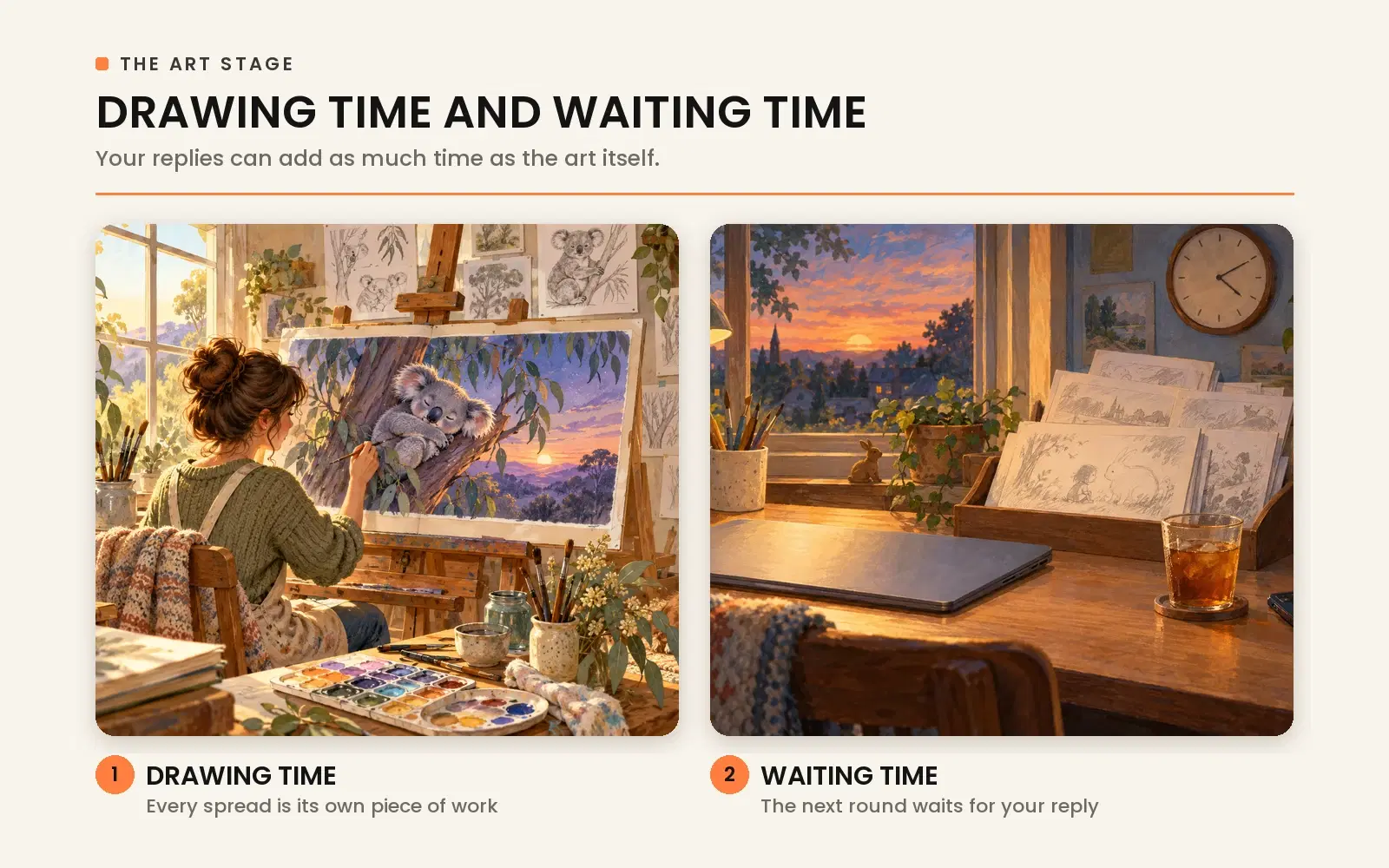
The illustration stage for a children's book gets shorter or longer because of a few things you can see before it starts. That's also why a careful illustrator may not give you an exact finish date on the first day. Here's what makes the biggest difference.
- How many pages or spreads carry full art, since each one is its own piece of work.
- How detailed the style and medium are, because a busy painted scene takes longer than a clean, simple one.
- Whether the illustrator is booked on other projects when you want to start, which adds waiting time before any drawing happens.
- How quickly you reply to sketches, since the next round can't begin until you've answered.
- Whether the text or the trim size changes after the sketches, which can send pages back to be drawn again.
- How clear your brief was, because a vague brief leads to extra rounds of guessing.
Two of those six are waiting time, not drawing time. Your replies and the illustrator's schedule can add as much time as the art itself. The best way to keep this stage short is to catch problems while they're still in pencil. That's exactly what storyboarding every spread before the final art does for a picture book.
Layout Starts When the Art Is Final
Layout and typesetting for a children's book begin once the final art is approved, because the words are placed around the pictures page by page. Cover design can start sooner, as soon as the cover art exists. The cover doesn't have to wait for the inside pages.
What stretches the layout stage is text that changes again. Once typesetting has started, a changed manuscript means the words on every page have to be set again, which is called reflowing. A sentence that moves on one spread can push words across a face or into a corner on the next. Each of those pages then needs checking again. The layout stage is quick when the words are truly final, and slow when they aren't.
The cover has its own rounds of feedback, first on the front and then on the spine and back. The spine's width depends on the final page count, so the full cover is finished once the inside is settled. It's worth approving your words one last time before layout starts, not after. It's far easier to change a line in a document than on a finished page.
The Paperwork That Can Run Alongside the Art
You can get your ISBN and request a Library of Congress Control Number while your illustrations are still being drawn. Both numbers then go onto the copyright page during layout. None of this paperwork needs finished art, so it only slows a children's book down when it's left until the end.
An ISBN is a number that identifies one edition of a book, such as the paperback or the hardcover. In the United States, ISBNs come from Bowker, the national ISBN agency. The real decision isn't the wait, it's who owns the number. You can use your own ISBN or a free one from Amazon KDP. KDP's free ISBNs can only be used on KDP, so it's worth deciding before anything is uploaded.
A Library of Congress Control Number works differently, because timing matters. These numbers are assigned in advance of publication through the Library of Congress Preassigned Control Number program. The Library of Congress can't give a preassigned control number to a book that's already been published. So the request belongs well before your release date. Ideally, it goes in while the art is still in progress.
Copyright is the easiest of the three. The U.S. Copyright Office says your work is protected from the moment it's created and fixed in a tangible form. That means registration isn't a step you have to wait on before you publish. The copyright page inside your book just needs the right details in place before the layout is final.
How Long Does the Platform Review Take?
Platform review is one of the shortest stages in publishing a children's book. After you publish a paperback on Amazon KDP, KDP says its detail page can take up to 72 hours to appear on Amazon.com. On IngramSpark, files that meet its file requirements take 3 business days to reach an eproof you can review, according to its user guide.
While a book is In Review on KDP, it's locked. You can't make changes until the review is finished. KDP also says review time varies with the type of book you submit. A file that doesn't pass the check has to be fixed and sent again. That means waiting through review a second time.
The short wait at this stage only stays short when the files were right the first time. That's why the careful work on files happens before upload, not during review.
How Long Does a Proof Copy Take?
Amazon KDP recommends ordering a proof copy of your children's book before you publish, so you can check your ink and paper choices. The time a printed proof adds is printing plus shipping. KDP gives you a delivery date when you order. That date already allows for manufacturing time. After you request a proof, KDP emails you a link to complete the order within 4 hours. You then have 24 hours to finish the purchase before the proof copies drop out of your cart.
KDP lets you order proofs while the book is still in Draft. So on KDP, the proof comes before you press publish and before the review begins. On IngramSpark, the first proof is a digital eproof that you review on screen, and IngramSpark recommends ordering a printed copy as well.
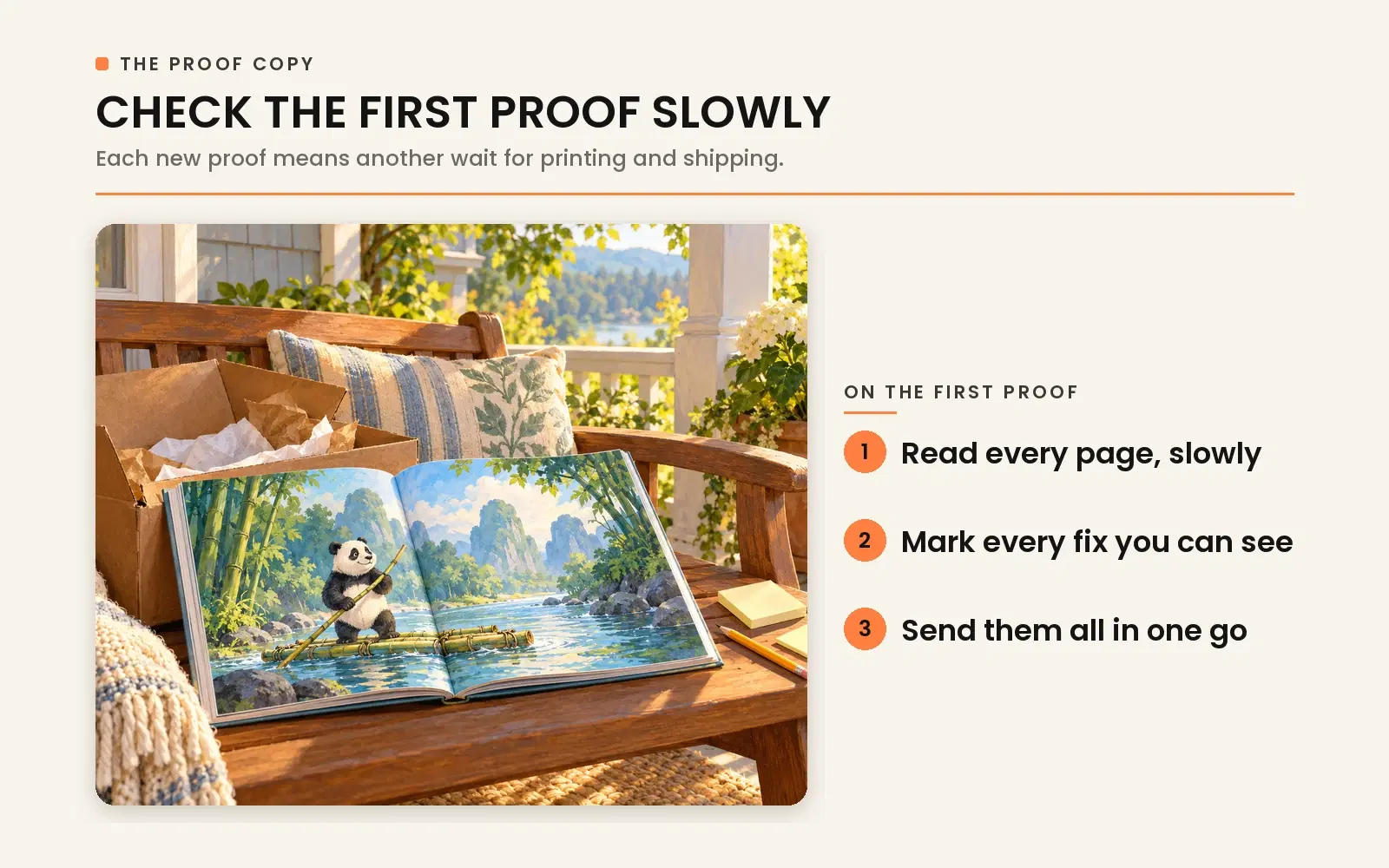
Say your first proof arrives and the night sky on one spread prints so dark that the little owl in the tree almost disappears. The art file has to be lightened. Then a second proof means a second wait for printing and shipping. That's why it pays to check the first proof slowly and fix everything you can see in one go.
When Your Book Shows Up in Search and Other Stores
A children's book can be live on Amazon before it shows up in search results. On Amazon KDP, a Kindle ebook can take up to 72 hours after it's live to appear in search. A paperback can take 48 hours to 1 week after each version is live to be linked to its ebook edition. Until those links settle, a reader might find one edition of your book and not the other.
Other stores that order through a distributor update their listings on their own schedules. Your book can appear in one place before another. So don't announce your book the minute you press publish. Give the listings a few days to settle, then share a link you've checked yourself.
How Long Does It Take to Print a Children's Book?
With print on demand, a children's book isn't printed until someone orders it. Printing time becomes part of each order, rather than a stage you wait through before release. Because copies are made one order at a time, there's no stock to wait for and none to store. So the time printing adds depends on which kind of printing you choose.
Each order still takes some time to print and ship. IngramSpark says that when readers buy through a purchase link an author shares, orders typically print and ship within 2 to 3 business days. It adds that actual service times can vary. Amazon KDP's delivery estimate depends on how many copies you order and the delivery speed you pick. So the date you see when you order is the best guide, though KDP notes that it can change with demand.
Why a Print Run Takes Longer Than Print on Demand
For a children's book, print on demand is quicker to get going. An offset printing run makes the whole batch before you have a single copy to sell. With offset printing, the printing, the checking and the delivery of the boxes all have to finish before your first sale. The U.S. Government Publishing Office's printing tips also note that offset jobs generally take longer to turn around than digital printing. So a print run adds a wait before your release date, and print on demand doesn't.
What stretches a print run is mostly practical. The size of the run matters, and so do the printed proofs the printer sends for your approval. Where the printer is, and how the finished boxes travel to you, can add time too. A board book raises its own question, since its thick pages are a different kind of printing job from a paper picture book.
How Your Book's Format Changes the Timeline
A board book or a chapter book takes a different amount of time than a picture book, mostly because of the art. A picture book carries art on nearly every page. A chapter book or a middle grade novel is mostly words with fewer pictures, so its illustration stage is usually shorter.
Fewer pictures doesn't mean less work overall, though. A longer text needs a longer edit, and more pages of words take more care in typesetting. So a chapter book moves time from the art to the words. A board book goes the other way. Its text is tiny, but its thick pages make printing a bigger part of its timeline. That's the stage to ask about early.
An early reader usually sits in between, with pictures that support the words rather than fill every page. Whatever the format, the stages stay the same, and only their length changes. If you're not sure which format your story belongs in, our guide to children's book categories by age explains each one.
What Speeds a Book Up, and What Slows It Down?
A children's book speeds up when the slow stages start early and run without waiting on decisions. It slows down when something already settled has to be reopened. So getting a book out quickly depends less on rushing and more on keeping every stage moving. The two sections below show where time can be saved and where it usually gets lost.
Which Stages Can Run at the Same Time?
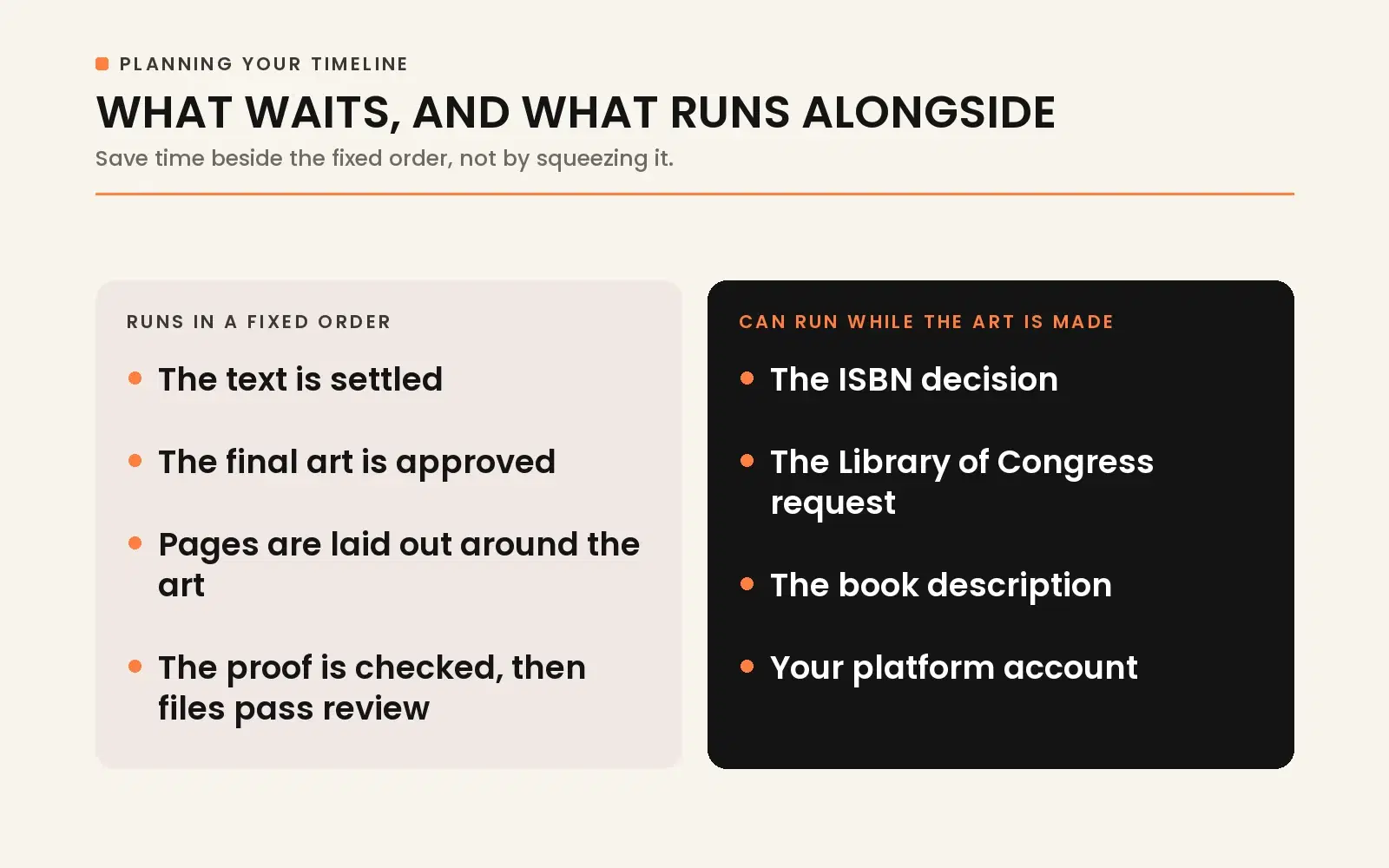
While the illustrations for a children's book are being made, several other jobs can move forward at the same time. The paperwork, the cover planning, the book description and your platform account don't need finished art. So none of them has to add time at the end. That's the simplest way to get a book out sooner without rushing any stage.
For example, the Library of Congress request and the book description can both be finished while the illustrator is still working on the middle spreads. Some stages can't overlap, though, because each one needs the finished work of the stage before it. These run in a fixed order.
- The text is settled and signed off.
- The final art is finished and approved.
- The pages are laid out around the art.
- The proof copy is checked and approved.
- The files pass platform review.
Each of those stages waits for your approval of the one before it, which keeps a finished book free of late surprises. The time you save comes from everything that runs beside that order, not from squeezing the order itself.
Delays That Are Easy to Avoid
Many delays in publishing a children's book come from reopening a decision after the next stage has started, and from time spent waiting on replies. You can avoid most of them once you know where they tend to hide.
- Text edits after the sketches, which can mean pages have to be drawn again.
- A trim size change after the art is done, since the art is drawn to fit the page.
- Slow feedback on sketches, because the next round waits for your answer.
- Files that fail platform review and have to be fixed and sent again.
- A proof that shows a problem, which means a second proof and a second wait.
- Leaving the Library of Congress request until after release, when a preassigned control number can no longer be given.
Late changes cost money as well as time, which is one more reason to settle things early. You can see how that works in our guide to what drives the cost of publishing a children's book.
One habit that helps is keeping a single list of every change you want and sending it in one go at each round. One clear list is easier to act on than a stream of separate notes. It also stops one round from quietly turning into three.
How Long Does It Take to Get a Children's Book Published?
It depends mostly on the route, because self-publishing a children's book is generally faster than a traditional publishing deal, where the publisher sets the schedule. The waiting can start before there's any deal at all. Charlesbridge, a traditional children's publisher, replies only to the manuscripts it's interested in. Its submissions page says that if you haven't heard back after 6 months, you can assume it has no place for your project.
When authors ask, "How long does it take to self-publish a children's book?", the honest answer is the sum of its stages. Those stages move at the pace you and your team set. With a traditional house, how long it takes to get a children's book published includes time you don't control. The publisher usually picks the illustrator and fits your book into its own schedule, so you wait on decisions made elsewhere.
Self-publishing doesn't skip any stage, though. The editing, the art, the layout, the paperwork, the proof and the review all still happen. Your book can only move as fast as the decisions it's waiting on.
What a Publishing Team Changes About Your Calendar
A publishing team can't make the art stage disappear, but it can keep the side jobs from piling up at the end. If you work with one, ask how the ISBN, the book description and the other paperwork will move forward while the pictures are drawn. Your own replies still set much of the pace, because no stage can finish until you've given your answer.
Book Writing US helps authors turn a finished manuscript into a finished book, from editing and illustration to page design, the cover, printing and publishing. Our children's book publishers work on picture books, early readers and educational books. They can build the book around art you already have, or have the pictures drawn through our children's book illustration services. If you'd like to talk through where your book is now, we'd be glad to hear from you.
Frequently Asked Questions
How quickly can a book be published on Amazon?
Once your files are finished, publishing a children's book on Amazon is quick. Amazon KDP says a new paperback's detail page can take up to 72 hours to appear on Amazon.com. The slow part comes before that. The editing, the illustration and the layout all have to be done first. For a picture book, the art is usually the longest wait.
Why is my KDP review taking so long?
Amazon KDP says review time varies with the type of book you've submitted, so there isn't one fixed wait for every title. While your book is In Review, it's locked, and you can't change anything until the review finishes. If KDP finds a formatting or content problem, you'll need to fix it and submit again. The new version then goes through review from the start.
Why do author copies take so long to arrive?
Author copies take time because they're printed after you order them. Amazon KDP also says its manufacturing times change with the total volume of orders. You can only order author copies once your book is Live, and the option can take an extra 24 hours to appear. A faster shipping speed can shorten the delivery, but KDP says it can't speed up the manufacturing of your order.
How long does it take to get a Library of Congress number?
The Library of Congress says most requests for a control number are processed in 1 to 2 weeks. It can't preassign one to a book that's already been published, so send your request well before your release date. An author can send a request as soon as they've set up an account, without waiting for staff approval. A publisher's account in the program should be processed within 10 business days. The Library also asks for requests well ahead of publication, since busy periods can make processing take longer.
Do you have to wait for copyright registration before you publish?
No, you don't have to wait for copyright registration before you publish a children's book. The U.S. Copyright Office says copyright exists from the moment a work is created and that registration is, in general, voluntary. Registration still matters if you ever want to bring a lawsuit over infringement, but it isn't a step that holds up your release.
Does an ebook take less time to publish than a printed children's book?
An ebook edition of a children's book can save some time, because it skips the waits that involve paper. There's no printed proof copy in the mail and no printing of each order. It doesn't skip the stages that take the longest, though. The illustration, the layout and the platform review all still happen. Once the ebook is ready, it can be listed next to the printed edition, so readers can choose either one.
- How Long Does It Take to Make a Children's Book?
- How Long Does Editing a Children's Book Take?
- Why Illustration Usually Takes the Longest in a Picture Book
- Layout Starts When the Art Is Final
- The Paperwork That Can Run Alongside the Art
- How Long Does the Platform Review Take?
- How Long Does It Take to Print a Children's Book?
- How Your Book's Format Changes the Timeline
- What Speeds a Book Up, and What Slows It Down?
- How Long Does It Take to Get a Children's Book Published?
- What a Publishing Team Changes About Your Calendar
- Frequently Asked Questions