What Drives the Cost to Print a Children's Book, per Copy and per Run
Short Answer: Printing a children's book has no single price, because a handful of print choices decide what each copy costs. The main ones are the page count, color, paper and cover finish, binding, trim size and the number of copies. Print on demand costs more per copy but nothing up front, while a print run costs less per copy but is paid all at once. That's why the lowest price per copy isn't always the cheapest way to print.
Maybe you typed "How much does it cost to print a children's book?" into a search bar. You found one printer's number sitting next to another that was far higher, for what sounded like the same picture book. That's normal, and it doesn't mean anyone is being dishonest. Each quote was simply for a different set of choices and a different number of copies.
This guide covers the printing bill only. The art, editing, design and ISBNs belong to the bigger budget. A separate guide explains what it costs to publish a children's book from start to finish. By the end of this one, you'll know which choices move the cost to print a children's book. You'll also see why the cost of one copy and the cost of a whole print run are two different sums.
What's the Difference Between Unit Cost and Total Run Cost?
The unit cost of a children's book is the printing price of one copy at a given quantity. The total run cost is everything you pay for the whole order, including getting the boxes to your door. With print on demand, each copy is printed only when someone orders it, so you pay one copy at a time. With a print run, the whole batch is printed at once, and you pay for every copy before a single one sells.
The number that really matters sits between those two. The true cost of each copy is what you spent to get the books home, divided by the copies you can use or sell. Printing, proof copies, freight and handling all go into that sum. Unsold or damaged copies don't lower it. They raise it, because the same money is now spread over fewer books.
Picture two authors with the same picture book. The first orders copies on demand as readers buy them. She pays more for each one, but she never pays for a copy nobody wanted. The second orders a big print run at a much lower children's book printing cost per unit. He pays for it all up front, then pays again to ship and store the boxes. If many of those boxes are still in the hall closet a year later, every copy that sold cost far more than the quote said.
IngramSpark makes the same point in its own guidance. Paying a little more per copy for the books you need can cost less than paying less per copy for books you'll never use.
What a Unit Price on a Printing Quote Leaves Out
A unit price on a children's book printing quote usually covers only the printing and binding. Costs such as freight, cartons, delivery to your home and proofs can sit outside it. That's how a low number per copy can still hide a bigger bill. Before you compare two quotes, ask each printer whether these are included.
- Freight from the printer to your address, which depends on the weight of the boxes and where they're going.
- A proof copy, printed and sent to you so you can check the real pages before the full order is printed.
- Cartons and packing, so the books arrive flat, dry and undamaged.
- Delivery to a home address rather than a business, which can cost more than you'd expect.
- File checks, and any fixes the printer makes to your files before printing starts.
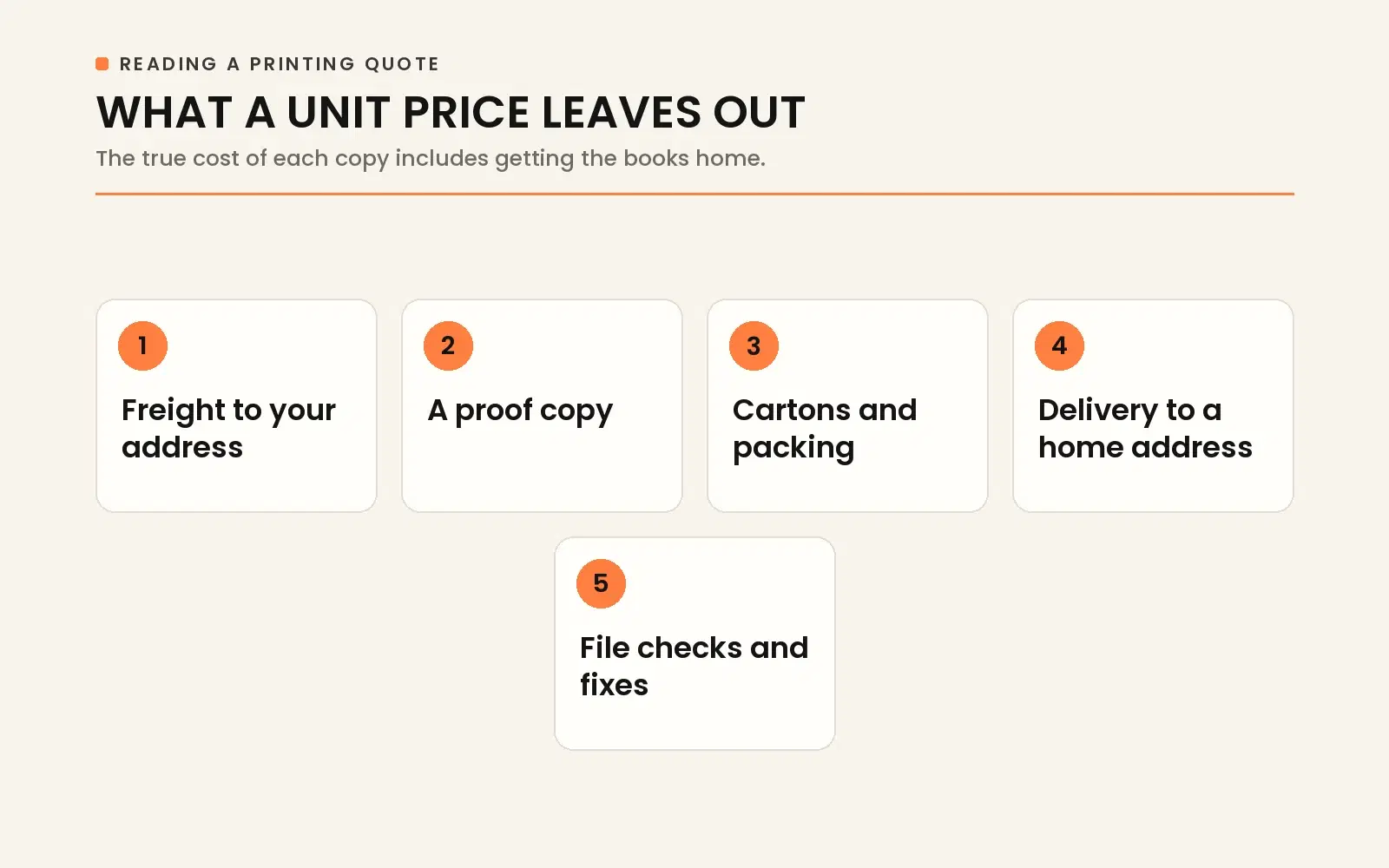
The simplest habit is to ask for the price delivered to your door, not the price at the printer's door. A calculator or an online quote can only price the choices you give it. So keep a short note of what each quote includes. That way you're comparing the same things, and the cheaper quote really is the cheaper one.
Is Print on Demand More Expensive Than Offset Printing?
Print on demand usually costs more per copy than a large offset print run, but it costs far less up front. That's because each copy is printed only when someone orders it. Offset printing costs less per copy at volume, but you pay for the whole batch before any copy sells. In short, print on demand costs more per book and less to start, and offset is the other way around.
The reason is setup. A print on demand press prints straight from your file, one copy at a time, so there's no big setup cost to share. An offset press, the kind used for big print runs, needs printing plates made and the press made ready before the first good page comes off it. That work is paid for once for each run. If you'd like the steps behind all this, here's how print on demand and offset printing actually work from file to finished copy. There's also a middle option, the short run, which the questions at the end of this guide explain.
Comparing offset vs print on demand costs only makes sense once you know how many copies you'll really use. Print on demand children's book costs stay much the same whether you sell one copy or many. An offset run only pays off once enough of its copies leave your house. Choosing a route involves more than money, but on cost alone, that's the question to ask.
Why Offset Printing Gets Cheaper per Copy as the Run Grows
Offset printing gets cheaper per copy as the run grows because its setup is a fixed cost for each run. That setup costs about the same whether the printer runs a small batch or a big one. The more copies share it, the smaller each copy's part of it becomes. That's why offset printing children's book costs fall per copy as the order gets bigger.
There's a catch, though. The total bill still goes up with every copy you add, because each one needs its own paper, ink and binding. A lower price per copy only saves you money when you need those extra copies. The fair measure is still the true cost of each copy you use. Extra copies that never sell push that cost up, not down.
Print on demand works differently. The price of each copy stays fairly steady, whether you order one or a whole box. IngramSpark does offer bulk pricing on bigger print orders, though. So ordering more copies at once can still lower the price of each one there.
The Printing Cost Drivers, Print on Demand vs a Print Run
Printing costs for a children's book come from seven choices, the page count, color, paper, cover finish, binding, trim size (the size of the finished page) and quantity. Shipping and storage join them once the books exist. Each one behaves a little differently on print on demand than on a print run, and the table below shows how.
| Cost driver | With print on demand | With a print run |
|---|---|---|
| Page count | Short books often pay one set charge, and longer books add a charge per page | Pages print in groups called signatures, so the cost rises in steps |
| Color | One color picture puts the whole book on the color price | Full color inside costs more than black ink alone |
| Paper | A short list of papers, and color books print on white | Heavier or coated paper raises the cost of every copy |
| Cover finish | No change on Amazon KDP, but part of the cost on IngramSpark | Special finishes add materials and handling |
| Binding | A hardcover carries a higher set charge per copy | A hardcover adds boards and steps, and board books are a specialist job |
| Trim size | Large sizes fall into a higher cost band | Bigger pages mean fewer pages fit on each press sheet |
| Quantity | Each copy costs about the same, apart from bulk pricing on large orders | Setup is paid once, so more copies lower the price of each |
| Shipping | Each order ships straight to the reader | Freight to you, then postage on every copy you send |
| Storage | Nothing to store, since copies are made to order | You need dry space, and damaged copies can't be sold |
Each row gets its own short section below, in the same order, starting with page count.
How Page Count Moves the Cost per Copy
Cutting a few pages from a picture book doesn't always make it cheaper to print. That's because page count changes the cost in two different ways. On print on demand, a short book often pays one set charge per copy, however many pages it has. On an offset run, pages are printed in groups, so the cost moves in steps rather than page by page.
Amazon KDP works out a paperback's printing cost as a fixed charge for each copy plus a charge for every page. For short books, though, KDP's own charts show the fixed charge only, with no charge per page. A short color picture book usually falls in that range. That's why there's no simple children's book print cost per page for a short picture book on KDP. Page count starts to matter once a book is long enough for the charge per page to apply. From then on, every page you add costs a little on every copy.
Say your illustrator suggests cutting two spreads from your rhyming picture book to save on printing. On KDP, if the book is already short, those pages may not be costing you anything extra. Cutting them could save nothing and lose part of the story.
Offset printing works in groups called signatures. A signature is a group of pages printed together on one big press sheet, which is then folded and trimmed. The trade art director at the children's publisher Lerner Publishing Group puts it simply. The more pages you can fit into a signature, the more cost effective the printing is. That's why picture books so often land on page counts that fill whole signatures. It's also why adding just a page or two can push a book into an extra group of pages.
The best time to settle your page count is before the art starts, while a change is still cheap. Planning every spread in a storyboard shows early whether your story fits the pages you've planned. That way, the page count is fixed before anything is drawn or printed.
Why Full Color Costs More to Print
Printing in full color costs more than printing in black ink, and Amazon KDP says plainly that the cost for books printed in color is higher. Color books print on white paper. On print on demand, the color price also applies to the whole book, not just the pages with pictures. That's why full color children's book printing costs sit well above those of a black and white book of the same length.
On Amazon KDP, the inside of a book is printed one way. KDP asks you to choose a color ink option if any image in your book is meant to print in color. So a single color picture puts every page on the color price. Here's how that plays out. A chapter book with black and white drawings stays on the black ink price. Add one color map at the front, and the whole book is priced as color. IngramSpark works the same way, because its interior color is one choice made for the whole book.
Short color picture books meet a second rule. KDP offers two color inks for paperbacks, premium and standard, and standard color is the lower cost of the two. Standard color needs a much longer book than most picture books, though. So a short color picture book in paperback prints in premium color. KDP itself describes premium color as ideal for image-heavy books like children's books.
On a print run, full color is still the bigger cost, since a full color inside costs more than black ink alone. Some books could work either way, such as an early chapter book with line drawings. If yours is one of them, ask for both versions to be quoted before the art is drawn. That choice is much harder to change once the pictures exist.
Paper and Cover Finish, Where They Change the Cost
Paper type changes the printing cost of a children's book on print on demand and on a print run. Cover finish is different, because whether it matters depends on where you print. Amazon KDP says cover finish doesn't affect its printing cost, so a matte or glossy cover costs the same there. IngramSpark, on the other hand, lists laminate type, gloss, matte or textured, among the things its print and ship cost depends on.
On print on demand, the list of papers is short. Color books print on white paper, so a picture book has very little paper choice to make there. KDP's premium color, for example, uses a heavier paper than its standard color. That heavier paper is part of what you pay for when your picture book prints in premium.
On a print run, you have far more choice, and every choice has a price. Heavier paper, coated paper, lamination and special finishes such as foil all change the materials and the handling. So each one raises the cost of every copy in the run.
If a special finish matters to you, ask the printer to quote it as its own line. Then you'll see exactly what it adds to each copy before you decide. A finish can't rescue a weak design. So before you pay extra for foil, it's worth reading about the design choices that make a children's book cover work.
Why Does a Hardcover Cost More to Print Than a Paperback?
A hardcover children's book costs more to print than a paperback because it's built from more parts and more steps. The pages are glued into a rigid case, and the finished book is heavier, so it also costs more to ship. That's why hardcover children's book printing costs run higher on print on demand and on a print run alike.
Amazon KDP works out hardcover and paperback printing cost the same way, but the fixed charge for each hardcover copy is higher. KDP also prints hardcovers only above a page count that most picture books never reach. So a hardcover edition of a short picture book usually needs another printer.
Board books are a different case again. Their chunky cardboard pages are a specialist job, and KDP's print options cover paperbacks and hardcovers, not board books. That's why a board book almost always means a print run, paid for before the first copy sells.
Whether a hardcover is worth its extra cost depends on how your book will be used. A hardcover suits a book that'll be handled for years or given as a gift. A paperback keeps each copy lighter and cheaper. You're the best judge of that. Just remember that the extra cost shows up on every single copy, not just once.
Why Your Book's Size Changes the Printing Cost
The size of your picture book changes what it costs to print. Larger pages use more paper, and they can move a book into a higher cost band. Trim size means the size of the finished page once it's cut. Amazon KDP's printing cost pages list separate costs for regular and large trim sizes, and the large sizes cost more.
KDP's large trim band begins just past the most common book size in the U.S. Picture books usually have a larger page than a novel. So many of them land in KDP's large band, and every copy carries that higher cost. It's easy to miss, because the size feels like a design choice rather than a price.
On a print run, size matters in another way. A printer fits your pages onto big press sheets, and the smaller the page, the more pages fit on each sheet. A large picture book page fits fewer, so it uses more paper per copy. An unusual size can also add setup costs on top.
If you're torn between two sizes you like equally, ask the printer which one fits its sheets better. The answer can lower the cost of every copy without changing how the book feels in a child's hands.
How Much Does It Cost to Print a Children's Book on Amazon?
With Amazon KDP, you pay nothing up front to print a children's book. Each copy is printed when a reader orders it, and KDP subtracts the printing cost from your royalty on that sale. How big that printing cost is depends on your book's page count, ink, trim size and paper. KDP's royalty formula shows the order clearly. Your royalty is the royalty rate times the list price, minus the printing cost.
You only pay the printing cost yourself when you order copies of your own. KDP offers author copies of your live book at print cost, and shipping comes on top. Those orders don't qualify for free or Prime shipping. That's worth knowing if you plan to sell copies by hand at a school fair or a library event.
IngramSpark builds its cost from the same kinds of choices. It says the cost to print and ship a book depends on seven things. They're the trim size, interior color and paper, binding, laminate type, page count, quantity and ship-to address. It also offers a Print and Ship Calculator to work it out. Compared with KDP's list, it adds the binding, the laminate, the number of copies and where they're going.
How Much Does KDP Charge to Print a Book?
Amazon KDP charges a printing cost made of two parts, a fixed charge that every copy carries and a charge for each page. The ink, black or color, and the size, regular or large, set how big each part is. KDP's Printing Cost & Royalty Calculator works out the figure for a given book. KDP also shows it while you set the book up.
Two things follow from that, and both matter for a picture book. A shorter book isn't cheaper in proportion, because a short one often pays a fixed charge alone. The charge per page is also higher for color and for large sizes. So a long color book in a large size sits at the costly end of KDP's charts.
Any calculator you use is really asking about the same choices this guide covers. Once you've settled the page count, ink, size and binding, the number simply follows.
Shipping and Storage Come After the Printing Bill
Shipping and storage are part of the cost of a printed children's book whenever you order a print run. The boxes have to travel to you, wait somewhere until they're needed, and then travel again to each reader. None of that shows up on the printing quote. All of it still comes out of the same budget.
Say you're a teacher who plans to sell your picture book at school visits, so you order several boxes. The printer's freight brings the cartons to your home, and heavy hardcovers weigh more and cost more to ship. Then every copy you mail to a buyer needs its own postage. That postage belongs in the cost of the book just as much as the ink does.
Storage costs money too, even when it's your own home. A big run takes up space and needs handling each time copies go out. It also carries a real risk of damage, and a bent or water-stained copy can't be sold. Every copy you lose that way raises the real cost of the copies you do sell. IngramSpark notes that before print on demand, authors printing by offset had to pay for warehousing or give up rooms of their home to book storage.
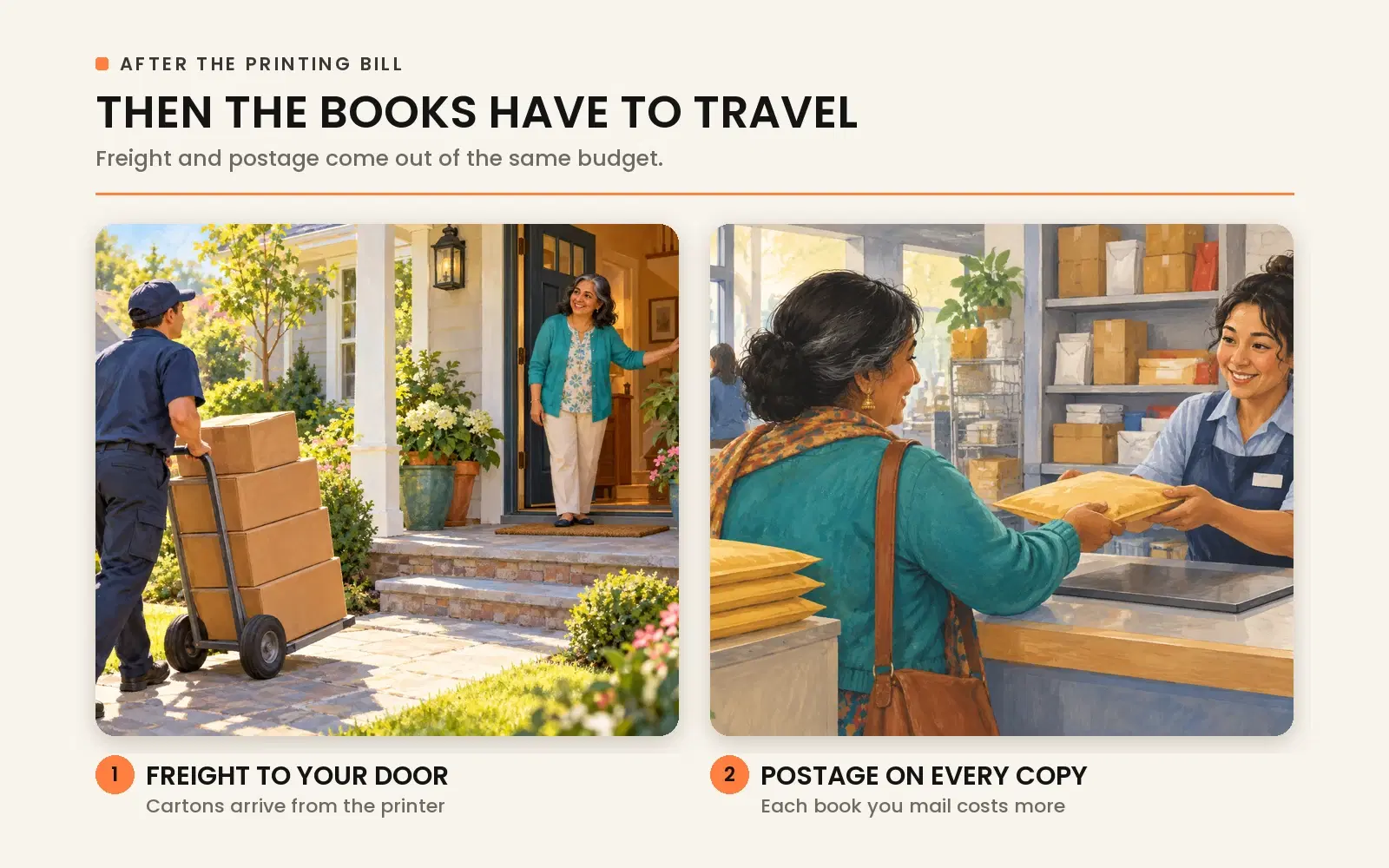
Print on demand removes most of this. The platform prints each order and ships it straight to the reader. There are no boxes to store and no freight to pay before a sale. IngramSpark calls shipping directly to customers cost-effective for exactly that reason, since you don't have to print or stock more copies than you sell.
What's the Cheapest Way to Print a Children's Book?
The cheapest way to print a children's book depends on whether you mean the lowest price per copy or the lowest total spend. If you don't know yet how many copies will sell, print on demand or a small batch usually keeps the total lowest. That's because you only pay for copies you actually use. A big run gives the lowest price per copy. But that only helps if those copies find readers.
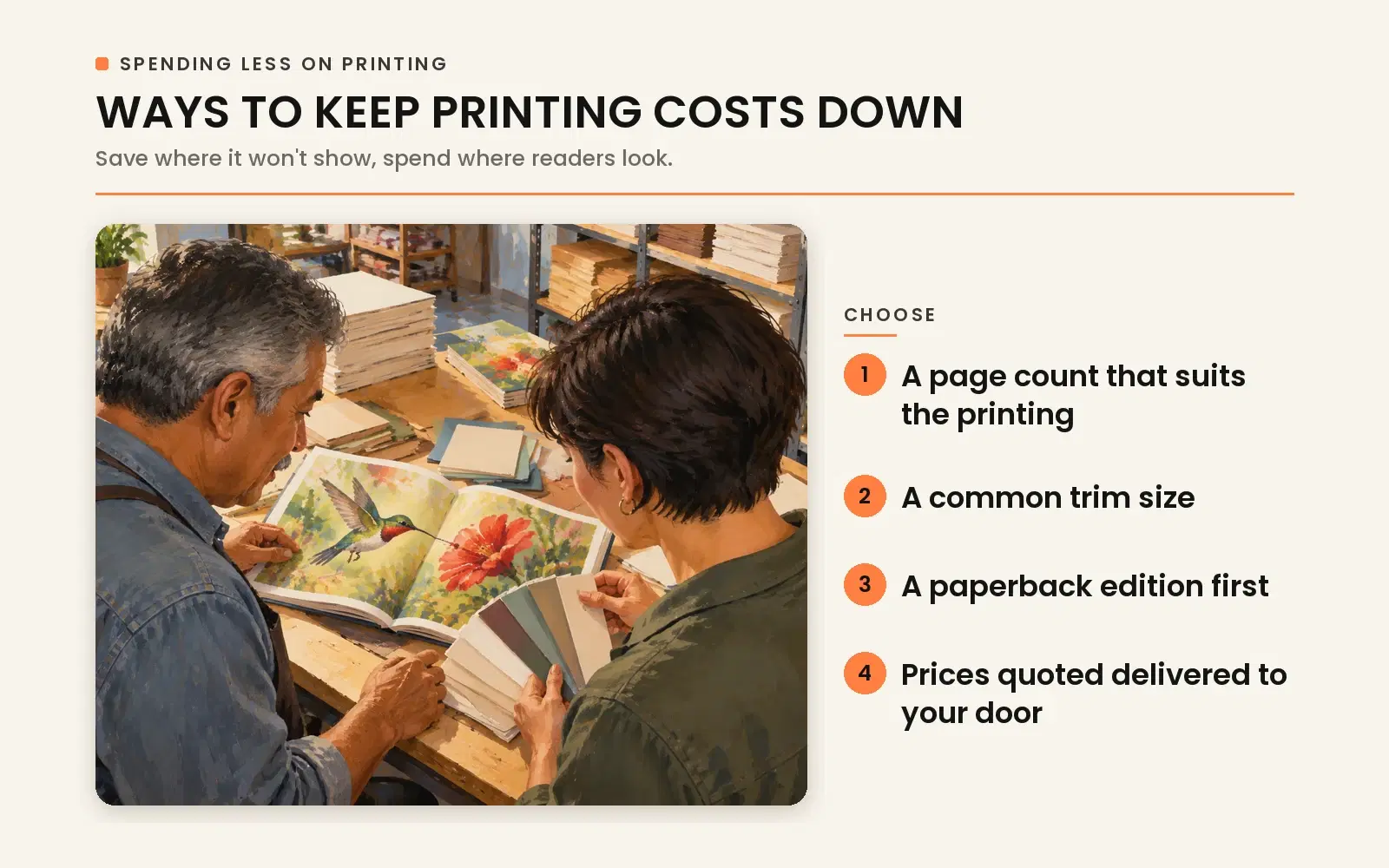
Beyond that, a few choices lower the cost without making the book feel cheap to a parent or a child.
- A page count that suits the printing, whether that's KDP's short range or whole signatures on a press.
- Black and white inside where the book really allows it, such as a chapter book with line drawings, but never a picture book.
- A common trim size, so the book doesn't slip into a higher cost band without a good reason.
- A paperback edition, either beside a hardcover or before one.
- Fewer special finishes, saving foil and textured covers for books that truly need them.
- Prices quoted delivered to your door, so no freight bill surprises you later.
What you shouldn't cut is the part a child actually sees. Moving a picture book onto thin paper or dull color saves a little on each copy. But the pictures are the reason the book gets picked up and read again, so that saving costs more than it's worth.
Settling Your Print Choices Before Anything Is Printed
The printing cost of a children's book is mostly decided before anything is printed, when the page count, color, size, paper and binding are settled. Once the art is drawn and the files are made, changing any of those means redoing work. So it pays to make these choices early and on purpose.
Book Writing US handles editing, illustration, page design, the cover, printing and publishing for children's book authors with a finished manuscript. That includes picture books, early readers and educational books. The art can be yours already, or our illustration service can draw it for you. If you'd like to talk through your print choices, our custom children's book publishing team would be glad to hear about your book.
Frequently Asked Questions
What is short run printing?
Short run printing is a planned small batch of books printed on a digital press, without the plates an offset press needs. It sits between print on demand and offset printing on cost. You pay more up front than with print on demand, because the whole batch is printed at once. In return, each copy tends to get cheaper as the batch gets bigger. Digital printing also lets you update your files between batches without paying for new setup.
Is there a minimum order for offset printing?
Offset printing has a practical minimum rather than one fixed rule. Each printer decides where offset starts to make sense for a given book. The setup for an offset run is a fixed cost, so it only pays off when it's shared across enough copies. IngramSpark explains that offset runs have traditionally needed very large orders to justify those fixed costs. If you need fewer copies than that, a short run or print on demand is usually the better fit.
How much does it cost to reprint a children's book?
The cost to reprint a children's book depends on how it's printed, and with print on demand there's no reprint to order at all. Each copy is printed fresh from your current file whenever someone orders it, so a corrected file replaces the old one for future copies. IngramSpark has changed its revision fees before, so check its current terms before you upload. On an offset run, a reprint is a new order with its own setup, and the copies already printed stay as they are.
Why do quotes from two printers differ for the same book?
Quotes from two printers usually differ because they aren't really for the same book and the same order. One may price a larger quantity, a different printing method, a different paper or finish, or a size that fits its press sheets better. One may include freight, cartons, proofs and delivery to your door, while the other stops at its own loading dock. Ask both to quote the exact same choices, delivered to your address. Then the difference becomes much easier to understand.
Can you ship your books by Media Mail?
Yes, you can usually send printed books by Media Mail. USPS describes it as a cost-effective way to send eligible books, media and educational materials. The rules matter, though. Only eligible items can go in the package, and if you include anything else, you or your buyer will pay higher postage. USPS can also open any Media Mail package to inspect it. Postage is part of the real cost of every copy you send yourself, so it's worth knowing the cheaper option.
- What's the Difference Between Unit Cost and Total Run Cost?
- Is Print on Demand More Expensive Than Offset Printing?
- The Printing Cost Drivers, Print on Demand vs a Print Run
- How Page Count Moves the Cost per Copy
- Why Full Color Costs More to Print
- Paper and Cover Finish, Where They Change the Cost
- Why Does a Hardcover Cost More to Print Than a Paperback?
- Why Your Book's Size Changes the Printing Cost
- How Much Does It Cost to Print a Children's Book on Amazon?
- Shipping and Storage Come After the Printing Bill
- What's the Cheapest Way to Print a Children's Book?
- Settling Your Print Choices Before Anything Is Printed
- Frequently Asked Questions