How Children's Books Are Printed, From File to Finished Copy
Short Answer: Children's books are printed from a finished, print-ready PDF, either one copy at a time or a whole run at once. Print on demand, used by Amazon KDP and IngramSpark, runs on a digital press, while an offset run uses metal plates. Either way, full color comes from four inks, and the pages are bound, trimmed and joined to a cover. A proof is approved before any copies are made.
Many parents, grandparents and first-time authors ask, "How are children's books printed?", once the story is written and the pictures are drawn. It's a fair question. A printer doesn't see your book the way you do. It sees a set of files, and your choices about size, paper, color and binding decide what happens to them.
This guide covers how children's books are made from that point on, in plain words. It follows your book from finished files to a copy you can hold, with a short stop at each big choice you'll meet. Those choices are the two ways to print, the paper, the color, the binding, the size and the proof.
What Happens After Your Files Go to the Printer?
Once a children's book's print-ready files reach the printer, the book goes through six steps in a fixed order. The steps are the same whether you print one copy or a whole run.
- The files are checked. The printer, or the platform's system, checks your inside pages and cover against its technical rules. Amazon KDP, for example, checks files by machine when you upload them and again by hand after you submit.
- A proof is approved. You look over a proof of your book, on screen or in print, and approve it.
- The pages are printed. A digital press prints straight from the file, while an offset press prints from metal plates.
- The pages are bound. The printed sheets are folded or stacked, put in page order and held together with glue, thread or staples.
- The cover goes on and the book is trimmed. A paperback's cover is glued on before the book is cut to size, while a hardcover's pages are trimmed and then fixed into their case.
- The copies are shipped. A print on demand copy goes straight to its buyer, while a print run leaves the printer in boxes.
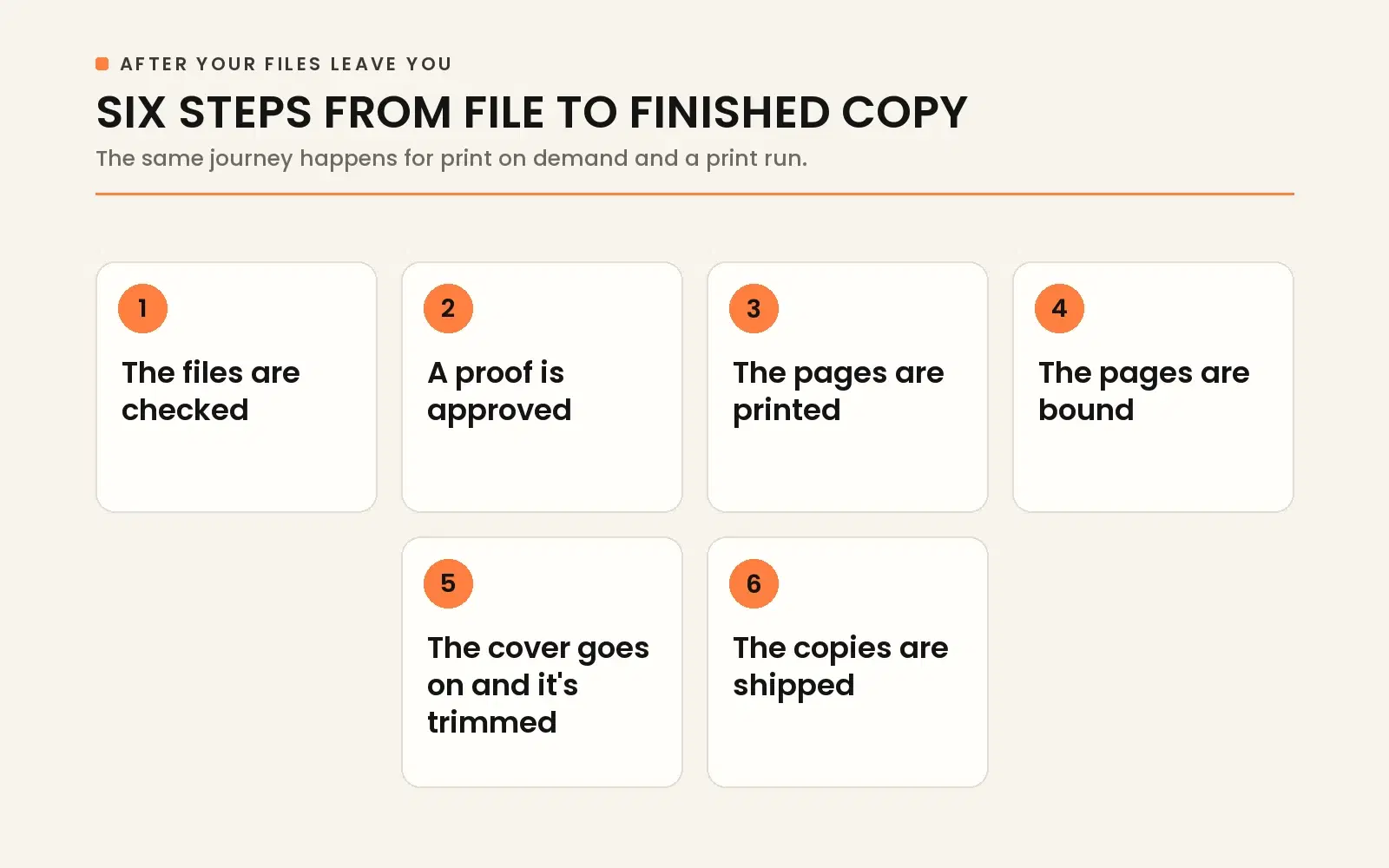
When someone asks, "How does book printing work?", these six steps are the plain answer. What changes between the two routes is how many copies are made at once and how the ink reaches the paper. The sections below take those one at a time. Everything that happens before your files exist, from editing to finished art, is covered in the guide to how children's book publishing works.
What a Print-Ready File Has to Include
A print-ready file is a finished PDF of the inside pages, plus a separate cover file. It's set up so the printer can print it exactly as it arrives. IngramSpark, for example, says it expects print-ready files, processes them as received and won't do editorial work such as proofreading or typesetting. So what you upload is what gets printed.
Printers check a print-ready file for five things.
- The right kind of PDF. Amazon KDP prefers a printing version called PDF/X-1a, and IngramSpark asks for PDF/X-1a or PDF/X-3.
- Pages built to the exact trim size, with the art extended past the edge wherever a picture runs off the page.
- Sharp pictures. Amazon KDP asks for at least 300 DPI, which means 300 dots per inch, and IngramSpark's guide uses the same figure.
- Color set up in CMYK, the four-ink color system that printing uses.
- Every font embedded, so the fonts travel inside the PDF and your words print exactly as they were designed.
Say your illustrator sent you a folder of pictures and you dropped them into a Word document. That isn't a print-ready file for a picture book yet. Amazon KDP says a book with art that runs to the edge of the page must be uploaded as a PDF. Still, these are the printer's rules, not your homework. A designer handles them, and you only need to know they exist.
Trim Size and Bleed Decide Where Each Page Is Cut
Art has to run past the edge of the page because every page is printed a little larger than the finished book and then cut down. The finished width and height is called the trim size. Amazon KDP trims 0.125 inch off the top, bottom and outside edge of each page. Art that runs past that cut line is called bleed, and without it a thin white border can show up after trimming.
Say your illustrator painted a night sky across a whole spread. That sky has to reach a little past every outside edge that gets cut. Otherwise the trim leaves a sliver of bare paper along the side. KDP only supports bleed in a fixed-format file such as a print-ready PDF, which is one reason picture books go to print as PDFs.
It's also why your book's size is chosen before the art. Every page is drawn to fit the trim size, so changing it later can mean redrawing or cropping finished pictures.
Why the Proof Comes Before Any Copies Are Printed
The proof comes before any copies because it's the last point where a mistake is fixed once, in the file. After that, the same mistake is in every copy. That's why a printed proof is worth ordering even when your PDF looks perfect. What your proof looks like depends on how your book is printed.
On an offset run, the printer checks your files and sends a digital proof for you to approve before the run starts. Amazon KDP has you approve the book in its Print Previewer, an on-screen preview. KDP also recommends ordering a printed proof copy before you publish, to make sure the ink and paper suit your book. IngramSpark sends an eproof, which is a digital proof, and recommends ordering a printed copy too.
A printed proof shows you things a preview can't. You can feel the paper and see where each page was trimmed. You can check how far the pages open at the spine and hold the book the way a child will. IngramSpark even says the best way to check the color from its printing is to look at a printed copy.
Picture an uncle who has read his picture book on a laptop a dozen times. On the printed proof, he spots that the last line on one page sits so close to the bottom edge that the trim nearly clips it. That's a quick fix in the file. Without the proof, it would've been in every copy.
Print on Demand and Offset, the Two Ways Books Get Printed
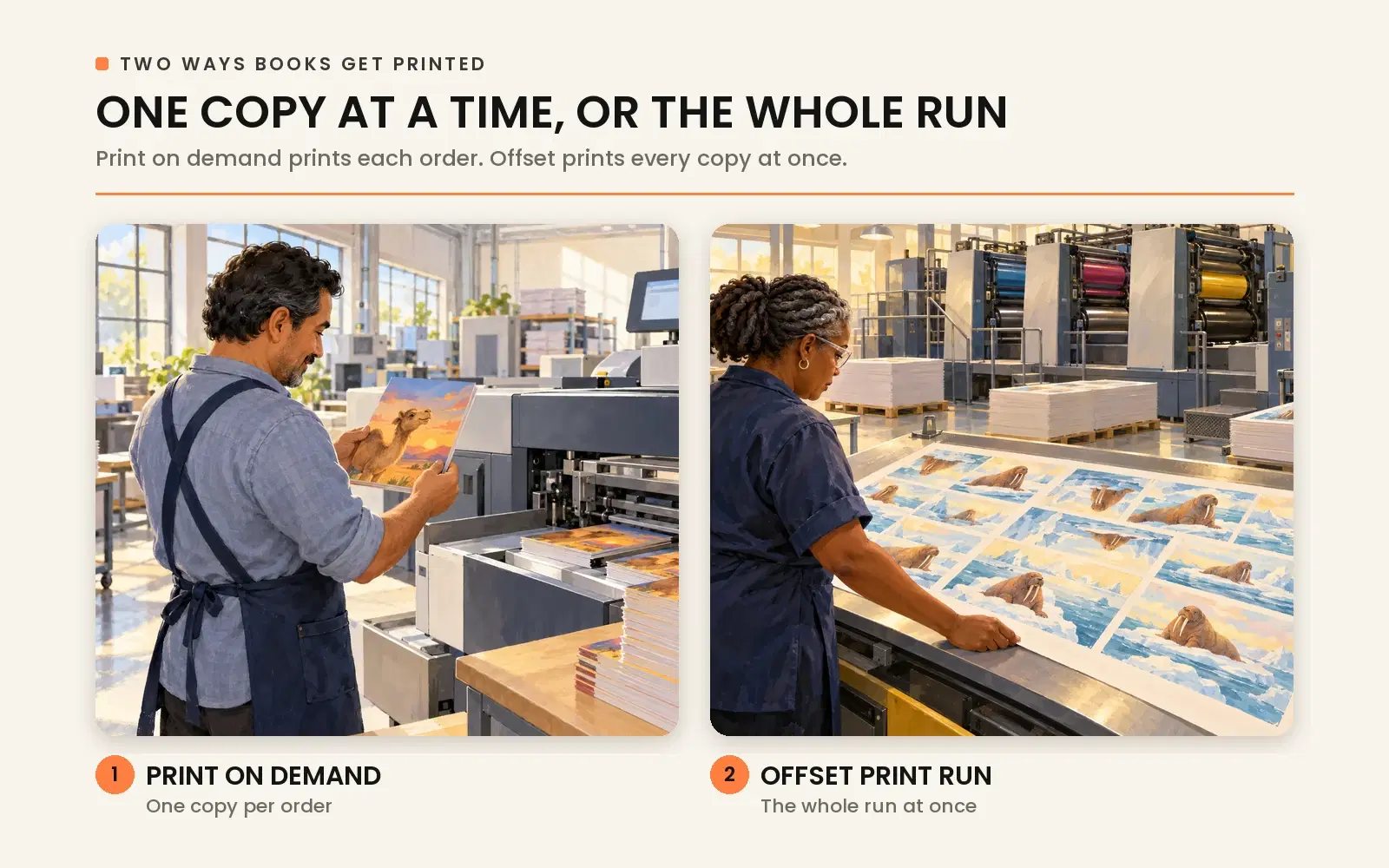
Children's books are printed in one of two ways. With print on demand, a digital press prints each copy after it's ordered. With offset printing, metal plates print a whole run at once. Digital presses can also print a small batch in one go, which printers often call a short run. The table below lays the two routes side by side.
| Stage | Print on demand | Offset print run |
|---|---|---|
| Setup before printing | The files are checked, and no plates are made | The files are checked, then one metal plate is made for each ink and the press is set up |
| How the pages are printed | A digital press prints straight from the file | Plates pass the ink to a rubber blanket, which prints it onto large sheets or rolls of paper |
| Copies at a time | One copy per order, or a few | The whole run at once |
| The proof you usually see | An on-screen proof, then a printed proof copy if you order one | A digital proof from the printer before the run |
| Paper and finishes | A short list set by the platform | A wide choice of papers, coatings and special finishes |
| Board books | Not offered by the main print on demand platforms | Made on offset presses with special equipment |
| Where the copies go | Printed and shipped straight to the buyer | Packed in boxes and sent to you, or to readers if the printer handles shipping |
Which route costs less depends mostly on how many copies you need, as the breakdown of what drives the cost of printing a children's book explains. Which route suits your book is a bigger decision, since the format, the finishes and where your copies need to go all play a part.
How Does Print on Demand Work for Books?
Print on demand keeps your book as a set of files and prints a copy only when someone orders one. Amazon KDP says it prints books on demand and ships them to customers. IngramSpark describes its hardcovers and paperbacks as created on demand, and it says the exact number of copies ordered is what gets printed.
The press is digital, so no plates are made. IngramSpark says its books are printed on digital printing equipment. KDP says its standard color paperbacks come off inkjet printers. Each copy is then bound, trimmed and mailed to whoever ordered it.
So if you list your picture book on Amazon, you never have to guess how many copies to print. If three people order it this week, three copies are made. How long each order takes is a separate question, covered in the post on how long it takes to publish a children's book.
Print on demand does have limits for children's books. It suits paperbacks and hardcovers made from standard materials. Board books and special finishes such as foil usually go to an offset printer instead.
How an Offset Press Prints a Whole Run at Once
An offset press prints from metal plates, one plate for each of the four inks. Each color passes from its plate to a rubber blanket, and the blanket prints it onto large sheets or rolls of paper. That middle step gives offset its name, since the ink is offset onto the blanket instead of going straight to the paper.
Before the first good sheet, the press operator runs some sheets through slowly. The operator checks that the four colors line up and the ink flows evenly, a setup step printers call make-ready. Then every page for the whole run is printed, and binding starts only after the printing is done.
Offset also allows things that print on demand usually doesn't. Offset printers typically offer many more papers and coatings, special finishes such as foil stamping, and sturdy formats like board books. If you're picturing a shiny gold title on your bedtime book's cover, you're picturing foil. That's the kind of finish offset printers handle.
How Are Picture Books Printed in Color?
Picture books are printed in full color with just four inks, cyan, magenta, yellow and black, known together as CMYK. On an offset press, each ink has its own plate. The ink goes onto the paper as a pattern of tiny dots, a method printers call halftoning. The dots sit so close together that your eye blends them, so four inks can show a wide range of colors.
Digital presses use the same four inks, just without plates. IngramSpark names cyan, magenta, yellow and black as the primary colors of its printing. Amazon KDP says spot colors, the premixed special inks some offset jobs use, don't work with its print on demand. So on print on demand, even a bright red balloon floating through every spread of your book is built from those four inks.
That's why printers ask for art saved in CMYK. Amazon KDP describes RGB as the color model of digital cameras and computer monitors. It calls CMYK the model for full-color printing and advises against mixing color models in one file. IngramSpark says it makes no color corrections to color book files, so your files have to arrive set up correctly.
If your picture book is like most, it carries color on every page, so the color option you choose matters. Amazon KDP and IngramSpark each offer more than one level of color printing. Both mention children's books when they describe their higher color options.
What Are Children's Books Made Out Of?
A children's book is made of paper for the pages and a heavier printed stock for the cover. A hardcover or a board book adds stiff board, and glue, thread or staples hold it all together. Here's what each part is.
- Inside pages. Color books are printed on white paper. Amazon KDP uses a lighter paper for standard color than for premium color, and IngramSpark offers its heavier white paper with every color option.
- The cover. It's a heavier white paper stock, printed and then finished with a glossy or matte laminate, a thin protective layer.
- Hardcover boards. They're stiff paperboard wrapped in the printed cover or in cloth, and IngramSpark calls the board inside its printed hardcovers chipboard.
- Board book pages. They're thick paperboard or cardboard, and each page is laminated for extra protection.
- The binding. Glue, thread or staples hold the pages together, depending on the kind of book.
Paper is a choice as well as a material. Print on demand platforms offer a short list of papers, while offset printers offer many more papers and coatings. Picking one for your book is its own question, and it's easiest to answer with the art in front of you.
How Printed Sheets Become the Pages of a Book
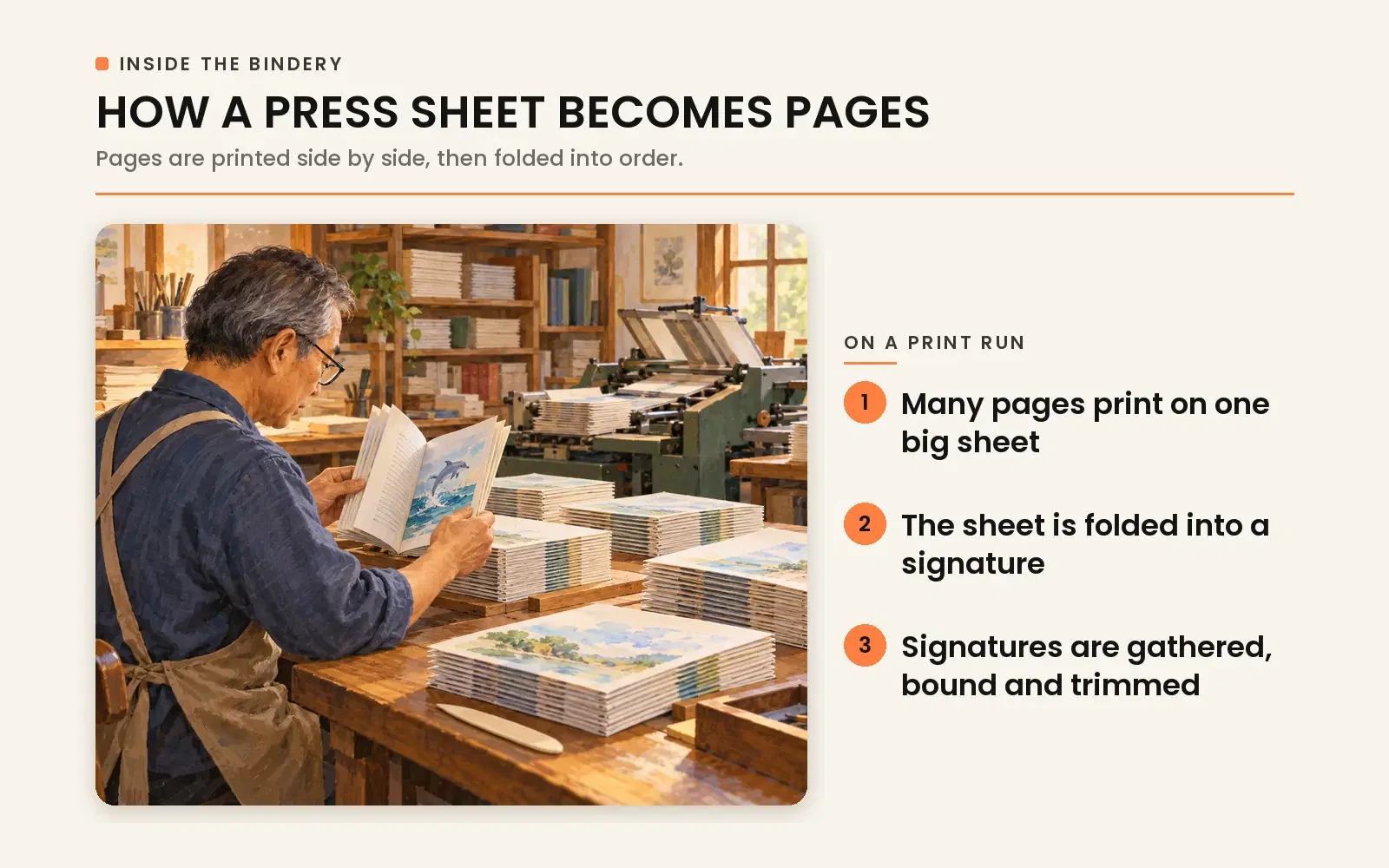
On an offset press, many pages are printed side by side on one big press sheet. The sheet is then folded into a group of pages called a signature. Signatures commonly hold 8 or 16 pages, though printers make other sizes too.
Laid flat, a press sheet looks scrambled. The pages aren't in reading order, and some face the opposite way. Each one is placed so it lands in the right spot once the sheet is folded. The folded signatures are gathered in order, glued or sewn together, and trimmed on three sides so the folds open into pages.
Print on demand works in much smaller groups. IngramSpark's user guide says its books are printed in single-sheet signatures of four or six pages. Half of those pages sit on the front of the sheet and half on the back. The sheets for one copy are then gathered into a block of pages and bound.
Printing in groups is why a book's page count moves in steps rather than one page at a time. It's a big part of why most picture books run 32 pages, and one reason your page count is settled before anyone starts drawing.
Stapled, Glued or Cased, How Children's Books Are Bound
A children's book is bound in one of four ways, with staples, with glue, in a stiff case or as thick board pages. Knowing how books are printed and bound helps you picture your own finished copy.
- Saddle stitch. The sheets are folded in half, tucked inside each other and stapled through the fold, like most magazines. It's used for thin books.
- Perfect bound. This is the usual paperback, with the pages and a laminated cover glued together at a flat spine.
- Case laminate. This hardcover has a printed, laminated cover pasted onto stiff boards and folded over their edges. Amazon KDP prints all its hardcovers this way, and IngramSpark also offers versions with a dust jacket or a cloth-look cover.
- Board book. Every page is a thick laminated board, made on special equipment by offset printers.
Which binding suits your book depends on the reader's age and how the book will be handled. A board book for a one-year-old who chews everything needs something very different from a bedtime paperback that a six-year-old reads alone. It's worth deciding before the art is drawn, since the binding and the trim size shape every page layout.
How the Cover Is Wrapped Around the Pages
A book's cover is printed separately from its pages, as one long piece. That piece holds the back cover, the spine and the front cover, and the spine is the narrow edge where the pages are bound. Amazon KDP asks for the cover as a single PDF with all three in one image.
On a paperback, glue goes along the spine of the page block and the cover is fixed onto it. Then the book is trimmed so the cover and pages line up. IngramSpark's quality checks include a cover that sits straight and a book that's cut square.
On a hardcover, the printed cover is first wrapped around stiff boards and folded over their edges to make a case. The page block is then glued into that case with endsheets, the sheets you see just inside the front and back covers. Whichever finish you pick, glossy or matte, it's a thin laminate over the print.
The design on that wrap is a job of its own. For that side of your cover, see what makes a children's book cover stand out.
Does Amazon KDP Print Children's Books?
Yes, Amazon KDP prints children's books on demand, as paperbacks and hardcovers, in black and white or in color. It makes those two formats only, so a board book or a stapled book needs a different printer. Its help pages spell out the printing facts that matter most for your picture book.
KDP describes its premium color as ideal for image-heavy color interiors, like children's books. It prints every hardcover as case laminate. Its covers come glossy or matte, and it describes glossy as typical for children's books. KDP hardcovers also have a minimum page count, so check it against your book's length before you plan one.
A grandfather hoping to make a chunky board book for his baby granddaughter won't find that option on KDP. He'll need an offset printer that makes board books.
IngramSpark is another print on demand platform open to independent authors, and it prints paperbacks and hardcovers too. It calls its Premium Color ideal for image-heavy books and children's books. Its top option, Ultra-Premium Color, is laser-printed rather than inkjet, and IngramSpark calls it ideal for high-quality children's books.
Two Routes to Getting Your Children's Book Printed
You can get a children's book printed in two ways. You can send print-ready files to a print on demand platform, or you can order a print run from a book printer. Printing a children's picture book either way asks a few things of you, and they're different for each route.
On print on demand, you need finished interior and cover files and an approved proof. If the book is for sale, you also need a listing on the platform. On a print run, the printer needs your book's size, page count, paper, binding and number of copies before the job is set up. You then approve the printer's proof, and you'll need somewhere to keep the boxes and a way to get books to readers.
The right route often follows from where your books need to be. A teacher who plans to sell her picture book at school readings may want boxes of copies on hand. A parent who only wants it listed online has no reason to store any. If your book is only for family, the guide to printing a children's book just for your family explains what you can skip.
Handing the Print Side to a Publishing Team
A publishing team can prepare your print files, go through the proof with you and arrange the printing. That way you don't have to learn PDF types, bleed or color models yourself. Whoever helps you, keep the final say on the proof, and get the ownership of the art and files agreed in writing.
Book Writing US takes authors from a finished manuscript to a finished, printed book. That covers editing, illustration, page design and the cover, printing and publishing, for picture books, early readers and educational books. If your pictures are done, the team can work with the art you already have. If they aren't, they can be drawn through its children's book illustration services. When you're ready to publish your children's book, get in touch and tell us where your book stands today.
Frequently Asked Questions
What is prepress in book printing?
Prepress is everything done to a book's files before printing starts. The printer checks the files and sets up the proof. On an offset press, prepress also includes making the metal plates, one for each ink. IngramSpark describes its own version as a file review that prepares each book for printing and binding. A problem caught in prepress is fixed once in the file, which is far easier than fixing printed pages.
Why do books have blank pages at the end?
Books have blank pages at the end because pages are printed in groups, and the page count has to fill every group. On an offset press the pages per plate are usually sixteen, so any spare pages in the last group stay blank. Print on demand does it too. IngramSpark says printing in signatures can add extra sheets at the back, and it keeps the last page blank for its own manufacturing details. If you'd rather not have empty pages, your designer can plan them in for a dedication or one more picture.
What is the gutter in a book?
The gutter is the inside margin of a page, where it meets the spine. Amazon KDP uses the word for that inside margin and makes it wider as the page count grows. A thicker book needs more room at the spine. Your words and key art are kept out of the gutter so nothing important sinks into the fold. Illustrators plan around it early, and there's a closer look at how a storyboard keeps faces and key art out of the gutter.
Is offset printing better quality than digital printing?
Not always, because each one is strong in a different way. Offset printing holds color more evenly across a big run and offers more papers and finishes. Digital presses have improved a lot, and one printer that runs both says digital quality is more than sufficient for most projects. Amazon KDP and IngramSpark both note that color can vary a little from one print to the next. That's one more reason to check a printed proof before you order more copies.
Are hardcover books made of wood?
No, hardcover books aren't made of solid wood. The stiff boards inside the covers are heavy paperboard, which IngramSpark calls chipboard, wrapped in a printed cover or in cloth. Paperboard itself is made from wood pulp and other fibers. So there's wood in a hardcover, just not in the form of a wooden board.
What is a book block?
A book block is the printer's name for the inside pages once they're printed, gathered in order and bound together. It's what you'd have before the cover goes on. From there, the book block is trimmed and joined to its cover, either a paperback wrap or a hardcover case. IngramSpark uses the same term when it checks that each cover matches its book block.
- What Happens After Your Files Go to the Printer?
- What a Print-Ready File Has to Include
- Why the Proof Comes Before Any Copies Are Printed
- Print on Demand and Offset, the Two Ways Books Get Printed
- How Are Picture Books Printed in Color?
- What Are Children's Books Made Out Of?
- How Printed Sheets Become the Pages of a Book
- Stapled, Glued or Cased, How Children's Books Are Bound
- Does Amazon KDP Print Children's Books?
- Two Routes to Getting Your Children's Book Printed
- Handing the Print Side to a Publishing Team
- Frequently Asked Questions