Famous Children's Book Illustrators, and What Their Work Teaches You About Choosing Yours
Short Answer: Famous children's book illustrators include Beatrix Potter, Maurice Sendak, Ezra Jack Keats, Eric Carle, Quentin Blake, Jerry Pinkney and Mo Willems. Each one is known for something you can look for in your own illustrator. That might be a look people know at a glance, a character children remember, or pages planned so the pictures tell part of the story. You don't need a famous name for your book, but you can borrow what made theirs last.
If you're about to hire someone to draw your picture book, the books on your own shelf are a free lesson. The famous illustrators of children's books made choices about style, characters and page design that you'll face too, just on a smaller scale.
This post isn't a ranking, and it isn't a list of people to hire. It takes a handful of names most families know and sticks to what their books and awards show. Then it turns each one into a question for your own search.
Who Are the Most Famous Children's Book Illustrators?
Seven names many families know are Beatrix Potter, Maurice Sendak, Ezra Jack Keats, Eric Carle, Quentin Blake, Jerry Pinkney and Mo Willems. There's no official list of children's book illustrators, so fame tends to come from three places: the books families keep reading, the award lists librarians publish, and the museums that collect picture book art. Each of these seven shows up in at least two of them, and each one teaches you something different.
| Illustrator | A book many families know | Known for | The lesson for your book |
|---|---|---|---|
| Beatrix Potter | The Tale of Peter Rabbit (1902) | Small books with a picture on every page | Settle your book's size and reader first |
| Maurice Sendak | Where the Wild Things Are | Caldecott Medal, 1964 | Let some pages speak through pictures alone |
| Ezra Jack Keats | The Snowy Day | Caldecott Medal, 1963 | Make sure your reader can see themselves |
| Eric Carle | The Very Hungry Caterpillar (1969) | Collage made from painted tissue paper | Choose a medium that suits your story |
| Quentin Blake | Roald Dahl's books | Hans Christian Andersen Award, 2002 | Match the drawing to the voice of the words |
| Jerry Pinkney | The Lion & the Mouse | Caldecott Medal, 2010 | Show feelings without leaning on words |
| Mo Willems | Don't Let the Pigeon Drive the Bus! | Caldecott Honors and Geisel Medals | Let a simple character carry big feelings |
Which names feel famous to you depends a lot on where and when you grew up. Well known children's book illustrators in the UK aren't always the first names an American parent would give. A reader raised in the UK may think of Quentin Blake first, while a parent raised in the US may reach for Maurice Sendak or Eric Carle. Both are right, and what matters more is what these famous children's book artists can teach you before you hire someone for your own book.
What Their Styles Teach You About Choosing a Look
An illustrator's style is the look you'd recognize anywhere. It comes from a few steady choices about materials, line and color. A famous style is often those same choices repeated across many books. For your book, the lesson is to choose a look that suits your story and to be able to say what you like about it. If you're still getting to know the options, this guide to the main children's book illustration styles is a good place to start.
Eric Carle Built His Look From Painted Tissue Paper
Eric Carle's look came from a material he made himself. The Eric Carle Museum of Picture Book Art explains that he painted acrylic on white tissue paper. He then cut the painted sheets and used them in collage. Carle (1929 to 2021) created more than 70 children's books, typically with those hand-painted papers. The Very Hungry Caterpillar (1969) went further, with holes and shortened pages that turned the book into something a child could play with.
His career in picture books also began with someone else's words. The museum notes that illustrating Bill Martin Jr.'s Brown Bear, Brown Bear, What Do You See? launched his career, and Carle said the chance changed his life.
For your own book, remember that the medium is part of the style. Collage, watercolor, pencil and digital painting each give a book a different feel, and each takes a different kind of work. When you talk to an illustrator, ask what they work in and whether they can keep it the same across every page.
Picture a school librarian who arrives with a stack of collage picture books and says she wants that look. It's a good start, but it helps far more if she names what she loves. She might say bright color, paint she can see and simple shapes on a white page. An illustrator can work with those words without copying anyone.
Quentin Blake's Quick, Lively Line Suits Many Writers
Quentin Blake's drawings look quick and full of movement, and that energy has suited a wide range of writers. According to his official biography, Blake (born 1932) has illustrated more than 500 titles. He's most famous for his work with Roald Dahl. He has also worked with writers such as Russell Hoban, Joan Aiken, Michael Rosen and John Yeoman.
In 1999 he became the UK's first Children's Laureate. In 2002 he won the Hans Christian Andersen Award for Illustration. The award's jury praised his originality and humor, and his skill with line, color and movement.
What this means for you is simple. The drawing should match the voice of your words. A loud, silly story needs pictures with the same bounce, while a gentle bedtime story needs a calmer hand. Blake's long run with Dahl is a good example of how one illustrator across several books can make them feel like a set. If you're planning a multi-book series, ask early whether your illustrator could stay with you for the next book too.
Characters Children Remember, and Why They Work
The main character is the part of a picture book a child bonds with, so it's the part you'll probably care about most. Two famous illustrators show two sides of it. One is who the character is, and the other is how clearly the face shows what the character feels. Designing that character comes early in the work, and this guide to what a children's book illustrator does on a book explains where it fits.
Ezra Jack Keats Made a Black Child the Hero
Ezra Jack Keats made a Black child the hero of The Snowy Day (1962). It was something he hadn't seen in the books he'd been hired to illustrate. The Ezra Jack Keats Foundation quotes his own account. None of the manuscripts he'd been illustrating featured Black children, except as token figures in the background. His book would have its hero there "simply because he should have been there all along."
The Snowy Day won the Caldecott Medal in 1963. Keats made its pictures with collage, handmade stamps and spattered ink, and the same boy, Peter, appears in six later books as he grows up. The foundation adds that the Library of Congress counts it among the books that shaped America.
Who your character is matters as much as how they're drawn. Many children notice whether a book shows someone like them, so it helps when the character is drawn with real care rather than as a generic kid.
Think of a hospital interpreter writing a bilingual picture book about a girl who wears hearing aids. Before she hires anyone, she asks each illustrator to show children they've drawn who look like her hero. She also asks how they'd draw the hearing aids clearly and kindly on every page. That one conversation tells her more than a whole portfolio.
How Does Mo Willems Show Big Feelings With So Few Lines?
Mo Willems is known for simple characters whose feelings come through clearly. That approach has been honored with major awards. The American Library Association lists three Caldecott Honors for his picture books, in 2004, 2005 and 2008. His early readers won the Theodor Seuss Geisel Award in 2008 and 2009, and five more became Geisel Honor Books between 2011 and 2015.
The Geisel Award honors books for beginning readers. Its rules ask for pictures that work as keys or clues to the text. That's because in an early reader, the picture helps a child work out the words. A very busy, detailed picture can make that harder.
Simple isn't the same as easy, and that's worth remembering when you hire. A character drawn in a few lines still has to show surprise, worry and joy clearly enough for a young child to read. Ask a candidate to sketch your character's face in a few different moods, using as few lines as they can.
Say a speech therapist is writing an early reader about a frog who can't say his own name. She'll want each picture to show exactly what its short sentence says, so a child can check the word against the picture. A plain, expressive frog will help her readers more than a beautifully detailed pond.
How Do Famous Picture Book Illustrators Plan a Page?
Many famous picture book illustrators plan each page around what the reader should feel when it turns. Page design is how the pictures and the words share the space, spread by spread. The Eric Carle Museum puts one part of it plainly. The size of a picture changes how a reader responds to a character, and so does the size of the character within it. Three famous names show three ways this works in a real book.
Beatrix Potter Made Her Books Small Enough for Small Hands
Beatrix Potter wanted The Tale of Peter Rabbit to be small enough to fit a child's hands and cheap enough to buy. She also wanted a picture on every page. According to the Victoria and Albert Museum, the story began in 1893 as an illustrated letter to a five-year-old boy who was ill. It was based on her own pet rabbit.
At least six publishers turned the book down, because they wanted something larger and more expensive. So in December 1901, Potter had 250 copies printed and published it herself. Before Frederick Warne published it in color in October 1902, Potter cut her text until the book was just 32 pages, and she designed the cover and the title page herself.
Before anyone draws a page, settle your book's size and your reader. A board book for a toddler, a picture book for bedtime and an early reader for a new reader all ask for different pages. It also helps to look for an illustrator who cares about the whole book, not just the pictures in it.
Maurice Sendak Let Three Spreads Run Without Words
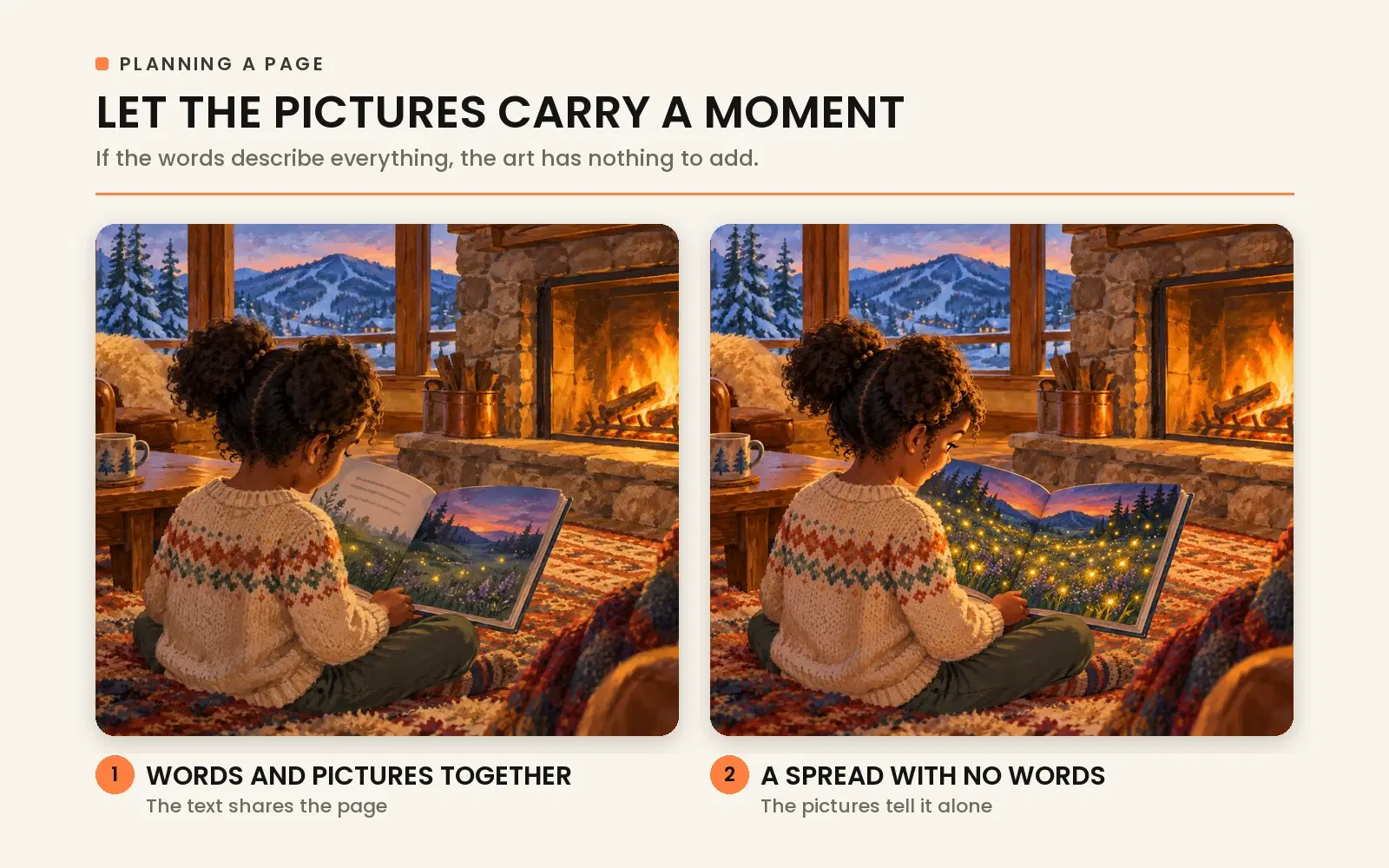
Maurice Sendak let the pictures carry part of Where the Wild Things Are with no words at all. The book won the Caldecott Medal in 1964. An essay published by the Eric Carle Museum points out that it contains three wordless double-page spreads in a row. A double-page spread is one picture that runs across both open pages. Sendak also won seven Caldecott Honors between 1954 and 1982.
In your own manuscript, leave room for moments the pictures can carry. If your words describe everything, there's nothing left for the art to add. When you talk with your illustrator, point to the moments you think could run with few words or none. Then listen to where they'd put them.
What Can Jerry Pinkney's Nearly Wordless Book Teach You?
Jerry Pinkney's The Lion & the Mouse shows that a picture book can tell a whole story with almost no words. The American Library Association gave it the 2010 Caldecott Medal and called it a virtually wordless retelling of Aesop's fable, told in textured watercolor. By then Pinkney had also won five Caldecott Honors and five Coretta Scott King Illustrator Awards.
A wordless picture book leaves the whole story to the art. The Carle Museum explains that in these books, artists show a character's personality through facial expressions and body language alone. That's a skill worth checking for, even if your book has plenty of words.
Picture a long-haul truck driver writing a quiet story for his daughter about the nights he's away. His text is short, and the pictures will have to show how she feels when the house goes quiet. So he asks each illustrator he likes to sketch one scene of his own with no words, a girl waiting by a window. He picks the one whose sketch tells him how she feels without a caption.
Who Were the Victorian Children's Book Illustrators?
Three of the most famous Victorian children's book illustrators are Randolph Caldecott (1846 to 1886), Walter Crane (1845 to 1915) and Kate Greenaway (1846 to 1901). All three worked with Edmund Evans, an engraver who made beautifully colored books with an improved wood engraving technique. The International Library of Children's Literature is part of Japan's National Diet Library. It says the three greatly influenced the picture books and illustrators that came after them.
They worked in the years when color picture books for children were spreading. Toy books, low-priced picture books in color, reached their peak of popularity in the 1860s. The library credits Evans with helping to spread picture books of high artistic quality. Caldecott's name lives on in the Caldecott Medal, and the American Library Association points to the humor, vitality and sense of movement in his work.
These classic children's book illustrators also show how much printing shapes art. Their pictures were made for the color printing of their day, and yours will be made for the printing of yours. So ask any illustrator you're considering whether they've seen their own work in print, and how it compared with the screen.
Who Are the Famous Children's Book Illustrators Today?
The famous children's book illustrators today include Mo Willems, Jon Klassen and Sophie Blackall, along with the artists who win the Caldecott Medal each year. Jon Klassen won the medal in 2013 for This Is Not My Hat. He also won Caldecott Honors in 2013 and 2015 for books written by Mac Barnett. Sophie Blackall has won the medal twice, in 2016 for Finding Winnie and in 2019 for Hello Lighthouse.
The newest names come from the most recent awards. The 2025 Caldecott Medal went to Rebecca Lee Kunz for Chooch Helped, written by Andrea L. Rogers. The 2026 medal went to Cátia Chien for Fireworks, written by Matthew Burgess.
Notice how many of these books were written by one person and illustrated by another. That's the same setup you're in when you hire an illustrator for your words. A good illustrator doesn't just decorate your story. They look for what your words leave unsaid, and they draw that part too.
How Are Illustrators Chosen for the Caldecott Medal?
The Caldecott Medal is chosen each year by a committee of the Association for Library Service to Children, a division of the American Library Association. It goes to the artist of the most distinguished American picture book for children from the year before, and it's been given since 1938. The committee can also name Honor Books, which the rules say must be "truly distinguished" too.
One line in the award's terms is worth remembering. It says the medal isn't given for teaching a lesson or for popularity, only for distinguished illustration. Other awards look at different things, as this table shows.
| Award | Who gives it | What it honors |
|---|---|---|
| Caldecott Medal | Association for Library Service to Children | The artist of the most distinguished American picture book of the year |
| Theodor Seuss Geisel Award | Association for Library Service to Children | The author and illustrator of the most distinguished book for beginning readers |
| Coretta Scott King Book Awards | Coretta Scott King Book Awards Round Table of the American Library Association | African American authors and illustrators whose books show an appreciation of African American culture |
| Pura Belpré Award | Two American Library Association divisions, with REFORMA | Latino and Latina writers and illustrators whose work celebrates the Latino cultural experience |
| Hans Christian Andersen Award | International Board on Books for Young People (IBBY) | An illustrator's whole body of work, given every two years |
Use Award Lists to Find the Look You Like
Award lists make a free reading list for training your eye. Borrow five or six medal and honor books from your library and read them aloud. Then write down in plain words what you liked about the pictures. You may find that popular children's book illustrators and award winners aren't always the same people. That's fine. What matters is which pages made you stop.
The Caldecott Medal page from the American Library Association links to a full list of winners and honor books going back to 1938. That means you can browse by decade. Bring your notes when you talk to illustrators. A note like "I loved how the night pages used only two colors" tells them far more than a list of titles.
Can You Ask an Illustrator to Draw Like a Famous Artist?
You can show an illustrator the books you love to explain the mood you want. What you shouldn't do is ask them to copy a famous artist's pictures or characters. The U.S. Copyright Office explains the general rule. Pictures are protected by copyright, and the copyright owner controls copies and new works based on them. Copyright doesn't protect ideas or methods, though, so a medium like collage or watercolor is generally open to any artist.
There's a practical reason too. A book that leans too hard on a famous look can end up feeling less like your own story. Your story deserves pictures that look like it and nobody else. A good illustrator will take your favorite books as a starting point, then find a look of their own for your characters. The rest of the search matters too, from where to look to what to agree in writing. This guide on how to find and hire a children's book illustrator walks you through it.
Describe the Look You Love Without Asking for a Copy
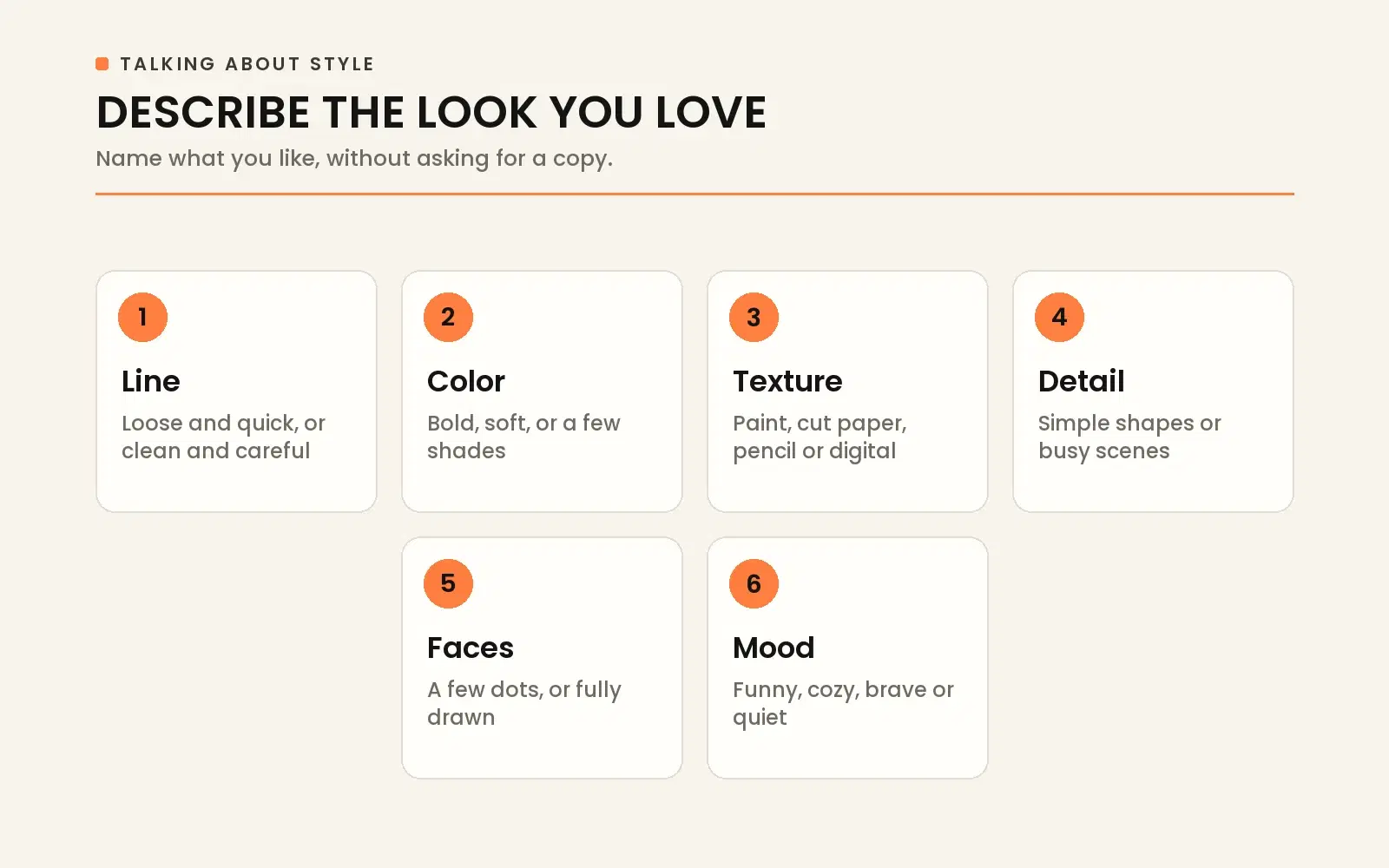
A few plain words about what you love will help an illustrator more than any famous name. Try describing these six things.
- Line, whether it's loose and quick or clean and careful.
- Color, whether it's bright and bold, soft and pale, or kept to a few shades.
- Texture, such as paint you can see, cut paper, pencil grain or smooth digital color.
- Detail, from simple shapes on a plain page to busy scenes with lots to find.
- Faces, from a few dots and lines to fully drawn features.
- Mood, such as funny, cozy, brave or quiet.
Put those six answers in your first message to an illustrator, along with two or three books that show them. It turns a vague wish for a famous look into something they can actually draw.
Does Your Book Need a Famous Illustrator?
No, your book doesn't need a famous illustrator. It needs one whose work fits your story. Most of the artists above made their books with traditional publishers. In traditional publishing, the publisher usually picks the illustrator for an author's words after offering the author a contract. When you self-publish, you're the one choosing, which is exactly why these lessons help.
What has helped these books last isn't fame alone. Each one shows a look that suited its story, a character children took to, or pages planned around the words, and you can look for the same things in an illustrator nobody has heard of yet.
Questions Borrowed From the Famous Names
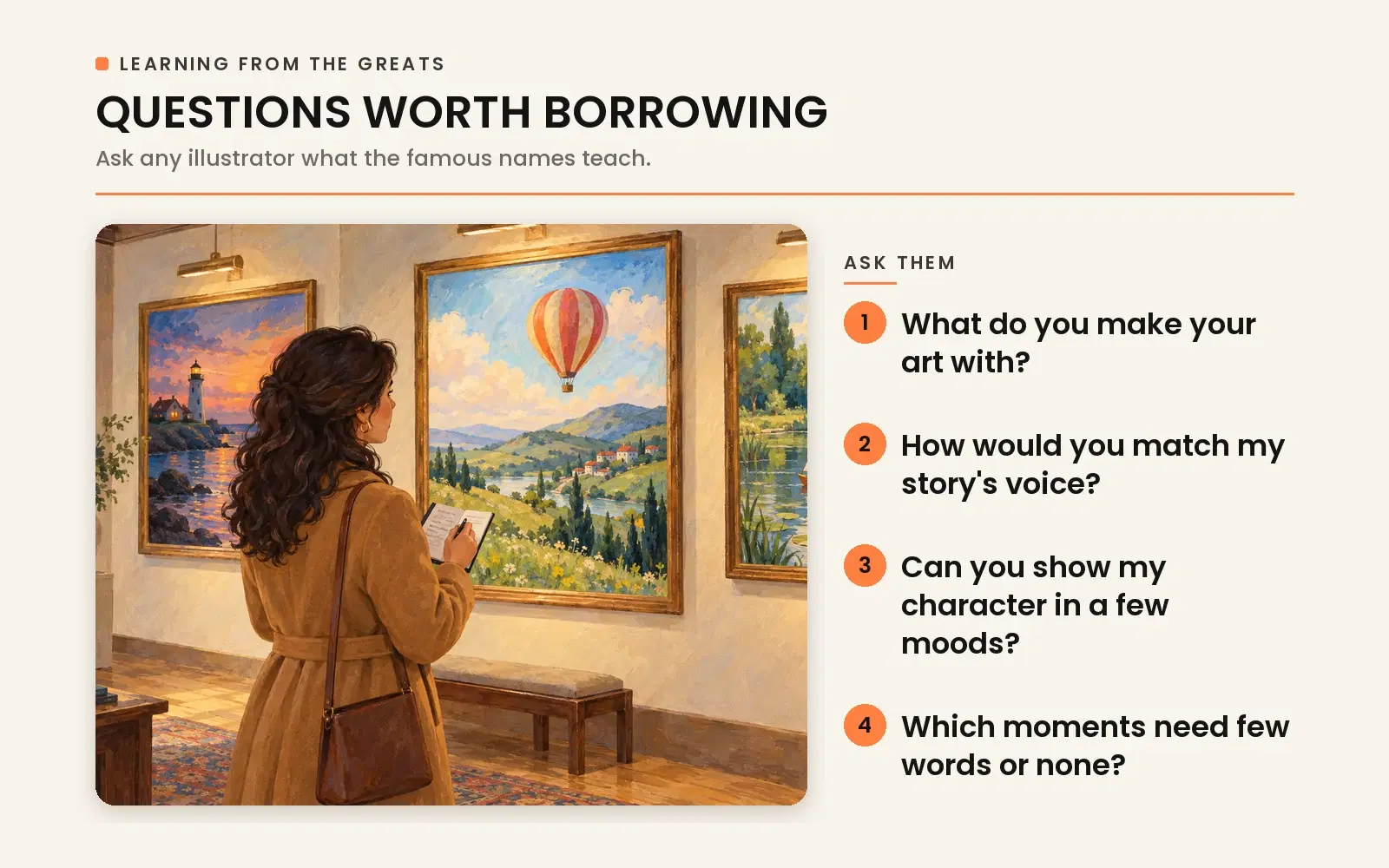
Each famous name above turns into one question you can ask a candidate.
- From Eric Carle, ask what they make their art with, and whether they can keep it the same on every page.
- From Quentin Blake, ask how they'd match their drawing to the voice of your story.
- From Ezra Jack Keats, ask to see children they've drawn who look like your main character.
- From Mo Willems, ask them to show your character's face in a few moods, with as few lines as they can.
- From Beatrix Potter, ask whether they've worked at your book's size and page count before.
- From Maurice Sendak, ask which moments in your story they'd tell with few words or none.
- From Jerry Pinkney, ask them to show a feeling with no words on the page.
You don't need perfect answers. You're listening for someone who has thought about these things before and takes your book seriously.
When You're Ready for an Illustrator of Your Own
The famous names in this post aren't connected with us at Book Writing US. They're here because their books are good teachers, and their lessons work with any illustrator you choose.
If you'd like help with the pictures, we offer children book illustration for picture books, early readers and educational books. That covers everything from the main character to the finished pages, and our illustration and publishing services can also work side by side.
Frequently Asked Questions
Can I hire a famous children's book illustrator for my book?
In most cases you can't, and you don't need to. Several of the artists in this post have died, including Ezra Jack Keats in 1983 and Eric Carle in 2021. The living ones mostly make their books with traditional publishers, and there the publisher chooses the illustrator, not the author. This post on whether you need your own illustrator or the publisher provides one explains how that works. If you're self-publishing, look for someone whose work fits your story, and use the questions above.
Who is the most famous children's book illustrator of all time?
There isn't one agreed answer, because fame depends on where and when you grew up. Beatrix Potter, Maurice Sendak, Eric Carle and Quentin Blake are names many families know, and museums and major awards have honored each of them. Even the Caldecott Medal doesn't pick a favorite illustrator, since its terms say it isn't given for popularity. It honors the illustration in one book each year.
Which famous illustrators drew stories written by someone else?
Many of them did, and some started that way. Eric Carle's picture book career began with Bill Martin Jr.'s Brown Bear, Brown Bear, What Do You See? Ezra Jack Keats illustrated other writers' books for years, starting with Jubilant for Sure by Elizabeth Hubbard Lansing in 1954. Maurice Sendak won Caldecott Honors for books by Ruth Krauss, Else H. Minarik and Charlotte Zolotow, and Quentin Blake is most famous for Roald Dahl's books. If you've written the words and need someone else to draw them, you're in very good company.
Where can you see original art from famous children's books?
A few museums collect original picture book art. The Eric Carle Museum of Picture Book Art collects and shows work by many picture book artists. It also cares for over 5,000 of Carle's own pieces. The Victoria and Albert Museum holds drawings Beatrix Potter made for The Tale of Peter Rabbit. In the UK, the Quentin Blake Centre for Illustration opened in June 2026. Your local library is the easiest place to start, since it has the finished books you can study up close.
- Who Are the Most Famous Children's Book Illustrators?
- What Their Styles Teach You About Choosing a Look
- Characters Children Remember, and Why They Work
- How Do Famous Picture Book Illustrators Plan a Page?
- Who Were the Victorian Children's Book Illustrators?
- Who Are the Famous Children's Book Illustrators Today?
- How Are Illustrators Chosen for the Caldecott Medal?
- Can You Ask an Illustrator to Draw Like a Famous Artist?
- Does Your Book Need a Famous Illustrator?
- When You're Ready for an Illustrator of Your Own
- Frequently Asked Questions