Do You Need Your Own Illustrator, or Does the Publisher Provide One?
Short Answer: You don't need your own illustrator if a traditional publisher takes on your book, because it picks the illustrator and pays for the art. If you self-publish, you do. You're the publisher then, so the pictures are your job unless you draw them yourself. A publishing company you hire may have the pictures drawn as part of the work, or build the book around art you already own.
Many first-time authors ask, "Do I need an illustrator for my children's book?" as soon as the story is written. It's a fair question, since a picture book tells its story in words and pictures together, and the pictures have to come from somewhere. What surprises many writers is that the answer changes completely with the way the book gets published.
This guide walks through each route in plain terms. You'll see who finds the illustrator, who pays, and what you should do next. It also covers the in-between cases, like a friend who paints, art you've already paid for, or a story you'd like to draw yourself. By the end, you'll know whether to start looking for an illustrator or to send your story out on its own.
Who Provides the Illustrator Depends on How You Publish
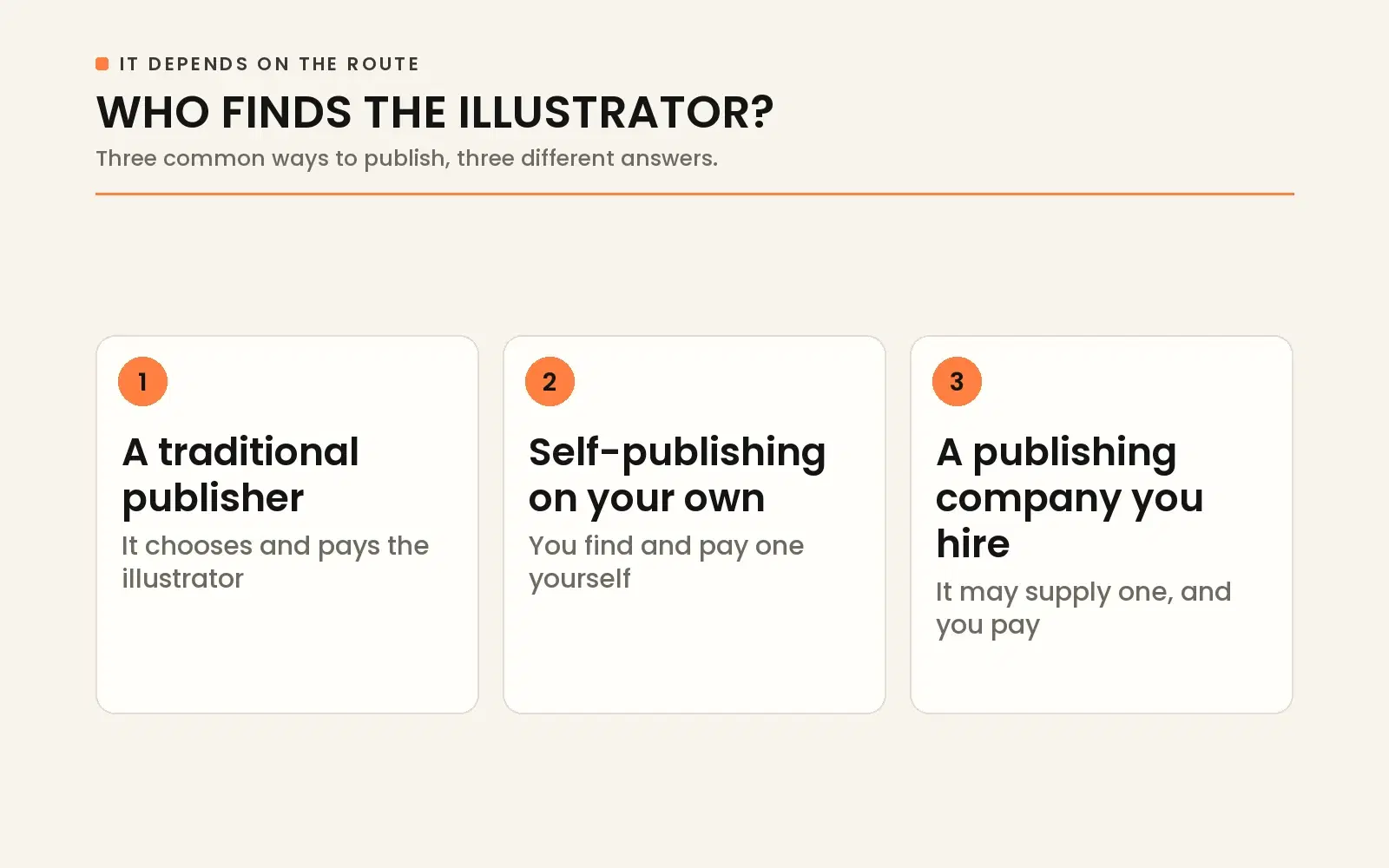
Who provides the illustrator for a children's book depends on the publishing route, and there are three common ones. A traditional publisher provides the illustrator and pays for the art. As a self-publisher, you find and pay one yourself. A publishing company you hire sits in between, since it may supply the illustrator, but you're the one paying for the work.
Many authors ask, "Do publishers provide illustrators?" and get a flat yes or a flat no. Both answers are true, just for different kinds of publisher. The word publisher can mean a house that buys your book or a company you pay to make it. Those two handle the art in opposite ways, as the table shows.
| Your route | Who finds the illustrator | Who pays for the art | What you do first |
|---|---|---|---|
| A traditional publisher | The publisher, usually its editor and art director | The publisher | Send the text alone, with no pictures |
| Self-publishing on your own | You | You | Find an illustrator and agree the terms in writing |
| A publishing company you hire | The company, if illustration is part of the work, or you | You | Ask whether illustration is included, or bring art you own |
If you haven't picked a route yet, that's fine. You don't need to hire anyone until you have. Each row of the table gets its own section below.
Does the Publisher Choose the Illustrator or the Author?
In traditional publishing, the publisher chooses the illustrator, not the author. A picture book usually stays a plain manuscript until the publisher offers the author a contract. Only then does the editor, working with the art director, pick an illustrator. The publisher hires that illustrator under a contract of its own. The author doesn't hire the illustrator, doesn't pay them, and may never work with them directly.
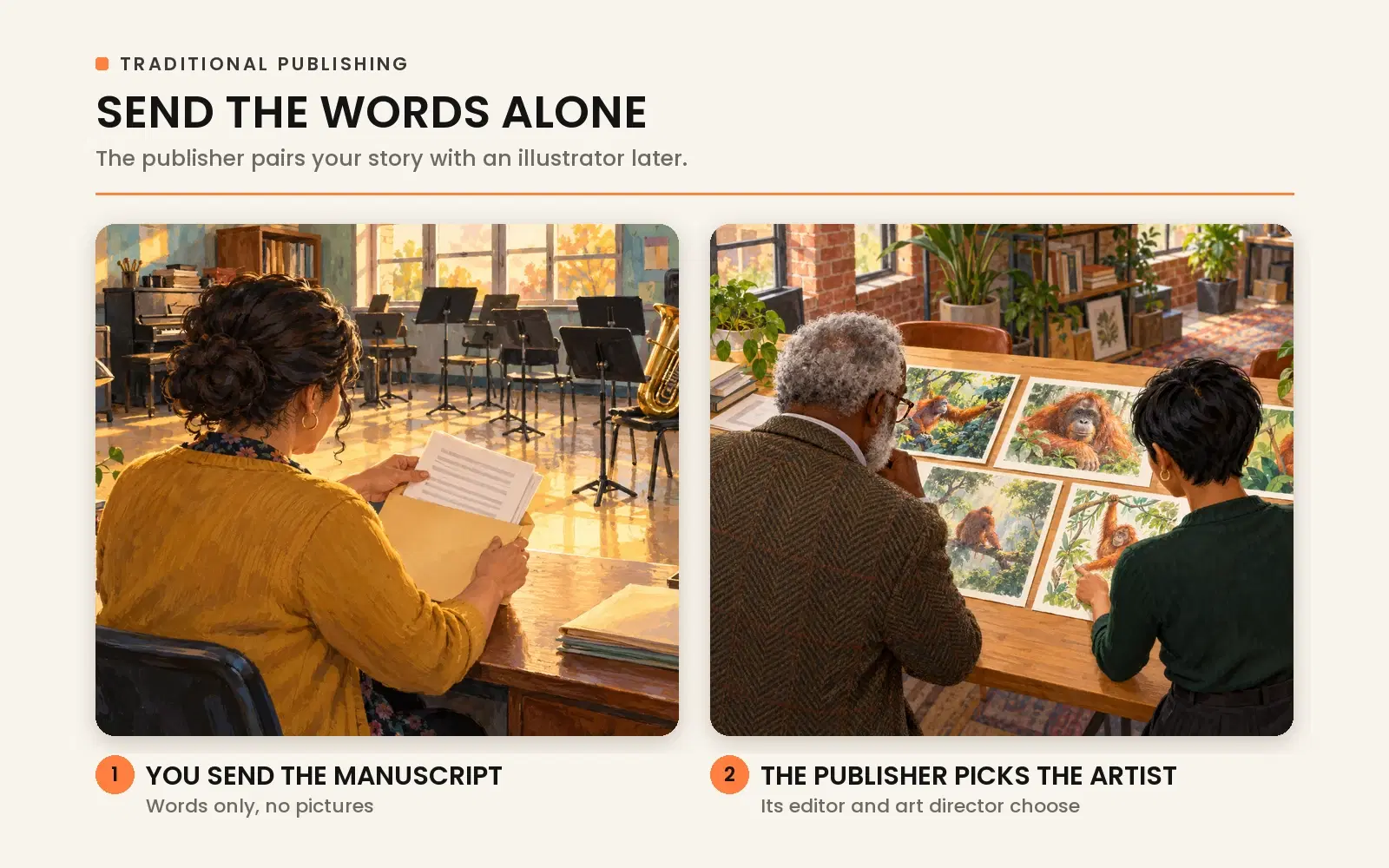
Publishers keep this choice because they're pairing words and art for a book they're paying to make and sell. An editor and an art director may already have an illustrator in mind and be waiting for the right story. Sometimes they pair a brand-new author with an experienced illustrator, because they know it can help the book get noticed. That pairing is part of what a traditional publisher brings to your book.
Picture a middle school band director who has written a funny picture book about a tuba that plays too loud. She doesn't need to find an artist, choose a style or set money aside for pictures before she submits. Her job is to make the words as strong as they can be and then send them out. If a publisher takes the book, how the tuba looks becomes the publisher's decision.
How Do Publishers Find Illustrators?
Publishers find illustrators mostly through the illustrators' own work. Children's book illustrators promote themselves to art directors with online portfolios, social media posts and sample postcards. Art directors keep the artists they like in mind. When a manuscript comes along that suits one of them, the publisher offers that illustrator a contract.
You can see this on publishers' own websites. Some submission guidelines have a separate section for illustrators, asking for samples or a portfolio link rather than a finished book. Some publishers also set up portfolio reviews with artists whose samples catch their eye. So when a traditional publisher takes on your story, it's choosing from artists it already knows, and it doesn't need you to bring anyone.
How Much Say Does the Author Get Over the Pictures?
A picture book author in traditional publishing usually gets less say over the pictures than they expect. The publisher works with the illustrator through the sketches, the layout and the final art. It may not involve the author much along the way. That's done on purpose, so the illustrator can bring their own ideas to the story instead of copying the pictures in your head.
Many authors find this hard at first, and many are later pleased by what the illustrator brought to their words. You still have a voice through your editor, too. If a sketch gets a fact wrong, such as a real place or a cultural detail, you can say so. If a joke only works when the picture shows something the words don't say, your editor can pass that on. What you won't do is pick the colors or redraw the hero's face.
Do You Need Illustrations to Submit a Picture Book?
No, you don't need illustrations to submit a picture book to a traditional publisher or a literary agent. Publishers' own submission guidelines say so plainly. Charlesbridge tells authors that illustrations are not necessary, and Holiday House says you don't have to supply them. Albert Whitman, which reads picture book manuscripts from authors without an agent, says it isn't necessary to send illustrations with the story text.
So your submission is the words, sent the way each publisher asks, usually with a short query letter, which is a brief note that introduces you and your story. If you do have art you want to show, send copies or a link, never the original paintings or drawings. Holiday House asks for detailed sketches or photocopies and warns authors not to send original art. Charlesbridge gives illustrators the same warning. Check each publisher's page before you send anything, because the rules vary from house to house.
Why Sending Your Own Art Can Work Against You
Sending your own art with a picture book manuscript can cost you an offer you might otherwise get. When the text and the art arrive together, the editor has to like both. Albert Whitman says it reviews text and art separately. It adds that it may be interested in the story but not the artwork, or the other way around. Pictures can also make an editor wonder whether you'd be willing to change the words.
A strong picture book text doesn't need pictures to be understood. Editors read unillustrated manuscripts all the time. They're good at seeing the finished book in their heads. Sometimes part of your story truly happens in the pictures, such as a twist the words never mention. A line in your cover letter or a short bracketed note on that page is enough for that. Keep notes like these rare, and let the words do the rest.
What If a Friend or Relative Wants to Illustrate It?
If a friend or relative wants to illustrate your picture book, submit your story on its own and let them share their art separately. When a manuscript and its pictures arrive as a pair, a publisher who loves one but not the other may turn down both. Submitting separately keeps both doors open. You can mention your illustrator later if a publisher accepts your book, and your friend can send samples to an art director directly.
Back to the band director, whose old school friend studied art and would love to draw the tuba. It's tempting to send the two together as a joint project. If they both feel the book must be published as a pair, they can submit together with a book dummy, which is a rough sketched version of the whole book. They should just know it can lower their chances. If they self-publish instead, the friend can draw every page, with a short written agreement about the art to keep things clear later.
Can You Submit a Book You've Already Had Illustrated?
Yes, you can submit a book you've already had illustrated, but you'll usually do better sending the text alone. Most traditional publishers prefer to find their own illustrator, so paid-for pictures rarely come along with an offer. The good news is that the art isn't wasted, since you can still use it in whatever ways your agreement with the illustrator allows.
Say a pharmacist paid a freelance artist to paint every page of her bedtime story about a sleepy moon. Then a friend urged her to try publishers first. She can send the words out on their own and keep the paintings safe. If a publisher makes an offer, it will most likely bring in its own illustrator. If no offer comes, she can self-publish with the pictures she has, as long as her agreement lets her use them in a printed book. That's why it's worth rereading the agreement before she picks a route.
Do You Need an Illustrator to Self-Publish a Book?
For a self-published picture book, you do need an illustrator, unless you draw the pictures yourself or already own finished art. When you self-publish, you're the publisher. Every job a publishing house would handle lands with you, from choosing the illustrator to paying for the pictures. Nobody assigns an artist to your book.
Self-publishing platforms don't supply pictures. Amazon KDP has you choose your print options before you upload your manuscript and cover, and IngramSpark lists cover and interior files among what you need. Both print and sell what you give them, so your pictures need to be finished first.
For the search itself, see the guide on how to find and hire a children's book illustrator. It covers where to look, how to read a portfolio and what to ask. You can hire a freelancer on your own, or bring in a children book illustrator through a company that also handles editing, design and printing. Either way, you're the one choosing the artist and paying for the work.
Think of a youth pastor who's writing a picture book about kindness for the children at his church. He plans to self-publish and give copies to the families. No publisher will step in with an artist, so he'll need to find one himself. He'll agree the price and the schedule and approve the pictures. Because the church hopes to use the main character on posters later, he'll want that use written into the agreement from the start.
What Changes When You're the One Hiring
When you're the one hiring, the decisions a publisher's team would make become yours. It helps to know what they are before any drawing starts.
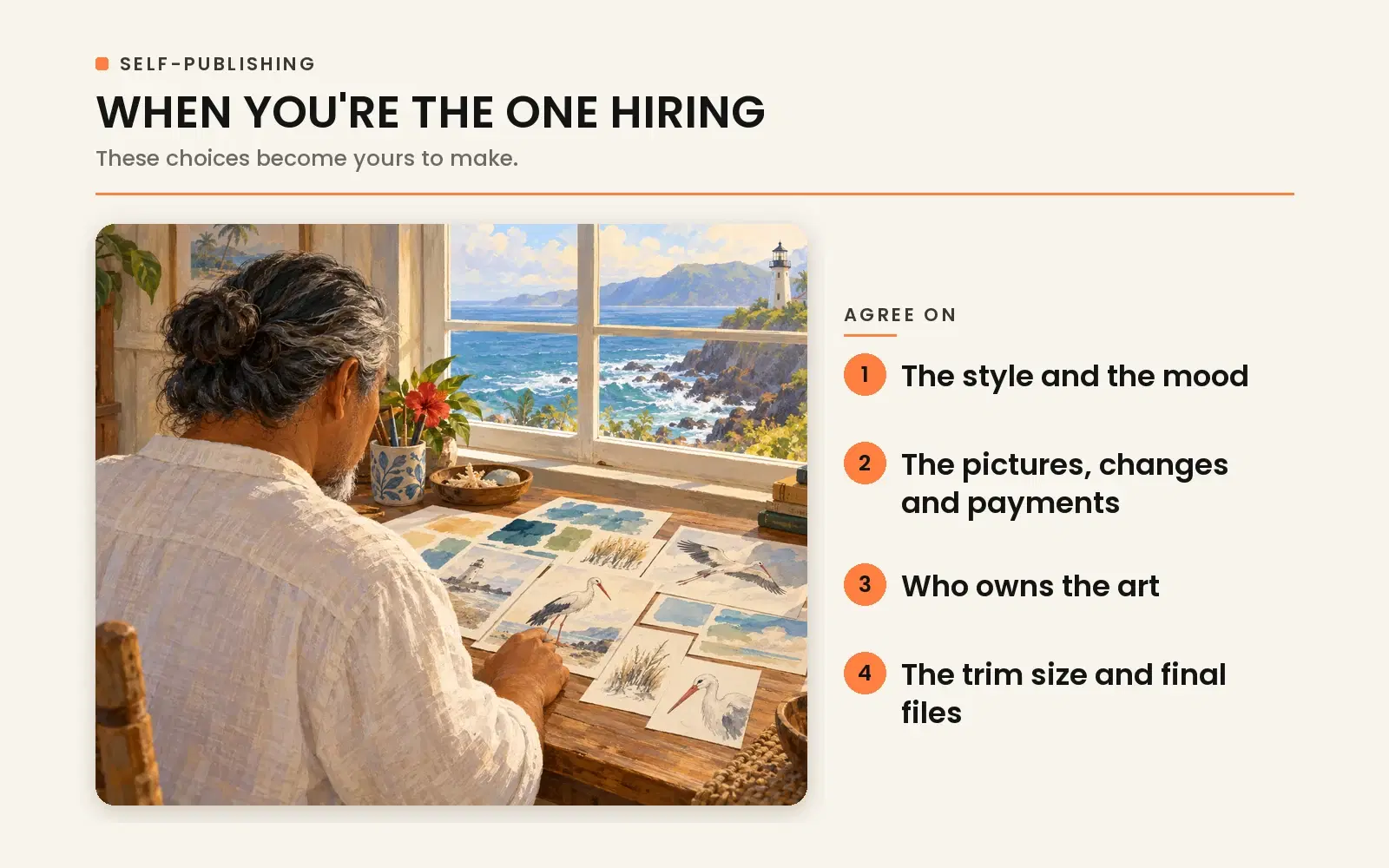
- The style and mood of the pictures, and whether they suit your reader's age.
- A written agreement on the number of pictures, the cover, rounds of changes, the schedule and the payments.
- Who owns the art, and how you can use it in later books, on a website or on posters.
- The trim size, which is the finished size of each printed page, so every picture is drawn to fit it.
- The final files, in a form your designer or printer can actually use.
Ownership deserves a careful look. In the United States, copyright in a piece of art generally belongs to the person who created it. The exceptions are a signed written transfer or art that counts as a work made for hire. The U.S. Copyright Office's guide to copyright basics explains these rules in plain terms. Paying for the pictures doesn't by itself make the copyright yours. So settle ownership in writing before the work begins, and ask a lawyer if a clause isn't clear to you.
What If You Hire a Publishing Company?
If you hire a publishing company for your children's book, it may provide the illustrator as part of the work you pay for. It may also build the book around art you already own. Either way, you're the client, so you pay for the pictures and you still make the final calls. That's the main difference from a traditional publisher, which pays for the art and makes those calls itself.
Some companies that help you publish your children's book can also have the pictures drawn, so you aren't managing an illustrator and a designer separately. Companies differ a lot in how they handle the art, though, so ask a few questions before you sign. Is illustration included, or is it a separate service? Who will draw the pictures, and can you see finished books they've illustrated? Who owns the art and the files when the work is done, and is that written down?
The post on everything a children's book publisher does explains the other jobs a team like this takes on. If you already have pictures, or just sketches and ideas, tell the company at the very start, because it changes where the work begins. The guide to what to have ready before a publishing team starts covers what to send.
Who Pays the Illustrator of a Book?
Who pays the illustrator of a book depends on who publishes it. In traditional publishing, the publisher pays the illustrator under its own contract, and the author pays nothing for the art. On a picture book, the illustrator often shares the royalties with the author. Royalties are a share of the money from each copy sold. In self-publishing, you pay the illustrator yourself.
Self-published authors usually pay an illustrator a flat fee agreed before the work starts, rather than royalties. A flat fee is simpler for both sides. Nobody has to track sales and send payments for years afterward. Paying in parts, each tied to finished work such as the sketches or the final art, protects you both.
When you hire a publishing company, you pay the company rather than the artist. However you pay, the price of the art depends on the number of pictures, how detailed they are and the rights you need. The post on what moves the cost of illustration explains each of those in turn.
Does Every Children's Book Need Illustrations?
Not every children's book needs illustrations inside, but every one needs a cover. The younger the reader, the more the pictures matter. Picture books tell their stories through words and art together, so they usually have art on every page or spread. A spread is the two pages you see side by side. Board books use very few words, so their pictures carry most of the story. That's why a picture book usually needs an illustrator for nearly every page, while a chapter book needs far fewer pictures.
Children's books without illustrations are mostly found further up the age range. Early readers, by contrast, are short books that are light on text and heavy on pictures. A chapter book, which Scholastic places at about ages 7 to 10, still includes some pictures, just fewer than an early reader. Middle grade novels, written for readers about 8 to 12, usually have few or no pictures inside beyond the cover, though some are illustrated. The guide to children's book categories by age explains where each format begins and ends.
Take a school bus driver writing a chapter book about a bus that talks back. His readers are 8 year olds, so he doesn't need a picture on every page. He might want a cover and a small drawing at the start of each chapter, or only the cover. That's a much smaller job than a picture book, and he should say so clearly when he asks for a quote. If he goes the traditional route instead, the publisher decides how much art the book gets.
When the Author Is Also the Illustrator
An author who can also illustrate may send the picture book to publishers as one package. Some publishers ask for exactly that. Author-illustrators usually send a book dummy, the rough sketched version of the whole book, along with a few pieces of finished art. Charlesbridge, for example, asks author-illustrators for a book dummy or a manuscript with sample illustrations.
Even then, be ready for a publisher to love the story and prefer a different artist. It can happen the other way around, too. Some author-illustrators agree to that, and others wait for a publisher who wants both. If you self-publish, drawing the pictures yourself removes the hiring question, though it adds a great deal of work. The guide on whether to illustrate your own children's book covers the skills, time and print needs behind that bigger decision.
Settle the Story Before Anyone Draws It
Whichever route you take, finish and edit the story before anyone starts drawing. Illustrations are planned page by page from the final words. A changed line can mean a redrawn picture. For a traditional publisher, a polished manuscript is also the whole submission, so it's where your effort does the most good.
If you're still shaping the story, read a beginner's guide to writing your first book before you think about pictures. Once the words stop changing, you'll know exactly what your book needs from an illustrator. You'll also know whether you need one at all.
Pictures for Your Book From Book Writing US
We can help with the pictures if you're self-publishing, or if you'd like help turning your story into a finished book. At Book Writing US, our children's book illustration services cover picture books, early readers and educational books, with the art made for your story from the main character onward. We can also run the illustration work alongside our publishing service.
Whoever you work with, keep the final say on your story. Get the ownership of the art and the files in writing, too.
Frequently Asked Questions
Can you submit a children's book without illustrations to a literary agent?
Yes, you can send a picture book text to a literary agent without illustrations, and that's the usual way to do it. Bradford Literary Agency, for example, says artwork isn't required to submit a picture book text. It asks only illustrators for a portfolio or dummy link. If an agent takes you on, they'll send your text to editors, and the publisher that buys it will choose the illustrator.
Can I suggest an illustrator to a traditional publisher?
You can mention an illustrator you admire, but the choice stays with the publisher. The better time to raise a name is after an offer, not in your first submission. A ready-made pairing can make a yes harder to give. Authors with several published books sometimes have more influence over the choice than first-time authors do.
Should I send pictures of how I imagine my characters?
For a traditional publisher, usually not, because imagining your characters is the illustrator's job. A picture book manuscript doesn't need descriptions of how a person or a place looks. The exception is a story set in a real place or time. There, you can tell your editor about photos or other references you found while researching. If you self-publish, reference pictures are welcome, and your illustrator will probably ask for them.
What if the publisher's illustrator draws my character differently than I pictured?
That's normal in traditional publishing, and it's often where a picture book finds its surprises. The illustrator brings their own vision to your words, and the publisher backs that choice. If a difference changes the story, such as a detail the plot depends on, raise it with your editor. If it's only a different look from the one in your head, give it some time.
Should a publisher ask you to pay for the illustrations?
A traditional publisher shouldn't ask you to pay for the illustrations, because it pays for the art itself. A company you hire to publish your book will charge for pictures it has drawn. That's a normal service when it's clear from the start. The warning sign is a company that calls itself a traditional publisher, offers a book deal and then asks you to pay for art. Publishers such as Holiday House now warn authors on their own websites about scams that misuse their names.
Can I use AI pictures instead of hiring an illustrator?
Some authors choose AI pictures, and doing so changes what you'll need to check. Some traditional publishers, Holiday House among them, say on their own websites that they don't publish art created by AI. Amazon KDP asks you to tell it when a book's images are AI-generated. For how the two ways of making pictures compare on consistency, style and changes, see how AI and human illustrators compare.
- Who Provides the Illustrator Depends on How You Publish
- Does the Publisher Choose the Illustrator or the Author?
- Do You Need Illustrations to Submit a Picture Book?
- Do You Need an Illustrator to Self-Publish a Book?
- What If You Hire a Publishing Company?
- Who Pays the Illustrator of a Book?
- Does Every Children's Book Need Illustrations?
- When the Author Is Also the Illustrator
- Settle the Story Before Anyone Draws It
- Pictures for Your Book From Book Writing US
- Frequently Asked Questions