How Many Illustrations Does a Children's Book Need?
Short Answer: Most 32-page picture books have room for about 12 to 14 main illustrations, one for each double-page spread of story. It's closer to 12 when the endpapers are part of the 32 pages and closer to 14 when they're separate. Split spreads and small spot pictures can push the count toward 24 to 28, plus the cover. Other formats need far fewer, and many chapter books use just one or two pictures per chapter.
Ask a few illustrators how many illustrations in a children's book are enough, and you'll hear anything from 12 to 28. They aren't really disagreeing about your book. Some count spreads, some count pages and some count every small picture as its own piece. Once you know which unit is being counted, the numbers start to line up.
You don't need an exact number before you start, but a rough one helps. It lets you brief an illustrator clearly and compare quotes fairly. It also shows you early if your plan won't fit your page count. The sections below give you the numbers format by format, along with the reasons behind them.
What Counts as One Illustration?
In your book, one illustration is one finished picture, whatever its size. A picture that stretches across two facing pages counts as one. So does a small teacup drawn in the corner of a page. That's why the size of each picture matters as much as the total when you plan your book.
Most children's book pictures fall into a handful of kinds, and your book will probably mix several. The table shows how much room each one takes and what it's good for.
| Kind of picture | Room it takes | What it's good for |
|---|---|---|
| Double-page spread | Both facing pages, running across the fold | Big moments, such as a wide view after a page turn |
| Full-page illustration | One whole page | A single strong moment on its own page |
| Spot illustration | A small part of a page, usually with no background | Small details beside the words, or the top of a chapter |
| Vignette | A small picture with a soft or open edge | Title pages and the start or end of a chapter |
| Front cover | The whole front of the book | Showing the main character and the feel of the book at a glance |
When you compare published answers, check which unit each one uses. A book told in 13 spreads has 13 pictures. Those same pictures fill 26 pages, so both numbers describe the same book and neither one is wrong.
What Is a Double-Page Spread?
A double-page spread is the two facing pages you see together when a book lies open, with one picture running across both. Dictionaries define a spread as two facing pages with material running across the fold. In a picture book, that material is usually one wide illustration. So a spread counts as one picture, though it fills two pages. That's also why, when you count how many double-page spreads in a picture book belong to the story, you're counting big pictures, not pages.
The fold down the middle is called the gutter. Illustrators keep faces, small details and words out of it, because anything placed there can get lost in the binding. That's one reason a spread takes more planning than a picture on a single page.
Spreads are where your picture book shows its biggest moments. When a child turns the page and a whole beach suddenly opens up, that's usually a spread. Quieter moments don't need that much room, and that's where smaller pictures come in.
Spot Illustrations and Vignettes Fill the Smaller Moments
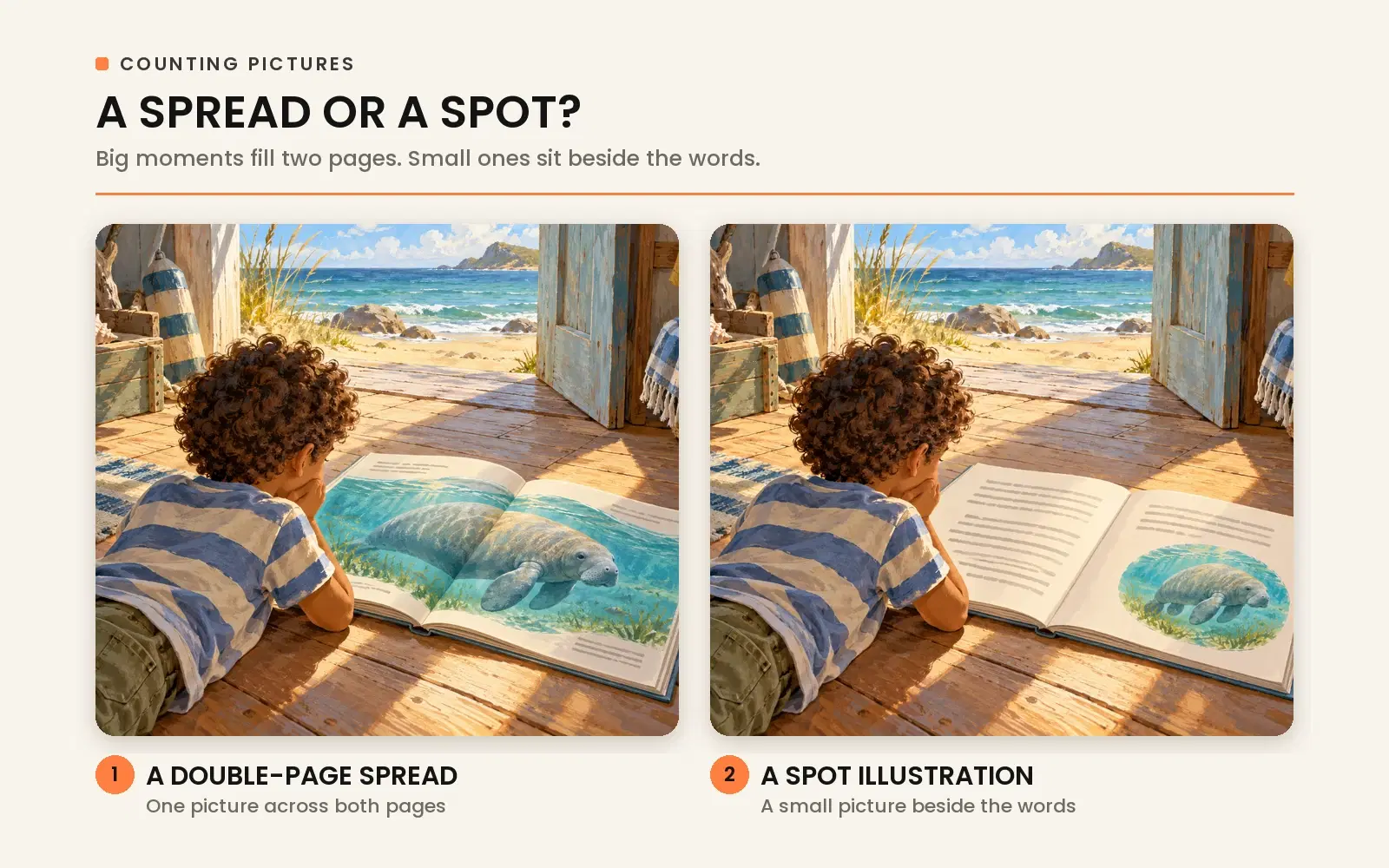
A spot illustration is a small picture, usually with no border or background, that sits beside the words rather than filling the page. A vignette is a close cousin. It's a small picture with a soft or uneven edge that fades into the white of the page. You'll often find one on a title page or at the start or end of a chapter.
An open illustration textbook from the City University of New York describes a spot as a picture that fills only a spot on the page. It works together with the text printed there. That's what makes spots so handy, because they show a small detail without taking up a whole page. Your book can then hold more pictures without each one being a big job.
Think of a dental hygienist writing a picture book to calm children before their first cleaning. Climbing into the tall chair is a big moment, so it deserves a full page or a spread. The tiny mirror, the toothbrush that tickles and the sticker at the end work better as spots. Her book gains several pictures, but each spot is usually a much smaller job than a spread.
How Many Pictures Are in a Picture Book?
A picture book generally has a picture on every page, and most picture books are 32 pages long. That doesn't add up to 32 pictures, though, because a few pages go to the title and the copyright notice. Some pictures also cover two pages at once. In some books, the endpapers use up a few of those 32 pages as well.
The page count itself comes from printing, since printers fold large sheets into groups of 8 or 16 pages. That's why picture books come in lengths such as 16, 24, 32, 40 and 48 pages, with 32 as the typical one. Before you decide how many of your pictures should be spreads, it helps to know where those 32 pages go. That tells you how many illustrations in a picture book you can realistically plan.
Not Every One of the 32 Pages Tells the Story
The first few pages of a picture book usually hold the front matter, not the story. First comes a half-title page, which usually shows just the title, then the full title page. The copyright page and often a dedication come next, so your story may not begin until around page 7.
Those pages can still carry art. A title page sometimes has its own illustration, such as a small vignette of the main character. The very last page can hold a single line of text or a spot illustration. So front matter doesn't always lower the number of pictures, but it does lower the number of story spreads.
The same goes for anything you add at the back, like a note for parents or a page about you. Each of those is a page your story can't use, so it's worth deciding early whether you want them.
Self-Ended or Separate Endpapers, and Why It Changes the Count
Endpapers are the pages at the very front and back of a book. One half is pasted to the inside of the cover, and the other half is the first loose page. How they're made decides how much of your 32 pages is left for the story.
In a self-ended book, the first and last pages of the 32 are pasted onto the cover and become the endpapers. In a book with separate endpapers, extra sheets do that job instead, often in a different paper. That leaves more of the 32 pages for the story.
| Question | Self-ended book | Book with separate endpapers |
|---|---|---|
| Where the endpapers come from | Pages from the 32, pasted onto the cover | Extra sheets added on top of the 32 |
| Pages used by endpapers and front matter together | About 8 of the 32 | About 4 to 6 of the 32, front matter only |
| Story spreads you can usually plan | About 12 | About 13 or 14 |
| What it means for your pictures | Each spread has to earn its place | Room for one or two more story moments |
Who decides which kind your book uses depends on how it's published, so ask before the pictures are planned. If you plan 14 story spreads and your book turns out to be self-ended, a couple of them will have nowhere to go. Endpapers can carry art too, like a pattern or a map. If yours do, add them to your count.
How Many Illustrations for a 32-Page Picture Book?
A 32-page picture book usually leaves room for about 12 to 14 double-page spreads of story. With one picture per spread, that's 12 to 14 main illustrations. If every page gets its own picture, the same book holds about 24 to 28.
Most picture books, and probably yours, land somewhere in between, because they mix sizes. A book might open on a spread and use two single pages for a quieter moment. It might add a few spots and save its biggest spread for the ending. You may also want title page and endpaper art. The cover is always its own piece.
Working out how many spreads in a 32-page picture book are left for the story mostly comes down to the endpapers and the front matter. It's worth knowing that number before you talk to illustrators, because a picture book is usually planned spread by spread.
Here's how the count can add up in a self-ended book with 12 story spreads. Say 8 of them are full spreads, 4 are split into two single-page pictures, and you add 3 spot illustrations. That gives you 8, plus 8, plus 3, which makes 19 story pictures before the title page and the cover.
What About 24-Page and 40-Page Picture Books?
A 24-page or 40-page book moves the count by 4 spreads. Picture books grow and shrink in steps of 8 pages, and 8 pages make 4 spreads. So a 24-page book has 4 fewer spreads for the story, and a 40-page book has 4 more. The same math applies at any length. It tells you how many spreads in a picture book of that size are left for the story.
Shorter books often suit the very young, since their stories are simple, while longer books are less common and cost more to print. Whichever length you choose, settle it before any pictures are planned, because each spread is drawn for its place. If you'll print through Amazon KDP, check its minimum too, since its premium color paperbacks start at 24 pages.
Board Books, Early Readers and Chapter Books Need Different Counts
Every children's book format has its own count, because the amount of art follows who's reading. The younger your reader, the more the pictures carry the book. If you're not sure which format fits your story, start with children's book categories by age, then come back to the counts below.
How Many Illustrations Does a Board Book Need?
A board book needs only as many pictures as it has pages to fill, and that's a small number. Board books typically run 12 to 24 pages and under 300 words. Their pictures are usually simpler than a picture book's, and with so few words, they do nearly all the telling. If you're working out how many illustrations in a board book your idea needs, start with the number of pages it fills.
Take an aunt making a counting book about her nephew's toy trucks, from one truck up to 10. Each number gets its own page with the right number of trucks, so 10 pictures carry the whole book. Add a title page and the cover, and her count is settled before she's written more than a few words.
Many board books are also shorter versions of picture books that already exist, with pages cut or combined to fit. If you'd like your picture book to become a board book one day, expect the count to shrink. Some pictures will likely be left out or merged.
Early Readers Keep the Pictures Beside the Words
An early reader still has plenty of pictures, but they support the words instead of telling the story. Early readers are for children around 5 to 8 who are learning to read alone. So the text does more of the work. An easy-reading picture book often runs 32 pages, while an early reader usually runs about 48 to 64.
Because the words come first, many early reader pictures share the page with a few lines of text instead of filling it. So an early reader can still hold a good number of pictures. Each one usually takes up less room than it would in a picture book.
Early readers often come in series, too, and that changes how you plan the pictures. A character drawn one way in your first book has to look the same in your third. So plan the look with the whole series in mind.
Do Chapter Books Have Pictures?
Yes, chapter books have pictures, but fewer than early readers, often just one or two per chapter. Early chapter books often run about 48 to 64 pages, and longer ones for older readers can reach about 80. Chapter books are read by children around 7 to 10, so the words carry the story and the pictures add to it.
Many chapter books put a small spot illustration at the top of each chapter, under the chapter title. It's a classic layout, and it gives your reader a hint of what's coming. The inside pictures are usually black and white, mostly because printing a whole chapter book in color is expensive.
That choice matters on print on demand. On Amazon KDP, you pick a color ink option if any image in your book is meant to print in color. Color books also cost more to print. So one color picture inside can turn your whole chapter book into a color book.
Say a former park ranger is writing a 10-chapter mystery set in a busy campground. At one or two pictures a chapter, she's planning roughly 10 to 20 small black and white pictures, plus a full-color cover. That's a very different job from a picture book, even though her book is much longer.
Middle Grade Leans on the Cover
Middle grade novels, written for readers about 8 to 12, have few inside pictures or none at all. Some add a small spot at the start of each chapter, but most of the visual work falls to the cover.
For a middle grade book, your count might be just the cover plus any chapter spots you choose. That's good to know early if you've been planning a picture on every page for a story that's really meant for older readers.
Does the Cover Count as an Illustration?
The front cover counts as its own illustration, separate from the story pictures, so add it to your count. It has to leave room for the title and still read clearly at a small size. That's why it deserves planning as a piece of its own.
A printed book needs more than a front cover, though. On Amazon KDP, a paperback cover is one file that holds the back cover, the spine and the front cover in a single image. So the art either stretches across all of them, or the back and spine get a simpler design that matches. The back cover can carry a smaller picture, a color from the front, or just the words about your book.
The spine is very narrow on a picture book. KDP only allows spine text on a paperback of 79 pages or more. So a 32-page paperback printed there can't carry its title on the spine. It's a small detail, but it changes how the cover art wraps around the book.
Other extras may or may not count as separate pieces, so ask about each one. Your title page might carry a small picture, and your endpapers might carry a pattern. A hardcover may also need a dust jacket.
What Changes the Number of Illustrations?
There's no fixed rule for how many illustrations should be in a children's book, and the honest answer depends on your story. The moments a child needs to see set the starting point. After that, a few other things push the number around.
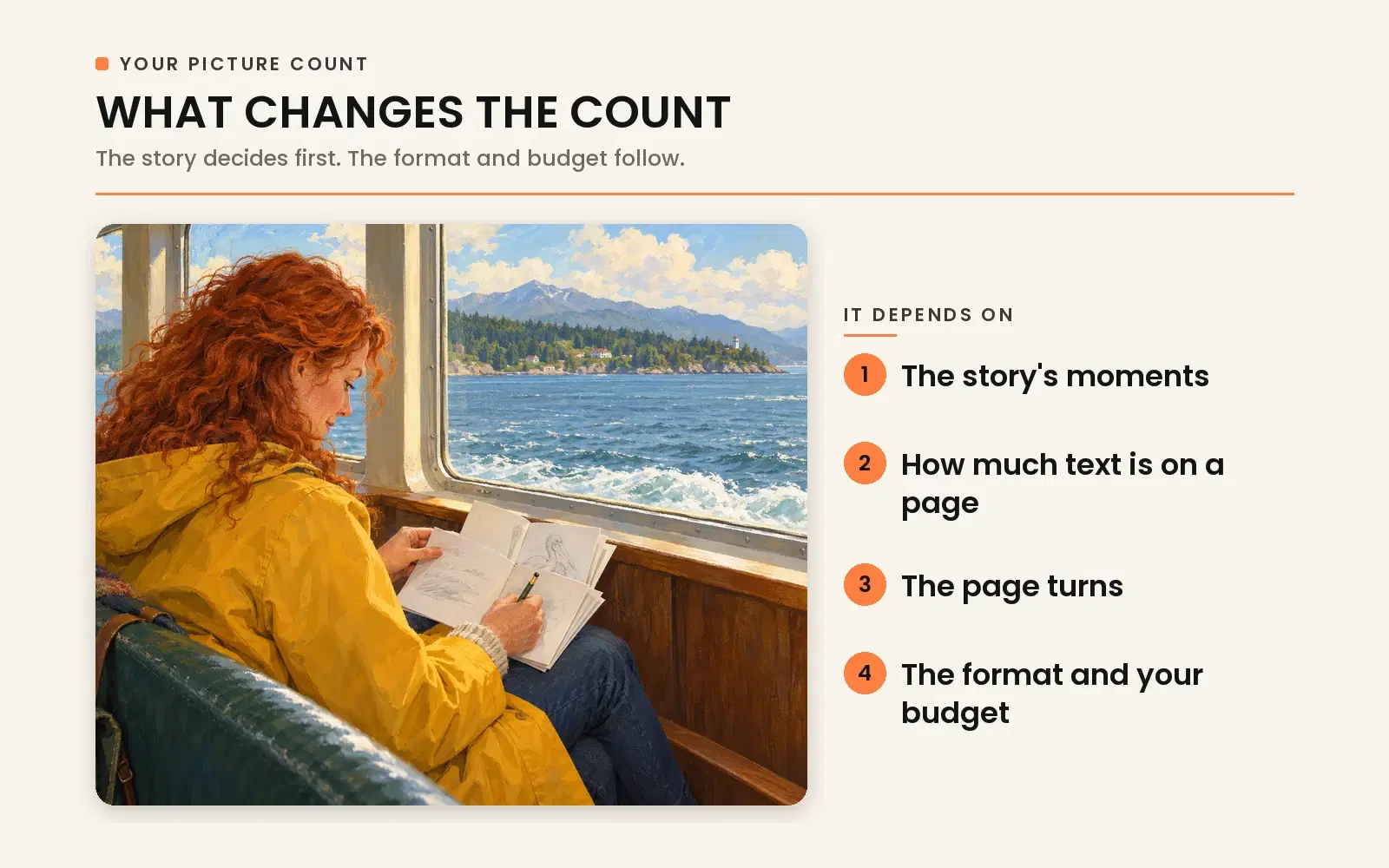
- The story's moments come first, since each scene where something new happens usually needs its own picture.
- The amount of text matters, because a page with several lines of words has less room for art.
- The page turns matter, since a surprise often lands on a spread right after the page is turned.
- The format sets the range, from art on every page of a picture book to one picture per chapter.
- Color or black and white changes the printing, since picture books are usually printed in full color.
- Your budget shapes it too, because every picture adds drawing time and the count moves the price.
Think about a swim teacher writing a picture book about a child who is afraid to put her face in the water. The first time she does it deserves a full spread, since it's the moment the whole story builds toward. The walk to the pool only needs a spot. The towel and the flip-flops can share a page. By sizing each moment to how much it matters, the teacher keeps the count in check without losing a scene.
Page turns shape the count more than most authors expect, because they decide where the big pictures fall. The guide to storyboarding your book before the art begins shows how those turns get planned. The count is also tied closely to price, so read what moves the cost of children's book illustration before you settle on a number.
How Do You Work Out How Many Illustrations Your Story Needs?
You can make a rough count from your manuscript alone. Mark each moment a child should see, then decide how big each one needs to be. It won't be final, since your illustrator will firm it up. Still, it gives you a clear number to start the conversation.
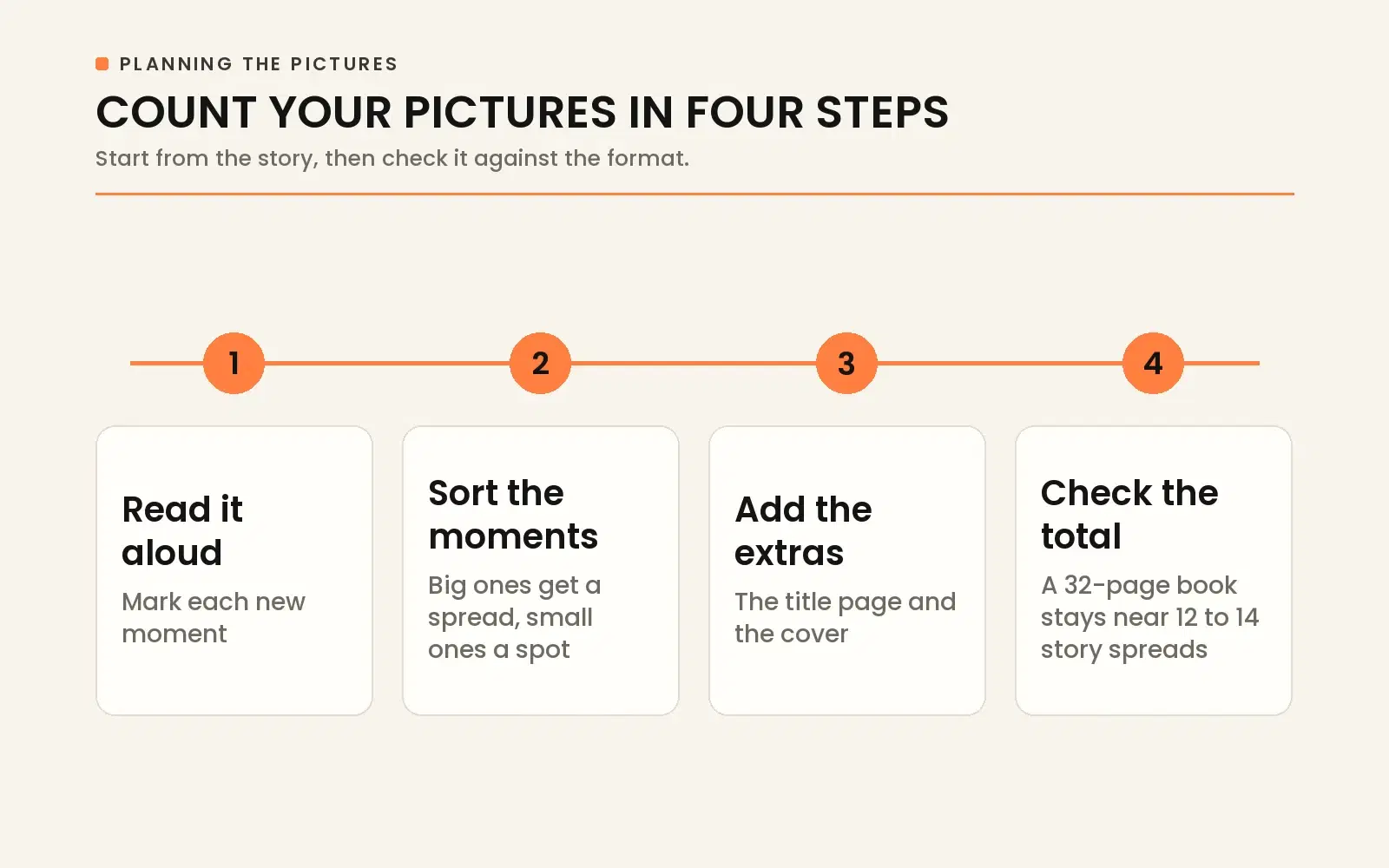
- Read your story aloud and mark each new moment.
- Sort those moments into big ones for a full spread and small ones for a spot.
- Add the pictures outside the story, such as the title page and the cover.
- Check your total against your format, so a 32-page book stays near 12 to 14 story spreads.
Take a bakery owner writing about a cat that sneaks into her shop on each day of the week. That's 7 visits, and each one is a natural spread. With an opening and an ending, that's 9 story spreads. That still leaves room in a 32-page book for a quieter spread and a few spots of the treats the cat steals.
Bring that rough count with you when you start finding and hiring a children's book illustrator. It helps you compare illustrators fairly, even though the final number usually gets settled later, in the thumbnails. You can see where that fits in what happens at each stage of an illustration project.
Turning Your Count Into Finished Pictures
Once you have a rough count, the next step is finding the right hands to draw it. At Book Writing US, our children book illustration service creates the art for picture books, early readers and educational books, covering each picture your story needs.
We can also pair it with our children's book publishing services if you'd like those pictures to become a printed book. When you're ready, connect with us about your book.
Frequently Asked Questions
Does every page of a picture book need an illustration?
Most picture book pages have art, but not every page needs a full picture. Front matter pages, like the copyright page, can be plain text, and some story pages carry only a small spot. If several of your pages are plain text, your story may be closer to an illustrated storybook.
Does a wordless picture book need more illustrations?
A wordless picture book doesn't usually need more pictures, but each one has to do more work. It's still planned in the same spreads. With no words to fill the gaps, every picture has to show clearly what happens next. Some wordless books use small panels or spots to show a quick run of action.
Do the endpapers need their own illustration?
No, endpapers don't need an illustration, and many are plain color. A pattern or a map can make them feel special, but it's a choice, not a rule. Plain endpapers keep things simple. In a self-ended book, they also come from the 32 pages, so any art there uses up story space.
Is the back cover a separate illustration from the front?
The back cover can be a separate illustration or carry the front cover's art around the spine, but either way it's planned with the front. On Amazon KDP, the whole cover goes in as one image covering the back, spine and front. Ask your illustrator whether the back cover is part of the cover or counted on its own.
Can a children's book have too many illustrations?
Yes, a children's book can have too many illustrations when the pictures crowd the words. It also happens when pictures repeat what another page shows. A cluttered page can feel as unplanned as an empty one. More pictures also mean more drawing time and a higher price, so each one should earn its place.
Can you add more illustrations after the pages are laid out?
You can add illustrations after layout, but it's harder and often costs more than planning them early. A picture book's page count moves in steps of 8, so a new spread may mean moving text and other pictures. If you think you'll want more art, raise it at the thumbnail stage, while changes are still quick.
- What Counts as One Illustration?
- How Many Pictures Are in a Picture Book?
- How Many Illustrations for a 32-Page Picture Book?
- Board Books, Early Readers and Chapter Books Need Different Counts
- Does the Cover Count as an Illustration?
- What Changes the Number of Illustrations?
- How Do You Work Out How Many Illustrations Your Story Needs?
- Turning Your Count Into Finished Pictures
- Frequently Asked Questions