What Children's Book Illustration Costs, and What Moves the Number
Short Answer: Children's book illustration costs as much as the work inside your book, so there's no single price that fits every book. The price moves with the number and size of the pictures and the detail in each one. It also moves with how many characters must match from page to page, which rights you buy and how soon you need the art. You control most of those choices before an illustrator ever sends you a quote.
If you search "How much does it cost to illustrate a children's book?" the numbers you find swing wildly. None of them was worked out for your story, your pages or your characters. A price only means something once it's tied to the pictures your book really needs.
So this guide doesn't give you a price list. It explains each choice that moves your children's book illustration cost, why it moves it, and which of those choices are yours to make. It covers the pictures only. Editing, layout, printing and the rest of the bill have their own guide, on what it costs to publish a children's book.
How Much Does a Children's Book Illustrator Cost, and Why Do Quotes Vary So Much?
What a children's book illustrator costs depends on two things, the job you describe and the illustrator you ask. Quotes for the same story often land far apart. That's usually because they're quotes for two different jobs.
Picture a first-time author with a story set at a busy Saturday farmers market. One illustrator prices a full market scene across every two-page spread, with shoppers, stalls and crates of apples behind the two main characters. Another prices the same two characters on soft, simple backgrounds, with a full market scene only where the story needs one. Both quotes are honest. They just describe different books. The first one simply holds far more drawing.
The person matters as much as the job. An illustrator with a shelf of published picture books, a full schedule and a style people seek out will usually charge more than someone newer to the work. You're paying for their skill, and also for how reliably they'll hand you a book that holds together from the first page to the last.
So when you ask, "How much does it cost to hire a children's book illustrator?" the only fair answer starts with your book's details. Give every illustrator you contact the same details, such as the number of pictures, the style, the rights and the deadline. Then their quotes can sit side by side. The gaps between them will start to make sense.
What Affects the Cost of Illustrations the Most?
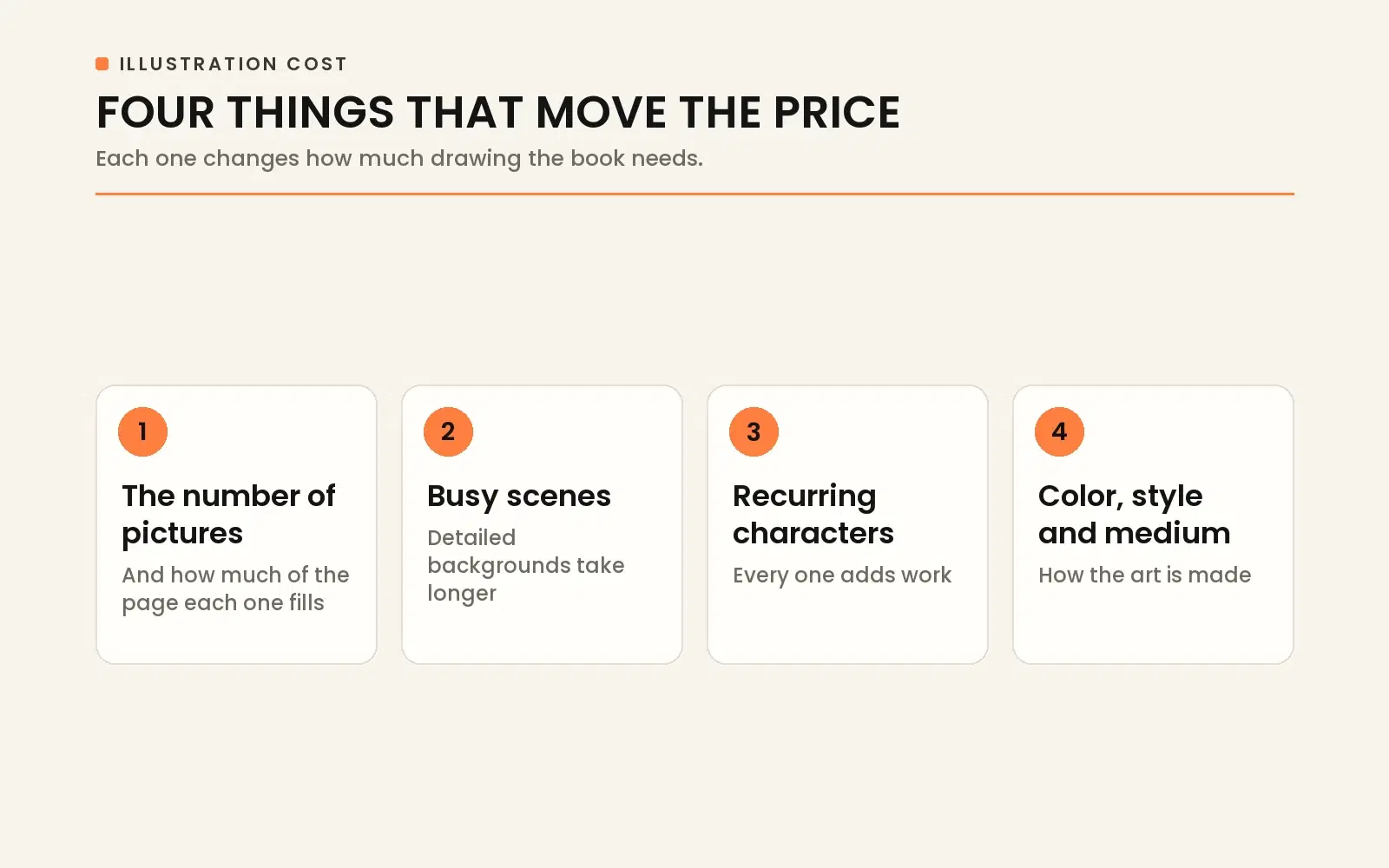
The amount of drawing affects the cost of illustrations the most. That amount comes from how many pictures your book has, how much of each page they fill and how much detail they hold. Rights, changes and the deadline then add to the price or take away from it. The table shows what pushes each one up or down.
| Cost driver | Costs less when | Costs more when |
|---|---|---|
| Number and size of pictures | Some pages carry small spot art | Nearly every page is a full spread |
| Detail and backgrounds | Quiet pages sit on simple backgrounds | Crowds and busy rooms fill most scenes |
| Recurring characters | A small cast appears in most scenes | Many characters, outfits or patterns repeat |
| Color | The art is line art in black and white | Every page is in full color |
| Style and medium | A simple style suits the story | A detailed painted style is chosen |
| Rights you buy | You need the art for one book | You want every use, including toys and film |
| Changes | Notes come in one clear list per stage | New ideas arrive after the art is approved |
| Deadline | There's room in the schedule | The art is needed in a rush |
| Files and extras | You need the print files only | You also want source files and extra images |
The first four rows often account for most of the price, so each gets a closer look below.
The Number of Pictures, and How Much of the Page Each One Fills
The number of pictures sets the size of the job, but the size of each picture matters just as much. A spread is one picture that runs across two facing pages, and it's usually the biggest piece of drawing in a picture book. A full-page picture fills one page, while a spot illustration is a small picture that often sits on white space beside the words. The cover is its own piece of art on top of all of those.
So two books with the same page count can hold very different amounts of drawing. A book told mostly in spreads asks for far more work than one that mixes spreads with single pages and spot illustrations. When you compare quotes, ask each illustrator how many of each kind they've counted.
Counting the pictures your book needs is covered format by format in the guide to how many illustrations a children's book needs.
Busy Scenes and Detailed Backgrounds
Detail adds time to every picture it appears in. A book full of busy scenes costs more to illustrate than one with calm, simple backgrounds. Crowds, rooms full of toys, leafy forests and patterned wallpaper all take longer to draw. They also take longer to keep the same from one page to the next.
That doesn't mean every page should be plain. In a picture book set at a busy farmers market, the opening spread might need the whole crowded market, because it sets the scene. A quieter page, like a close-up of the two friends sharing a peach, can sit on a soft wash of color. A good illustrator will often suggest where detail earns its place and where a simpler page lets the eye rest.
Putting detail where it matters is one of the easiest ways to shape the price without the book looking thin.
Every Recurring Character Adds Work
Every character who appears on more than one page adds work, because the illustrator has to draw them the same way every time. A main character is designed once, with a settled face, shape, outfit and colors, and then redrawn to match that design on every page. A child notices at once when a nose changes shape or a scarf changes color halfway through the book.
So a small cast costs less to draw than a big one. A patterned animal, like a tabby cat or a spotted giraffe, takes longer on every page than a plain one. Outfit changes add up in the same way, since a school uniform, pajamas and a raincoat each need their own design.
If your story has a big cast, ask which characters truly need to be in every scene. Some can appear only where the story calls for them. Your book won't feel any emptier for it.
Color, Style and the Medium the Art Is Made In
Full color art costs more to make than black and white line art, and a detailed painted style costs more than a simple one. Color adds a whole extra pass to every picture, because each shape has to be filled, shaded and checked against the pages around it.
The kind of book plays a part too. A picture book is usually illustrated in full color on nearly every page. An early reader usually has smaller pictures that sit beside the words, and a chapter book often has just a few drawings per chapter, sometimes in black and white.
The medium changes the cost as well. Watercolor and other paints have to be scanned and cleaned up before they're ready for print, and a painted mistake can't simply be undone. Digital art is easier to adjust, which can make later changes cheaper. You can compare how each approach looks in this guide to children's book illustration styles.
The color choice also follows your book to the printer. On Amazon KDP and IngramSpark, a book with color pages is printed and priced as a color book. Even a few color pictures put the whole book on color printing. That side of the bill is explained in the guide to what drives the cost to print a children's book.
Why Is Children's Book Illustration So Expensive?
Children's book illustration is expensive because every picture is custom finished art, drawn for one story, one page size and one set of characters. None of it can be borrowed from another book, and all of it has to work together.
Much of the work happens before a single finished page exists. The illustrator reads your manuscript closely, designs the characters and plans every page turn in small rough drawings. Then come full-size sketches, your notes, the final art and the color checks. Last come the print-ready files. They're sized to your book's trim size, the finished page size, with bleed added so the art still reaches the edge after trimming. Each step takes skilled hours, and the guide to each stage of an illustration project walks through them in order.
Consistency is the hidden part of the price. Drawing one lovely picture is hard enough, but drawing a whole book of them is harder. On every page, the same child needs the same face and height beside the same dog. That steady sameness is what makes a book feel finished rather than pieced together.
It helps to remember what you're buying. You aren't paying for a stack of drawings. You're paying for pictures that tell half your story, drawn by someone who knows how children read a page.
How Do Illustrators Price Their Work?
Children's book illustrator rates are set in a few common ways. The same book can look cheap in one kind of quote and costly in another, so it helps to know what each one really means.
- Per illustration means each picture has its own price, so the total grows with every picture you add. It's easy to follow, as long as the quote says which pictures are spreads and which are small.
- Per page or per spread ties the price to the book's pages, which is simple to read but can hide what's on each page.
- A flat project fee covers the whole book for one price, which makes budgeting easier if the quote lists exactly what's included.
- An hourly rate often applies to work outside the agreed job, such as extra changes or new pictures you add later.
If a traditional publisher takes on your picture book, its art director usually finds the illustrator. So the cost drivers in this guide matter most when you're self-publishing or paying for the art yourself. Some illustrators also earn royalties, a share of each sale, but that's a separate deal from the fee for drawing your book. The guide on whether you need your own illustrator explains how the two routes differ.
How Much Do Children's Book Illustrators Charge per Page?
A per-page price only means something once you know what each page holds. Some illustrators count a spread as two pages, because it covers two, while others count it as one picture. A page with a small spot illustration may be priced lower than a page filled edge to edge, or it may be priced the same. Pages with only words, like the title page, may not be counted at all. The cover is usually priced on its own.
So before you compare per-page prices, ask each illustrator three plain questions. How do you count a spread? Do small pictures cost less than full pages? And which pages, including the cover, does the price include?
The answers turn a page price into a clear picture of the job. They also stop a low page price from quietly growing once the spreads and the cover are added.
The Rights You Buy Change the Price
The rights you buy are part of what you pay for, and they can change an illustration quote as much as the drawing does. Copyright generally belongs to the creator of the art unless there's a signed written transfer or a work made for hire.
Rights don't have to be bought all at once. The U.S. Copyright Office's Copyright Basics circular says a copyright owner can transfer any or all of their rights, or only parts of them. It also says a transfer generally has to be made in writing and signed.
That's why the rights line moves the price. An illustrator who signs over every use of the art gives up the chance to earn from those uses later. So a full transfer usually costs more than permission to use the art in one book. That permission is called a license. It lets you use the art in the ways you've agreed, while the illustrator keeps the copyright.
Work made for hire is a legal term with its own conditions, explained in the guide to the legal steps of publishing a children's book. For pricing, the lesson is simpler. Decide which rights you need before you ask for quotes. Then make sure every quote names them in writing.
Planning Ahead for a Series, Toys or an Animated Version
If you might use your characters beyond one book, say so before the illustrator prices the job. Toys, T-shirts, a second book and an animated video are all separate uses of the art. The rights for them may not be part of a quote for one printed book.
Imagine an author whose picture book stars a sea turtle named Pearl. Today it's one bedtime story, but she can picture a squeaky Pearl bath toy one day. If her quote only covers the printed book, that toy would need new permission, and a new price, later. Asking up front lets the illustrator price the wider rights now, or tell her plainly what they'd cost to add.
You don't have to buy every right you might want someday. You just need to know which ones you're getting. That way, there are no surprises when your plans grow.
What an Illustration Quote Covers, and What Costs Extra
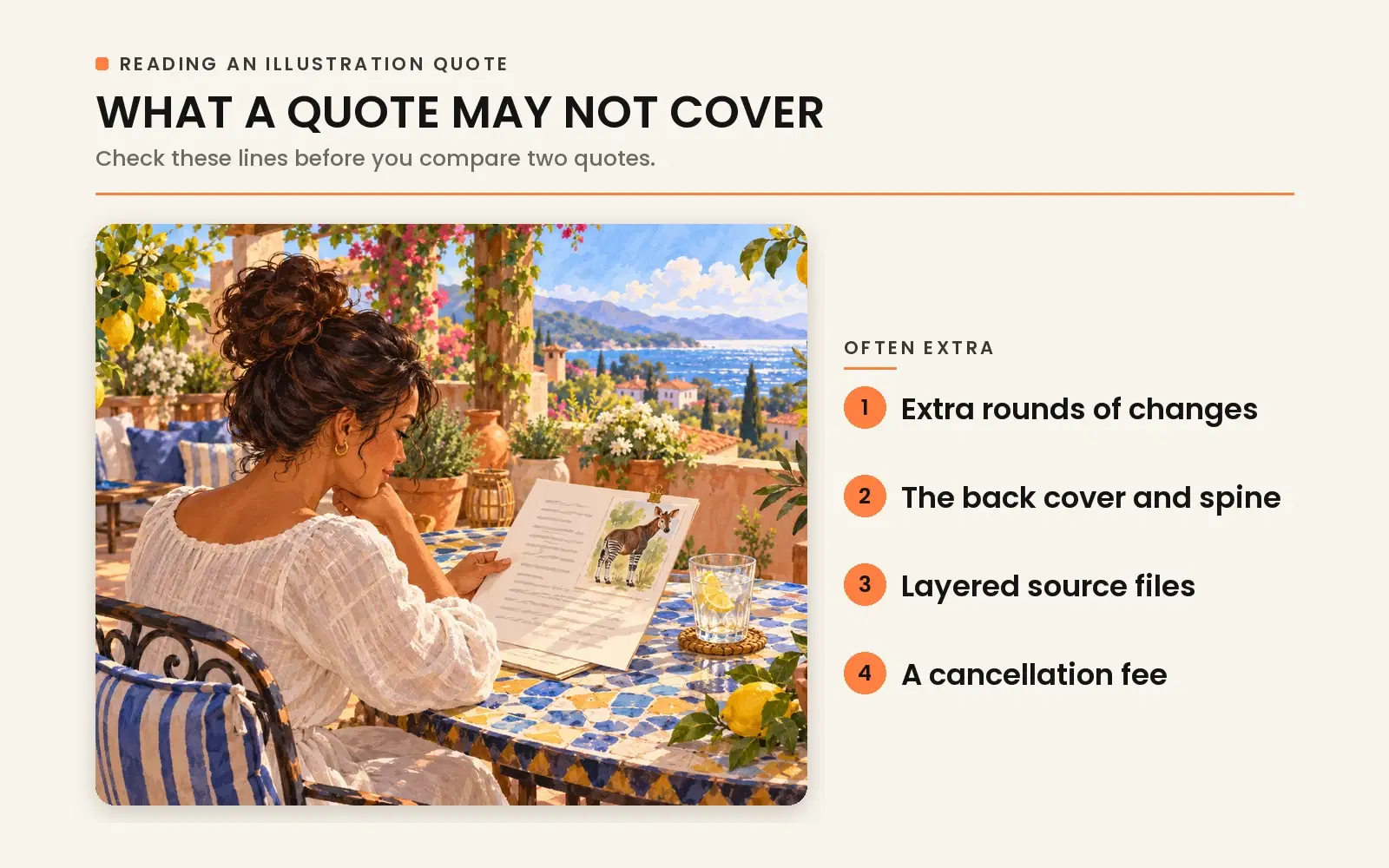
A clear illustration quote names every piece of work it covers, so you can see what you're paying for and what would cost extra. It usually lists the character design, the sketches, the final art, a set number of change rounds and the files you'll get. Other work is often priced separately, so ask about each item before you sign.
- Extra rounds of changes beyond the number the quote includes.
- The back cover and spine, which some quotes leave out even when the front cover is included.
- Placing the words on the pages, which is layout work that not every illustrator offers.
- Layered source files, the working files the art is built in, as opposed to the finished files for print.
- Extra pictures for your website, social media or a book launch.
- A cancellation fee, sometimes called a kill fee, which pays for work already done if the project stops partway.
Files deserve a clear line of their own. The U.S. Copyright Office notes that owning a copy of a work doesn't give you the copyright in it. Having the files and owning the rights are two separate things. Your quote should say which files you'll get and which rights come with them.
Why Extra Rounds of Changes Show Up on the Bill
Extra rounds of changes show up on the bill because a change after approval means redrawing work that was already finished. Many quotes include a set number of rounds for each stage, and anything beyond that is usually charged separately.
Not every change counts the same. If the illustrator gave the boy a red coat when your notes asked for blue, fixing that is normally part of the job. A new idea of yours is different, especially once the sketches are signed off.
Say an author decides, after the sketches are approved, that the main character should have a baby sister. The sister now has to be designed, then drawn into every scene she belongs in, with the other characters moved to make room. That's a lot of finished work undone, so it's fairly billed as new work. In general, the more finished work a change undoes, the more it tends to cost.
How a Tight Deadline Changes the Price
A tight deadline usually raises the price, because the illustrator has to move other work aside or work longer days to finish in time. A rush fee pays for that squeeze, not for better art.
Think of a florist who wants her picture book about a shy seed ready to hand out to customers on Mother's Day weekend. If she asks for the art close to the holiday, she may pay a rush fee. She may also have less time to check the sketches properly. Planning backward from the day she needs printed copies gives her more choices and a calmer price.
How long the art really takes, stage by stage, is covered in the guide to how long it takes to illustrate a children's book.
How Much Should I Pay an Illustrator for My Children's Book?
Pay for the book you actually need. Then let more than one illustrator price the same clear details. That's the fairest way to set your number, since no chart can price your story for you.
Start by deciding the drivers in this guide for your own book. How many spreads and spot illustrations do you want, and in what style? Which rights do you need, and when do you need the art? Once those are settled, the quotes you get back can be compared fairly. The one that fits your book and your budget then becomes much easier to spot.
Whatever you agree, pay in stages as the work is approved, rather than all at once up front.
The Details an Illustrator Needs to Price Your Book
An illustrator can only price your book accurately when they know what the job involves. Send the same details to everyone you ask, so the quotes can be laid side by side.
- Your finished, edited manuscript, since the words decide what each picture shows.
- The kind of book, such as a picture book or an early reader, and its trim size if you've chosen one.
- A rough plan of the pictures, meaning how many spreads, full pages and spot illustrations you have in mind.
- A few examples of styles you like, and whether you want full color or black and white.
- The rights you need, including any plans for a series, toys or an ebook.
- The date you need the finished files, and how many rounds of changes you'd like included.
- Whether the cover is part of the job, and if it is, the front only or the full wrap with the back and spine.
The rough plan doesn't need to be perfect. Even a simple list of which pages get big pictures helps an illustrator give you a quote that won't change later.
What a Very Low Quote Often Leaves Out
A very low quote often leaves something out. It's worth finding out what before you say yes. Sometimes the price is low because the sketch stage is skipped, so you only see the art when it's finished and hard to change. Sometimes there's no real character design, and the main character drifts from page to page.
Other gaps are harder to spot. The files may be too small to print sharply. The rights may be a narrow license rather than the rights you expected. Poses and backgrounds may simply be repeated from page to page.
None of this means every low price is a bad deal. It means a low quote needs the same questions as any other. The guide on how to find and hire a children's book illustrator covers the warning signs in full.
Ways to Spend Less Without Making the Book Look Cheap
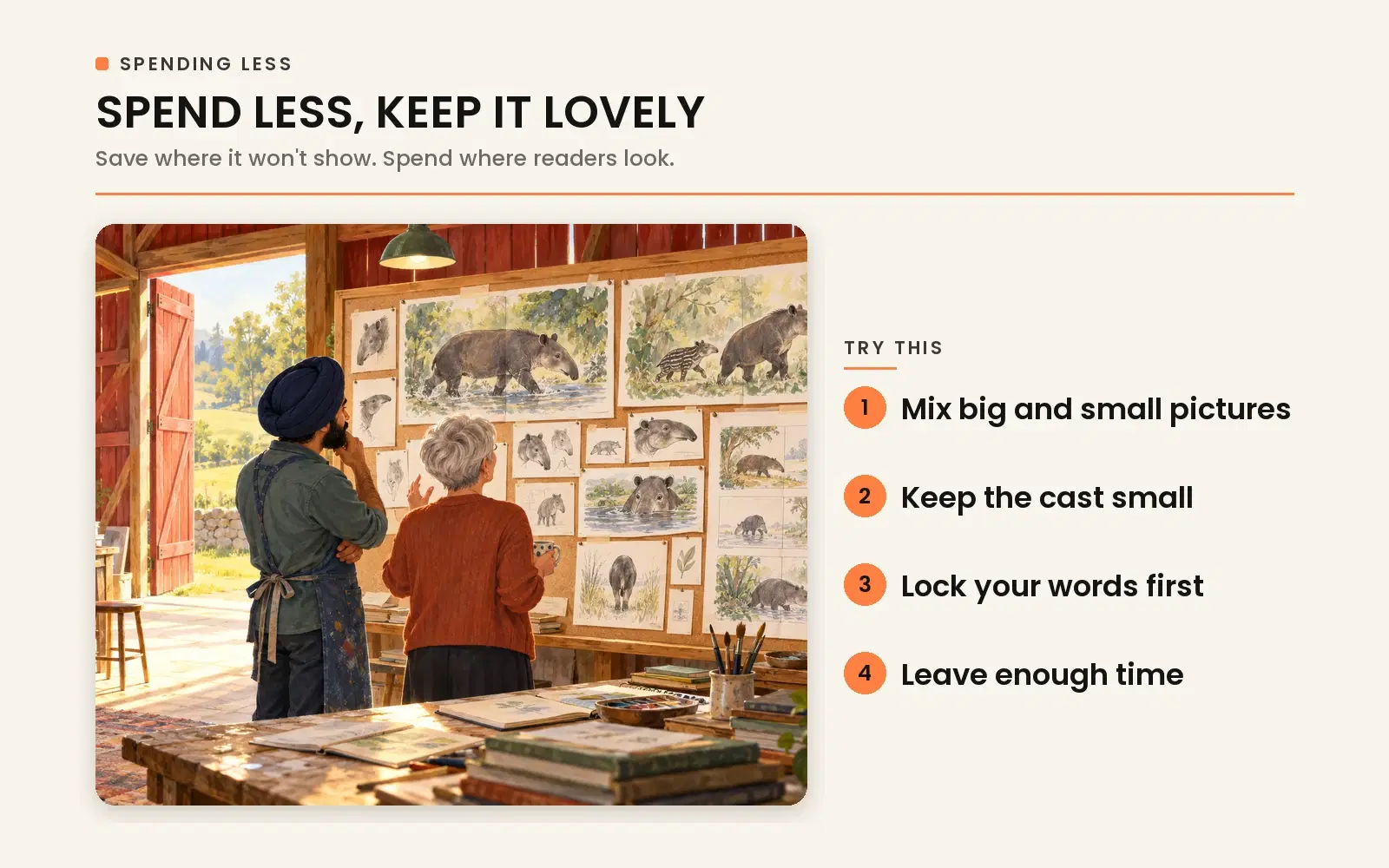
You can spend less on illustration without making your book look cheap by changing the job, not by squeezing the illustrator. These choices shape the price while keeping the pages you care about most at full strength.
- Mix big and small pictures, keeping full spreads for the moments that matter and using spot illustrations on quieter pages.
- Keep the cast small in most scenes, and bring extra characters in only where the story needs them.
- Let calm pages sit on simple backgrounds, and save the busy detail for the scenes that set the mood.
- Finish and lock your words before the sketches start, so the art isn't redrawn to fit new text.
- Plan the pages with a storyboard first, since planning every page before the drawing starts catches problems while they're still cheap to fix.
- Buy the rights you'll really use now, and ask what wider rights would cost later.
- Leave enough time in your plans, so no rush fee is needed.
- Gather your notes into one list per stage, so a single round of changes covers everything.
What's worth protecting is the character design and the key spreads. Those are the pictures a child remembers and a parent sees first, so they're the last place to save.
Having Your Story Illustrated by Book Writing US
At Book Writing US, we're a children's book illustration company for picture books, early readers and educational books. Our illustrators can take on all the pictures in your book, starting with the main character. We can also pair the illustration work with our publishing service, if you'd like help to publish your children's book too.
When you're ready to talk about the pictures in your book, get in touch with us.
Frequently Asked Questions
Does a more experienced illustrator always cost more?
An experienced illustrator usually costs more, but not always, and the difference often buys something real. An illustrator with several published picture books has already solved problems like keeping a character steady across a whole book and preparing files a printer accepts. Some newer illustrators price lower while they build a portfolio, and their work can be lovely. Judge the finished books in a portfolio, not the years listed on a website.
Is the cover included in the price of the illustrations?
The cover isn't always included, so check the quote line by line. The front cover is a separate piece of art, drawn to catch a parent's eye at a small size, and it's often priced on its own. The back cover and the spine may be extra again. If the quote simply says "cover", ask whether that means the front only or the full wrap.
How much does it cost to get a children's book illustrated if the story is very short?
A very short story usually costs less to illustrate than a long one, but the page count alone won't tell you by how much. A short picture book can still need a full spread on almost every page, a big cast and full color. A longer early reader, by contrast, might use a handful of small pictures. What sets the price is the number, size and detail of the pictures, not the number of words. So a very short story with rich pictures can cost more to illustrate than a longer one with a few simple ones.
Does a series cost less to illustrate than a single book?
A second book in a series can cost less to start, because the main characters have already been designed. The illustrator knows the look, the colors and the proportions, so the early design work is smaller. Every new book still needs its own sketches, final art and cover, though, so most of the work starts fresh each time. Check that your first agreement lets you reuse the character design, or that saving may not be there.
Is AI art cheaper than paying an illustrator?
It can be, but that depends on the tool and on how much work the pictures need afterward, and price isn't the only difference that matters for a children's book. Keeping a character the same on every page, making precise changes and knowing what you can own all work differently with AI. The guide to AI and human illustrators compared explains those trade-offs without taking sides, so you can weigh them against your budget and your goals.
Why does character design cost extra in some quotes?
Character design is sometimes priced separately because it's real work that happens before any page is drawn. The illustrator settles each main character's face, shape, outfit and colors, often trying a few versions before you choose one. Every later picture is drawn to match that design, so time spent here saves trouble on every page. Some quotes fold it into the page prices and others list it on its own, so the totals can match even when the lines look different.
- How Much Does a Children's Book Illustrator Cost, and Why Do Quotes Vary So Much?
- What Affects the Cost of Illustrations the Most?
- Why Is Children's Book Illustration So Expensive?
- How Do Illustrators Price Their Work?
- The Rights You Buy Change the Price
- What an Illustration Quote Covers, and What Costs Extra
- How Much Should I Pay an Illustrator for My Children's Book?
- Ways to Spend Less Without Making the Book Look Cheap
- Having Your Story Illustrated by Book Writing US
- Frequently Asked Questions