Should You Illustrate Your Own Children's Book? An Honest Decision Guide
Short Answer: You should illustrate your own children's book if you can draw your main character the same way on every page. You'll also need time for a whole book of pictures and a way to finish art a printer can use. If one of those is missing, sharing the work with an illustrator, or hiring one, usually serves your story better.
Once the story is written, many authors who draw ask, "Should I illustrate my own children's book?" It's a fair question. It deserves an honest answer, not a cheer and not a warning.
This guide won't teach you how to draw, and it won't try to talk you out of it. Instead, it walks through the four things that decide whether self-illustrating a children's book is right for you. Those are your drawing skills, how steadily you can draw one character, the time the pages take and what a printer needs from the art. You'll also see how the book's purpose changes the answer. Then come the middle paths, and the signs it's time to bring in help.
Nothing Stops You From Drawing Your Own Book
Nothing stops you from drawing your own book, and no rule says a children's book needs a separate illustrator. If you self-publish, Amazon KDP and IngramSpark print the files you upload, whoever drew the pictures in them. So the short answer to whether you can illustrate your own book is yes.
The harder question is whether you should. That depends on the book in front of you. A birthday story for one child asks far less of the art than a picture book you hope to sell. Writing and illustrating your own children's book can be one of the most satisfying things you ever make. It can also turn a finished story into a long, stalled project if the pictures ask for more than you can give right now.
That's why the rest of this guide looks at what the pictures actually ask of you. Skill comes first, then keeping one character the same, then time, then printing. None of these checks is about talent in general. Each one is about whether your art can carry the story all the way to a finished book.
Do Authors Illustrate Their Own Books?
Yes, many authors illustrate their own books, especially picture books. A children's book writer and illustrator is usually called an author-illustrator, and some of the most loved picture books were made this way. The American Library Association's list of Caldecott Medal winners shows one clear example. It credits Where the Wild Things Are, the 1964 winner, simply to Maurice Sendak. That means one person made both the words and the pictures.
The Caldecott Medal itself shows how seriously picture book art is judged. It's awarded each year by the Association for Library Service to Children, part of the American Library Association. The medal goes to the artist of the most distinguished American picture book for children. When the award was set up in 1937, its terms said this holds whether or not the artist also wrote the text. Today the award is decided mainly on the pictures, and on how well they carry the story.
Children's book authors who are also illustrators don't all have art degrees, either. Debbie Ridpath Ohi, who writes and illustrates books for young people, says plainly that she has no formal art training. What Ohi recommends is regular practice. She advises keeping a sketchbook and drawing regularly, and reading many picture books to see what kinds of characters and settings appear in them. The guide to famous children's book illustrators looks at how some well-known artists handle character and page design.
What Skills Does a Picture Book Ask of You?
A picture book asks for more than being able to draw a nice picture. It asks you to tell a story in a run of pictures that work together, page after page. Debbie Ridpath Ohi tells new illustrators that, ideally, they'll be able to draw children in many positions and moods. Those children should also interact with other characters and with the world around them. That's a long way from drawing one happy face that looks straight out at you.
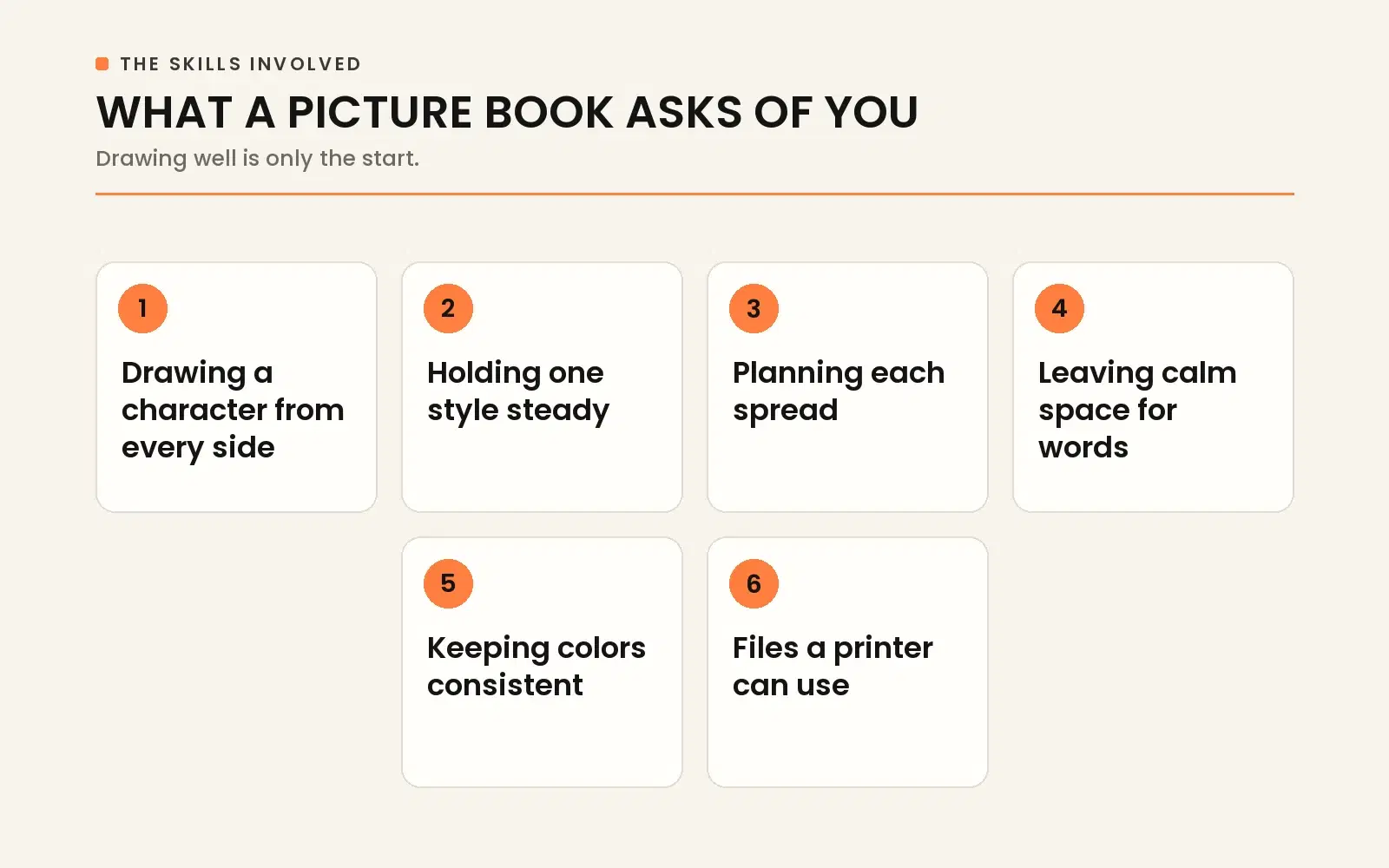
Here are the skills a picture book usually asks for, in plain terms.
- Drawing people or animals from the front, the side and behind, sitting, running and sleeping, and looking happy, cross or scared.
- Holding one style steady, so a page in the middle looks like it belongs in the same book as the cover.
- Planning each double-page spread, the two facing pages a child sees at once, so the story moves forward at every page turn.
- Leaving calm space where the words will sit, so the text doesn't land on a face or a busy background.
- Finishing the color so the same colors mean the same things all the way through the book.
- Turning the finished art into files a printer can use, at the right size and quality.
You don't need to be strong at all six on day one. But if several of them feel unfamiliar, that's useful to know before you promise yourself a whole book. These skills grow with practice, and a full picture book tends to show every gap that's still there.
An Honest Test Before You Commit
The quickest honest test is to make a small piece of the book before you decide to make all of it. Draw your main character five or six times on one sheet, in different poses and moods. Then make one full spread from your story, with space left for the words, at roughly the size the book will be.
Now put your pages next to a picture book you admire, from the library or your own shelf. Look at them side by side, and ask someone outside your family what they see. People who love you tend to be kind judges. A friend who reads picture books to children, or a parent from your child's school, will usually tell you more.
The result tells you where you stand. Maybe your character looks like the same person in every sketch, and the spread reads clearly with the words in place. Then you've got a real starting point. If the character changes each time, or the page feels crowded, that doesn't mean you can't draw. It means this book may need more help than you'd planned.
Can You Draw Your Main Character the Same Way on Every Page?
Drawing your main character the same way on every page is the part most self-illustrators find hardest. Children follow the hero by face, colors and clothes, so a small change can make them think someone new has walked in. The shape of the ears, the color of a scarf and the hero's height next to a sister all have to hold steady.
Picture a high school chemistry teacher who has doodled the same grumpy cat in the margins of her notes for years. She can draw that cat perfectly, but always sitting and always facing left. Her story needs the cat running for a bus, peeking over a fence and curled up asleep. The first time she draws it from behind, it doesn't look like her cat at all.
Illustrators keep a character steady with a character sheet, a single page that shows the character from several sides and in a few expressions. Every later picture gets checked against it. A character sheet helps when you draw your own book too. It can guide your drawing, but it can't steady your hand.
There's a quieter problem as well. Over a long project, your drawing usually gets better. That's good news for you, but it can leave the last spreads looking more confident than the first ones. The fix is to redraw the early pages so the whole book matches, and that's worth building into your plans from the start.
Where the Time Goes When You Draw It Yourself
Drawing your own book takes a lot of time because there are far more pictures to make than most authors expect. Most picture books are 32 pages, and a 32-page book usually leaves room for about 12 to 14 double-page spreads of story. Then there's the cover, which is a full piece of art on its own.
Each of those spreads goes through several rounds before it's finished. You plan it, sketch it, check it against the words, draw the final art and add the color. A storyboard is a small plan of every spread on one sheet. It lets you see the whole book before you draw any of it. The guide on why storyboarding matters before any page is drawn explains that step.
You're also doing a second job at the same time. At a publishing house, an art director checks the illustrator's pages. When you draw your own book, you're both the illustrator and the person checking the work. And if you change a line of the story late, you're the one who redraws the page.
Think of an accountant who loves to sketch in the evenings. He starts his picture book in the fall and gets halfway through by winter. Then tax season takes every evening he has, and by the time he picks up the pencil again, his style has shifted a little. The book he planned for one year stretches into two. None of that means he shouldn't draw it. It means the time has to be counted honestly at the start.
The guide on how long illustrating a children's book takes covers what makes each stage of the art shorter or longer.
What Will a Printer Need From Your Pictures?
A printer needs your pictures to fit the book's page size and reach past the edges where the pages are trimmed. They also have to be sharp enough to print clearly. Those needs shape the art from the very first page. So they're worth weighing before you decide to draw the book yourself.
The book's trim size, which is its finished page size, has to be settled before the drawing starts. A picture made for a tall page won't fit a square one without cropping or redrawing. Art that runs to the edge of the page also needs a little extra past the edge. That extra is called bleed, and it's there because the pages are cut after printing. Amazon KDP asks for a PDF when a book's pictures bleed to the edges. It also asks for every image to be at least 300 DPI.
Picture a carpenter who draws a bashful otter smiling right across the middle of a double-page spread. When the book is bound, the fold runs straight through the otter's face, and half of that smile sinks into the gutter, the space where the two pages meet. His drawing is charming, but that spread has to be drawn again with the face moved to one side.
Art made on paper also has to be scanned or photographed with care before a printer can use it. Colors can shift along the way, too. If trim size, bleed and 300 DPI all feel new, that's normal. It's also a good reason to get help with at least the files. The guide to mistakes that make a self-published picture book look unfinished shows how these problems look in a printed copy.
Pros and Cons of Illustrating Your Own Books
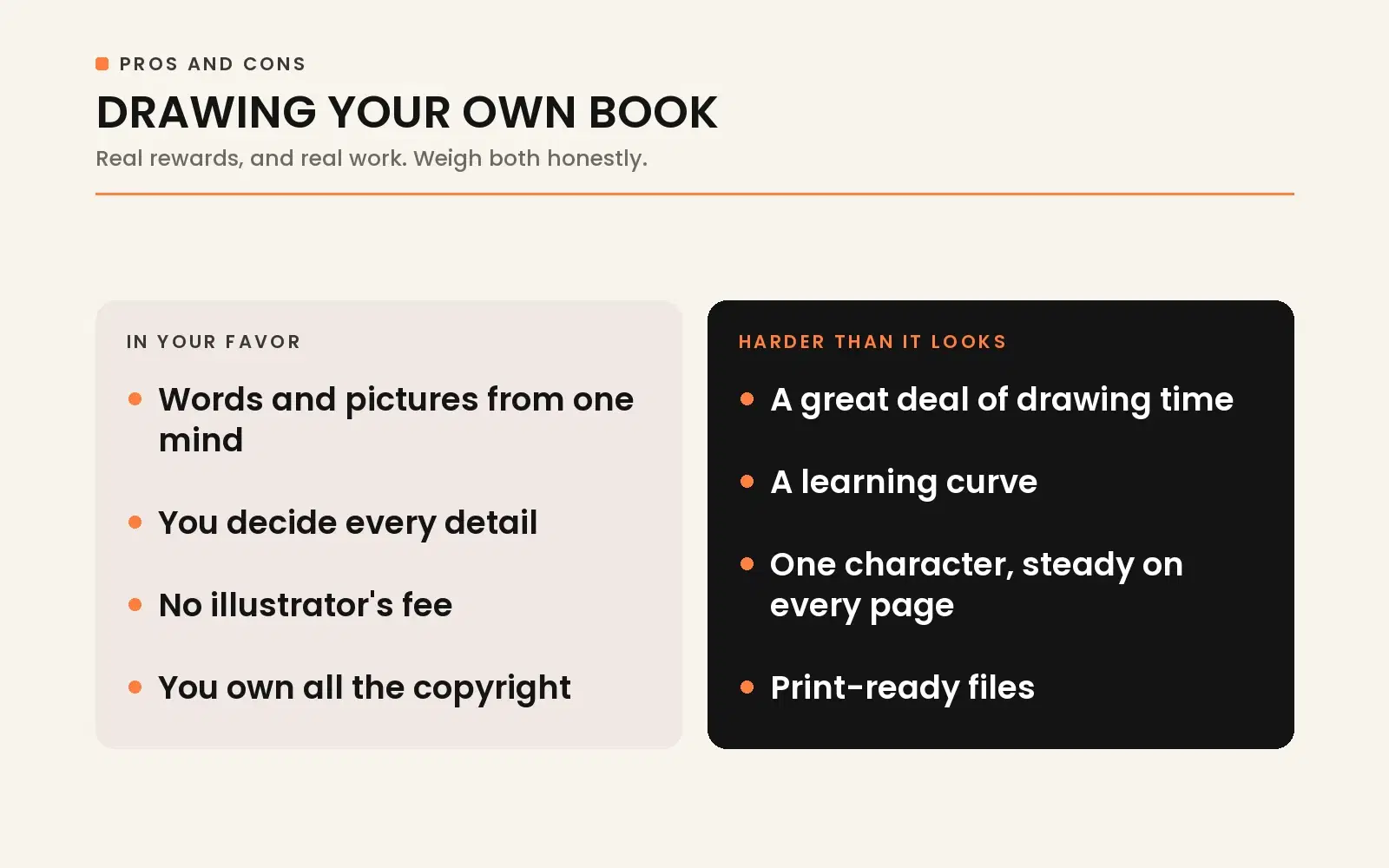
The pros and cons of illustrating your own books come down to control against time, skill and print work. On the plus side, drawing a children's book yourself gives you real control.
- The words and pictures come from one mind, so they can fit together closely.
- You decide the look, the colors and every small detail.
- There's no illustrator's fee to pay.
- You own the copyright in the pictures as well as the words.
- You can change a picture whenever the story needs it, on your own schedule.
The ownership point is worth a closer look. The U.S. Copyright Office's Copyright Basics circular explains that the copyright in a work initially belongs to the person who created it. When someone else draws your pictures, the art generally stays theirs. That changes with a signed written transfer, or when the art is a work made for hire. When you draw the pictures yourself, the copyright in the art is generally yours from the start.
The other side of the list is just as real, and it's better to see it now than halfway through the book.
- A picture book takes a great deal of drawing time, often alongside a job and a family.
- There's a learning curve, and the finished book may show it.
- Keeping one character steady on every page is hard.
- Print-ready files ask for skills that have nothing to do with drawing.
- It's hard to judge your own work, because you see what you meant as well as what's on the page.
- A traditional publisher may love your words and still pair them with a different artist.
Is It Worth Illustrating Your Own Books?
Whether it's worth illustrating your own books depends mostly on what the book is for. The same drawings can be perfect for one purpose and not quite enough for another, and that isn't a judgment on your talent.
For a book made for your own family, your own hand can be the whole charm. Picture a college student home for the summer, drawing a bedtime book for her little brother about the family's two backyard chickens, one very bossy and one very shy. The chickens won't look professional, and nobody at home will mind. Her brother will know who drew them, and that's what he'll remember.
A book you plan to sell is a different case. It sits on the same listing pages and shelves as professionally illustrated picture books. Parents often compare the cover and the sample pages before they buy. That doesn't rule out drawing it yourself. It means the art has to hold up next to those books. If you're still weighing how to publish, it helps to read about whether self-publishing a children's book is worth it for your goals.
Should Authors Illustrate Their Own Books for a Traditional Publisher?
Authors don't need to illustrate their own books for a traditional publisher. It tends to work best for authors whose art is ready to be judged next to professional work. A traditional publisher pairs the story with an illustrator it chooses. Charlesbridge, a children's book publisher, says in its guidelines for authors that "Illustrations are not necessary," so the words can go in alone.
An author-illustrator is the exception. Charlesbridge, for one, asks author-illustrators for a book dummy, a sketched version of the whole book, or a manuscript with sample illustrations. So if you're not sure your art is ready to be judged that closely, sending the words alone is the safer choice.
Say a driving instructor has written a funny picture book about a sleepy tapir who naps through every lesson. He sketches, but only for fun. The stronger move for him is to send the words alone and let the publisher find the artist. If you're not sure which route your own book is on, read about whether you need your own illustrator before you decide.
Middle Paths Between Drawing Everything and Hiring Everything
You don't have to choose between drawing every page and handing over the whole book. Many authors share the work, drawing the part they're good at and getting help with the rest. Here's how the main routes compare.
| How the pictures get made | Final pages drawn by | Your time on the art | Character kept steady by | Print files prepared by |
|---|---|---|---|---|
| You draw everything | You | The most | You | You |
| You draw, a designer lays out the book | You | A lot | You | The designer |
| You sketch, an illustrator finishes | The illustrator | Some | The illustrator, from your sketches | The illustrator or a designer |
| You hire an illustrator from the start | The illustrator | The least, mostly reviewing | The illustrator | The illustrator or a designer |
The two middle rows are where a lot of authors land. Some authors can design a character but struggle to keep it steady for a whole book. Their sketches can guide an illustrator who draws the finished pages. If your art is strong but the layout and files feel foreign, a designer can build the pages around the pictures you made.
Think of a veterinary nurse whose hero is a three-legged beagle. She knows exactly how that dog stands, sits and wobbles, and her sketches show it. An illustrator draws the finished pages from those sketches, so the dog still looks like hers. Whenever someone else draws or finishes your pictures, agree in writing who owns the art and the files before the work starts.
Some authors also look at AI image tools as another middle path. That's a different choice with its own trade-offs, and it's covered in the guide on how AI and a human illustrator compare.
When Is It Time to Hire an Illustrator Instead?
It's time to hire an illustrator when the honest checks in this guide point the same way. Maybe your test pages showed gaps, your character keeps changing or the time just isn't there. At that point, plenty of authors ask, "Should I hire an illustrator for my book?" Usually it's yes when several of these are true.
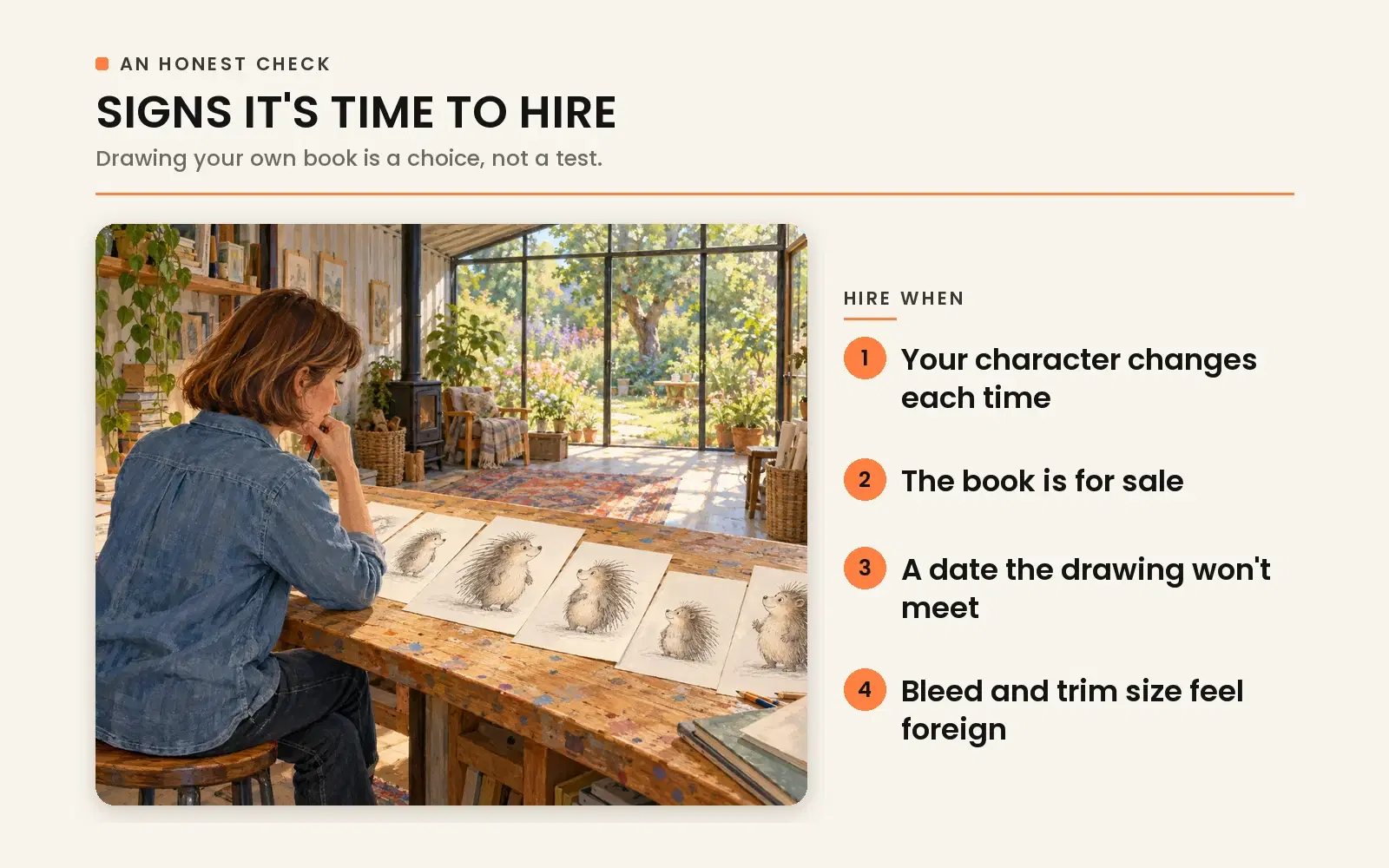
- Your main character looks different each time you draw it.
- The book is for sale, and it needs to stand beside professionally illustrated picture books.
- You have a date in mind, such as a school visit or a birthday, and the drawing won't fit before it.
- Words like bleed and trim size still feel like a foreign language.
- You'd rather spend your time on the story and on sharing the finished book.
Hiring an illustrator isn't giving up on your vision. You still choose the style and share your ideas, and you can ask for changes. A children's book illustrator brings the practice that keeps the character steady and the pages ready for print. Before you reach out to professional illustrators for hire, look at a few finished picture books in the style you love. They'll help you show what you have in mind.
Finding the right person takes some care, from reading a portfolio to agreeing on ownership in writing. The guide on how to find and hire a children's book illustrator walks through each part of that search.
Getting Help With the Drawing From Book Writing US
If you'd rather not draw every page yourself, we can help. At Book Writing US, our children's book illustration services draw the pictures for picture books, early readers and educational books, from the main character to the finished pages.
We can also pair the illustration work with our publishing service. That's useful if you'd like help to publish your children's book once the pictures are done.
Frequently Asked Questions
Can I illustrate my own book if I'm not very good at drawing?
Yes, you can, though it helps to be honest about what the book needs. For a family keepsake, simple drawings with a lot of heart can be exactly right. For a book you plan to sell, a simple style can work well when you choose it on purpose. Bold shapes and only a few colors are often easier to keep steady than detailed art. Try the test in this guide first. If your character still changes from page to page, sharing the work with an illustrator may suit you better.
Is it cheaper to illustrate your own children's book?
Drawing it yourself removes the illustrator's fee, which is often one of the largest costs in a picture book. It doesn't make the book free, though. You'll still put in a great deal of your own time. You may also pay for page layout, file preparation, cover design or proof copies. If you'd like to see what drives the price when someone else draws the pictures, read about what moves the cost of illustration.
Can I draw the pictures myself and have a professional do the cover?
Yes, and some authors do exactly that. The cover still has to look like the book inside. If a professional cover uses a different style from your pages, readers can feel the mismatch as soon as they open the book. The simplest fix is for the cover artist to work from your character and your style. Another option is to draw the cover art yourself and have a designer handle the title, spine and back.
Can I switch to an illustrator after I've started drawing the book myself?
Yes, you can switch to an illustrator partway through. Your early work isn't wasted, either. Your sketches, character drawings and page plans show the illustrator what you had in mind. It's usually better for the illustrator to draw every page in one style, so the book matches from start to finish. That works better than finishing only the pages you didn't get to.
Should I illustrate the first book myself if I'm planning a series?
Think carefully before you do. Readers expect a series to look the same from book to book. If you draw the first book and hire someone for the second, the characters may change in ways young readers notice. If you plan to grow one book into a series, choose the route you can keep up for every book, not just the first one.
Does it matter whether I draw by hand or on a tablet?
No, both can make a lovely picture book, as long as the finished files are sharp enough and the right size for print. Art made on paper has to be scanned or photographed with care. Digital art needs to be made at print size and quality from the start. Choose the way you draw most comfortably, since you'll be drawing a lot of pages.
- Nothing Stops You From Drawing Your Own Book
- Do Authors Illustrate Their Own Books?
- What Skills Does a Picture Book Ask of You?
- Can You Draw Your Main Character the Same Way on Every Page?
- Where the Time Goes When You Draw It Yourself
- What Will a Printer Need From Your Pictures?
- Pros and Cons of Illustrating Your Own Books
- Is It Worth Illustrating Your Own Books?
- Middle Paths Between Drawing Everything and Hiring Everything
- When Is It Time to Hire an Illustrator Instead?
- Getting Help With the Drawing From Book Writing US
- Frequently Asked Questions