What Do You Need to Publish a Children's Book, Before a Publisher Starts Work?
Short Answer: To publish a children's book, you need a settled manuscript, a clear idea of your reader, and your art or your ideas for it. You'll also need written permission for any art or photos you didn't make. Add the few short pieces of writing that go around your story, and pick one person to approve each stage. The publishing team handles the editing, design, printing and listing, while your job is to bring the story and make the calls.
Many first-time authors ask, "What do I need to publish a children's book?" as soon as the last line is written. Maybe you've found a publishing team, or you're about to, and you're just not sure what to hand over first. That worry is fair, because nobody tells you what a team will ask for until it asks. The good news is that the requirements to publish a children's book are simpler from your side of the table than they look. This guide follows the handover in the order a team usually needs each piece. It starts with the story and ends with who says yes at each stage. Parents, grandparents and teachers with one special story will find it just as useful as authors planning a series.
What Do I Need to Send to a Publisher?
What you send depends on the kind of publisher. A traditional house usually needs only the words, while a publishing team you hire needs quite a bit more. Picture book authors don't need to bring an illustrator to a traditional publishing house, because the house's own art director finds one. That's why the story usually goes in on its own.
A hired team works for you, and you're the one making the decisions. So it needs your settled story, your reader, your art or ideas, your permissions, the words around your story, your plans and one person who approves. The table below shows when a hired team needs each piece, since not everything has to be ready on day one.
| What you bring | When the team needs it | Why it matters |
|---|---|---|
| A settled manuscript | Before any work starts | Every later stage is built on the words |
| Your reader's age and the book's use | Before any work starts | It shapes the size, the binding and the art |
| Your art, or your ideas for it | Before illustration begins | It decides what happens first |
| Written permission for art, photos and quotes | Before any of it is used | The owner usually has to agree to its use |
| Title, name, dedication, bio and back cover words | Before the pages and cover are designed | The designer places your exact words |
| Your date, plans and limits | At the first conversation | They shape the schedule and the choices |
| One person to approve each stage | From the first approval | Clear answers keep the book moving |
The timing column is the part most authors don't expect. A grandfather who hasn't written his author bio yet can still get started, because the bio isn't needed until the pages are designed. What can't wait is the story itself, since the edit and the art both depend on it.
Once your part is handed over, the publisher has its own list of jobs. This guide to what a children's book publisher does with your book explains each one.
Start With a Settled Manuscript
Your children's book manuscript doesn't need a professional edit before you hand it over. It does need to be settled, though. A settled manuscript is one where the story, the characters and the ending are decided. There's only one final version of it, even if it hasn't been polished yet. Settled means you've stopped rewriting the story. Locked comes later, after the edit, when you read the edited words and sign them off as final.
The difference matters because a publishing team edits the words you give it. If you're still swapping endings, the editor ends up working on a story that's about to change, and that work has to be done twice. Say you've written two endings for your bedtime story and can't choose between them. Pick one before you hand it over, or ask the editor to help you decide first. Character names count as well. If the dog is called Biscuit on the first page and Muffin by the end, settle on one name before the team starts. The editor and the illustrator both work from it.
Send one file, named clearly as the final version, and never two drafts for the team to choose from. You don't need to polish the words first, either. That polish comes later, in the edit. Shaping the read-aloud rhythm and placing page breaks is part of what a children's book editor does that a regular editor doesn't.
If the story isn't finished yet, start with a beginner's guide to writing your first book rather than a publishing checklist.
What Should a Children's Book Manuscript Look Like?
A children's book manuscript should look plain, and no special template is needed. It's a simple text document with the title and your name at the top, followed by the story as ordinary text. Here and there you might add an art note in brackets. An art note is a short line telling the illustrator something the words don't say. You can also mark where you imagine a page turn, the point where the reader turns to the next pages. Just label each mark clearly as a suggestion.
There's no need for special fonts, colors, pasted-in pictures or a page layout. If the story lives in a notebook, type it up first, since the team needs text it can edit and place on the page. Here's a short children's book manuscript example, so you can picture the file.
- Title line: Pip's Red Boot, by Grandma June.
- Pip looked under the bed for his red boot, and then he looked behind the door.
- (Suggested page turn.)
- He even checked inside the cat's basket, but the cat just yawned at him.
- [Art note: the red boot is on Pip's foot the whole time.]
The words leave space for the art. The single art note carries a joke the text never tells. That's the kind of file a publishing team is happy to receive.
How a Children's Book Manuscript Differs From a Novel
A picture book manuscript is far shorter than a novel's, and it leaves out much of what a novel would describe. In a picture book, the pictures tell part of the story, so the words don't need to say what the child can already see. Think of the children's book manuscript vs novel difference this way. A novel's words do all the work, while a picture book's words share the work with the pictures.
Picture book words are also written to be read aloud, often by a parent at bedtime. They're split across page turns rather than chapters. If your manuscript looks bare next to a friend's novel, that's normal. A short, spare file is exactly what a picture book manuscript is meant to be. It won't look like a finished book when you send it. Nobody on the team expects it to.
Who Is Your Book For, and Where Will It Be Read?
A publishing team needs two answers about your children's book before anything else. The first is the age of the child the book is for, and the second is how the book will be used. Those two answers shape the size, the binding, the style of the art and even the kind of book it becomes. That's why they come first.
For the age, a rough idea is enough. You might say a toddler, a child who's read to at bedtime, or a child who's starting to read alone. That tells the team whether your book is a picture book, an early reader or something else. If you're unsure where your story fits, children's book categories by age explains each category and its reader.
For the use, think about where the book will actually be read. A bedtime story, a classroom copy, a birthday gift and a family keepsake all lead to different choices. A hardcover handles library shelves and gift giving well, while a paperback is lighter and a common pick for classroom and activity books. A book for sale on Amazon KDP can also carry a reading age, the age range shoppers see on its listing. A keepsake printed only for the family may never need a public listing at all.
You don't need to know trim sizes or binding terms to answer any of this. The trim size is simply the finished size of the page. A publishing team turns your answers into the right size and binding before any art starts, and the pictures are then drawn to fit them. A teacher making a book for her class and a grandmother making one gift might write similar stories. They'll still end up with very different books.
Where Does Your Art Stand Right Now?
You don't need any illustrations to start publishing a children's book. The team does need to know exactly where your art stands, though, because that decides what happens first. Most authors fit one of four starting points, and each one asks you to bring something a little different.
| Where your art stands | What to bring | What happens next |
|---|---|---|
| Nothing drawn yet | Your story and any notes on how it should look | Illustration comes before any design |
| Ideas and pictures you love | A few examples, each with a line on what you like | They guide the illustrator's style |
| Rough sketches of your own | Your sketches, marked as ideas rather than final art | The illustrator uses them as a starting point |
| Finished art you own | The original full-size files | The design is built around your art |
Plenty of authors sit between two rows. You might have one finished painting of the main character and nothing else. Say so plainly, because a single picture you love can still guide the look of the whole book. Would you like the pictures made for you? Look for children's book illustration services that can work from your story and your notes.
Pictures and Notes That Help an Illustrator
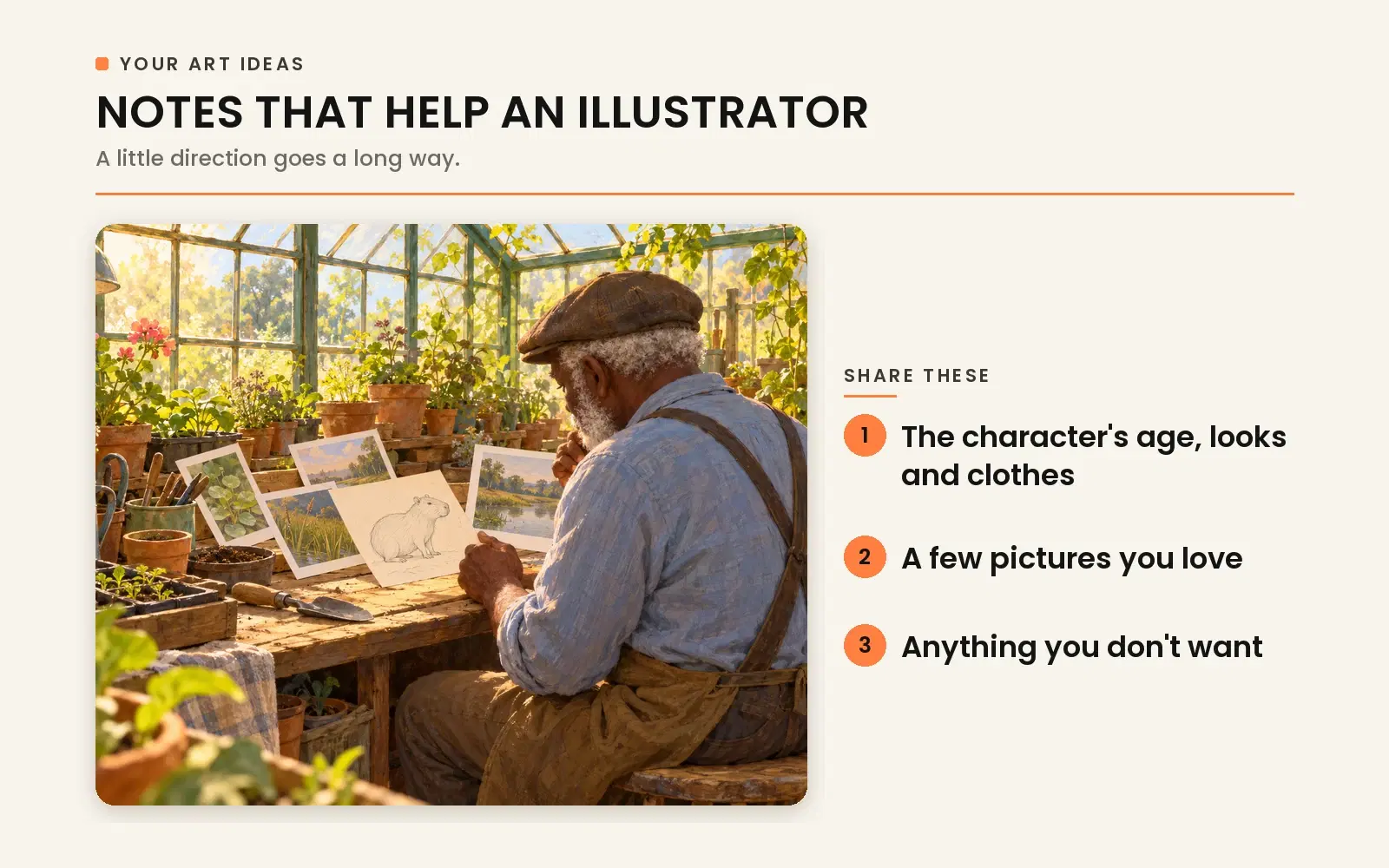
The most useful things you can give an illustrator are a short note on each main character and a few pictures whose look you love. Add photos if a character is based on a real child or pet. With those, the illustrator can draw your characters the way you picture them instead of guessing. Keep each note to a few lines, and cover these points.
- The character's age, looks and clothes, plus one or two things about their personality.
- A few pictures you love, each with a line on what you like, such as the colors or the soft lines.
- Photos of any real child or pet behind a character, with a note on whether you want a close likeness or just a starting point.
- Anything you don't want, like a color you dislike or a style that feels too busy for your reader.
From notes like these, an illustrator usually builds a character sheet. A character sheet is a page showing each character from a few sides and with different faces. It's what keeps your hero looking the same on every page.
If your granddaughter is the heroine of your picture book, send two or three clear photos of her. Then tell the illustrator whether she should be easy to recognize or simply inspire the look. A close likeness and a character based on her are different jobs, so say which one you want.
If Your Art Is Finished, Send the Original Files
If your art is finished, send the original full-size files. Phone photos, screenshots and pages pulled out of a PDF aren't enough, because they often lose detail. Name each file by the page it belongs to, and add a short note with the size the art was drawn at. Also mention any words already painted into a picture, since those can't be moved later. The team then checks each picture against the book's size before the design is built around it.
Maybe you painted every page in watercolor and photographed the paintings on your kitchen table. Tell the team before you send anything, because paintings on paper usually need a proper scan and a phone photo loses detail and color. Keep the originals flat and dry until the book is printed, in case a page needs scanning again.
Have Written Permission for the Art and Photos Ready
Before work starts, have written permission ready for anything in the book you didn't create yourself. The person who draws a picture or takes a photo generally owns the copyright in it. That stays true unless they sign it over to you in writing. A signed agreement can also make it a work made for hire, which means the person who hired the artist counts as its legal author. Either way, if a friend drew your art, you need a signed agreement from your friend. Here's the paperwork to gather.
- A written agreement with whoever drew the art, even a friend, a niece or your own daughter.
- Permission from the person who took any photo you plan to use.
- A parent's OK in writing if a real child's name or face appears in the book.
- Permission for song lyrics, poems or quotes you didn't write, unless they're in the public domain or a short quote clearly counts as fair use.
- An agreement with your co-writer, if two of you wrote the story, that says who decides what.
Picture a friend who drew your pictures as a favor a few years ago. She'll probably be glad to help, but a short signed note now saves an awkward talk later. It also means nobody has to wonder whose pictures they are once the book is printed.
Treat this as general information rather than legal advice. For the wider picture, including copyright and contracts, read about the legal steps in publishing a children's book.
The Words That Go Around Your Story
Besides the story, you'll need to write a handful of short pieces yourself. The team designs the pages these words sit on, but only you know what they should say.
- The title, even if it's only a working title for now.
- The name for the cover, which can be your real name or a pen name, meaning a made-up name an author publishes under.
- A dedication, the short line at the front that says who the book is for.
- A short author bio, which is a few sentences about you for the back cover or the book's listing.
- A few lines for the back cover, the text a parent reads when they flip the book over.
- Any thank-yous you'd like to include.
Write all of these in the same file as the story, at the end, so nothing gets lost between emails. The name on the cover deserves an early decision. The front, the spine and the listing all carry it, so a change after the cover is designed means redoing that work. Settle the name first, even if the title stays open a little longer.
The back cover lines are worth a little extra thought. They're written for the grown-up holding the book, not the child. It helps to know what makes parents and kids stop at a children's book cover before you write them.
A Few Early Decisions Only You Can Make
At the very first conversation, tell the team your date, your plans and your limits. Each one changes the schedule or the choices that follow. None of these needs a long answer, but each one is yours to decide.
- A date you need copies by, such as a birthday, a school visit or a holiday.
- Whether this is the first book in a series, so the look and the characters can carry on into the next one.
- Print only, or an ebook as well.
- Whose name should show as the publisher, which is called the imprint. That depends partly on whose ISBN the book uses. An ISBN is the number that identifies one edition of a book. With a free ISBN from Amazon KDP, the imprint appears as "Independently published" rather than a name you pick.
- What matters most to you if something has to give, such as the date, the page count or the kind of cover.
Suppose you need copies in time for your son's birthday in the spring. Mention the date on the first day, not after the sketches are done. A fixed date shapes every step, and it can change which choices make sense. A date shared early is a plan, while a date shared late is a rush.
What You Don't Need to Have Yet
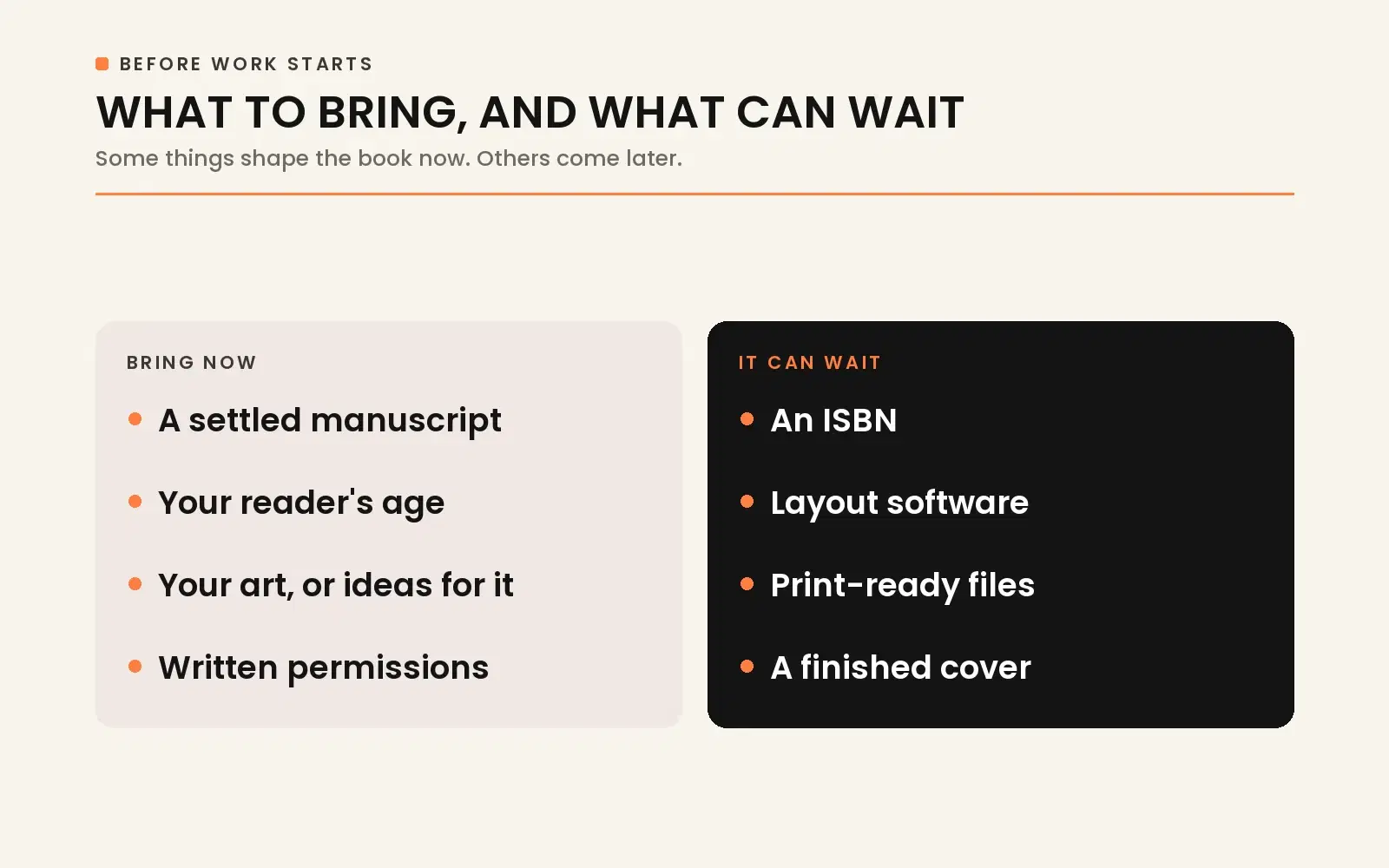
No ISBN, design software or print-ready files are needed before a publishing team starts on your children's book. The same goes for a manuscript template, a finished cover and a copyright registration. Many self-publishing checklists put these items first, which can leave a first-time author feeling behind before they've even begun.
- An ISBN, which comes up later, once the format is settled and you know whose name will show as the publisher.
- Layout or design software, because placing the words and pictures on each page is the designer's job.
- Print-ready files, which are made from the finished pages near the end.
- A manuscript template, since a plain text file works well.
- A finished cover, which is designed after your title and name are settled.
- A copyright registration, because your story is protected once it's written down, and registering it is generally voluntary.
Setting this list aside frees you to focus on the parts only you can supply. Those are the story, the answers and the approvals. If you've already bought an ISBN or sketched a cover idea, that's fine too. Mention it at the start so the team can plan around what you have.
Pick One Person to Approve Each Stage
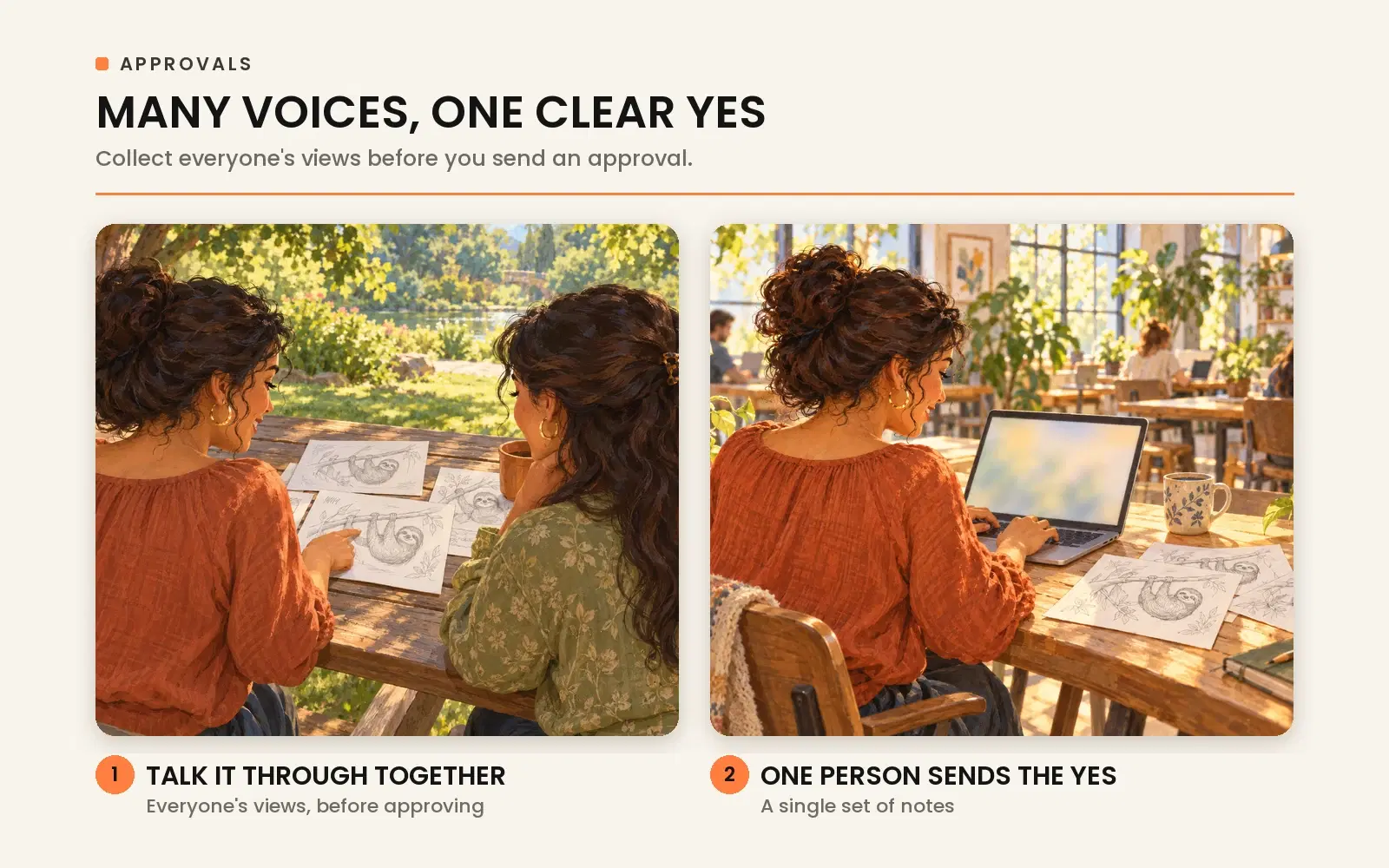
Choose one person to give the final yes at each stage of your children's book. That holds even when a family, two co-writers or a whole school is behind it. Approving a stage means you're happy for the next stage to be built on it. A clear yes from one person keeps the book moving. It also stops mixed messages.
Collect everyone's views before you send an approval, not after. If three relatives each send their own notes on the sketches, the team gets three different answers and has to guess which one counts.
Imagine you and your partner wrote the story together. Talk through the sketches at the kitchen table, agree on one set of notes, and have one of you send them. The other person still has a full say, but the team hears one voice.
Quick answers matter as well, because each stage waits on your approval before the next can start. For the order of the stages, see each stage of children's book publishing and what you sign off.
Agree How Changes Are Asked For Before Work Starts
Agree with the team, before the first stage begins, how you'll ask for changes and how an approval is given. For example, change requests might come in writing, from the one person who approves, in one set per round. Then everyone knows which request counts and when a stage is finished.
A simple agreement like this also protects you. If a request is ever questioned later, there's a written record of what was asked and approved. That beats a half-remembered phone call every time. Settling it takes a few minutes. It saves a lot of back and forth later.
How Book Writing US Can Help With Your Book
Book Writing US works with authors of picture books, early readers and educational books. It helps turn a finished manuscript into a finished book, with editing, illustration, page design and the cover, printing and publishing. It can also work with art you already have, or have the pictures drawn through its illustration service.
If you're ready to publish your children's book, or you're still gathering the pieces on this list, get in touch. Tell us how far along your book is today.
Frequently Asked Questions
Can you just send a book to a publisher?
Yes, you can send your manuscript straight to a publishing team you hire, since that team works for you. Traditional publishing houses work differently, because few of them accept manuscripts sent directly by authors. Most authors going that way look for a literary agent first, someone who offers an author's book to publishers. Either way, send your one settled version, not a draft.
How much money do you need to publish a children's book?
There's no single amount, because the total depends on a few choices. The biggest are how much art the book needs, your printing choices, whether you already own finished art, and how many changes come late. This guide to what drives the cost of publishing a children's book walks through each one.
Is it easy to publish a children's book?
The paperwork side is easier than most people expect, but making an illustrated book well is real work. The words, the pictures and the page design all have to fit together on every page. Each part is checked before the next is built on it. Having your settled story, your answers and your permissions ready at the start helps the work move smoothly.
What do I need to publish a book on Amazon?
To publish a print book through Amazon KDP, you need the finished inside pages as a file, plus a cover, which you can upload or make with KDP's free Cover Creator. You'll also add the book's details, such as the title and the description. For a children's book, include a reading age, because Amazon KDP says a book without one may not be eligible for children's categories. A print edition also needs an ISBN, and KDP offers a free one that can only be used on KDP.
What should a children's book author bio say?
A children's book author bio should say who you are and why you wrote this book, in two or three warm sentences. Write it for the parent reading the back cover or the listing, not for the child. A personal detail helps, such as the grandchild who asked for the story every night. Leave out anything that shares too much, like your street or your children's full names.
Does a children's book manuscript need illustration notes?
A children's book manuscript needs only a few illustration notes, and only where the picture must show something the words don't say. A joke the art carries or a twist the text hides are good reasons for one. Leave everything else to the illustrator, and keep each note to one line in brackets. For how an editor decides which notes stay, see when a children's book editor keeps an art note.
- What Do I Need to Send to a Publisher?
- Start With a Settled Manuscript
- Who Is Your Book For, and Where Will It Be Read?
- Where Does Your Art Stand Right Now?
- Have Written Permission for the Art and Photos Ready
- The Words That Go Around Your Story
- A Few Early Decisions Only You Can Make
- What You Don't Need to Have Yet
- Pick One Person to Approve Each Stage
- How Book Writing US Can Help With Your Book
- Frequently Asked Questions