How Long Does It Take to Illustrate a Children's Book, and Why Does It Vary?
Short Answer: Illustrating a children's book has no fixed length, because each stage of the art can run short or long, and the pauses between them count. Four things decide most of the time. They're how many pictures the book needs, how detailed the style is, when the illustrator can start, and how quickly you reply at each stage. A change made late can add more time than any of them.
Once your story is finished, the next thing you probably want is a date. So you ask, "How long does it take to illustrate a children's book?" You're hoping for an answer you can write on the calendar. The honest answer is built from your own book: its pages, its style, its illustrator and you.
This guide goes through the art one stage at a time and shows what makes each stage shorter or longer for you. It also shows how to plan backward from the day you need finished books. The stages themselves are explained step by step in the guide to what happens at each stage of the art. Here, the focus is time.
How Long Does It Take to Illustrate a Picture Book?
A picture book takes as long as its slowest stages, plus every pause between them. It helps to split that time into two kinds. There's drawing time, when the illustrator is actually working on your pages. Then there's waiting time, when your book sits between rounds for your reply, a decision or a free spot on the illustrator's calendar.
Drawing time grows with the number of pictures in your book, their size and the detail in them. Waiting time grows with slow replies and decisions that get reopened. Most authors plan for the first kind and forget the second. That's often why a finish date slips. The table below shows what keeps each stage short and what stretches it.
| Stage | What keeps it shorter | What makes it longer |
|---|---|---|
| Waiting to start | An illustrator with an opening soon, and a quick decision to hire | A busy illustrator's calendar, or a hiring decision that drags on |
| The brief | A finished story, clear notes and a few good photos | A story still being rewritten, or notes that leave the illustrator guessing |
| Character design | One main character, clearly described | A large cast, or a character who must look like a real person |
| Thumbnails and storyboard | Final words and a chosen trim size | Words that keep moving, or a book size that isn't settled |
| Sketches | Simple settings and a few characters on each page | Crowded scenes, and new ideas in every round |
| Your review | Quick replies sent as one list of notes | Late replies, or several people sending separate notes |
| Final art and color | A clean, simple style | Detailed painting, busy backgrounds and art that has to dry and be scanned |
| Files and hand-off | A book size and printer chosen before the drawing | A size change at the end that means reworking every page |
Every row in that table can swing either way. So a fair estimate only comes after the illustrator has read your story and seen what each page needs. A number you're given before that is really a guess about an average book, and your book isn't average. Ask for a schedule once the illustrator has seen your manuscript. It should give you a date for each stage, not just one date at the very end.
How Long Does It Take to Illustrate a 32-Page Children's Book?
A 32-page children's book can take very different amounts of time to illustrate. That's because the page count tells you the size of the book, not the size of the job. For a picture book, 32 pages is the typical length. Some of those pages go to the title page and the copyright page, and in some books the endpapers use pages too. Fewer are left for the story itself.
Here's how two books of the same length can differ. One is a quiet story about a single lamb in a wide, empty meadow, with a few soft shapes on mostly white pages. The other follows a city parade, with a marching band, floats and a crowd of waving faces across every spread. Both books are 32 pages long. The parade book can take far more drawing, because every face in that crowd has to be drawn, placed and colored.
An illustrator will often ask how many spreads you're picturing and how much background each one needs. Those questions are about your timeline as well as your price. If you haven't counted your pictures yet, the guide to how many illustrations a picture book needs explains how to do it.
Why the Wait Often Starts Before the First Sketch
For many books, the first stretch of time passes before anyone picks up a pencil. Children's book illustrators often work on more than one book at a time. A busy one may already have other books booked ahead of yours. So the day you decide to hire someone and the day they start drawing can be far apart.
The start also waits on a few things only you can settle. The agreement has to be signed, the brief has to be sent, and the illustrator's first questions need answers. None of this is slow on its own. It only drags when your story is still being rewritten, or when your choice of illustrator keeps going back and forth.
The easiest fix is to ask about timing in your very first conversation, before you fall in love with a portfolio. These questions give you a clear picture of when the work can really begin.
- When could you begin drawing, and what are you finishing before then?
- How soon after the start would I see the first character sketches?
- How quickly do you need my replies to keep to the schedule?
- What happens to the dates if I'm late with a reply?
With a traditional publisher, you usually won't be the one setting these dates. The publisher chooses the illustrator after it offers you a contract. Then it works with the illustrator on the sketches and final art, and it may not involve you much along the way. The questions above are for authors who hire an illustrator themselves. Whatever you agree, put the dates in writing, along with the other points in what to agree in writing when you hire an illustrator.
How Long Does Character Design Take?
How long character design takes depends on how quickly you and the illustrator settle on one look, and that depends on the character. A single invented character who's clearly described can often be settled in only a few rounds. A large cast needs more. So does a character who has to carry a whole series, or one who's based on a real person.
The stage usually ends with a character sheet. That's a page showing the character from several sides, with a few expressions and the exact colors. Every later page is drawn from that sheet, so time you spend here is time you save later. A character who's still changing during the sketches slows down every stage after it.
Likeness is the part that surprises people. A son writing a picture book about his mother is a good example. She was the crossing guard outside the local elementary school for years and knew every child by name. He doesn't just want a kind woman in a bright vest. He wants his family to open the book and see her, with her smile, her glasses and the way she wore her hair. That's a much harder target than an invented character. It's fair to expect extra rounds, and it helps if you send several clear photos at the start.
Animals and made-up creatures raise their own question, which is how human they should look. A rabbit who walks upright in overalls needs different choices from one who hops through a field. If you know the answer before the first sketch, character design moves faster. Do you hope the character will star in future books? Say so now, because a series character may need extra views and poses on the sheet.
Thumbnails and Sketches Move Faster When the Words Are Settled
Thumbnails and sketches move quickly when your text is final and slowly when it isn't. Thumbnails are tiny, rough drawings of every page. Together they form the storyboard, which is the plan for the whole book. They're quick to draw, but they can't be approved until the words on each page stop changing.
Any change to the text at this point changes the plan. Cutting a line can leave a page with too little to show, and adding one can call for a new picture. When the words keep moving, the storyboard gets redrawn instead of approved. That's why a finished manuscript that you've read aloud is one of the biggest time savers in the whole project. The post on why storyboarding saves time before the final art covers the planning side in more depth.
Sketches take longer than thumbnails because they're drawn at full size, with the poses, faces and settings in place. Crowded scenes, detailed rooms and outdoor settings full of trees or buildings all add time. Some illustrators also put the sketches together into a picture book dummy. That's a rough mock-up you can page through like a real book. It's worth the extra step, because a problem you catch in pencil is quick to fix.
Your trim size, which is the finished size of the book, needs to be settled by now as well. The sketches are drawn to fit the page. If you change the shape of the book later, they have to be drawn again.
Final Art Is Where Most of the Drawing Time Goes
Final art usually takes more drawing time than any other stage, because every approved sketch becomes a finished, fully colored page. Each picture gets clean lines, color, light, shadow and background detail. The earlier stages decided what goes on your pages. This one is the actual making of them.
The medium changes the pace. Art made by hand in paint or ink has steps a screen doesn't. The layers often have to dry, and finished pages have to be scanned or photographed before they can be printed. Digital art skips those steps, and it makes small fixes easier. Still, a richly detailed digital painting can take as long as one made by hand, so the level of detail matters more than the tool.
Color adds its own work to every page. Each spread is colored and then checked so that your main character's colors stay the same from the first page to the last.
How Long Does an Illustration Take?
One illustration can take a little time or a great deal. That's because "an illustration" can mean a small spot drawing or a full double-page spread. A spot illustration is a small picture on a mostly white page, often a single character or object. A double-page spread stretches across two facing pages and may hold a whole scene, with a sky, a street and a crowd of people.
Within that range, a few things set the pace. The size of the picture, the number of characters, the amount of background and the medium all add or save time. That's why an illustrator can't honestly tell you the time for one picture without knowing which picture you mean.
Watercolor is a good example of how the medium sets the pace. Consider a story set in a harbor at dawn, with sailboats resting on still water. Each sky and each stretch of sea is built from thin washes of color. Often each wash has to dry before the next one goes on. A spread like that can't be rushed without muddying the colors, so the illustrator plans the order of work around the drying.
If your illustrator offers to finish a sample spread before the rest, it's usually worth saying yes. It takes a little time at the start. But agreeing on the finished look early keeps a whole book of pages from needing a second pass.
Your Review Time Is Part of the Schedule
Your review time is the part of the illustration schedule you control, and it often decides whether the art finishes on time. After each round, the illustrator waits for your notes before starting the next one. A slow reply pushes every later date back by the same amount.
Illustrators plan their calendars around those replies. If your notes arrive late, your illustrator may already have moved on to another client's pages. Then your book waits for the next free spot. So a short delay on your side can turn into a longer one on theirs.
Reviews also slow down when several people have a say. Three sisters might write a book about their father's old corner hardware store. Each one looks at the sketches in her own time and sends separate notes. One wants the shop brighter, another wants it just as dusty as they remember, and the third hasn't opened the email yet. Every round then waits for three answers that don't agree. If one sister gathers everyone's thoughts and sends a single reply, the book keeps moving.
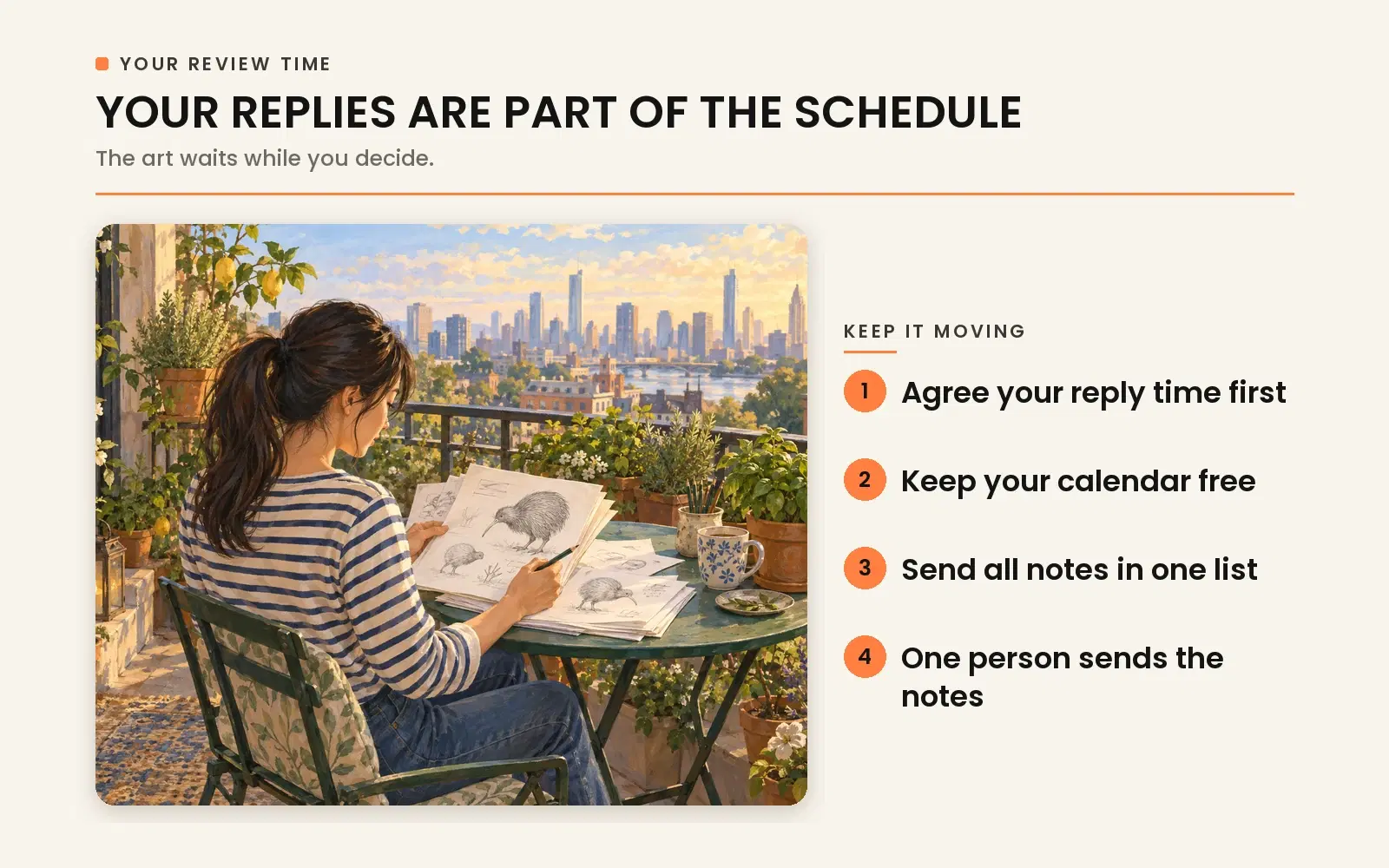
A few habits keep your review time short without rushing your judgment.
- Agree before the work starts how long you'll take to reply to each round, and write it into the schedule.
- Keep some time free on your own calendar around the day each round is due.
- Look at every page before you write any notes, then send them all in one list.
- Choose one person to send the notes if more than one of you is involved.
- Tell your illustrator early about a trip or a busy season when you can't reply quickly.
Clear notes save time too. A note asking for the boy's jacket to stay blue on every page gets fixed in one round. A vague one, like saying a page "doesn't feel right", can take two or three rounds to work out.
A Late Change Costs More Time Than an Early One
A late change adds more time than an early one, because it undoes finished work instead of rough work. The same note can be a quick pencil fix in the thumbnails and a full redraw in the final art.
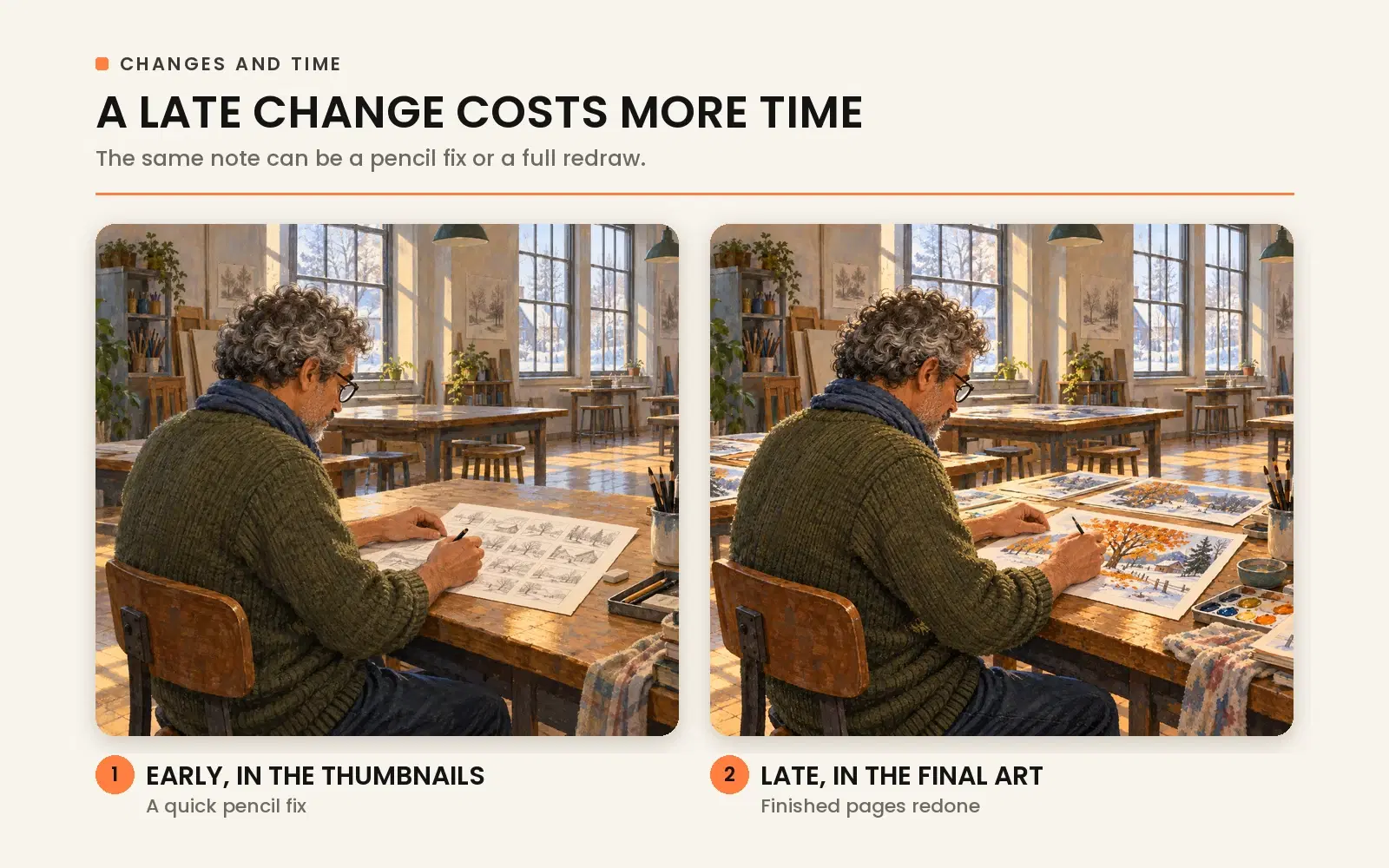
It helps to think of each stage as a layer resting on the one below it. A change to your story reaches down through the storyboard, the sketches and the finished pages all at once. A change to one color only touches the final art. The lower the layer you change, the more has to be redone on top of it.
Seasons are a good example. Suppose an author sets her story in winter. After the sketches are done, she decides it should happen in autumn, so the book can come out when school starts. Every snowy background now needs fallen leaves, every coat and scarf needs rethinking, and the light changes in every scene. Made during the storyboard, the same choice would have cost almost nothing.
Many illustration agreements include a set number of rounds of changes at each stage. Changes beyond that usually add time to the schedule and money to the bill. The guide to what moves the cost of children's book illustration explains why. A late idea isn't always a bad one. It's just worth asking what it will do to your finish date before you send it.
How Long Does It Take an Illustrator to Finish a Book?
An illustrator has finished your book's art when the last fixes are made and the files are ready for print. Anything else in the agreement, such as the cover, has to be handed over too. That last stretch is usually shorter than the final art, but it can still run long in a few ways.
The most common one is a size change at the end. If the trim size changes after the art is done, every page may need to be resized or reworked. Another is a cover that was never planned. If the cover wasn't part of the original job, it gets added at the end. Then it has to wait for a free spot on the illustrator's calendar. A third is not knowing where your book will be printed, so the files have to be prepared again once you decide.
That's why a finish date belongs in a written agreement, not only in a friendly email. A useful schedule gives a date for each stage, says how long you have to reply, and says how many rounds of changes are included. It also says what happens to the dates if either side runs late. A schedule like that won't make the art any faster. What it does is make a delay easy to spot early, while you still have time to do something about it.
Planning Backward From the Day You Need the Book
The simplest way to plan the art is to start from the day you need finished books and work backward. The art isn't the last thing that happens. After it come the page layout, a proof copy, the platform's review and printing, and each of those takes its own time.
So the date your art must be finished falls well before your launch date. How far before depends on those later steps. The guide to how long the publishing steps after the art take covers them. It also explains how print on demand differs from a print run.
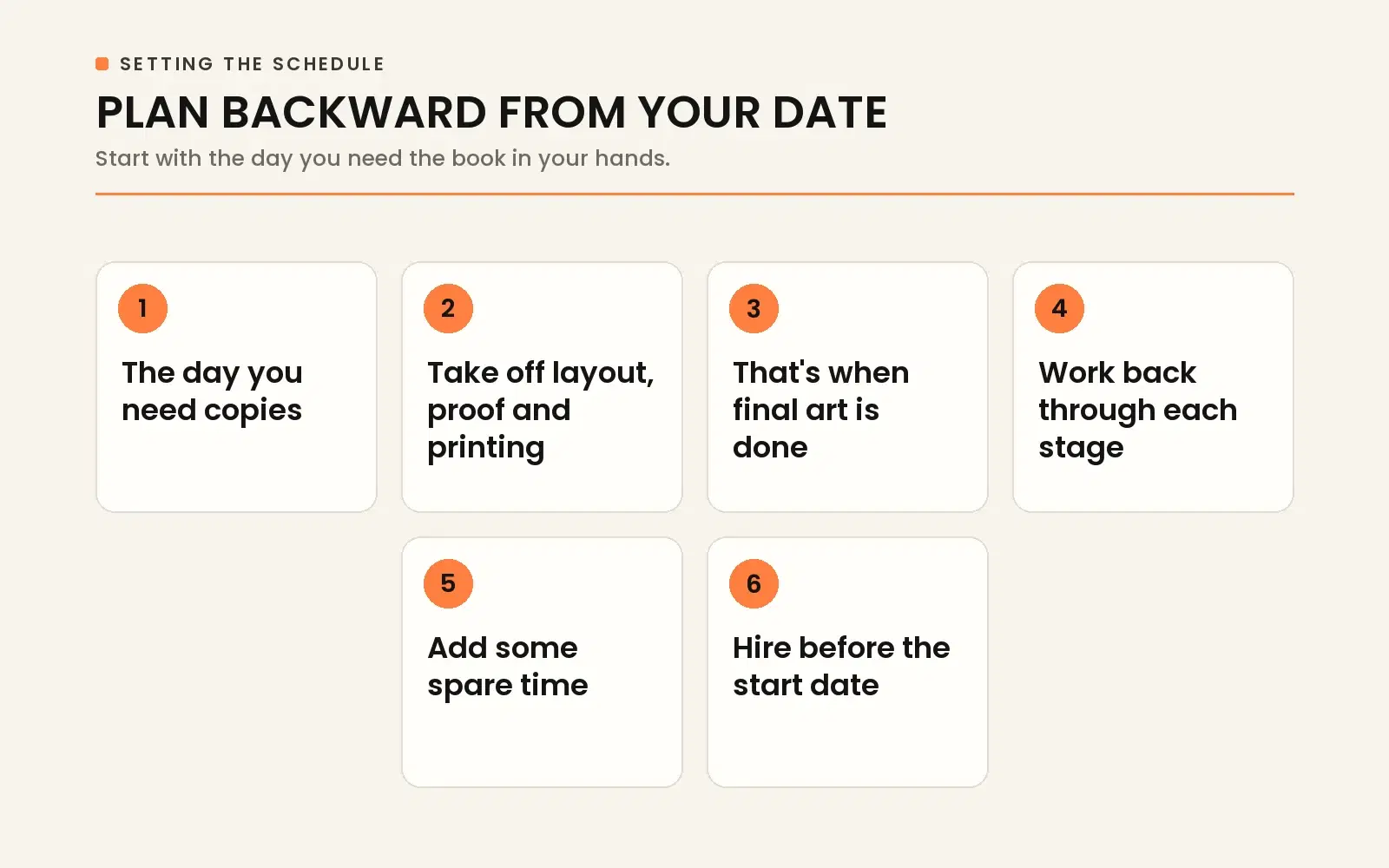
Once you know when the art has to be done, work back through the art itself.
- Start with the day you need printed copies in your hands.
- Take off the time for layout, the proof copy, the platform's review and printing.
- Mark that earlier day as the date the final art must be finished.
- Work back through final art, sketches, thumbnails and character design, adding your own review time after each one.
- Leave some spare time for an illness, a holiday or a late change.
- The date you land on is when the illustrator needs to start, so you'll need to hire them before then.
Here's how a plan might look. A guide at a nature center writes a picture book about monarch butterflies. She wants copies in the gift shop the week the center's new butterfly house opens in spring. Working backward, she sees that the art has to be finished well before spring. She also learns that the illustrator she likes is booked for a while. So she signs in the fall instead of waiting for winter, and she keeps her own reviews quick because the opening day won't move.
If your dates don't fit, it's better to find out early. You can move the launch date, simplify the art, or use fewer full spreads and more small pictures. Rushing the art at the end is usually the choice that costs you most, in quality as well as money.
Starting Your Book's Art With Book Writing US
For authors who want the pictures handled for them, we provide children's book illustration services at Book Writing US for picture books, early readers and educational books. Our work covers everything from the main character to the finished pages.
When the art is done, we can pair it with our children book publishing services to turn it into a finished book. When you're ready, get in touch with us about your book.
Frequently Asked Questions
How long does it take to illustrate a book cover?
A cover usually takes less time than the inside of the book, but more than you might expect for a single picture. The time depends on how much of it is painted art. A single character on a plain background is quicker than a full scene that wraps around the spine to the back. Hand-drawn title lettering adds a little more. Ask early whether the cover is part of your illustrator's schedule at all, because adding it late means waiting for a new opening.
How many illustrations can an illustrator do in a day?
There's no standard number, because one day's work might finish several small spot illustrations or only part of one detailed spread. Illustrators also rarely take a single picture from start to finish in one sitting. Many work in rounds across the whole book, sketching every page and then finishing every page. So your progress shows up stage by stage, not picture by picture. A more useful question is when you'll see each stage.
How long does it take to write and illustrate a children's book?
Writing and illustrating a children's book takes the writing time plus the illustration time, because the art can't really start until the words are settled. A short picture book text can still go through many drafts. A rewrite after the sketches begin can send pages back to be redrawn. If you plan to write and draw the book yourself, both jobs land on your calendar. The guide on whether to illustrate your own children's book can help you weigh that first.
Can an illustrator work faster if you need the book sooner?
Sometimes, but only by making room in their calendar, not by skipping steps. An illustrator may be able to move other work aside or work longer hours, and that often comes with a rush fee. The stages still have to happen in order, though. Your surest time savings are usually on your own side, from settled text, quick replies and early changes. Simpler art, with fewer full spreads or less background, also shortens the work.
Does a black-and-white book take less time to illustrate?
A black-and-white book usually takes less time, because it skips coloring every page and checking that the colors match from page to page. Line work, shading and detail still take real time, so a detailed black-and-white style isn't automatically quick. Decide early, since switching to color after the art is drawn means going back over every page. On Amazon KDP, you choose a color ink option if any images in your book should print in color. So a book with only a few color pages is still priced as a color book.
Why is my illustrator taking so long?
Most delays come from a few familiar places, and it's worth checking your own side first. The illustrator may be waiting on your notes or a decision. A change may have sent pages back to an earlier stage. Or the detail in the final art may simply be taking longer than planned. Illustrators get sick and take vacations like anyone else, too. A kind, direct message asking where things stand and when the next stage will arrive usually clears it up. If you have a written schedule, it gives you both something fair to point to.
- How Long Does It Take to Illustrate a Picture Book?
- Why the Wait Often Starts Before the First Sketch
- How Long Does Character Design Take?
- Thumbnails and Sketches Move Faster When the Words Are Settled
- Final Art Is Where Most of the Drawing Time Goes
- Your Review Time Is Part of the Schedule
- A Late Change Costs More Time Than an Early One
- How Long Does It Take an Illustrator to Finish a Book?
- Planning Backward From the Day You Need the Book
- Starting Your Book's Art With Book Writing US
- Frequently Asked Questions