What Does a Children's Book Editor Do That a Regular Editor Doesn't?
Short Answer: A children's book editor does everything a regular editor does, then edits for a young listener, the page and the pictures. Beyond checking the story, clarity and grammar, the editor reads your text out loud and checks its length and words against your reader's age. They plan where each page turns, cut words the pictures will show and keep the repetition children love. Later, they check the rough sketches against your words.
You've finished a children's story, maybe a bedtime tale you've told for years. Now everyone keeps telling you to get it edited. "What does a children's book editor do?" is one of the first questions many first-time authors ask at this point. It's a fair question, too. Your picture book looks so short that it seems any good editor could fix it in an afternoon.
That short length is exactly what makes the job different. Every word in your picture book gets read aloud, often night after night, and every page has to leave room for a picture. This guide walks through the jobs a children's book edit adds, format by format. It ends with how to find an editor who knows your kind of book.
How Is Editing a Children's Book Different From Editing a Novel?
Editing a children's book starts with the same basics as editing a novel. Both editors ask whether your story works, whether it's clear and whether it's correct. The difference is that a children's book editor also edits for three things a novel editor rarely thinks about. Those are the listener, the page and the picture.
So if you've written a picture book for a grandchild, a good general editor can fix your grammar. A children's book editor will also check how your story sounds, how it's split into pages and how it works with the art.
A novel editor works on sentences, scenes and chapters. A children's book editor works on the page and the spread, because that's the unit your young reader actually meets. A spread means the two pages that face each other when the book lies open. The editor treats each one as its own small scene.
Here's a simple example of the difference. A novel editor who sees the same line three times will usually trim it as padding. A children's book editor may keep it, because it's the line your listener waits for and says with you.
The table below puts the two kinds of edit side by side, so you can see where the extra work goes.
| What the editor looks at | A regular edit | A children's book edit |
|---|---|---|
| Repeated words and lines | Trims them as padding | Keeps the planned ones, trims the slips |
| Description | May ask for more detail | Cuts what the picture will show |
| Word choice | Looks for the most exact word | Tests each word against the child's age |
| Sound | Reads it on the page | Reads it aloud for beat and breath |
| Where the text breaks | Paragraphs and chapters | Page turns and spreads |
| The pictures | Not part of the job | Art notes and a check against the sketches |
Each row gets its own section below. You'll see what the editor does in each case, and why it matters for your book.
What Is Developmental Editing for Children's Books?
Developmental editing for children's books is the first, big-picture edit. It asks whether your story works for its young reader before anyone fixes a comma. That makes it a different job from a copy edit, which comes much later and checks grammar, spelling and consistency.
For a children's book, the big-picture questions change. A developmental edit for a young reader usually asks questions like these about your manuscript.
- Is this the right format for your story, a picture book, or really an early reader or a chapter book?
- Does it suit your reader's age in its ideas and feelings, not just its words?
- Is there anything too frightening, too confusing or unsafe for a child to copy?
- Does the child in your story solve the problem, rather than a grown-up who steps in and fixes it?
- Does the story start at the right moment, and does it fit the length of its format?
- Does it end on a page worth turning to?
Take a character who climbs onto the kitchen counter to reach the cookie jar. It might make you laugh, but an editor may flag it, because a small reader could try the same thing at home.
Now picture a grandmother who's written a bedtime story about a hedgehog who can't find a place to sleep. Her first three pages describe the woods, the weather and the hedgehog's family before anything goes wrong. A developmental editor would likely suggest starting on the page where the hedgehog's bed of leaves blows away. That's the moment a young listener leans in.
What comes back from a developmental edit is usually an editorial letter, along with notes on your manuscript. The rewriting stays with you, so the story keeps your voice. After that, a line edit, a copy edit and a proofread follow. Those rounds work the same way for any book, so you can read about the general rounds of editing and proofreading separately.
Word Count and Reading Level Change With the Format
Your editor checks the word count and the reading level against your book's format first. That's because picture books, early readers and chapter books are read by different people in different ways. A grown-up reads a picture book aloud, while a child works through an early reader on their own.
So if your picture book runs long, yes, an editor will likely ask you to cut. Most picture book texts come in under 1,000 words, in a book that's usually 32 pages.
The editor is really checking two things. The first is length, meaning whether your text fits its format. The second is reading level, meaning who can actually read the words.
In a picture book, your words can be richer, because a grown-up does the reading and the pictures help the child follow along. An early reader is different. Most of its words have to be ones a new reader can sound out, which teachers call decodable words. It also uses common words a child learns to know on sight, and it keeps sentences short and simple. An early reading guide from the Institute of Education Sciences recommends that beginning readers practice decodable words and learn common high-frequency words. Knowing those words quickly lets a child read faster and pay attention to meaning.
Early reader levels also vary by publisher. A Level 1 in one series isn't the same as a Level 1 in another. So the editor checks your text against the series or publisher it's written for.
Chapter books need short chapters, so a young reader always has an easy spot to stop and pick up again later. Middle grade is edited much like a novel, with the focus on plot, pace and character.
| Format | Reader age | Who reads it | Length the editor checks against | What the editor watches most |
|---|---|---|---|---|
| Board book | 0 to 3 | A grown-up, to a baby or toddler | Very few words, often well under 300 | A few clear words that are easy to say |
| Picture book | 3 to 8 | A grown-up, out loud | Usually 32 pages, most texts under 1,000 words | Rhythm, page turns and room for the art |
| Early reader | 5 to 8 | The child, alone | About 32 to 64 pages | Words a new reader can sound out, short sentences |
| Chapter book | 7 to 10 | The child, alone | About 48 to 80 pages | Short chapters with a natural place to stop |
| Middle grade | 8 to 12 | The child, alone | About 80 to 200 pages | Plot, pace and character, much like a novel |
These ages overlap, and they move by a year or two depending on the source. That's why the editor looks at who does the reading, not only at your reader's birthday. For a fuller description of each format, see this guide to children's book categories by age.
Are Big Words Allowed in a Children's Book?
Yes, big words are allowed in a picture book when the story and the picture make their meaning clear. A grown-up reads the book aloud, so the child learns the word by hearing it. In an early reader the rule is tighter, since the child has to read every word alone.
Your editor tests each unusual word in your text with two questions. Can a child this age work out the meaning from the story or the picture? And can the grown-up say it easily, without stumbling?
Say a dad writes a picture book for his 4 year old about a tiny snail. In one scene the snail calls a puddle "enormous", and the picture shows it staring up at a puddle the size of a lake. That word works, because the picture explains it, and his daughter gets a new word for free. Now imagine a line that calls the snail "melancholy" with nothing on the page to show what it means. The story stops while the grown-up explains. An editor would probably suggest "lonely" or "sad" instead, since a child can feel those words.
Age right also covers ideas and feelings, not only words. A story can use simple words and still hand a young child a worry that's too big. A good editor watches for that too.
Reading Every Line Out Loud, More Than Once
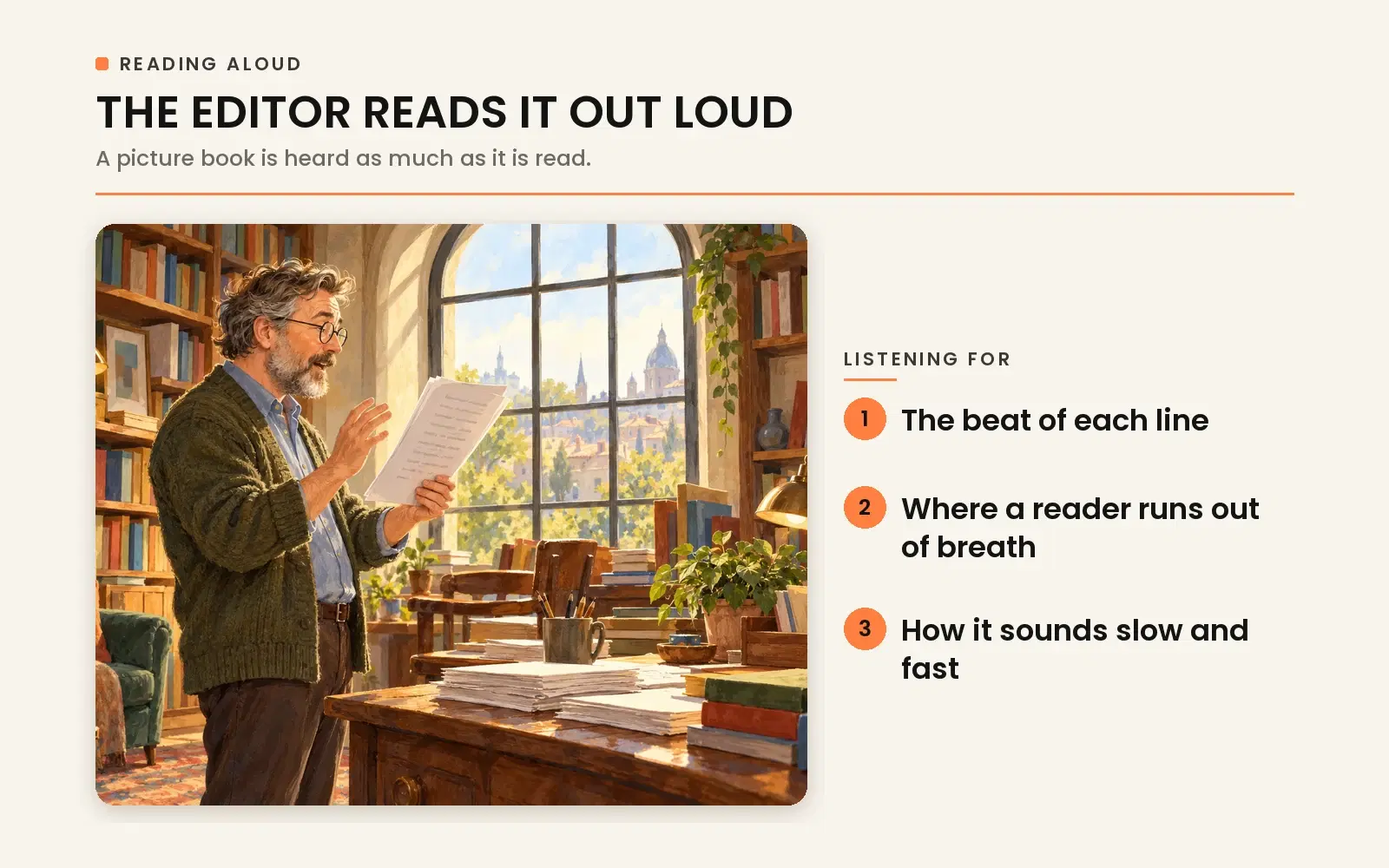
A children's book editor reads every line of your text out loud, because a picture book is performed, not read silently. A grown-up reads it to a child, often night after night. So your words have to be easy to say and pleasant to hear.
When the editor reads your picture book aloud, they listen for specific things and mark each one on the manuscript.
- The beat of each line, and where the stress falls on each word.
- In a rhyming text, a steady rhythm, with no rhyme that bends a sentence into an order nobody really speaks.
- The places where a reader runs out of breath, or where a pause lands in the wrong spot.
- How your text sounds read slowly, the way a tired parent reads at bedtime, and read quickly, the way an excited one does.
Imagine a grandfather writing a picture book about a block tower. His big line is "With a crash that made the cat jump, down came the tower," and it looks fine on paper. Read aloud, though, the big moment arrives in the middle, and the sentence fizzles out at the end. An editor might suggest "The tower wobbled, and wobbled, and came down with a crash" instead. Now the loudest word lands last, right where the child is waiting for it.
Early readers get read aloud too, usually by the child, one word at a time, to a grown-up who listens. So the editor also checks that each line breaks where a child would naturally pause. A line break that splits a phrase in two can make a new reader stumble.
Why Is Repetition Important in Children's Books?
Repetition is important in children's books because it lets a young child guess what comes next, join in and remember the words. So if your story repeats one line on every page on purpose, a children's book editor will usually protect it. An editor of adult books might trim that line as padding. The editor may trim a few repeats, but only if your story starts to stall.
The real job here is telling planned repetition from accidental repetition. Planned repetition is a pattern your story is built on, like a line that keeps coming back. It can also be something that happens three times, with a twist on the third. Accidental repetition is a slip, like the same describing word used twice on one page. The editor keeps the first kind and cuts the second.
The editor also checks that a repeated line stays word for word the same each time, unless the change is on purpose. Say your refrain is "Not yet, said the moon" and it quietly becomes "Not now, said the moon" on a later page. A child will notice, and so will the grown-up reading it for the hundredth time.
General editing advice often says a good edit removes repetition. In a picture book, that's only half true. The right repetition is part of what makes children ask for your book again and again.
A Refrain Gives the Child a Line to Say
A refrain is a line that comes back again and again through a story, like the chorus of a song. In a picture book, the refrain is often the line the child says along with the grown-up.
Say a mom writes a story about a little owl who keeps asking to stay up late. Every time, the answer is "Not yet, little owl, not yet," and by the third time, her son is saying it with her. By the fifth, he's saying it before she does. That's a refrain doing its job.
The editor checks that your refrain is short, easy to say and lands at the same kind of moment each time. The editor also makes sure it doesn't come back so often that the story stalls. A refrain on every single line stops feeling like a treat.
The Editor Decides Where Each Page Turns
In picture book editing, the editor works with you to decide where each page break falls. The page turn is where a picture book builds surprise, so the breaks matter. Your text is split into pages and spreads before any art is drawn, while moving a break still only means moving words.
A page turn gives a child a tiny pause. They guess what's coming, then they turn the page and find out. The editor marks page breaks on your manuscript so each spread ends on a question or a small cliffhanger. The answer waits on the next spread.
Picture a spread that ends halfway through a sentence, with "Slowly, Nia opened the closet door, and inside she found" as its last line. The next spread shows a very sleepy puppy. The words stop early on purpose, so the turn of the page finishes the sentence. A child who's heard that book before will often reach for the page before the grown-up does.
The editor also checks that every spread gives the illustrator something new to draw. Any spread that's carrying too much text gets flagged. A picture book is usually 32 pages, so these breaks get planned early. Later, the illustrator turns the breaks into rough sketches. This post on why storyboarding comes before the final art explains that side of the work.
Cutting Words the Pictures Already Show
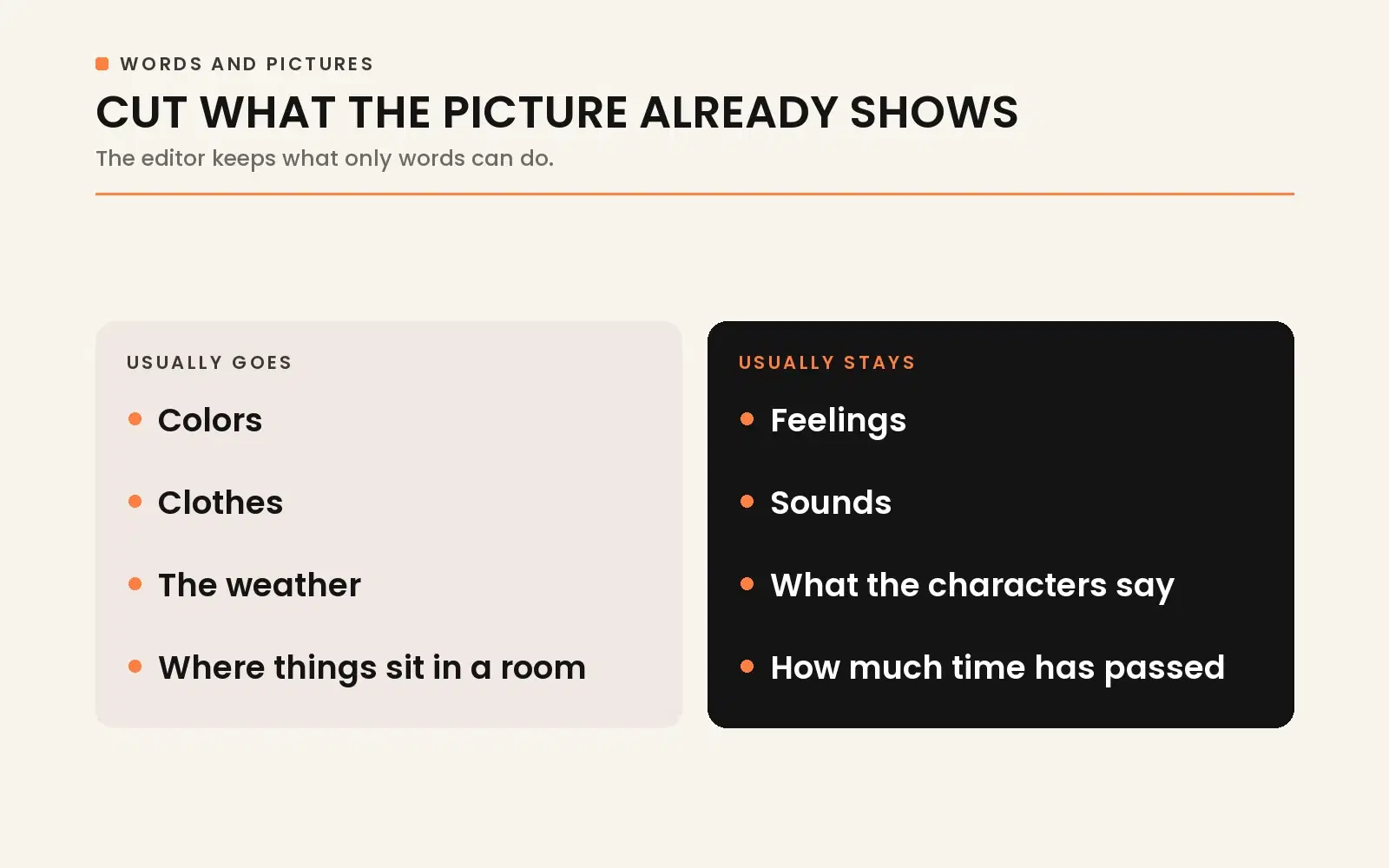
Your editor cuts any words that only tell what the pictures will show anyway. That way, the words and the pictures share the storytelling. Your words are left free to carry what a drawing can't, such as speech, thoughts, sounds and the passing of time.
Line by line, the editor asks whether the picture will show what the words say. If it will, the line usually goes.
- What usually goes is colors, clothes, the weather and where things sit in a room.
- What usually stays is feelings, sounds, what the characters say and how much time has passed.
Here's a before and after. In a first draft, Grandpa Joe puts on his big brown fishing hat and his green boots. He picks up his long rod and walks down the path to the blue lake, smiling. After the edit, the whole page might read "Grandpa Joe was going fishing, and today, Ruby was coming too" and nothing more. The picture shows the hat, the boots and the lake. So the words are free to carry the news that matters to the child.
This cut is also a big reason picture book texts stay short. Once the pictures take over the describing, what's left in your text is usually lean, and it reads aloud better for it.
Art Notes Cover What the Words Leave Out
Art notes are short notes in a picture book manuscript that tell the illustrator something the picture must show but the words don't say. You can include a few in your manuscript. A children's book editor keeps only the art notes the story truly needs and cuts the rest.
An art note earns its place when the picture has to show the opposite of your words. It also earns a place for a hidden character, or a small detail the ending depends on. Each note is brief and set apart in brackets, so no one mistakes it for the text. Too many notes box the illustrator in and leave no room for the pictures to surprise you.
An editor may also add an art note after a cut. Say the fishing line above loses the word "smiling", but the joy still has to show somewhere. A short note such as [Grandpa and Ruby grin at each other] keeps it in the picture instead.
The Editor Checks the Sketches Against the Words
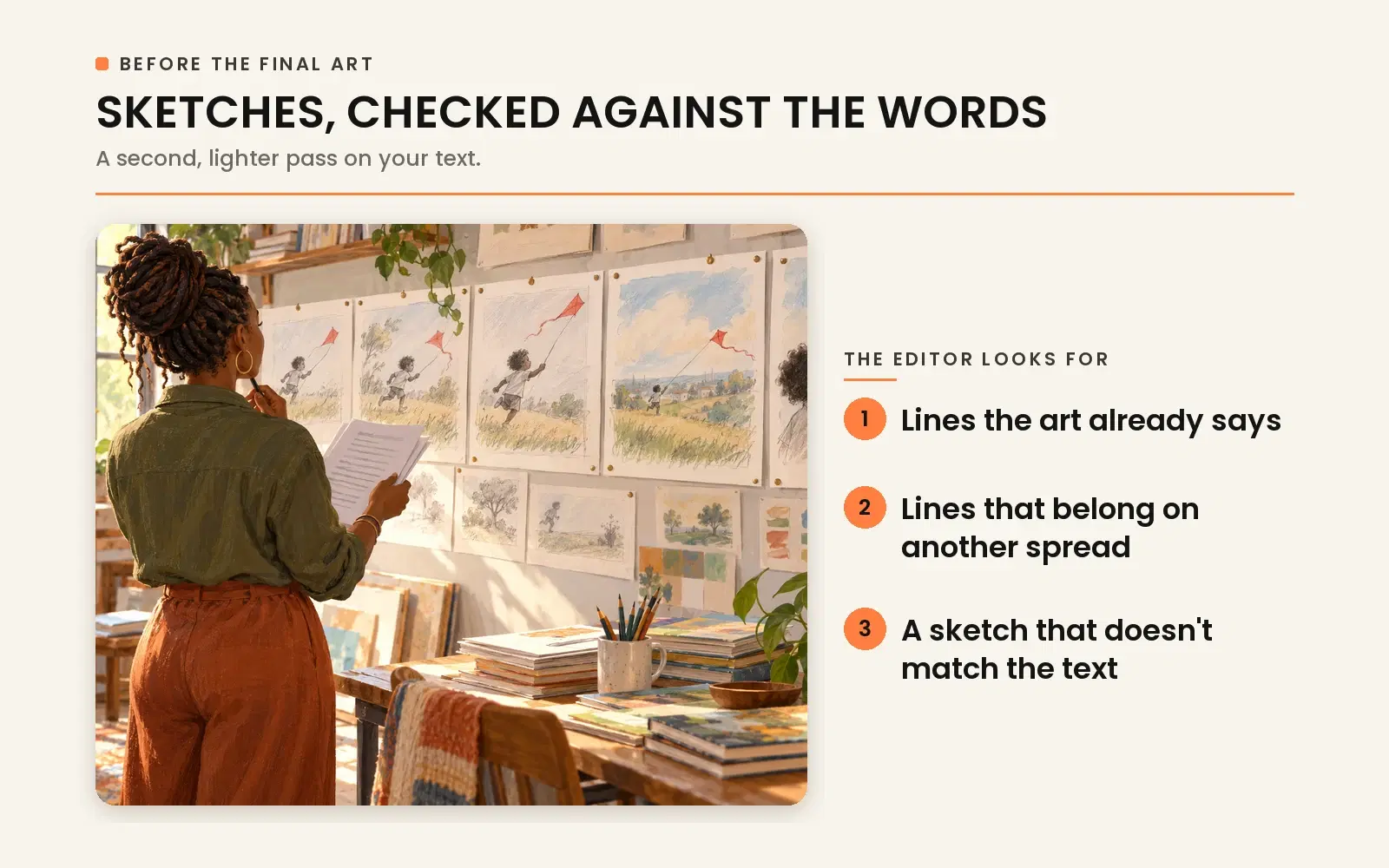
A children's book editor does look at the illustrations, reading the rough sketches against your text before any final art is made. With the pictures in front of everyone, the editor can see which words the art now says and which lines need to move.
This is a second, lighter pass on your text. A line might be trimmed because the sketch shows it perfectly. Another might move to the spread where its picture landed. The editor also flags any sketch that doesn't match the words, like a character holding the wrong toy. If your text says Ben's kite is red and the sketch shows it blue, this is the moment to catch it.
Your words are settled before the art starts, and at sketch stage they're trimmed rather than rewritten. A big rewrite at this point can undo pictures that are already drawn.
At a traditional publishing house, the art director usually finds the illustrator. The editor then works with the design team on how the words and pictures fit together. When you self-publish, you'll often see the sketches yourself, alongside your editor. The drawing itself is the illustrator's job. If you don't have an illustrator yet, children's book illustration services cover that side, from rough sketches to finished art.
Once the words and pictures agree, your finished pages bring their own risks, such as text placed over busy art. Those are covered in the post on publishing mistakes that make a self-published children's book look amateur.
Children's Book Editor vs Publisher, Who Does What?
A children's book editor and a publisher aren't the same thing. The editor works on the words and the story. A publisher is the company that turns the finished book into copies people can buy. The editor is one role inside publishing.
At a traditional publishing house, the editor helps choose which books the house takes on. Once the house buys a book, the editor works with the author to turn the manuscript into a finished book. Other teams handle the design, the printing and the selling. You can see how those stages fit together in the post on how children's book publishing works, from finished manuscript to printed book.
When you self-publish, the choices sit with you, so you decide who does each job. You can hire a children's book editor on your own, or work with children's book publishers who handle the whole book with the edit included. An editor you hire on your own works on the words only, so the design, the printing and the listing still need someone else. Either way, the editor's job stays the same, and the rest of the work is laid out in what a children's book publisher does.
Think of a grandfather who wants a handful of printed copies of his story for the family. He doesn't need a publishing house to buy his book. He still needs someone to read it aloud, mark the page turns and trim what the pictures will show. That's the editor's job, whoever he hires.
How to Find a Children's Book Editor Who Knows Your Format
To find a children's book editor, look first for one who edits your exact format. Picture book editors, early reader editors and middle grade editors listen for different things. Then ask to see how they work before you commit.
Here are the things worth checking, and the questions worth asking, when you talk to an editor about your book.
- Books in your format they've already worked on, so you can hear the result.
- Whether they read your text aloud as part of the edit.
- Whether they mark page breaks and handle art notes for picture books.
- Whether they'll check your text against the sketches later on.
- What you'll get back, such as an editorial letter and notes on your manuscript.
- How they treat your voice, and whether the final say on your words stays with you.
Say you're a school nurse who's written an early reader about washing hands for a kindergarten class. An editor who mostly works on adult novels may polish your grammar. That editor could still miss that half your words are too hard for a new reader to sound out. An editor who knows early readers will spot that straight away.
Your editor doesn't need to live nearby, since the work moves by email and shared files. You can look for the right fit anywhere in the United States. Before you reach out, it helps to know what a children's book publisher needs from you before work starts. Then your first conversation can be about the story rather than missing pieces.
How Book Writing US Helps With Your Children's Book
At Book Writing US, editing is one part of a bigger job, turning an author's finished children's manuscript into a printed, published book. Alongside the edit, that work includes illustration, the cover and page design, printing and publishing. Picture books, early readers and educational books are all part of it.
If your pictures are already drawn, we can work with them. If not, our illustration service can draw them for you. Tell us where your story stands, and we'll talk about what it needs next.
Frequently Asked Questions
What is a picture book dummy?
A picture book dummy is a rough mock-up of the book, page by page. The text sits where it will go, and quick sketches stand in for the final art. Authors, illustrators and editors use a dummy to test how the story fits the format. It shows the page turns and how much text sits on each spread. Because it's a working tool, your sketches can stay rough.
How many words should be on each page of a children's book?
There's no set number of words for each page of a children's book. The amount changes from spread to spread, and some spreads have no words at all. On those pages, the picture carries the moment. What an editor watches is the total, which for most picture books is under 1,000 words across usually 32 pages. The editor also listens for any spread that feels crowded when it's read aloud.
What is an editorial letter?
An editorial letter is the editor's written overview of your manuscript. It covers what works, the big-picture problems and suggestions for fixing them. It usually comes with notes on the manuscript itself that point to specific lines and pages. For a children's book, the letter often covers format fit and your reader's age. It may also talk about the page turns and how much room your text leaves for the art.
What does Level 1 or Level 2 mean on an early reader?
Level 1 and Level 2 are a publisher's own labels for how hard an early reader is. They aren't the same from one series to the next. Children's librarians often point out that reading levels printed on covers vary widely among publishers, because each one uses its own formula. So an editor checks your text against the levels of the series it's written for.
What are sight words, and why do early readers use them?
Sight words are common words such as "the", "said" and "was" that a child learns to recognize at a glance. A reading guide from the Institute of Education Sciences calls these high-frequency words, because they show up often in all kinds of text. Early readers use them because knowing these words quickly speeds up reading. Then a child can pay more attention to what the story means.
Why is reading aloud important for children?
Reading aloud is important for children because it builds vocabulary and helps them understand stories. That stays true even after a child starts reading alone. Reading aloud also invites talk. Reading guides for teachers suggest conversations before, during and after a read aloud to build a child's thinking and language. That's a big reason a children's book editor cares so much about how every line sounds.
- How Is Editing a Children's Book Different From Editing a Novel?
- What Is Developmental Editing for Children's Books?
- Word Count and Reading Level Change With the Format
- Reading Every Line Out Loud, More Than Once
- Why Is Repetition Important in Children's Books?
- The Editor Decides Where Each Page Turns
- Cutting Words the Pictures Already Show
- The Editor Checks the Sketches Against the Words
- Children's Book Editor vs Publisher, Who Does What?
- How to Find a Children's Book Editor Who Knows Your Format
- How Book Writing US Helps With Your Children's Book
- Frequently Asked Questions